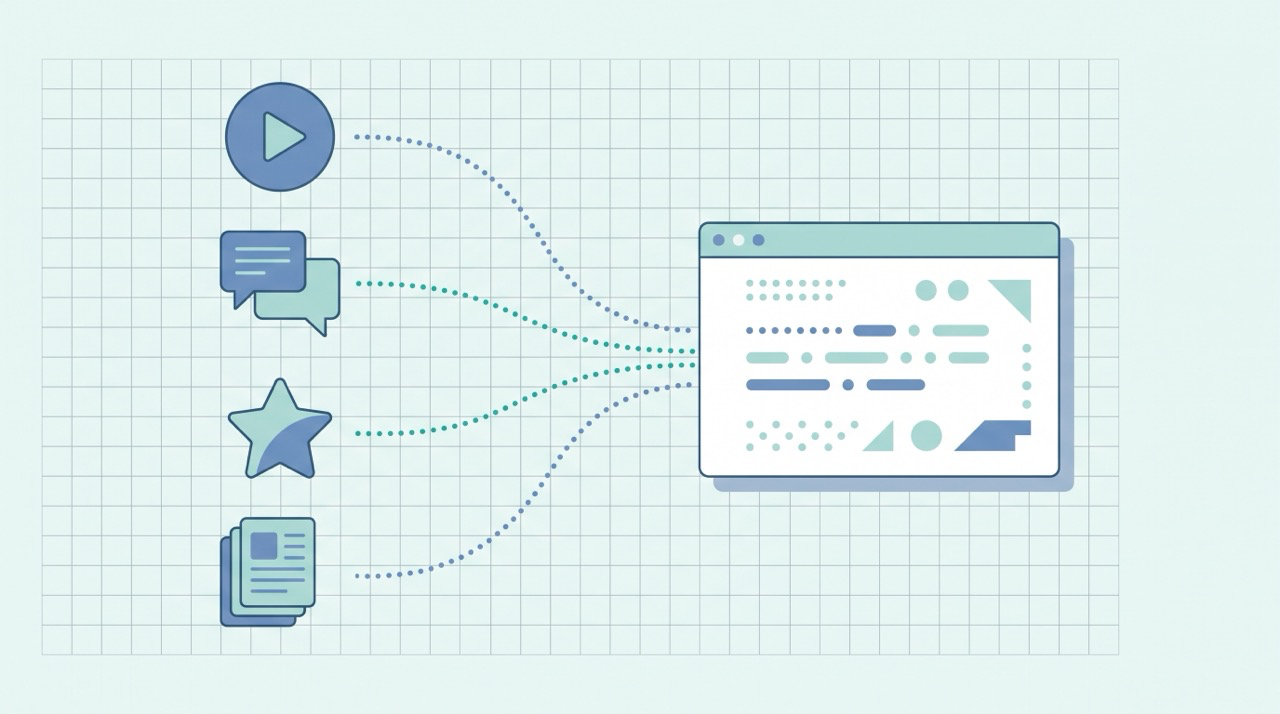
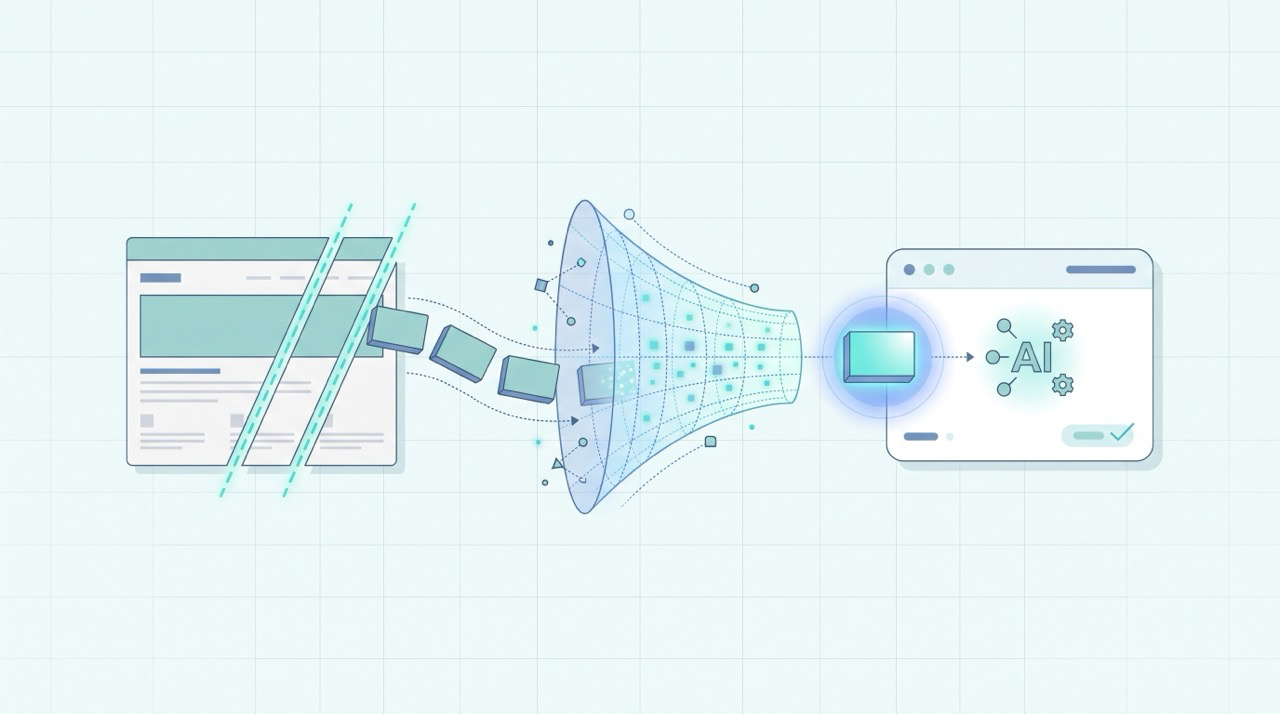
AI engines don't read your page the way a person does — top to bottom, with the whole argument in mind. They slice it into chunks, turn each chunk into a vector, retrieve the handful that best matches the question, and write the answer citing only from that handful. If your key point sits in a chunk that never gets retrieved, it doesn't exist as far as the answer is concerned. Understanding that pipeline — crawl, chunk, embed, retrieve, cite — explains most of why some brands get quoted everywhere and others never show up.
This is the companion to our guide on how to structure content for AI citations. That post is the craft — what to actually do on the page. This one is the mechanism underneath it: why those tactics work, and why a few popular "GEO tricks" don't. Both sit under our pillar guide to generative engine optimization.
First, the plumbing: AI answers stand on search indexes
Before anything can be chunked or retrieved, your page has to be found and stored. AI answer engines inherit the classic search pipeline — Google describes its own as three stages: crawling, indexing, and serving. Google's AI Overviews and Gemini draw on Google's index; Perplexity maintains its own crawlers and index; ChatGPT's search features lean on partner indexes plus its own crawlers.
The practical consequence: everything that kept you out of a traditional index still keeps you out of AI answers. Blocked by robots.txt, behind a login, rendered only by JavaScript the crawler won't run, or simply never crawled — the AI era hasn't changed any of that. Retrieval happens over an index, and if you're not in one, the pipeline ends for you here. (The boring technical basics still pay the rent — our technical SEO guide covers them.)
Step 1: Your page gets chunked
Nobody feeds a whole web page into a language model — context windows and budgets don't allow it. The standard architecture, established by the original retrieval-augmented generation (RAG) research, is to split documents into passages and retrieve only the relevant ones at query time. AI search products do essentially this: your page is divided into chunks — a few hundred words each, give or take — and each chunk is processed as a standalone unit.
Engines don't publish their exact chunking parameters, and they vary. But the architectural implication is constant: each chunk has to make sense alone. A paragraph that only works if you read the two before it ("As we said above…", "Building on that…") is a paragraph that may arrive at the model stripped of its context. The section that states a complete claim, names who or what it's about, and answers a question in one breath is the section that survives chunking.
Step 2: Every chunk becomes an embedding
Next, each chunk is converted into an embedding — a vector, a list of numbers that represents its meaning. As OpenAI's embeddings documentation puts it, "the distance between two vectors measures their relatedness," and the canonical use case is search: "results are ranked by relevance to a query string."
This is the deepest difference from classic SEO. Google keyword-matching could be gamed by repeating the phrase; embedding-matching works on meaning. A chunk that thoroughly answers "how do I reduce blog bounce rate" can retrieve well for "why visitors leave my blog quickly" — same neighborhood in vector space, zero shared keywords. The flip side is that a chunk stuffed with the query's exact words but thin on substance no longer wins by keyword density. The Princeton/Georgia Tech GEO study quantified this: presentation-level edits (adding citations, statistics, quotations, authoritative tone) lifted visibility in generative-engine responses by up to 40%, while keyword stuffing ranked among the least effective tactics.
Step 3: Retrieval picks a handful — and citations come only from it
When someone asks a question, the engine embeds the question, looks up the most related chunks in its index, and hands a small set of them to the language model. The model then writes the answer, grounding it in those retrieved passages — and the citations you see point back to them.
That last link in the chain is the one marketers miss: an engine can only cite what it retrieved. Your page might be brilliant overall, but brilliance doesn't get quoted — retrieved chunks do. In our own study of how AI engines decide which brands to recommend, the pages that surfaced consistently were the ones answering the question thoroughly and unambiguously in compact, self-contained passages. Not the longest pages. Not the highest-keyword-density pages. The most retrievable ones.
Why some chunks get picked and others don't
Put the three steps together and the selection criteria fall out naturally. A chunk retrieves well when it:
- Answers a real question directly — the kind people actually type into ChatGPT or Perplexity. Question-shaped headings help the match both ways: the heading resembles the query, and the chunk under it resolves it.
- Leads with the answer. If the model only sees this chunk, the first sentence should still carry the point. Throat-clearing openers waste the chunk's most weighted words.
- Stands alone. Names the subject, states the claim, includes the number or the source — no "as mentioned above."
- Is specific and sourced. The GEO study's 40% lift came from exactly this: citations, statistics, expert quotes. Vague chunks lose to concrete ones in vector space and in the model's synthesis alike.
That's the what. The full how — with templates and examples — is in how to structure content for AI citations.
How the engines differ (briefly)
The pipeline is the same; the index and the emphasis are not. Google AI Overviews and Gemini sit on Google's index and lean toward pages that already rank — which is why getting cited in AI Overviews looks a lot like good SEO plus extractable structure. Perplexity is retrieval-first and real-time, favoring fresh, directly-answering passages — we break its quirks down in getting cited in Perplexity. ChatGPT mixes partner indexes with its own crawling and shows a stronger editorial streak in what it quotes — see getting your brand mentioned in ChatGPT. The chunk-level craft is universal; the per-engine tactics are in those guides.
Three misconceptions to drop
- "The AI read my whole site." No — it retrieved a few chunks. Your best argument may live on a page that was never chunked into the retrieval set at all.
- "An llms.txt file feeds my content to the model." It doesn't — no major engine has confirmed consuming it, and retrieval runs on indexes and chunks, not curated manifests. We cover the evidence in what is llms.txt.
- "Chunking means I should write in tweets." Short isn't the goal; self-contained is. A tight 300-word section that fully answers a question beats ten disconnected one-liners — the model still needs substance to synthesize from.
Frequently asked questions
Can I see which chunks an engine retrieved from my page?
Not directly — engines don't expose their retrieval logs. The practical proxy is to ask the engines your target questions and note which pages (yours or competitors') get cited, then compare the cited passages' structure against yours. Our guide on how to check if AI mentions your brand walks through that measurement loop.
Does classic SEO still matter if retrieval is semantic?
More than ever. Crawling and indexing are the pipeline's entry point, pages that rank feed the indexes AI engines trust, and the metrics these citations produce are an extension of search visibility — what we track as AI share of voice. SEO gets you into the index; chunk-aware writing gets you retrieved from it.
Is there an ideal chunk size to aim for?
Engines don't publish their parameters, so anyone quoting you an exact number is guessing. Aim for sections of roughly 150–400 words, each under a descriptive heading, each answering one thing completely. That range reads well for humans and lands inside every reasonable chunking window.
Will restructuring old posts actually change what engines cite?
Yes — the same content, restructured into self-contained answer-shaped sections, becomes retrievable where it wasn't before. It's the highest-leverage edit most older posts can get, and it stacks with everything else: better structure helps Google rankings, featured snippets, and AI citations simultaneously.
The bottom line
AI search runs on a simple pipeline: crawl, chunk, embed, retrieve, cite. You can't optimize for the model directly — but you can make sure you're in the index, that your key points live in self-contained chunks, and that those chunks answer real questions with specifics and sources. Do that and you stop hoping to be quoted and start being retrievable.
The research-and-measurement half of that loop — finding which questions your buyers ask AI engines and tracking whether you're cited — is what QuickCreator is built for: it turns those questions into well-structured, citation-ready articles on your own domain.
Try QuickCreator free and make your content the chunk the engines pick.