To get cited in Perplexity, give it clean, well-structured, up-to-date content that directly answers a specific question — and make sure it can crawl you. Perplexity is an "answer engine": it retrieves a handful of live web pages for every query and names them as sources right in the answer. Getting cited means being one of those few sources, which rewards clear, quotable, current pages on a crawlable site more than raw domain size. For a small business, that's a winnable game.
Of the major AI engines, Perplexity is the most citation-first — it shows its sources on practically every answer. That makes it both the easiest engine to see whether you're winning, and a high-value place to be named, since its users are actively researching. This guide explains how Perplexity picks sources, what it actually tends to cite, and a zero-budget playbook to start getting named. It's the Perplexity-specific companion to our explainer on what generative engine optimization (GEO) is.
How is Perplexity different from Google — and from ChatGPT?
Perplexity is an answer engine, not a search engine. Where Google returns a list of links for you to choose from, Perplexity reads a few sources and writes you a single cited answer. The goal isn't to "rank" in a list — it's to be one of the sources the answer is built from.
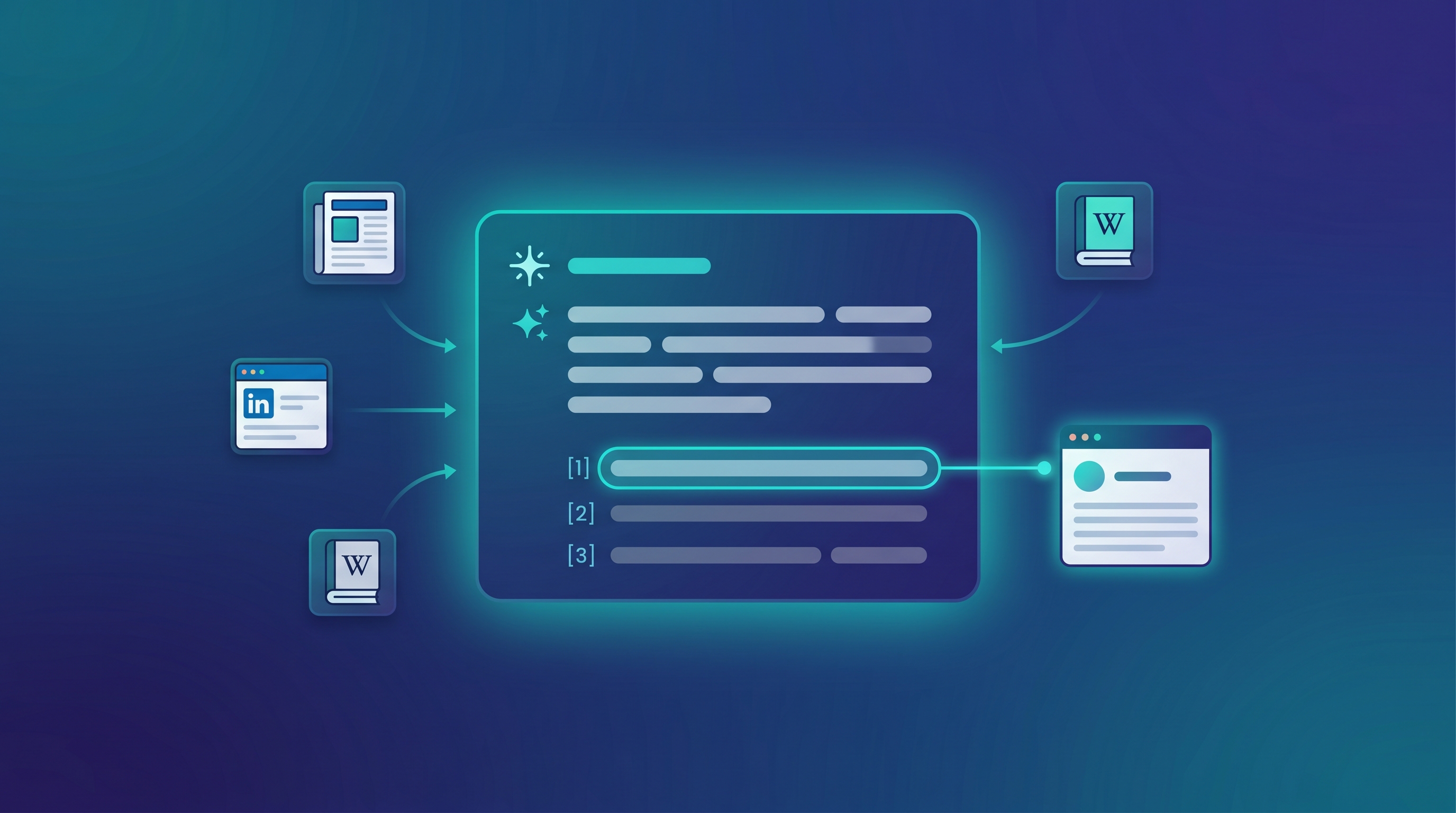
It does this with real-time retrieval (a process called RAG — retrieval-augmented generation): for each question, Perplexity searches the live web, pulls a small set of pages, and synthesizes an answer that footnotes them. Two things follow from that:
- Freshness matters more than on most engines. Perplexity leans on current pages, so up-to-date content has an edge.
- Citations are visible and countable. Unlike ChatGPT, where sourcing is often invisible, Perplexity lists its sources — so you can measure your presence directly.
It also differs from ChatGPT in what it cites, which is the most actionable part — and where we have data.
What sources does Perplexity actually cite?
Most guides stop at "build authority." We can be specific, because we measured it.
In our own audit of how AI recommends brands — 50 buyer questions across ChatGPT, Gemini, Perplexity, and Google AI Overviews, about 200 answers — Perplexity showed a clear, distinctive pattern: it cited densely and repetitively, leaning on the same trusted sources again and again. It favored trade publications, LinkedIn, and reference/wiki-style sites, with a single trade blog cited 21 times and a wiki-style reference cited 15 times in one industry.
That's a different profile from its peers:
| AI engine | Tends to cite |
|---|---|
| Perplexity | Trade publications, LinkedIn, and reference/wiki-style sites — often citing the same trusted sources repeatedly |
| ChatGPT | Niche specialist industry blogs + credible news/data outlets |
| Google AI Overviews | YouTube and LinkedIn + industry association sites |
| Gemini | Regional and specialist blogs |
Your specific domains will differ by industry, but the shape holds: Perplexity rewards being present in the trade press and reference sources of your niche, and being structured enough to quote. Because it leans on a recognizable set of trusted sources and returns to them repeatedly, getting into that set — your niche's trade publications, an accurate reference-site listing, an active LinkedIn presence — pays off disproportionately here. (For the ChatGPT side of this comparison, see our guide on how to get your brand mentioned in ChatGPT.)
How does Perplexity choose which sources to cite?
Getting cited is really two gates — sometimes called selection and absorption. First (selection), Perplexity has to find and be willing to use your page: it must be crawlable, relevant to the query, and in the candidate set it retrieved. Then (absorption), it has to actually pull from yours over the other candidates when it writes the answer. A page can clear the first gate and still fail the second if a competing source states the answer more clearly. You influence both:
- Be crawlable. Perplexity uses its own crawler, PerplexityBot. If your
robots.txtblocks it, you can't be cited — check Perplexity's own crawler documentation and make sure you're not accidentally shutting it out. - Be relevant and current. It retrieves pages that match the query and tend to be reasonably fresh.
- Be the cleanest answer. Among the pages it pulls, it favors the ones that state the answer plainly, with structure it can lift — direct answers, lists, tables, and quotable facts.
That second gate is where small teams win. You may not outweigh a big domain on authority, but you can absolutely out-clarity it.
The zero-budget playbook to get cited in Perplexity
No ad budget or agency required. Do these roughly in order of impact:
Lead with the answer (BLUF — "bottom line up front"). Put a direct, quotable answer in the first few sentences, under a heading that matches the question. Perplexity lifts self-contained answers; don't make it dig. Compare:
- Hard to cite: "There are many factors to consider when choosing project management software, and the right answer depends on your situation, but in this guide we'll explore…"
- Easy to cite: "The best project management tool for small teams is the one with the simplest workflow your team will actually use — for most, that's a lightweight kanban tool under $10/user. Here's how to choose…"
The second gives Perplexity a clean, self-contained sentence it can quote directly. That's the single biggest on-page lever.
Structure for extraction. Use clear H2s phrased as real questions, short paragraphs, bulleted lists, and HTML tables. Comparison tables in particular are citation magnets — they answer "which is best for X" cleanly, and Perplexity (which loves a structured comparison) pulls them readily. A messy wall of text gives it nothing to grab.
Keep it current. Perplexity favors fresh content, so update your cornerstone pages and add visible "last updated" dates. A page that's accurate today beats one that was great two years ago — and because retrieval is live, a refresh can change your citation status in days, not months. Put your most important pages on a quarterly review cycle.
Make sure PerplexityBot can crawl you. Don't block it in
robots.txt; confirm the page is indexable. This is a one-time check that quietly disqualifies sites that skip it.Add structured data. Mark up articles and FAQs with schema so machines parse your content correctly. A free SEO plugin does this for you, or you can paste a small block yourself — a minimal
FAQPagelooks like:json{ "@context": "https://schema.org", "@type": "FAQPage", "mainEntity": [{ "@type": "Question", "name": "How do I get cited in Perplexity?", "acceptedAnswer": { "@type": "Answer", "text": "Publish clear, current, well-structured answers on a crawlable page, and be present in the trade and reference sources Perplexity cites." } }] }Add quotable facts and figures with sources. Concrete, attributable data gets pulled into answers far more than vague claims — and it doubles as a trust signal.
Be present in the sources Perplexity reads. This is the one that sounds expensive but isn't — here's the zero-budget version. You don't need a Forbes placement; you need to show up in the trade and reference layer of your niche:
- Answer real questions in the trade forums, subreddits, and communities where your buyers and industry hang out — helpfully, not as a pitch.
- Publish your expertise on LinkedIn consistently (it's a source Perplexity leans on), and keep your company page accurate.
- Submit accurate entries to the industry directories, wikis, and reference sites that cover your category — these reference sources are exactly what Perplexity reaches for.
- Pitch one guest post or expert quote to a trade publication in your space; even small niche outlets count, because they're the specialist sources Perplexity cites.
None of this costs money — only consistent effort, which is a small team's real budget.
Show real expertise (E-E-A-T). Named authors, genuine experience, and the trust signals Google describes as E-E-A-T make any engine more confident citing you.
This week, for free, you can make real progress: confirm PerplexityBot isn't blocked, turn one key page's opening into a tight answer capsule, add a comparison table to a "best/vs" page, drop a "last updated" date on your cornerstone content, and check that your LinkedIn and any reference-site listing about you are accurate. Five small moves, all aligned with how Perplexity actually picks sources.
Common mistakes that keep you out of Perplexity citations
Sometimes the fastest win is removing what disqualifies you. The patterns that quietly keep small businesses out of Perplexity's citations:
- Blocking the crawler. If
robots.txtexcludes PerplexityBot — often by accident, or via a blanket AI-bot block — you simply can't be cited, no matter how good your content is. Check this first. - Burying the answer. Pages that open with long preamble give Perplexity nothing clean to lift. Lead with the answer.
- Stale content. Perplexity favors current pages; a cornerstone article you haven't touched in two years loses to a fresher competitor.
- Wall-of-text pages. No headings, lists, or tables means nothing is easy to extract. Structure is what gets quoted.
- Relying on self-claims. "We're the best" on your own site carries little weight; Perplexity weighs the wider web — trade coverage, reference sites, reviews — about you.
- Ignoring the off-site profile. If you're absent from the trade publications and reference sources Perplexity reads in your niche, you're missing the exact places it looks.
A quick word on Perplexity Pages and features
Perplexity has a few surfaces worth knowing as you go deeper. Perplexity Pages lets users (and brands) publish article-style pages within Perplexity itself, which can become citable content. Perplexity has also rolled out shopping and publisher partnerships over time. None of these replace the core work above — being a clean, crawlable, credible source is what earns organic citations — but they're worth watching as the platform evolves. If your audience genuinely lives inside Perplexity, publishing a well-made Page on your core topic is a low-effort experiment worth running.
Does traditional SEO still matter for Perplexity?
Yes — it's the foundation. Perplexity retrieves from the live web, so the same things that make you findable and credible to Google (crawlability, relevance, clear content, authority) make you retrievable and citable here. As the foundational GEO research found, content that states facts plainly and authoritatively, with clear structure and citations, gets pulled into AI answers more often. Strong SEO doesn't compete with Perplexity optimization; it's the same root work, pointed at being quoted rather than just ranked.
Can you pay to rank in Perplexity?
Not for the organic citation you're trying to win. Perplexity has experimented with ads and partner programs separately, but you can't buy your way into being named as a source in an answer — that's earned by being the clean, credible, retrievable page. As with the other engines, this is good news for a small business: you compete on clarity and credibility, not ad spend.
How do you know if it's working?
Perplexity makes this easy, because it shows its sources. Ask it the exact questions your customers would, and look at the citation list under each answer — are you there? Repeat monthly and track the trend. Our companion guide on how to check if AI mentions your brand walks through a free, ten-minute monthly test across Perplexity, ChatGPT, and Google's AI Overviews.
Because the underlying work overlaps, it's worth optimizing for the other engines in parallel — see our guide on how to get cited in Google AI Overviews for the Google side.
Frequently asked questions
Does Perplexity use real-time search or a fixed index? Primarily real-time retrieval. For each query it searches the live web, pulls a small set of pages, and cites them — which is why fresh, crawlable content has an edge and why you can see your citations change over time.
Does Perplexity cite Wikipedia, Reddit, and LinkedIn? It cites a broad mix, and in our audit it leaned notably on trade publications, LinkedIn, and reference/wiki-style sources. The exact mix varies by query and industry, but reference sites and LinkedIn are common — keeping those accurate about your brand matters.
What is PerplexityBot and do I need to allow it?
PerplexityBot is Perplexity's web crawler. If your robots.txt blocks it, your pages can't be retrieved or cited. Check Perplexity's crawler documentation and make sure you're not excluding it.
Can I submit my site to Perplexity to be cited? There's no submission form for organic citations. You earn them by being crawlable, relevant, current, clearly structured, and credible — the playbook above.
How is getting cited in Perplexity different from ranking on Google? Google ranks you in a list of links and rewards the click; Perplexity names you as a source inside a written answer. The foundation is shared, but Perplexity puts extra weight on freshness, clear extractable answers, and being present in the trade and reference sources it likes to cite.
How often does Perplexity refresh its sources? Because it retrieves in real time, the sources behind an answer can change whenever you re-ask — there's no fixed "index update day" to wait for. Publish or update a strong page and it can be picked up quickly; that's also why a once-good page can quietly drop out as fresher competitors appear.
How long until Perplexity cites me? It varies. Because retrieval is live, a genuinely clear, current, crawlable page can start getting cited within days to weeks — much faster than traditional rankings. But it's unpredictable and shifts over time, so judge it by a consistent monthly check, not a single result.
The bottom line
Getting cited in Perplexity isn't about being the biggest brand — it's about being the cleanest, most current, most crawlable answer, and being present in the trade and reference sources it reads. Lead with the answer, structure for extraction, keep it fresh, let PerplexityBot in, and earn a presence where your niche is discussed. Then check monthly — Perplexity will literally show you whether it's working.
Doing that consistently across every page and channel is the hard part for a small team, which is exactly what QuickCreator is built for: it runs the whole content workflow — finding the questions buyers ask, drafting, and optimizing the clear, structured, citable content AI engines reward — as one connected system.
Try QuickCreator free and start earning the Perplexity citations your competitors are already collecting.