To get cited in Google AI Overviews, your page needs to do three things: rank in the top 10 for the query, answer the question clearly and high up on the page, and come from a source Google already trusts. Get those right and your content becomes the kind of clean, quotable material an AI Overview lifts into its answer. The encouraging part for a small business: most of this is free, and none of it requires code.
AI Overviews — the AI-written summary at the top of many Google searches — increasingly answer questions before anyone clicks a link. Being named in that summary is now its own prize. This guide breaks down how to earn it, in plain English, starting with the moves that cost nothing. It's the "how to win the citation" companion to our explainer on what generative engine optimization is.
How do Google AI Overviews choose what to cite?
You can't optimize for something you don't understand, so start here. An AI Overview doesn't invent its answer — it assembles one from web pages it can find, read, and trust, then names some of them as sources. A few patterns drive which pages get picked:
- They lean on pages that already rank. Research consistently finds the large majority of AI Overview citations come from results already in the top 10. AI visibility is built on a foundation of ordinary SEO, not instead of it.
- They lift clean, self-contained answers. Overviews quote passages that answer the question directly and completely in a few sentences — not points buried mid-article. The original generative engine optimization research found that content which states facts plainly and authoritatively, with citations and clear structure, gets pulled into AI answers more often than vague or meandering text.
- They favor sources they trust. Established authority on the topic, clear authorship, and brand recognition all make Google more confident citing you.
- They fan a question out into sub-questions. Google often breaks one query into several related ones (a process it calls query fan-out) and pulls a source for each — so content that thoroughly covers a topic and its sub-topics has more chances to be cited.
Google's own documentation on AI features confirms the reassuring headline: there's no separate program to join and no secret trick. The same fundamentals that earn rankings are what make you eligible here.
Do you need to rank #1 to appear?
No — and this is good news for small businesses. You don't need the top spot. But you do generally need to be on the first page, because that's the pool AI Overviews draw from most heavily. A page ranking 6th with a crystal-clear, quotable answer can get cited over the page ranking 1st with a rambling one.
The practical takeaway: you're not chasing #1. You're chasing "on page one and the clearest answer to the exact question." That second half is where most competitors are weak — and where a focused small team can win.
The zero-budget checklist: what to do first
Most guides on this topic assume you have a developer, a plugin budget, and an SEO background. You don't need any of that to start. Here's the minimal, ordered list — do them top to bottom, and stop worrying about the rest until these are done:
- Pick one real question per page and make sure the page genuinely, thoroughly answers it.
- Put a direct answer in the first 100–150 words — before any throat-clearing intro.
- Use the question as a heading (an H2 phrased the way people actually ask it).
- Break the page into clear sections with descriptive headings, short paragraphs, lists, and tables.
- Add a few concrete facts or figures with their sources, instead of vague claims.
- Show who wrote it and why they're credible — a real author name and a line of relevant experience.
- Make sure the page can rank at all — it's indexed, loads fine, and targets a realistic, specific query.
Every item is free, and none needs code. Do these seven and you've done 80% of what gets a small business cited. The sections below go deeper on the two that move the needle most.
Write "answer capsules" AI can lift
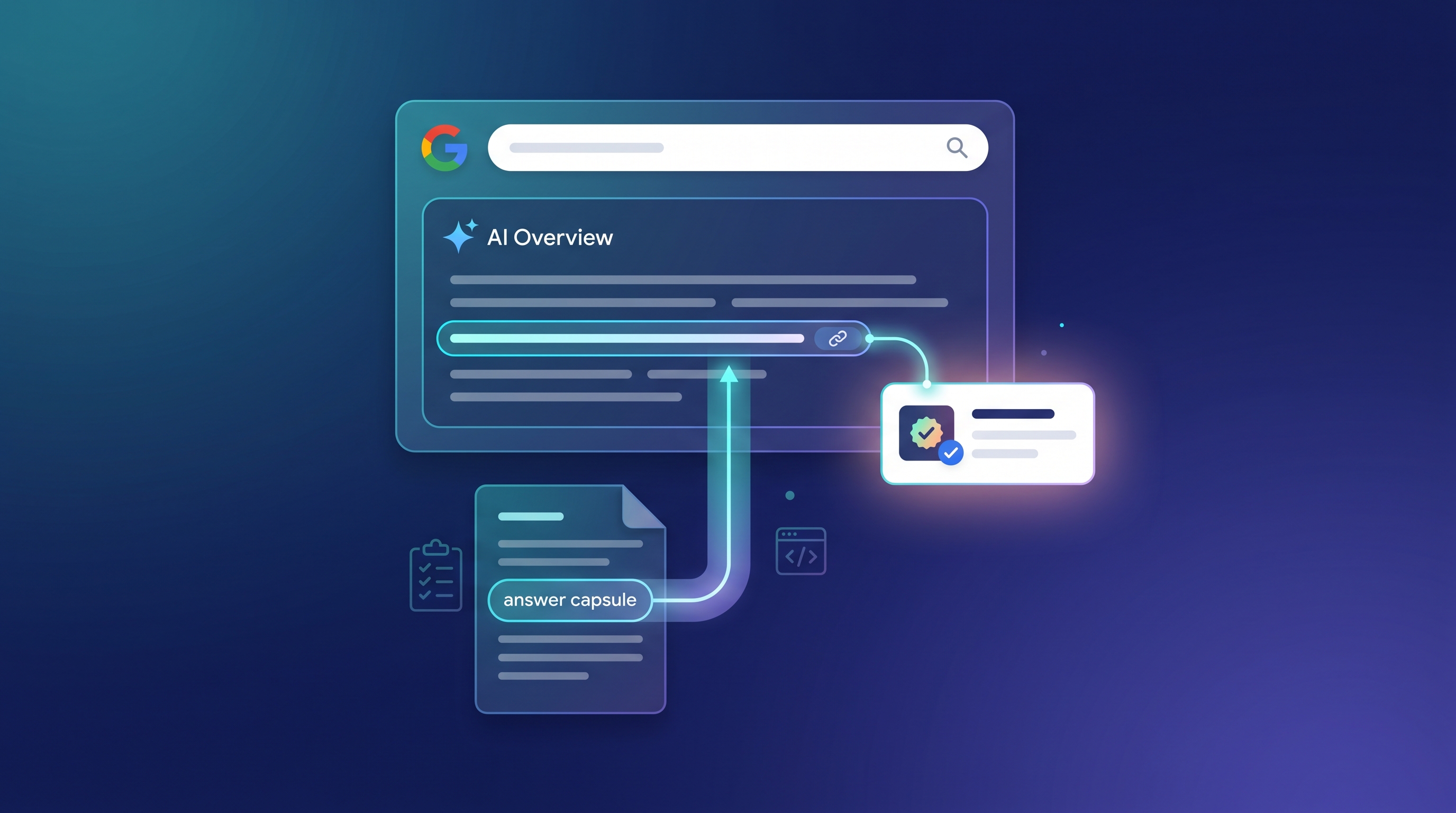
If you do one thing, do this. An answer capsule is a short, self-contained answer — roughly 40 to 75 words — placed right under a question-style heading, that fully answers the question on its own. It's the single most liftable unit of content for both featured snippets and AI Overviews.
The difference is concrete. Compare:
- Buried and vague: A paragraph that opens with backstory, mentions the answer halfway through, and depends on the sentences around it to make sense.
- Capsule (citable): "A topic cluster is a group of interlinked pages built around one subject: a broad 'pillar' page covering the topic, plus several focused pages on its sub-topics, all linking to each other. It signals topical authority to search engines and helps a small site rank for competitive terms."
The second can be lifted straight into an answer with nothing else for context — which is exactly what makes it citable. Write one of these under each major question on the page. (Curious whether your capsules are actually getting picked up? Our guide on how to check if AI mentions your brand shows you how to verify it for free.)
What kinds of content get cited most often
Some formats are simply easier for an AI Overview to lift than others. When you're deciding what to write or how to structure a page, lean toward the shapes that get quoted:
- Clear definitions. "What is X?" answered in one tight, standalone paragraph is prime citation material — it's self-contained by design.
- Direct how-to steps. A numbered list of concrete steps is easy to extract and reuse, especially for "how do I…" queries.
- Comparisons and "vs" breakdowns. A clean table comparing options answers the comparison questions people increasingly ask AI assistants, and tables are highly liftable.
- Specific, sourced facts and figures. A concrete statistic with its source is far more quotable than a general claim — and it doubles as a trust signal.
- FAQ blocks. Short question-and-answer pairs are almost purpose-built to be lifted into AI answers, and they map neatly onto the way people phrase queries.
You don't need all of these on every page. But a page built mostly from vague prose, with no lists, tables, definitions, or data, gives an AI engine very little to grab. Structure is what makes content liftable.
Add schema markup — without a developer
Schema markup is structured data that spells out what your content is — an article, an FAQ, a how-to — so machines parse it correctly. It's a genuine help for being understood and surfaced, and you don't need to hand-code it.
- If you use WordPress, Wix, Squarespace, or Shopify, a free SEO plugin or built-in setting can add Article and FAQ schema for you with a few clicks — no code touched.
- If you want to do it manually, Google offers a free structured data guide, and the vocabulary itself lives at schema.org. You paste a small JSON-LD block into the page; Google's Rich Results Test then tells you if it's valid.
- Start with two types:
Articlefor your posts andFAQPagefor any page with a Q&A section. Those cover the majority of what a small business publishes. (Note: Google no longer shows FAQ rich results for most sites, but theFAQPagemarkup still helps machines understand and parse your Q&A content — which is what matters for AI answers.)
If you're curious what the manual version actually looks like, here's a minimal FAQPage block — you'd paste it into the page's HTML, swapping in your own question and answer:
json{
  "@context": "https://schema.org",
  "@type": "FAQPage",
  "mainEntity": [{
    "@type": "Question",
    "name": "Do you need to rank #1 to appear in AI Overviews?",
    "acceptedAnswer": {
      "@type": "Answer",
      "text": "No. You generally need to be on the first page, but the clearest, most quotable answer often gets cited over the #1 result."
    }
  }]
}
That's the whole idea — a small, structured label that tells a machine exactly what's on the page. Schema won't force a citation, but it removes ambiguity about your content, and clarity is exactly what AI engines reward.
Build the trust signals that make AI confident citing you
Ranking and clarity get you eligible; trust gets you chosen. AI Overviews favor sources they can stand behind, so make yours easy to trust:
- Show real authorship. A named author with a genuine bio and relevant experience signals the kind of E-E-A-T — Experience, Expertise, Authoritativeness, Trust — that Google's systems reward.
- Earn brand mentions, not just links. Studies have found that being mentioned across the web correlates more strongly with AI citations than raw backlink counts. A guest post, a podcast, a genuinely helpful Reddit answer, a directory listing — each makes engines more confident you're a real, known entity.
- Be consistent and specific about your niche. The more clearly you own a focused topic, the more often you'll be the source a relevant answer reaches for. This is where a small business's natural focus beats a sprawling competitor — and where a deliberate content plan compounds over time.
You don't need a PR agency. A handful of credible mentions and a clear, authored, specific body of content is enough to move the needle.
Common mistakes that keep small businesses out of AI Overviews
Sometimes the fastest way to get cited is to stop doing the things that disqualify you. These are the patterns that quietly keep small-business content out of AI answers:
- Burying the answer. A page that opens with three paragraphs of preamble before getting to the point gives an AI engine nothing clean to lift. Lead with the answer.
- Writing for keywords instead of questions. Pages stuffed with a keyword but never plainly answering the real question rarely get cited. AI Overviews quote answers, not keyword density.
- One thin page trying to cover everything. Because Overviews fan a query into sub-questions, a single shallow page loses to a focused page (or cluster) that genuinely covers the topic and its sub-topics.
- No author, no authority. Anonymous content with no signals of who's behind it or why they'd know is a weak citation candidate. Add a real byline.
- Chasing AI citations while ignoring rankings. If the page can't crack page one, it's not in the pool Overviews draw from. Fix the underlying SEO first — being cited is built on top of ranking, not instead of it.
- Publishing once and walking away. AI answers shift, and a page you never revisit falls behind fresher, clearer competitors. Refreshing a near-cited page beats starting a new one from scratch.
Fixing any one of these is often enough to turn an overlooked page into a cited one.
When getting cited isn't realistic (and that's OK)
One honest caveat before you pour effort into this: not every query triggers an AI Overview, and not every page can realistically be cited. AI Overviews show up far more often for informational, "how does this work" questions than for navigational or purely transactional ones — and Google still chooses when to show one at all. If your target searches rarely trigger an Overview, optimizing for citation there is wasted effort.
So aim where it pays off: the informational and comparison questions in your niche, where AI answers are common and your expertise is real. And remember that getting cited is built on top of ranking — if a page can't reach the first page of normal results, AI citation isn't the place to start. Fix the fundamentals first, then optimize the pages that genuinely have a shot.
How do you know if it's working?
Optimizing without checking is guessing. Once you've made these changes, verify them: search your target questions on Google and read the AI Overview — are you cited? Ask the same questions in ChatGPT and Perplexity. Watch your rankings and impressions in Google Search Console, since first-page ranking is the precondition for everything above.
There's also a newer, first-party signal worth checking. In 2026, Google began rolling out a dedicated Generative AI performance report inside Search Console that shows your site's impressions in AI features like AI Overviews and AI Mode, broken down by page, country, and device. It's still rolling out to a subset of sites and currently focuses on impressions rather than clicks, so you may not see it in your account yet. But when you do, it's the most authoritative view there is of whether your pages are actually surfacing in AI answers — check whether it has appeared under the Performance section of your Search Console.
Do this monthly, not daily — AI answers shift gradually. Our companion guide on how to check if AI mentions your brand walks through a free, ten-minute monthly check, including how to catch the AI-driven traffic that normally hides in your analytics.
Frequently asked questions
Does schema markup help with AI Overviews?
It helps indirectly. Schema doesn't guarantee a citation, but it removes ambiguity about what your content is, which makes machines more confident using it. Start with Article and FAQPage — both are free to add and cover most small-business pages.
Do I have to rank #1 to be cited in an AI Overview? No. You generally need to be on the first page, since that's where Overviews pull from most, but the clearest, most quotable answer often gets cited over the #1 result. Aim for "page one plus the best answer," not the top spot.
How is getting cited in AI Overviews different from regular SEO? SEO earns you the ranking and the click; getting cited earns you a mention inside the AI's answer. They share the same foundation — clear, trustworthy, well-structured content — which is why the work overlaps so much. For the full picture, see our explainer on what GEO is.
How long until I get cited? It varies. Because Google re-crawls and regenerates Overviews frequently, a well-optimized page can start appearing within weeks — but it's unpredictable, so judge progress over months and keep your fundamentals strong.
The bottom line
Getting cited in Google AI Overviews isn't a dark art or a budget line. It's three things done well: rank on page one, answer the question clearly and early, and be a source Google trusts. For a small business, that's refreshingly doable — write genuine answer capsules, add basic schema, show real authorship, earn a few honest mentions, and check your results monthly.
The catch is consistency. Doing this across every page you publish, month after month, is the hard part for a team of one — which is exactly what QuickCreator is built for: it runs the whole content workflow, from finding the questions worth answering to drafting in your brand voice and optimizing the structure that AI engines reward, as one connected system.
Try QuickCreator free and turn one content workflow into the kind of clear, citable content AI Overviews actually pick — without a developer or a dedicated team.