AI decides which brands to recommend based on three things: which brands already rank and get talked about across the web, which sources each AI platform trusts and pulls from, and how clearly and positively those sources describe each brand. The result is that a small handful of brands capture most AI recommendations — and the rest are effectively invisible, even when buyers never named a brand in their question. We know this because we measured it.
To see how this actually plays out, we ran a discovery-mode audit of one industry — solar (PV) — across the four biggest AI answer engines. We asked 50 brand-free buyer questions (the kind real buyers type, like "which solar panel brand is most reliable for a European commercial rooftop") to ChatGPT, Gemini, Google AI Overviews, and Perplexity, across five markets (Germany, UK, Italy, Spain, US), and parsed every answer for which brands got named, recommended, and cited. That's roughly 200 AI answers. The patterns that fell out apply far beyond solar — they're how AI recommendation works for any industry. Here are the five lessons.
Key findings at a glance
- A few brands own AI. Four brands captured 37% of all brand mentions across the 200 answers; the single most-mentioned brand alone held 10.4% of the industry's AI "share of voice."
- AI names brands buyers never mention. Every question was brand-free, yet AI returned specific brand names in almost every answer.
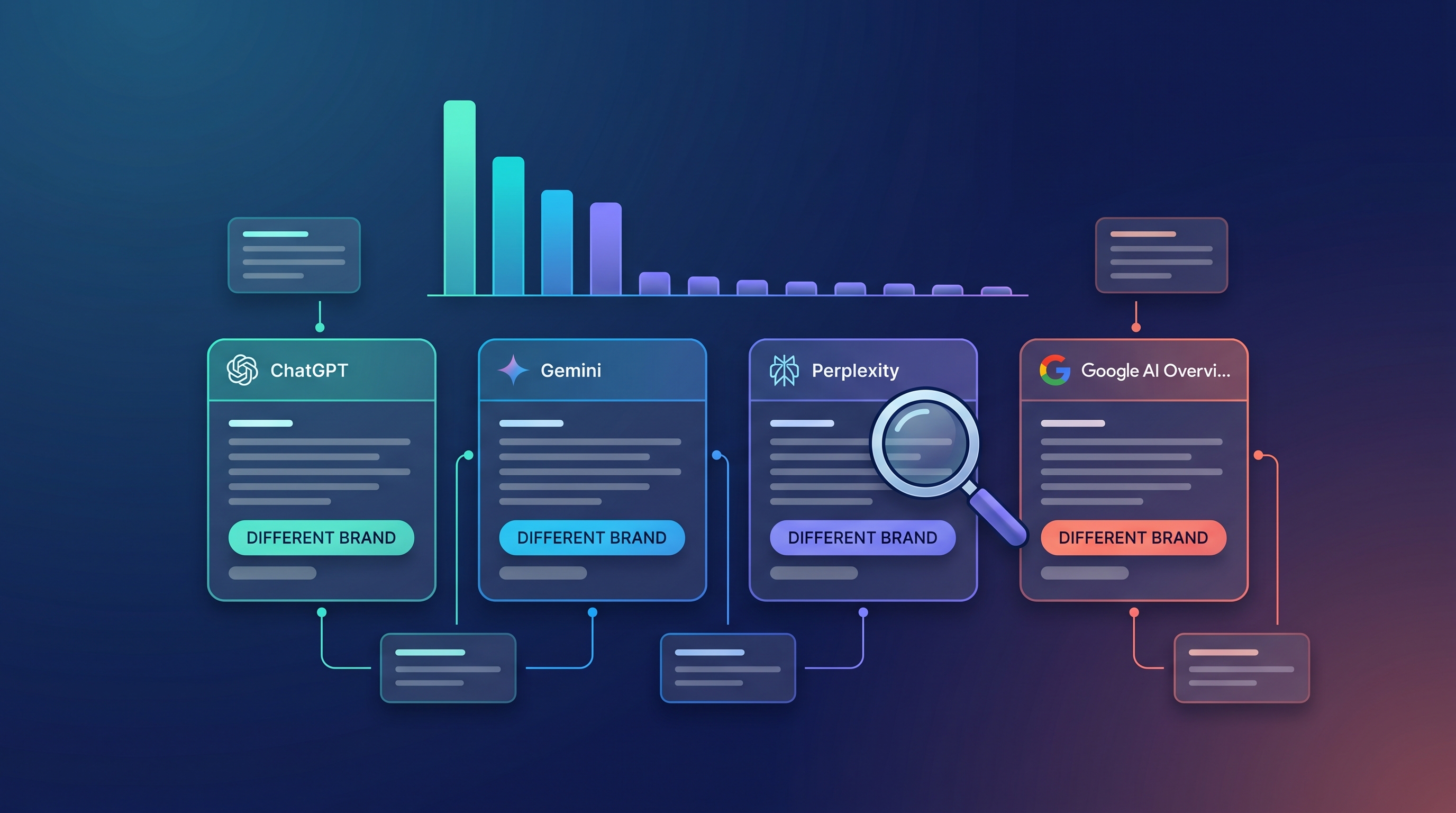
- Each engine crowns a different winner. For the same questions, the top recommendation was LONGi on ChatGPT, Huawei FusionSolar on Gemini, Sungrow on Google AI Overviews, and SMA on Perplexity.
- Each engine reads a different web. Google's AI Overviews leaned on YouTube and LinkedIn; ChatGPT on niche trade blogs; Perplexity on trade publications and wiki-style references.
- Mentioned ≠ recommended ≠ liked. The most-mentioned brand wasn't the most-recommended, and the most positively described brand (net +71%) wasn't a share-of-voice leader at all.
Lesson 1: AI names brands even when the buyer doesn't
Every question we asked was brand-free — the buyer never mentioned a specific company. They asked things like "what's the best solar inverter for a UK warehouse?" Yet the AI answered, almost every time, with specific brand names.
This is the core shift, and it's easy to miss. In the old search world, a buyer typed "LONGi vs JinkoSolar" — they'd already picked their shortlist, and you competed for the click. Now the buyer asks an open question and the AI builds the shortlist for them. If your brand isn't in the answer, you were never in the running, and you'll never see it happen — there's no impression, no click, no trace in your analytics.
That's the uncomfortable headline: AI is making the first cut of buyer decisions, and most brands don't know whether they made it. (If you want to find out where you stand, our guide on how to check if AI mentions your brand walks through a free way to test it.)
Lesson 2: A few brands own the "share of voice" — everyone else is invisible
When we counted every brand mention across all 200 answers, the distribution was brutally top-heavy. Four brands captured 37% of all brand mentions — and the single most-mentioned brand alone held 10.4% of the entire industry's AI "share of voice," roughly the same as the #2 brand and several times the share of brands ranked just outside the top 10.
The leaders clustered tightly at the top:
| Rank | Brand | Total mentions (200 answers) |
|---|---|---|
| 1 | SMA | 83 |
| 2 | Sungrow | 82 |
| 3 | Trina Solar | 70 |
| 4 | JinkoSolar | 68 |
Below that handful, the drop-off was steep. Plenty of real, established companies — brands with serious market share in the physical world — barely registered, landing in the low single digits or not appearing at all. In AI recommendation, they were statistically invisible.
This is the GEO version of a winner-take-most dynamic. AI engines gravitate toward the brands that are most consistently mentioned, reviewed, and cited across the sources they read. Once a brand reaches that threshold, it gets named again and again; below it, you're fighting just to appear once. The lesson for everyone outside the top few: AI visibility is a share-of-voice game, and the gap compounds — which is exactly why measuring and improving it deliberately matters.
Lesson 3: The same question gets different answers on different platforms
Here's the finding that surprises people most. We asked the same questions to all four platforms — and they recommended different brands.
When each engine gave a "best for X" recommendation, the top pick diverged sharply:
| Platform | Top recommended brand (in our audit) |
|---|---|
| ChatGPT | LONGi |
| Gemini | Huawei FusionSolar |
| Google AI Overviews | Sungrow |
| Perplexity | SMA |
Four platforms, four different "winners" for overlapping questions. There is no single "AI answer" to optimize for — each engine has its own taste, shaped by the sources it leans on. A brand that dominates ChatGPT can be nearly absent from Gemini.
For a business, this kills the idea of a one-and-done "rank in AI" project. You have to think per-platform, and accept that winning everywhere at once is rare. It also means opportunity: if a competitor owns ChatGPT but no one owns Perplexity in your niche, that's an opening.
Lesson 4: Each platform cites different sources — so "where to show up" changes
Why do the platforms disagree? Because they read different parts of the web. We logged which domains each engine cited, and the "citation fingerprints" were strikingly distinct:
- ChatGPT leaned on niche industry blogs and a few news/data sites (its top sources were specialist solar blogs plus outlets like Reuters and pv-magazine).
- Google AI Overviews pulled heavily from YouTube and LinkedIn plus industry association sites — by far the most UGC-heavy mix. LinkedIn and YouTube were its #1 and #2 most-cited domains; one platform association site appeared 16 times.
- Perplexity favored a blend of industry trade publications, LinkedIn, and reference/wiki-style sources (a single trade blog was cited 21 times, and a wiki-style reference site 15 times).
- Gemini skewed toward a cluster of regional and specialist blogs — its most-cited sources were UK and EU solar sites most marketers have never heard of.
The takeaway isn't the specific domains — yours will differ by industry. It's the shape: each engine has a recognizable source diet, and they barely overlap.
This is the single most actionable finding for content strategy: to be quoted by a given AI, you need to be present on the sources that AI actually trusts. Getting cited in Google's AI Overviews might mean a strong YouTube and LinkedIn presence; getting cited by ChatGPT might mean coverage on the specific trade blogs it reads. The same effort spread evenly is wasted — you target the source profile of the engine you care about. (Our guide on how to get cited in Google AI Overviews goes deep on this for Google specifically.)
Lesson 5: Mentioned, recommended, and liked are three different things
It's tempting to treat "AI talks about us" as the goal. The data says that's only the first of three separate battles:
- Mentions (share of voice) — how often you appear at all.
- Recommendations — who the AI actually endorses when it says "best pick." The most-mentioned brand in our audit was not the most-recommended one; on some platforms a brand with fewer mentions won the explicit endorsement.
- Sentiment — how positively you're described. The brand with the most positive framing across answers (net +71% positive) was not a share-of-voice leader at all.
These can move independently. You can be mentioned constantly but rarely recommended, or recommended warmly but rarely mentioned. A complete picture tracks all three — because being named in a neutral list is a very different outcome from being the AI's enthusiastic "best overall" pick. It even shows up at the product level: when AI got concrete, it named specific models (one panel line was mentioned 13 times by name), not just the parent brand — so the "unit" AI recommends can be a single product, not the company.
There's a segment dimension too. When we split the audit by buyer type, the leading brand sets were different:
| Buyer segment | Top 3 brands by mentions |
|---|---|
| Commercial rooftop (C&I) | SMA (46), Sungrow (42), Trina Solar (38) |
| Utility-scale developers | Sungrow (40), SMA (36), JinkoSolar (33) |
Same five countries, same four AI platforms — but a different leaderboard, because the two audiences ask different questions and surface different brands. The same company can be famous to one customer segment and invisible to the next. So "our AI visibility" is really several visibilities, one per audience you serve.
What this means for your business
Strip away the solar specifics and the lessons are universal to any company whose buyers research online:
- Your buyers are asking AI open questions, and AI is naming brands in response. You're being judged whether or not you're paying attention.
- A few brands dominate; most are invisible. Closing that gap is deliberate work, not luck.
- There's no single "AI" to win — each platform has its own recommendations and its own trusted sources.
- You earn citations by being present where each engine looks — clear, well-structured, frequently-referenced content, on the right sources.
- Track mentions, recommendations, and sentiment separately, per platform and per audience segment.
None of this is reachable with paid ads. It's earned the same way trust has always been earned online — by being genuinely present, clear, and credible across the web, which is what both traditional search and AI engines reward. If the concept is new to you, start with our explainer on what generative engine optimization (GEO) is; it's the foundation everything above sits on.
A note on the data (and its limits)
So you can weigh the findings fairly: this was a discovery-mode audit — 50 brand-free questions, each sent once to ChatGPT, Gemini, Google AI Overviews, and Perplexity, across five markets, with answers parsed for brand mentions, recommendations, cited domains, and sentiment. A few honest caveats. AI answers are non-deterministic — ask again tomorrow and the exact counts shift, so treat these as a snapshot of patterns, not fixed rankings. Sentiment was measured with a simple positive/negative lexicon around each mention, which catches tone differences but isn't a substitute for human reading. Some platforms surfaced very few explicit recommendations (Gemini gave only a handful), so the per-platform "winners" rest on smaller samples than the mention counts do. And it's one industry in five markets — your numbers will differ. What generalizes is the shape of the findings, not the specific figures: top-heavy share of voice, per-platform divergence, distinct citation sources, and the gap between being mentioned and being recommended. Those held across every cut of the data.
How to act on this
You don't need an enterprise budget to start applying these lessons:
- Measure where you stand. Run brand-free buyer questions through ChatGPT, Perplexity, and Google's AI Overviews and see whether you're named. Our free monthly AI-visibility check shows you how, including the new Search Console Generative AI performance report.
- Optimize the content AI actually lifts. Clear, quotable answers; structured pages; real authorship and the trust signals Google describes as E-E-A-T. Google's own AI features documentation confirms there's no separate trick — the fundamentals that earn rankings are what get you cited.
- Target the right sources per platform. Figure out which sites the engine you care about cites in your niche, and earn a presence there.
- Do it consistently. The brands that own AI share of voice got there by being referenced again and again, which is the slow-compounding work the original GEO research and every audit since keep confirming.
Frequently asked questions
Does AI recommend brands when the buyer doesn't name one?
Yes. Every question in our audit was brand-free, yet the AI named specific brands in almost every answer. The AI builds the shortlist for the buyer, so a brand that isn't mentioned was never in the running — and there's no impression or click to tell you it happened.
Do different AI engines recommend different brands?
Yes. Asked the same questions, the four platforms crowned four different winners: LONGi on ChatGPT, Huawei FusionSolar on Gemini, Sungrow on Google AI Overviews, and SMA on Perplexity. There is no single "AI answer" to optimize for — you have to think per platform.
Why do AI platforms disagree on which brands to recommend?
Because they cite different parts of the web. Each engine has a distinct source diet — Google's AI Overviews leaned heavily on YouTube and LinkedIn, ChatGPT on niche trade blogs, Perplexity on trade publications and wiki-style references. To be quoted by a given AI, you need a presence on the sources that AI actually trusts.
Is being mentioned by AI the same as being recommended?
No. Mentions, recommendations, and sentiment move independently. In our audit the most-mentioned brand was not the most-recommended, and the brand described most positively (net +71%) wasn't a share-of-voice leader. A complete picture tracks all three, per platform and per audience segment.
How can a smaller brand improve its AI visibility?
Measure where you stand by running brand-free buyer questions through ChatGPT, Perplexity, and Google's AI Overviews; publish clear, well-structured, genuinely credible content with real E-E-A-T; earn a presence on the specific sources each engine cites in your niche; and do it consistently, because AI share of voice compounds over time.
The audit behind this article is the kind of intelligence QuickCreator produces as a GEO Industry Report — and QuickCreator is built to do the harder follow-on work too: running the whole content workflow, from finding the questions buyers ask to drafting and optimizing the clear, citable content that earns those AI mentions, as one connected system. That's how a small team turns a visibility gap into share of voice.
Try QuickCreator free and start earning the AI recommendations your competitors are already getting.