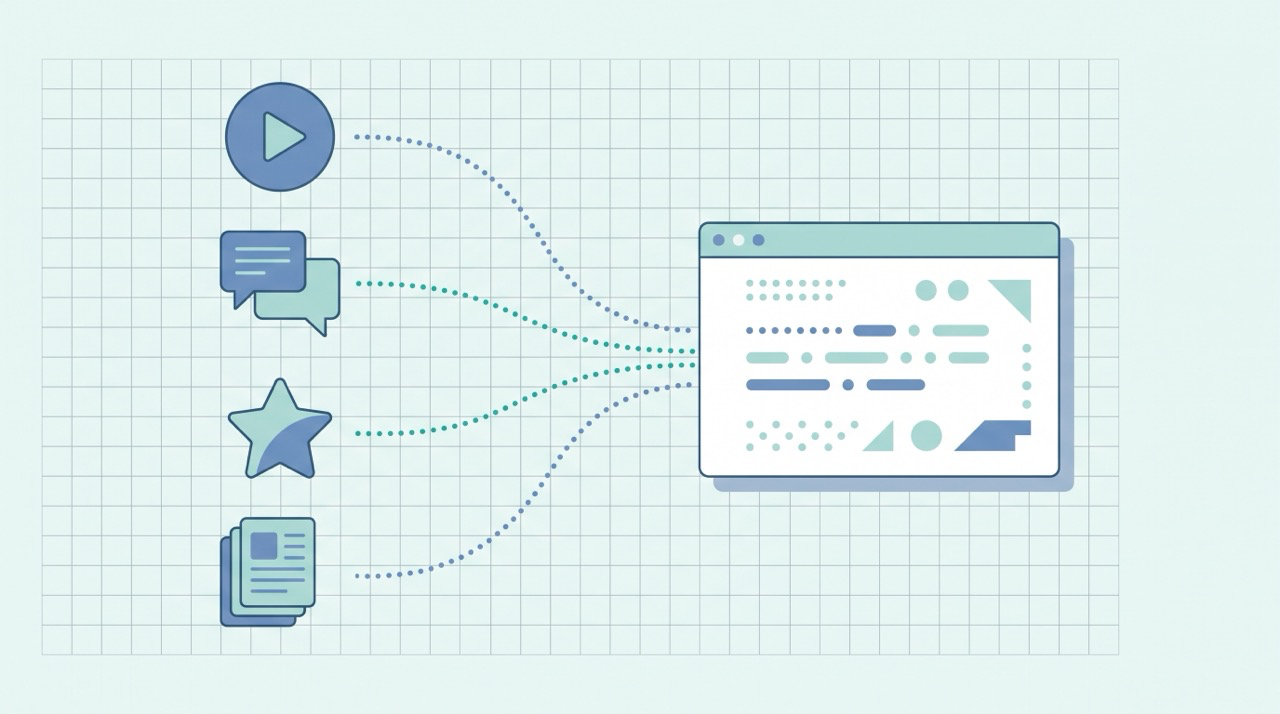

llms.txt is a proposed Markdown file, placed at the root of your site (/llms.txt), that hands large language models a clean, curated map of your most important content — a short summary plus a linked list of the pages that matter, written in plain Markdown instead of messy HTML. It was proposed by Jeremy Howard of Answer.AI in September 2024, and since then it's been hyped as the next big lever for getting cited by ChatGPT, Perplexity, and Google's AI Overviews. The reality in 2026 is more nuanced — and worth understanding before you spend an afternoon writing one.
This guide explains what llms.txt actually is, how it differs from robots.txt and sitemaps, who's really using it, and the honest answer to the question everyone asks: does adding one help you show up in AI answers? It's a natural companion to our explainer on what generative engine optimization (GEO) is — llms.txt is one of the most talked-about GEO tactics, so it's worth knowing where the hype ends and the evidence begins.
What llms.txt actually is
llms.txt is a convention, not a law of the web. The official spec at llmstxt.org defines a simple Markdown file with a specific shape:
- An H1 with your site or project name — the only strictly required part.
- A blockquote with a short summary of what the site is and the key context a model needs.
- Optional free-form Markdown describing the site in more detail.
- One or more H2 sections, each a bulleted list of links in the form
[page name](url): optional note about the page. - An optional section literally titled
## Optional, holding links a model can safely skip when it needs a shorter context.
The idea is that a person who knows the site — you — curates the handful of pages worth reading, in the order that makes sense, with a sentence of context each. A model (or an AI agent acting on a user's behalf) can then fetch one predictable file and get an expert-picked table of contents instead of trying to crawl and de-clutter your whole HTML site.
You'll also see a second file, /llms-full.txt, popularized by documentation platforms. Where /llms.txt is a curated index of links, /llms-full.txt inlines the entire body of your documentation into one long Markdown file, so a model can load everything in a single request. (The spec itself defines slightly different tool-generated variants — llms-ctx.txt and llms-ctx-full.txt — but the community has largely settled on the llms-full.txt name for the "everything in one file" version.)
What problem it's trying to solve
Two real limitations sit behind the proposal. First, context windows are finite — a model can't ingest a 500-page site to answer one question, so it needs a way to know which few pages actually matter. Second, HTML is noisy: navigation, ads, cookie banners, and JavaScript make it hard and imprecise to convert a live web page into the clean text a model wants.
As Howard puts it in the original proposal, "Site authors know best, and can provide a list of content that an LLM should use." llms.txt is an attempt to let you do exactly that — to volunteer a clean, authoritative shortlist rather than leaving a machine to guess. Notably, the proposal frames the flagship use case as developer documentation and APIs consumed by coding agents, not as a search-ranking tactic. That origin matters for judging it fairly.
llms.txt vs robots.txt vs sitemap.xml
llms.txt is easy to confuse with two files you may already have, but each does a different job:
- robots.txt is about access. Google's own docs describe it plainly: "A robots.txt file tells search engine crawlers which URLs the crawler can access on your site." It's a gatekeeper that says what bots may not read — see our technical SEO basics for beginners for how it fits the wider picture.
- sitemap.xml is about discovery. It's an exhaustive, machine-readable list of every URL you want indexed — no priorities, no summaries, no explanations. It answers "what exists?"
- llms.txt is about curation for reading. It's selective and annotated: a short list of your best pages, each with a human-written note, formatted to be read as context by a model.
A one-line way to remember it: robots.txt says what not to read, sitemap.xml says everything that exists, and llms.txt says here's the good stuff, and why it matters.
Who's actually using it
Adoption is real but concentrated. The clearest cluster is developer-tools and documentation sites: companies like Anthropic, Stripe, Zapier, Vercel, and Cursor publish an llms.txt (you can usually check by visiting /llms.txt on their docs domain). A big driver is that documentation platforms such as Mintlify auto-generate the file for every site on their platform, so a lot of technical docs got one without their authors lifting a finger.
Estimates of how widespread it is vary a lot and none is authoritative — studies through 2025 and 2026 have put adoption anywhere from a directory of under a thousand domains to roughly 5–15% of sites surveyed, depending on the sample. Treat any single number with caution. The honest summary: llms.txt is common in dev-docs circles and rare across the general web.
The honest part: do AI engines actually read it?
This is where the hype and the evidence diverge, and it's the most important section if you're deciding whether to bother.
Google says it does not use llms.txt. Its Search Central guidance on AI features states, "You don't need to create new machine readable files, AI text files, or markup to appear in these features." Google's John Mueller was blunter still, noting that "none of the AI services have said they're using llms.txt (and you can tell when you look at your server logs that they don't even check for it)," and comparing it to the long-abandoned keywords meta tag — a self-declared signal that got ignored precisely because site owners can claim anything.
That server-log point is the single most concrete piece of evidence in the whole debate: the major AI crawlers largely don't even request /llms.txt, and you can verify that in your own access logs. As for the other engines — OpenAI, Anthropic, and Perplexity have not published statements confirming their models consume other sites' llms.txt files in production. Several of them publish their own llms.txt, but publishing one is not evidence of reading everyone else's.
The fairest counterpoint: llms.txt was pitched for inference-time retrieval by agents — a coding assistant pulling your API docs into its context — not for search ranking. Judged as an SEO tactic it looks weak; judged as a way to feed your own or a user's AI agent clean documentation, it's genuinely useful. So the accurate 2026 verdict is narrow, not "dead" and not "essential."
So should you add one?
Here's the practical call:
- If you run developer docs, an API, or a technical product whose users point coding agents at your documentation — add it, especially if your docs platform generates it for free. This is the original, real use case, and the upside is concrete.
- If you run a general small-business blog or marketing site and the goal is getting cited in ChatGPT, Perplexity, or AI Overviews — it's optional and low-priority. Google confirms it won't help or harm your rankings, and there's no verified evidence the big AI engines consume it for citations today. Adding it is cheap insurance if the ecosystem converges on it later, but it is not a ranking lever now.
Either way, don't let llms.txt crowd out the things AI engines demonstrably respond to: clean, crawlable pages, clear structure and schema markup, genuine expertise and third-party credibility. Our research on how AI decides which brands to recommend found that being consistently described as a good option across the web matters far more than any single file. If you want to actually move the needle in AI answers, start with the fundamentals in how to get cited in Google AI Overviews and how to get your brand mentioned in ChatGPT.
How to create an llms.txt (if you want one)
It's a five-minute job:
- Create a plain text file named
llms.txtand place it at your site root so it resolves athttps://yoursite.com/llms.txt. - Start with an H1 of your site name, then a one-paragraph blockquote summary of what you do.
- Add an H2 section (for example
## Core pages) with a bulleted list of your most important URLs, each with a short note. - Put anything secondary under a
## Optionalheading. - Keep it current — a stale llms.txt that points to moved or deleted pages is worse than none at all.
After you publish it, check your server logs periodically to see whether any AI crawlers actually request it. That's the most honest signal of whether it's earning its keep for your site.
Frequently asked questions
What is an llms.txt file?
It's a proposed Markdown file at your site root (/llms.txt) that gives large language models a curated summary and a linked list of your most important pages. The goal is to hand a model a clean, expert-picked map of your content instead of making it crawl and de-clutter your full HTML site.
Is llms.txt an official web standard?
No. It's a community proposal introduced by Answer.AI in September 2024, not a standard ratified by a body like the W3C or IETF. It's a convention some sites choose to follow, and support for it is voluntary.
Does Google use llms.txt?
No. Google's documentation says you don't need special machine-readable or AI text files to appear in its AI features, and Google's John Mueller has said AI services aren't checking for the file and compared it to the deprecated keywords meta tag. Adding one won't help or hurt your Google rankings.
Does adding llms.txt help me get cited in ChatGPT or Perplexity?
There's no verified public evidence that major AI engines consume other sites' llms.txt files for citations in production as of 2026. It may help agents that fetch your documentation directly, but for AI-search visibility, credible content and third-party mentions matter more today.
How is llms.txt different from robots.txt and sitemap.xml?
robots.txt controls which URLs crawlers may access; sitemap.xml lists every URL you want indexed; llms.txt curates a short, annotated shortlist of your best pages for a model to read as context. They solve access, discovery, and curation respectively — different jobs.
Who should bother creating an llms.txt?
Developer-documentation and API sites whose users point coding agents at their docs get the clearest benefit, and many docs platforms generate the file automatically. For a general blog or marketing site, it's optional and low-priority — useful as cheap future-proofing, not as a ranking tactic.
The bottom line
llms.txt is a genuinely thoughtful idea — a clean, curated, model-readable map of your site — with a real home in developer documentation and a lot of premature hype everywhere else. In 2026, Google explicitly ignores it, no major AI engine has confirmed using it for citations, and the biggest risk is treating it as a shortcut to AI visibility that it isn't yet. Add it if you run docs or an API and it's cheap to maintain; add it to a marketing site only as low-cost future-proofing. Then put your real effort where AI answers are actually earned.
That earning — publishing clear, credible, citable content and tracking where AI already mentions you — is exactly what QuickCreator is built for. Try it free and focus your GEO effort on what moves the needle today.