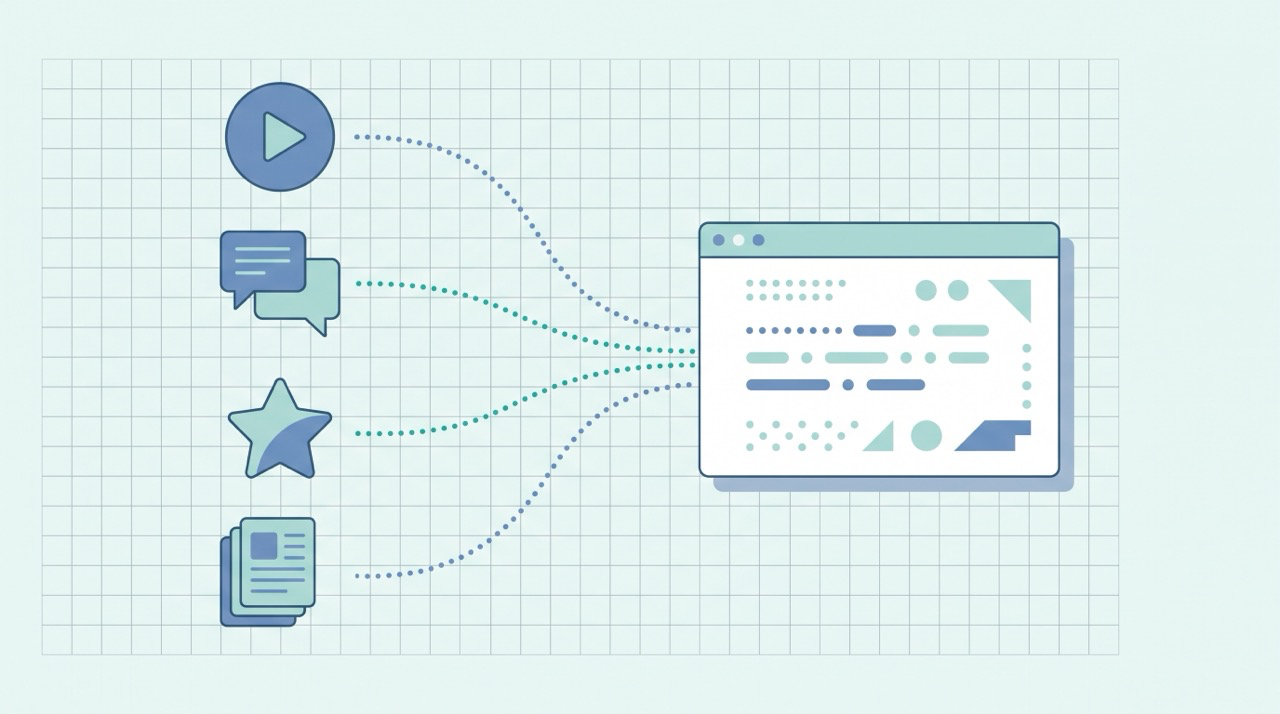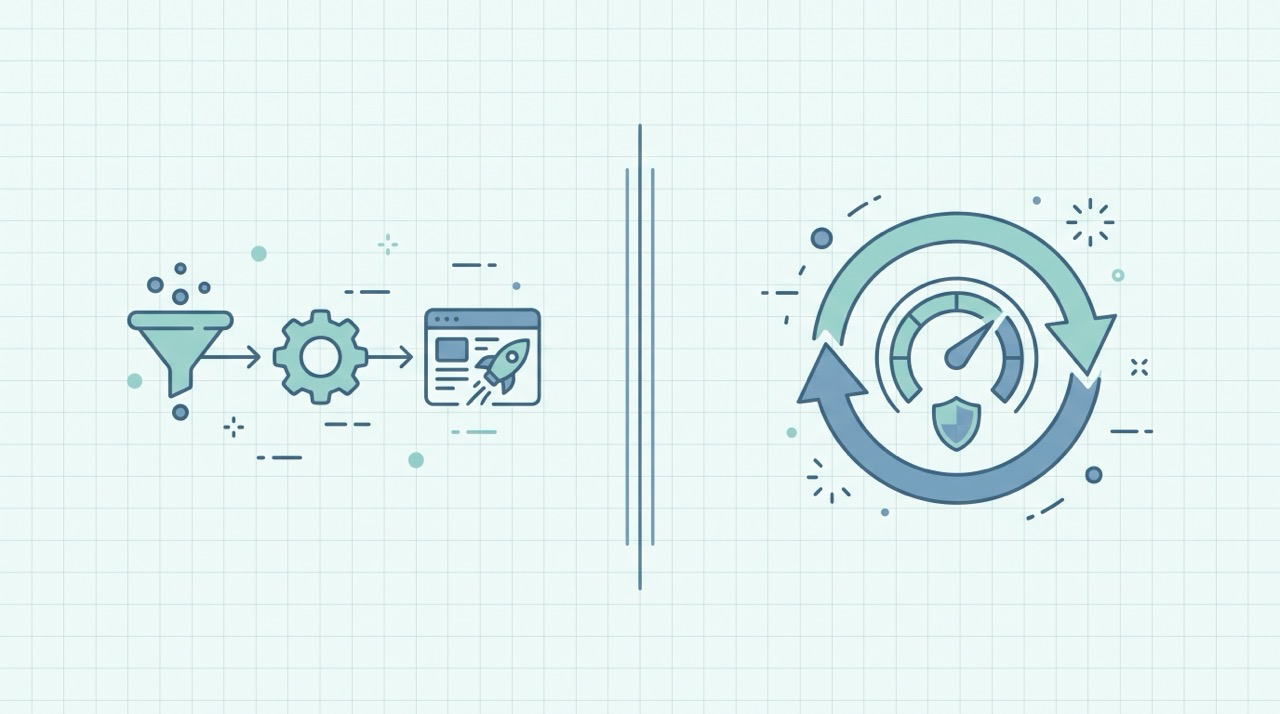

On-page SEO is everything you control on the page itself — the title, the headings, the words, the links, the images — tuned so both a reader and a search engine instantly understand what the page is about and why it deserves to rank. Unlike backlinks or server config, every item on this list is in your hands today, and you can work through it in the time it takes to publish a single post.
This is the on-page companion to our beginner's guide to blog SEO, which covers the whole publishing routine, and to our walkthrough of keyword research for beginners, which decides what to write before on-page work tunes how you write it. Keep this checklist open while you draft — it's meant to be run, not just read.
What "on-page" SEO actually covers (and what it doesn't)
SEO splits into three buckets, and it helps to know which one you're working in:
- On-page SEO — everything on the page: title, headings, body content, internal and external links, images, structure. This guide.
- Off-page SEO — signals from elsewhere, mostly backlinks and mentions from other sites. Earned over time, not edited on the page.
- Technical SEO — how your site is built and served: crawlability, speed, mobile rendering, sitemaps.
On-page is where a beginner should start, because it's the bucket you fully control and the one that pays off fastest. Get these elements right and you've given every post the best possible chance before a single backlink arrives.
Here's the whole checklist at a glance; the sections below explain each item.
| # | On-page element | The one thing to get right |
|---|---|---|
| 1 | Title tag | One primary keyword, front-loaded, ~60 characters |
| 2 | Meta description | A compelling 150–160 character summary that earns the click |
| 3 | URL slug | Short, readable, keyword-bearing, hyphen-separated |
| 4 | Headings (H1–H3) | One H1, logical H2/H3 outline |
| 5 | Keyword placement | Primary term early and natural — never stuffed |
| 6 | Content quality | Matches search intent, genuinely helpful and original |
| 7 | Internal links | Descriptive anchors to your own related posts |
| 8 | External links | A few links to credible, authoritative sources |
| 9 | Images | Descriptive file names, real alt text, compressed |
| 10 | Readability | Short paragraphs, lists, scannable structure |
1. Write a title tag that earns the click
The title tag is the single highest-leverage element on the page — it's usually what shows as the clickable blue headline in search results. Put your primary keyword near the front, keep it to roughly 60 characters so it doesn't get truncated, and make it specific enough that a searcher knows exactly what they'll get.
Google generates the headline in results from several sources but leans heavily on your <title>. Its guidance on title links is blunt about what not to do: title text like "Foobar, foo bar, foobars, foo bars" doesn't help the user. One clear keyword beats five jammed-together variations. Each page should have its own distinct title — never reuse one boilerplate title across the site.
2. Craft a meta description that sells the result
The meta description doesn't directly move rankings, but it's the sales pitch under your title in the results — and a better pitch means more clicks. Write a unique 150–160 character summary that promises what the page delivers and includes the keyword naturally.
Google explains in its snippet documentation that it "sometimes uses the meta description HTML element if it might give users a more accurate description of the page than content taken directly from the page," and asks for "unique descriptions for each page." Treat every post's description as its own one-line ad.
3. Keep the URL slug short and readable
A clean URL — /blogs/on-page-seo-checklist rather than /blogs/post?id=8842 — tells both readers and engines what the page covers before they even click. Use your primary keyword, separate words with hyphens, drop filler words ("a," "the," "and"), and keep it short. Set the slug when you publish and avoid changing it later, since changing a live URL breaks links and the ranking that came with them.
4. Structure the page with one H1 and a logical heading outline
Headings are the skeleton of the page. Use a single H1 for the main title, then H2s for major sections and H3s for points within them, so the outline reads like a table of contents. This helps readers scan and gives engines a clear map of your sub-topics.
Don't over-engineer it: Google's SEO Starter Guide notes that "from Google Search perspective, it doesn't matter if you're using them out of order" — semantic order matters most for screen readers and humans. The goal is a clear, logical structure, not a rigid hierarchy you obsess over.
5. Place your keyword early, and naturally
Work your primary keyword into the first 100 or so words, into at least one H2, and a handful of times through the body — wherever it reads naturally. Variations and related phrasing count too; you're writing for a human who happens to be searching, not feeding a counter.
The line not to cross is keyword stuffing. The Starter Guide is direct: "Excessively repeating the same words over and over (even in variations) is tiring for users, and keyword stuffing is against Google's spam policies." Pick the term once during keyword research, then write for the person.
6. Make the content genuinely helpful and intent-matched
No amount of tag-tuning saves a post that doesn't answer the question behind the search. Before writing, search your keyword and look at what already ranks — that's the format and depth Google has decided the query wants. Then write something at least as useful, ideally better.
Google's guidance on creating helpful, people-first content frames the test as content "created primarily for people, and not to manipulate search engine rankings," and asks whether "after reading your content, will someone leave feeling they've learned enough about a topic to help achieve their goal?" That question is the real ranking factor every checkbox below serves.
7. Add internal links with descriptive anchor text
Link from each new post to your own related posts, using anchor text that describes the destination — "building an SEO content plan," not "click here." Internal links pass authority between your pages, help readers go deeper, and show engines how your content connects.
The Starter Guide puts it plainly: "Link text (also known as anchor text) is the text part of a link that you can see. This text tells users and Google something about the page you're linking to." Aim for at least a couple of meaningful internal links per post, and link up to your pillar pages so authority concentrates where it matters.
8. Cite a few credible external sources
Linking out to authoritative sources — official documentation, original research, primary data — adds credibility for readers and context for engines about your topic. A handful per post is plenty. Choose genuinely trustworthy destinations (this guide links to Google's own documentation), and never invent a source to look authoritative.
9. Optimize every image
Images make a post readable, but unoptimized they're invisible to search and slow to load. For each one: give it a descriptive file name (on-page-seo-checklist.png, not IMG_2841.png), write alt text that describes the image for screen readers and image search, and compress it so it loads fast.
Google's image SEO best practices recommend filenames that are "short, but descriptive" and alt text that creates "useful, information-rich content that uses keywords appropriately" — its example is simply "Dalmatian puppy playing fetch." Describe what's in the image; don't stuff keywords.
10. Format for readability
A wall of text fails even when it's well-optimized, because people bounce before they read it. Break content into short paragraphs, use bullet and numbered lists for steps, add subheadings every few hundred words, and bold the occasional key phrase. The easier a post is to scan, the longer people stay — and engagement is a signal engines notice.
Where on-page SEO meets AI search
The same on-page work increasingly decides whether AI answers cite you. AI Overviews, ChatGPT, and Perplexity pull from pages that are clearly structured, intent-matched, and well-sourced — exactly what this checklist produces. Clean headings give an engine extractable sections; descriptive links and credible citations signal trustworthiness; helpful, original content is what gets quoted.
So every box you tick pays off twice. If you want the second payoff, start with what Generative Engine Optimization (GEO) is and then how to get cited in Google's AI Overviews, which build directly on the on-page foundation here.
Common on-page mistakes to avoid
- Duplicate titles and descriptions. Reusing one title or meta description across many posts wastes your strongest on-page signal. Each page gets its own.
- Keyword stuffing. Cramming the term into every sentence reads badly and trips Google's spam policies. Write naturally.
- Vague anchor text. "Click here" and "read more" tell engines nothing. Describe the destination.
- Ignoring images.
IMG_2841.pngwith no alt text is a missed ranking and accessibility opportunity on every post. - Optimizing a post that doesn't match intent. Perfect tags on content that answers the wrong question still won't rank. Match the search first.
Frequently asked questions about on-page SEO
What's the difference between on-page and off-page SEO?
On-page SEO is everything you control on the page itself — title, headings, content, links, images. Off-page SEO is external signals like backlinks from other sites. On-page is the right place for a beginner to start because you fully control it.
How long should a title tag be?
Aim for around 60 characters so it doesn't get truncated in search results, with your primary keyword near the front. The exact pixel limit varies, but 60 characters is a safe, simple target.
Do meta descriptions affect rankings?
Not directly, but they strongly influence click-through rate, which matters. A compelling, unique 150–160 character description earns more clicks from the same ranking position.
Where should I put my keyword on the page?
In the title tag, the H1, at least one H2, the first 100 words, and naturally throughout the body — plus the URL slug and an image alt text where it fits. The rule everywhere is "natural," never forced.
Do I need paid tools for on-page SEO?
No. Every item on this checklist can be done by hand or with free tools. Paid platforms speed up auditing at scale, but they don't change what good on-page SEO is.
The bottom line
On-page SEO is the most controllable, fastest-paying work in search: a repeatable checklist you run on every post — title, description, URL, headings, keyword placement, helpful content, internal and external links, images, and readability. None of it requires a budget, and all of it compounds, helping each post rank in classic search and get cited in AI answers alike.
Running that checklist flawlessly on every post, while also researching, writing, and publishing, is the genuinely hard part when you're a team of one — which is exactly what QuickCreator is built for: it drafts in your voice and bakes on-page SEO and GEO structure into every post automatically.
Try QuickCreator free and turn this checklist into posts that ship optimized by default.