
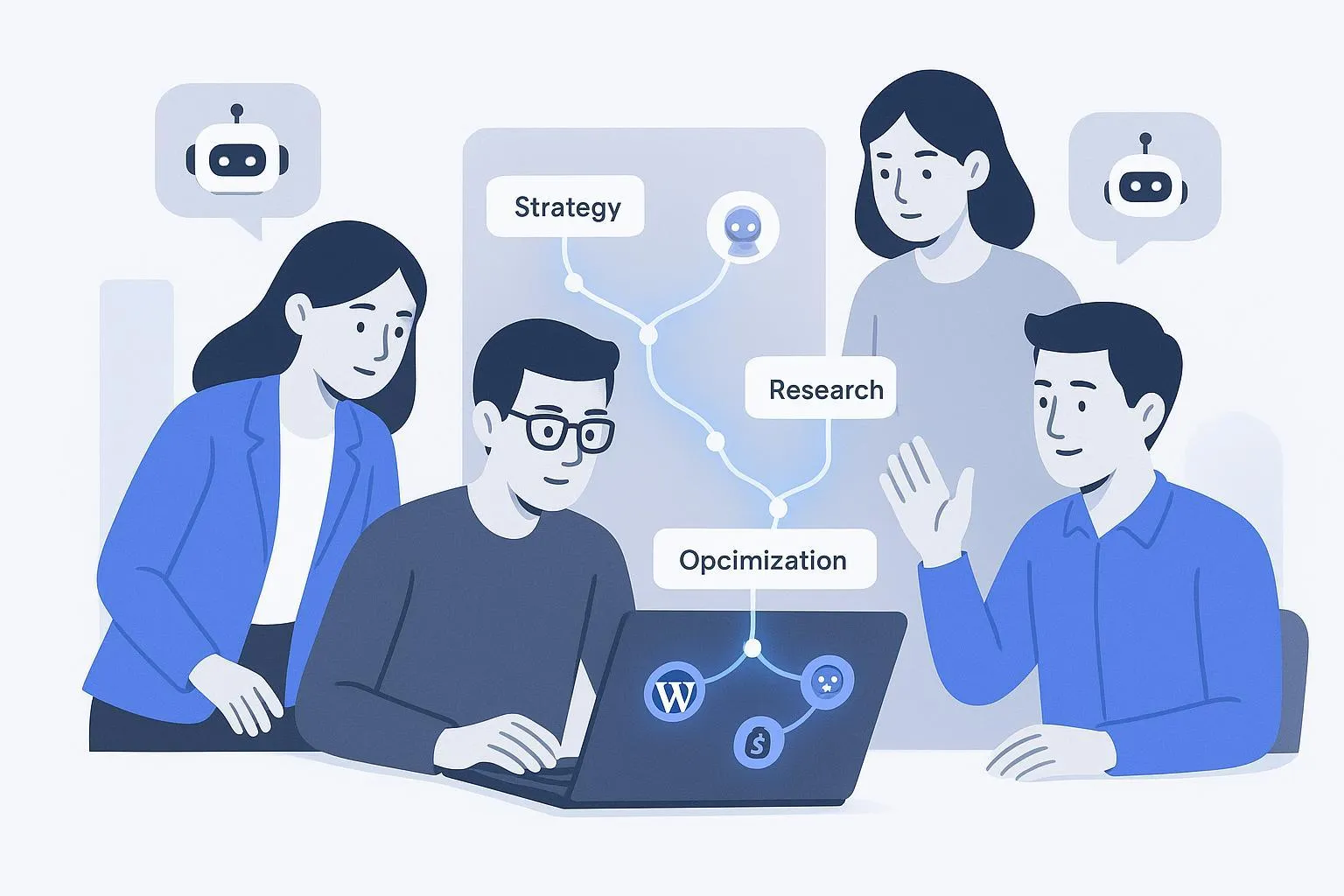
Small teams are under pressure to publish more, stay on-brand, and prove results with fewer resources. Agentic marketing platforms promise help by coordinating multiple AI agents—planning, researching, writing, optimizing, and even publishing content with shared brand context and human oversight.
This guide ranks the best agentic marketing platforms for SMBs, with a strict focus on time-to-value, pricing clarity, ease of integration, governance, and SEO/GEO performance. If you’re comparing options for the next two quarters, you’re in the right place.
If you want a fast, end-to-end content workflow that keeps brand voice intact, you can review QuickCreator’s platform overview on the neutral product page at the QuickCreator website before continuing.
What we mean by an agentic marketing platform
In this list, an agentic marketing platform is software that orchestrates specialized AI agents across the full content lifecycle: strategy, research, writing, optimization, and distribution—with shared brand memory and human-in-the-loop governance. That scope excludes single-function tools unless they enable multi-step, goal-driven workflows that map to SMB marketing outcomes.
Who this is for: SMB and early-stage startup marketing teams (typically 1–8 people) that need to scale brand-safe content across channels quickly and affordably—without hiring a large content staff.
How we chose and ranked these tools
We scored each platform against seven dimensions (weights add up to 100):
End-to-end lifecycle coverage and orchestration — 22%
SMB time-to-value and setup friction — 18%
Brand safety, governance, and human-in-the-loop — 15%
SEO/GEO performance enablement — 15%
Integration breadth/depth with common SMB stacks — 12%
Evidence transparency and reliability — 10%
Cost/value predictability — 8%
To keep this practical, we prioritized SMB fit (time-to-value, pricing transparency, integrations) while still recognizing robust orchestration and governance. For landscape context and evaluation patterns, see the practitioner coverage from Demandbase on AI agents for marketing in their method-focused explainer, the comparative overview by DataCamp on leading AI agents frameworks in 2025, and Automation Anywhere’s buyer guidance on agentic AI platforms:
According to Demandbase’s analysis in the AI agents for marketing explainer (2025), clear evaluation dimensions include orchestration scope and governance.
The DataCamp ‘Best AI agents’ overview (2025) catalogs capabilities and trade-offs across agent frameworks.
Automation Anywhere’s agentic AI platforms guide (2025) provides buyer-oriented criteria applicable to SMB decision-making.
Side-by-side comparison of agentic marketing platforms for SMBs
Prices and limits are subject to change; verify on vendor sites.
Platform | End-to-end coverage | Governance/brand safety | Integrations | Time-to-value | SEO/GEO support | Starting price | Free trial? |
|---|---|---|---|---|---|---|---|
QuickCreator | E2E agents across strategy→distribution | Brand Intelligence + human-in-loop; audit logs not publicly documented | WordPress documented | Fast for WordPress publishing | GEO/SEO-oriented agents | $29/mo | 7-day |
Jasper | Strong plan→create→manage | Style Guide, Brand IQ, versioning | Broad app ecosystem | Moderate | AEO/GEO positioning | Not publicly listed | Trial |
HubSpot | Broad content + personalization | Approvals and governance in CRM | Deep CRM + channels | Moderate–high | SEO + personalization | Pro ~$800 base (+contacts) | 14-day + Free tools |
StoryChief | Plan→create→approve→publish | Built-in approvals | 450+ destinations | Fast for content ops | SEO assistant | ~€29/user (varies) | Free plan + trial |
Narrato | AI workspace + workflows + publish | Roles/comments/workflows | WP/Strapi/Webflow/Contentful + Zapier | Fast for teams | SEO briefs/checks | Varies; verify | 7-day |
Copy.ai | GTM workflows/automations | Centralized governance | CRM/marketing stacks via workflows | Varies | SEO content possible | Not public | Trial |
Zapier Agents | No-code agentic orchestration | Admin controls | 8,000+ apps | Fast | Indirect (via workflows) | Free; Pro from $19.99; Agents add-on ~$33.33 | 14-day |
Make (Make.com) | Visual orchestration + agents | Transparent reasoning | 3,000+ apps | Fast for builders | Indirect (via workflows) | Free (1k credits); paid from $9 | Free plan |
ActiveCampaign | AI campaigns + automations | General controls | Email/SMS/CRM | Moderate | Predictive send | Contact-tiered | 14-day |
Buffer | Lightweight creation + approvals | Team roles + approvals | Major social | Fast | Limited SEO | Free; paid from $5/channel | 14-day |
Hootsuite | Social planning + approvals + AI | Planner + compliance add-ons | Broad social | Moderate | Limited SEO | $99–$199+ (varies) | 30-day |
Semrush Content Toolkit | SEO creation/optimization | Workspace approvals | Semrush suite | Fast for SEO writers | Strong SEO focus | $60/mo | 7-day |
The 12 best agentic marketing platforms for SMBs in 2026
1) QuickCreator — End-to-end agentic content ops for small teams

Positioning: QuickCreator coordinates specialized AI agents to plan, research, write, optimize, and publish brand-aligned content across channels for SMBs.
Standout capabilities:
Multi-agent pipeline spanning brand, topic strategy, research, writer, optimization, and distribution with shared context.
Brand Intelligence that enforces voice/terminology with human-in-the-loop approvals.
Streamlined WordPress publishing via official plugin for rapid time-to-first-publish.
Pros:
Especially strong for SEO-led content operations and small teams that need speed.
Clear starting price and accessible trial.
Cons:
Public documentation for audit logs/role permissions is limited.
WordPress flow is documented; other CMS/analytics connectors are referenced but less public.
Best for: SMB content teams prioritizing consistent brand voice and fast publishing. Not for: enterprises seeking deep CRM-native governance or complex multi-org policies.
Pricing: Starts at $29/month with a 7-day free trial (subject to change). See the transparent tiers on the QuickCreator pricing page.
Key integrations: WordPress documented publicly; distribution agent handles multi-channel publishing.
Evidence: Platform overview and agent pages on the QuickCreator site; WordPress plugin setup guide in the official help article.
2) Jasper — Brand-governed AI content pipelines

Positioning: Jasper provides AI-native content pipelines with embedded brand governance (Brand IQ, Style Guides) to plan, create, and manage content at scale.
Standout capabilities:
Canvas and Pipelines for strategy-to-execution with collaboration and versioning.
Brand IQ and Style Guide apply rules at generation time.
Pros: Mature brand-governance features; collaborative workflows.
Cons: Pricing is not consistently public; may skew enterprise.
Best for: Teams wanting robust brand rules and versioning. Not for: very small budgets that need transparent entry pricing.
Pricing: Not publicly listed at time of review; trial available (verify current terms).
Integrations: Broad ecosystem and exports.
Evidence: See the January 2026 capability update on Jasper’s official blog for current features.
3) HubSpot (Content Hub + Marketing Hub with AI) — CRM-embedded orchestration

Positioning: HubSpot embeds AI agents across CRM, content, and automation for creation, remixing, personalization, and approvals.
Standout capabilities:
Flexible Approvals and Data Quality governance integrated with Smart CRM.
Content Remix and AI personalization at scale across channels.
Pros: Deep CRM + content connection; governance primitives.
Cons: Higher onboarding fees and contact-tier costs; complexity can extend time-to-value.
Best for: SMBs already on HubSpot that want AI across CRM + content. Not for: teams with very lean budgets or zero CRM footprint.
Pricing: Marketing Hub Pro around $800/month base (+ contacts, onboarding); Content Hub Pro around $450/month (subject to change).
Integrations: Native across CRM, email, web, and partner ecosystem.
Evidence: Official pricing pages for Marketing Hub and the Content Hub pricing guide.
Mid-list soft CTA: Want to see how an end-to-end, brand-safe content workflow compares? Explore the neutral overview on the QuickCreator website and evaluate it against your stack requirements.
4) StoryChief — Content ops with collaborative approvals and publishing

Positioning: StoryChief centralizes planning, creation, approvals, SEO assistance, and multi-channel publishing.
Standout capabilities:
Built-in approval workflows and version control.
Distribution to 450+ destinations.
Pros: Fast to coordinate multi-channel posts; approachable UI.
Cons: Pricing specifics vary by page; verify limits and tier features.
Best for: Agencies and SMB teams with many destinations. Not for: those needing deep CRM-native governance.
Pricing: Public blog references start near €29/user/month; free plan/trial exist (subject to change).
Integrations: Broad channel connectors.
Evidence: See StoryChief’s approval workflow explainer for governance context.
5) Narrato — AI content workspace with CMS publishing

Positioning: Narrato offers templates, SEO briefs, collaboration, workflows, and direct publishing to popular CMSs and social.
Standout capabilities:
Custom workflows with task assignments and calendar.
Direct publishing to WordPress, Strapi, Webflow, Contentful; Zapier support.
Pros: All-in-one workspace for content teams.
Cons: Pricing references vary publicly; confirm active tiers.
Best for: SMB teams wanting a unified content workspace. Not for: complex enterprise review chains.
Pricing: 7-day free trial; tiered plans (verify current pricing).
Integrations: Popular CMSs + Zapier.
Evidence: Narrato’s content ops and publishing feature guides on their official blog.
6) Copy.ai — GTM workflows and agent automations

Positioning: Copy.ai focuses on cross-functional marketing workflows and automations with centralized governance.
Standout capabilities:
Workflow Builder to generate scalable, multi-step processes.
AI agents for campaign execution and content repurposing.
Pros: Powerful automations for GTM content and ops.
Cons: Pricing opacity; GTM tilt vs deep SEO/distribution.
Best for: Teams automating multi-step content or localization. Not for: buyers who need clear, low entry pricing.
Pricing: Trial referenced; current plan details need verification.
Integrations: CRM/marketing stacks via workflows.
Evidence: Copy.ai’s own governance and agent-building guides outline current capabilities.
7) Zapier Agents — No-code agentic orchestration across your stack

Positioning: Zapier Agents let you build goal-driven AI agents that act across 8,000+ apps.
Standout capabilities:
No-code builder with browsing, live data, and agent-to-agent delegation.
Generous free inclusion for light usage; scalable on paid tiers.
Pros: Fast time-to-value; huge app ecosystem.
Cons: Activity/task-based limits require monitoring.
Best for: SMBs wanting flexible agentic automations fast. Not for: teams that need a native long-form content suite.
Pricing: Free plan includes up to 400 agent activities/month; Pro from $19.99/month; Agents add-on from ~$33.33 (subject to change).
Integrations: 8,000+ apps.
Evidence: Zapier’s official Agents overview provides current features and limits.
8) Make (Make.com) — Visual orchestration with transparent agent reasoning

Positioning: Make combines a visual scenario builder with next-gen AI agents and an explainable reasoning panel.
Standout capabilities:
Dynamic routing, transparent agent reasoning, and natural-language scenario generation (Maia).
Credit-based pricing with low-cost entry.
Pros: Powerful for builders who value visibility and control.
Cons: Credit model and advanced features are tiered; learning curve if brand-new to Make.
Best for: Ops-minded marketers who like visual automation. Not for: teams needing out-of-the-box content pipelines.
Pricing: Free (1,000 credits) with paid from $9/month (subject to change).
Integrations: 3,000+ apps and LLM providers.
Evidence: Make’s release notes and pricing comparisons explain credits and agent features.
9) ActiveCampaign — AI-assisted campaigns and automations

Positioning: ActiveCampaign’s “Active Intelligence” helps generate campaigns, content, and multi-step automations.
Standout capabilities:
Predictive sending and AI-suggested segments/actions.
Conversational builder for goal-aware workflows.
Pros: Deep email/CRM roots; approachable AI assists.
Cons: Governance documentation on AI-specific controls is lighter.
Best for: Email-led SMBs scaling automations. Not for: teams centering on long-form SEO content.
Pricing: Tiered by contacts and plan; 14-day free trial (limits apply; subject to change).
Integrations: Email/SMS/CRM ecosystem.
Evidence: ActiveCampaign’s platform page and trial documentation outline current limits.
10) Buffer — Lightweight social creation, scheduling, and approvals

Positioning: Buffer offers an approachable scheduler with AI Assistant and basic approvals.
Standout capabilities:
AI Assistant for ideation/repurposing inside the composer.
Team roles and draft approvals on paid plans.
Pros: Extremely fast time-to-value and low entry price.
Cons: Social-first; minimal long-form/SEO capability.
Best for: Lean teams focused on social content. Not for: SEO-led content operations.
Pricing: Free; paid from $5/channel/month; 14-day trials (subject to change).
Integrations: Major social platforms.
Evidence: Buffer’s pricing page and approvals documentation.
11) Hootsuite — Social governance, Planner, and AI assist

Positioning: Hootsuite combines Planner, approvals, and OwlyWriter AI for teams that need governed social at scale.
Standout capabilities:
Built-in approvals and role workflows.
Enterprise governance/compliance add-ons.
Pros: Mature social governance and scheduling.
Cons: Higher entry price than lightweight schedulers.
Best for: Larger social teams needing approvals. Not for: budget-constrained micro-teams.
Pricing: Self-serve prices commonly range $99–$199+ per month with a 30-day trial (verify current tiers; subject to change).
Integrations: Broad social ecosystem.
Evidence: Hootsuite’s help center pages for OwlyWriter and Planner outline current features.
12) Semrush Content Toolkit (ContentShake AI) — SEO-centric content creation and optimization

Positioning: Semrush’s Content Toolkit generates and optimizes long-form articles grounded in Semrush data.
Standout capabilities:
AI Article Generator + data-driven SEO Briefs.
AI Search Optimizer with actionable fix suggestions.
Pros: Strong for keyword-led content and optimization.
Cons: Limited multi-channel distribution without external tools.
Best for: SMBs prioritizing SEO content quality. Not for: teams seeking native publishing to many channels.
Pricing: $60/month after a 7-day free trial (subject to change).
Integrations: Within the Semrush suite and exports.
Evidence: Semrush Knowledge Base on the Content Toolkit covers features and pricing notes.
Implementation and time-to-value checklist for SMB teams
Use this to get first value in days, not months:
Define your “agentic scope.” Start with a narrow goal like “publish two SEO blog posts and three social repurposes weekly.”
Load brand intelligence. Centralize voice rules, terminology, and disallowed claims to reduce back-and-forth.
Connect your CMS and analytics. If you’re on WordPress, follow the QuickCreator plugin steps in the official how-to guide to enable one-click publishing.
Establish human-in-the-loop gates. Decide who approves briefs, drafts, and final copy; document these in the tool.
Standardize SEO/GEO inputs. Use data-backed briefs, internal-link rules, and publication checklists.
Pilot one repeatable workflow. For example: Topic brief → Draft → Optimization pass → Publish → Social repurpose.
Measure cycle time and quality. Track hours-to-first-publish, revisions per asset, and organic performance.
Iterate integrations. Add CRM or ecommerce connectors once your core content workflow is stable.
FAQ
What is an agentic marketing platform? It’s software that coordinates multiple specialized AI agents to cover strategy, research, writing, optimization, and distribution with shared memory and human approvals. This enables closed-loop, goal-driven content operations.
How is this different from traditional marketing automation? Traditional tools rely on static rules and triggers. Agentic platforms use reasoning across agents, shared brand context, and adaptive handoffs to produce and optimize content—not just route tasks.
What does SMB-friendly pricing look like? Clear entry tiers, transparent usage limits, free trials, and realistic on-ramps in the ~$100–$500/month band for core needs. Some options start even lower depending on scope.
Which tools integrate with WordPress, Shopify, or HubSpot? WordPress is widely supported. QuickCreator publicly documents a WordPress flow; StoryChief and Narrato offer broad CMS connectors; HubSpot provides deep CRM-native orchestration. Verify specifics for Shopify/HubSpot before committing.
How long to first value? Simple social schedulers and no-code orchestrators can deliver value the same day. Full content suites typically produce first publishable assets within the first week when brand inputs are ready.
What governance features matter most? Role permissions, approval gates, audit logs, brand voice enforcement, and version history. For regulated categories, ensure export logs and content history are accessible.
How do these tools impact SEO and GEO? Tools that generate data-backed briefs, enforce on-page structure, and support internal linking help most. GEO-focused features can improve visibility in AI search surfaces over time.
Do I need engineers to set this up? Usually no. Zapier/Make are no-code. Content suites need marketing ops hygiene more than engineering, though complex CRM scenarios (e.g., HubSpot Enterprise) may benefit from admin support.
Next steps
Shortlist 3 platforms that match your stack and budget.
Run a one-week pilot using the checklist above.
Compare cycle time, brand alignment, and early SEO/GEO signals.
If your priority is fast, brand-safe content operations tied to WordPress, review the neutral overview and pricing details on the QuickCreator website and weigh it against your shortlist.
Disclosure: Pricing and features are subject to change. Information in this article links to official vendor resources for verification where possible. Last reviewed: 2026-03-05.