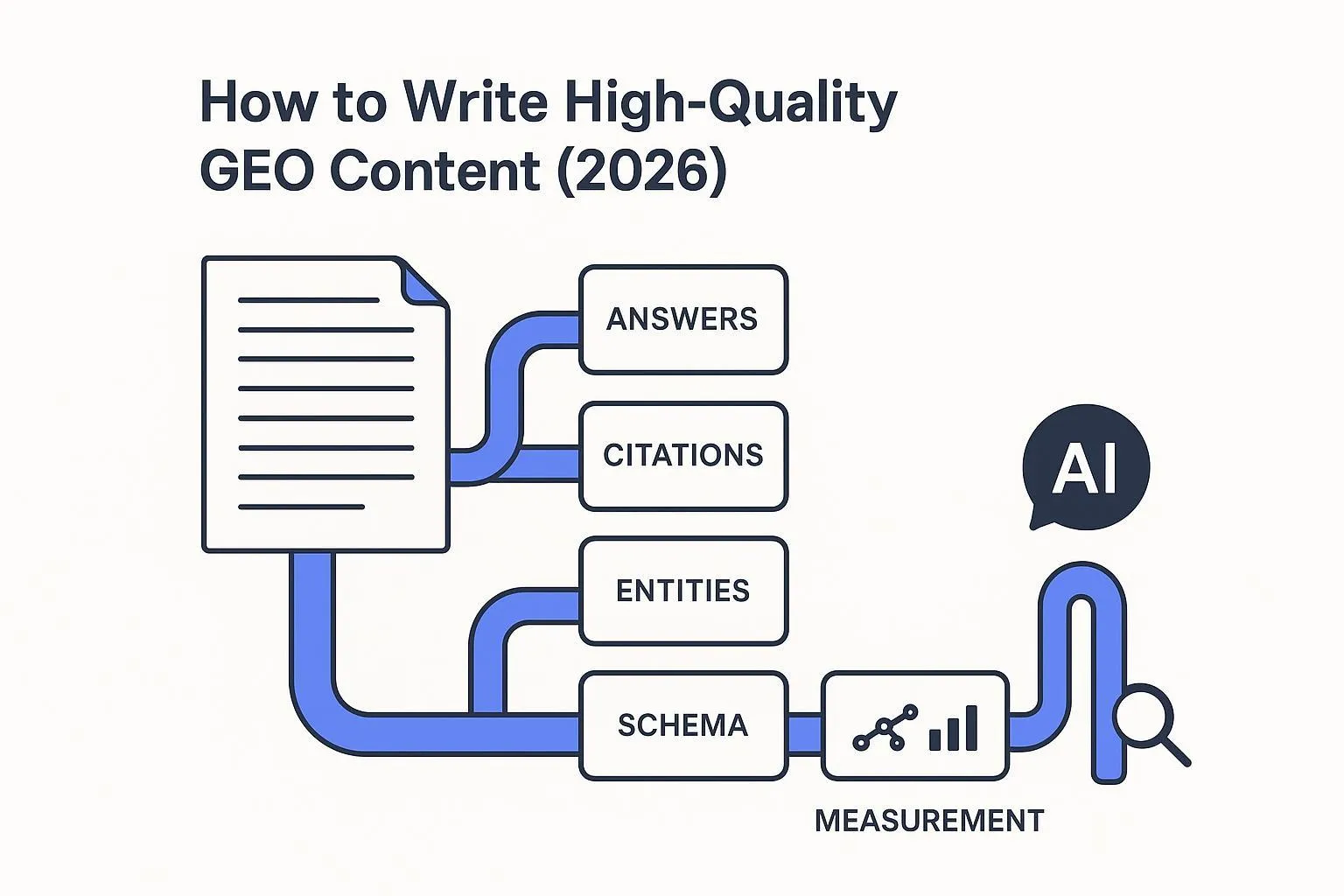
Generative Engine Optimization (GEO) is the craft of writing pages that AI answer engines can reliably retrieve, extract, and cite.
If you’re a scaling SMB marketing team, GEO isn’t “SEO but with new buzzwords.” It’s a different quality bar:
SEO rewards relevance + authority over time.
GEO rewards extractability (can an answer engine lift a correct, self-contained chunk?) + credibility (will it trust and cite you?)
This guide is a consideration-stage playbook on how to write high-quality GEO content: you’ll get evaluation criteria, a step-by-step writing workflow, good vs. bad examples, an SOP template, and a simple measurement system.
What “high-quality GEO content” actually means
High-quality GEO content is content that consistently produces citable answer nuggets without becoming thin or formulaic.
A practical definition (that you can QA against):
A reader can scan any H2 section and get a complete, accurate answer in under 30 seconds.
Every important factual claim is verifiable, and the page makes verification easy with natural inline citations.
Entities are unambiguous (who/what you mean is obvious), and terminology is consistent.
The page is structured for retrieval (clear headings, explicit questions, and “answer-first” segments).
Several GEO guides converge on these themes—answer-first structure, authoritative sourcing, and clear structure—including HubSpot’s generative engine optimization best practices (2026), Frase’s GEO strategy workbook (2025), and Directive Consulting’s GEO best practices guide (2025).
The GEO quality criteria (use this to evaluate any draft)
Before you change how you write, you need a shared definition of “good.” Here are the criteria I’d use to score a page for GEO readiness.
1) Answer-first clarity
Does each section start with the answer?
Would a busy reader quote the first paragraph because it’s clear and complete?
2) Fact density with attribution
Are you making claims that could be checked?
When you reference a concept, guideline, or number, do you cite an original or authoritative source inline?
3) Entity and terminology precision
Do you name the exact thing you mean (tool, framework, standard, organization)?
Do you expand acronyms on first use?
Do you use the same term consistently across headings and body?
4) Extractable structure
H2s and H3s are descriptive and question-aligned.
Paragraphs are short enough that a model can lift a coherent chunk.
Lists are used sparingly—but when used, each item has real substance.
5) Trust signals beyond the text
Even if you’re only “writing,” remember that AI systems still ingest on-page credibility signals: author identity, publication dates, and site integrity. Schema can support those signals, but it can’t rescue vague or unverified writing.
Good vs. bad GEO paragraphs (what changes in the writing)
Below are two pairs you can use as patterns during editing.
Example 1: Definition lead + scoped claim
Bad (uncitable):
GEO is when you optimize your content for AI. It’s important because AI is changing search and you need to adapt quickly.
Why it fails:
Vague definition (“optimize for AI”) with no retrieval cues.
No specificity on what changes in the writing.
Good (citable):
Generative Engine Optimization (GEO) is the practice of structuring and sourcing your content so AI answer engines can retrieve it, extract a self-contained answer, and cite your page as evidence. In practice, that means answer-first sections, explicit entities, and verifiable claims with inline citations.
What changed:
Defines GEO precisely.
Adds a concrete “in practice” translation into writer actions.
Example 2: Turning advice into a checkable rule
Bad (uncitable):
Add more sources to increase credibility. Use more headings to help AI understand your page.
Why it fails:
- “More” is not a rule. It can’t be QA’d.
Good (citable):
For every non-obvious factual claim (numbers, standards, “best practice” assertions), add one inline citation to an authoritative source and include the year and scope in the sentence when it matters. Structure the page so each H2 answers one question, starting with a 2–4 sentence “answer block,” then details.
What changed:
Converts advice into a measurable standard.
Makes structure explicit (H2 = one question; answer block first).
How to write high-quality GEO content step by step (writer-ready)
This workflow is designed for small teams: minimal meetings, clear handoffs, and “done when…” checks.
Input (topic + audience + intent)
  → Evidence plan (what needs sources)
    → Outline as questions (H2/H3)
      → Draft answer blocks (2–4 sentences each)
        → Expand with proof + examples
          → Entity pass (names, acronyms, consistency)
            → Citation pass (inline, primary sources)
              → Extractability pass (tighten sections)
                → Publish + measure
Step 1: Convert the topic into 6–10 reader questions
Do this: write your outline as questions the reader would ask.
H2s = the big questions.
H3s = the follow-ups that need proof.
Done when: you can read only the headings and the article still has a clear argument and learning path.
Step 2: Build an “evidence map” before drafting
Decide which sections require citations.
A simple rule: if a statement is not obvious to your ICP, it needs one of:
a cited source
a scoped assumption (“In most SMB teams with 1–2 writers…”)
a concrete example
Done when: each H2 has either (a) a planned source or (b) a planned firsthand example.
Step 3: Draft the answer blocks first
Write a 2–4 sentence “answer block” under every H2 before you expand anything.
Rules for answer blocks:
Standalone meaning (no “this” without a referent).
Concrete nouns (“Google AI Overviews,” “schema markup,” “FAQ section”), not vague placeholders.
No throat-clearing.
Done when: a reader could get the gist by reading only the first paragraph under each H2.
Step 4: Expand with proof, examples, and failure modes
Now you earn credibility.
For each section, add:
one example (what it looks like)
one failure mode (what goes wrong)
one verification cue (“You’ll know you did this right when…”)
Done when: the section contains at least one “how” and one “what to watch for,” not just “what it is.”
Step 5: Run the entity pass (clarity for humans and machines)
Do a fast sweep for:
First-use acronym expansions
Consistent naming (pick one term; remove synonyms that create ambiguity)
Named entities (company names, standards bodies, tools) spelled correctly
Done when: a new reader can’t misinterpret what each key term refers to.
Step 6: Run the citation pass (trust + retrievability)
You’re aiming for verifiable writing, not link dumping.
Cite primary/authoritative sources.
Put citations inside sentences with descriptive anchor text.
Include year/scope when it matters.
Done when: any skeptic could click through and verify your key claims without hunting.
Step 7: Run the extractability pass (make sections liftable)
Edit for:
tighter topic sentences
shorter paragraphs
fewer pronouns, more explicit nouns
fewer “however/therefore” chains; more direct statements
Done when: the first ~120–180 words of each section can be quoted without losing meaning.
Citations and source quality: what to cite, and how
Citations are not decoration in GEO—they’re a selection signal.
What counts as an “authoritative” source
Prefer:
original research reports
official standards/guidelines
primary documentation
reputable publications with clear authorship and dates
Avoid:
anonymous blogs with no editorial accountability
“AI rewritten” aggregators
stale sources for time-sensitive claims
The citation pattern that works (and reads like normal prose)
Use this template:
- “According to Publisher’s Document Title (Year), …”
Then link the document title inline.
Don’t accidentally sabotage your own citations
Common mistakes:
Bare URLs
“Source” links
Dropping a link at the end of a sentence with no integration
Linking to a homepage instead of the specific report/page
Pro Tip: When you cite data, include the year and the scope in the sentence (US vs global, sample size, industry). It helps humans and reduces misquotes in AI answers.
The GEO Content SOP template (copy/paste)
Use this as a lightweight operating procedure your team can adopt.
GEO SOP — for one article
Inputs
Primary query / topic
ICP + funnel stage
Target page type (guide, checklist, comparison, etc.)
Process
Outline as questions (30 min)
H2s are questions; H3s are follow-ups.
Done when: headings alone tell the story.
Evidence map (20 min)
For each H2, list: 1 source OR 1 firsthand example.
Done when: every “non-obvious” claim has a planned proof path.
Answer blocks (45–60 min)
Write 2–4 sentences under each H2.
Done when: the page is understandable by reading only answer blocks.
Expand sections (60–120 min)
Add 1 example + 1 failure mode + 1 verification cue per section.
Done when: each section teaches execution, not just concepts.
Entity pass (15 min)
Expand acronyms; fix naming consistency.
Done when: no ambiguous “this/that/it” around key terms.
Citation pass (20–40 min)
Inline descriptive anchors; primary sources.
Done when: key claims are verifiable in one click.
Extractability edit (20 min)
Tighten first paragraphs; shorten paragraphs; reduce fluff.
Done when: each H2’s first 150 words can be quoted cleanly.
Publish + measurement setup (15 min)
- Add to prompt set; record baseline.
Outputs
Published article
Evidence map (kept in doc or brief)
Measurement row in GEO tracker
How to measure GEO impact (without enterprise tooling)
GEO measurement is messy because engines vary in how they show citations. But you can still run a credible system.
The minimum viable GEO scorecard
Track three layers:
Visibility: do you appear?
Citation quality: are you cited, and is it the right page?
Business impact: does it lead to traffic, leads, or branded search lift?
Metric 1: Citation rate (per prompt set)
Define 25–50 prompts your ICP would actually ask.
Each month, run the prompts through a consistent set of engines.
Track: “cited vs not cited.”
Formula: cited prompts ÷ total prompts.
Metric 2: AI share of voice (AI SOV)
For each prompt, record which brands are mentioned/cited. Your AI SOV is your share across the prompt set.
Metric 3: Accuracy rate (brand safety)
For high-intent prompts (comparisons, “best tool for X”), evaluate whether the AI’s statements about your brand are correct.
Why this matters: an incorrect claim can be worse than no mention.
Metric 4: AI referral traffic (GA4)
Set up a simple report for traffic from AI/chat referrers and monitor:
landing pages
engaged sessions
conversions (or assisted conversions)
Metric 5: AI-assisted leads (human input)
Add one field to your forms:
- “Did you find us via ChatGPT / Perplexity / Google AI Overview / other?”
It’s imperfect, but it’s directionally useful.
⚠️ Warning: Don’t promise a fixed “GEO ROI” window. Treat it like SEO: you’re building a citation footprint over time, and visibility can fluctuate with model and index updates.
Where QuickCreator fits (neutral example)
If you’re operationalizing this across many pages, the hard part is not “knowing the rules.” It’s enforcing them across research, briefs, writing, and QA.
A coordinated, human-in-the-loop workflow can help by splitting responsibilities (topic → research → writing → optimization → publishing) with a review gate. As a concrete example, QuickCreator positions itself as an agentic content pipeline built for this kind of end-to-end execution.
If you want a workflow reference you can adapt, QuickCreator also published a walkthrough on content workflow orchestration and where AI agents fit.
If you’re evaluating tooling categories for GEO tracking and optimization, use this as a starting point: QuickCreator’s generative engine optimization tools roundup (2025).
Next steps
Pick one existing article and run the SOP above end-to-end.
Build your first 25-prompt measurement set and record a baseline.
Commit to one update cycle: revise the page based on what gets cited, not just what ranks.
For further reading on GEO writing patterns, see the three references cited in the definition section: HubSpot’s generative engine optimization best practices (2026), Frase’s GEO strategy workbook (2025), and Directive Consulting’s GEO best practices guide (2025).