If you’ve been using LLMs with clever prompts and you’re still not getting reliable outcomes, you’re not “bad at prompting.” You’re probably trying to solve a multi-step workflow with a single-step interface.
That’s the core difference:
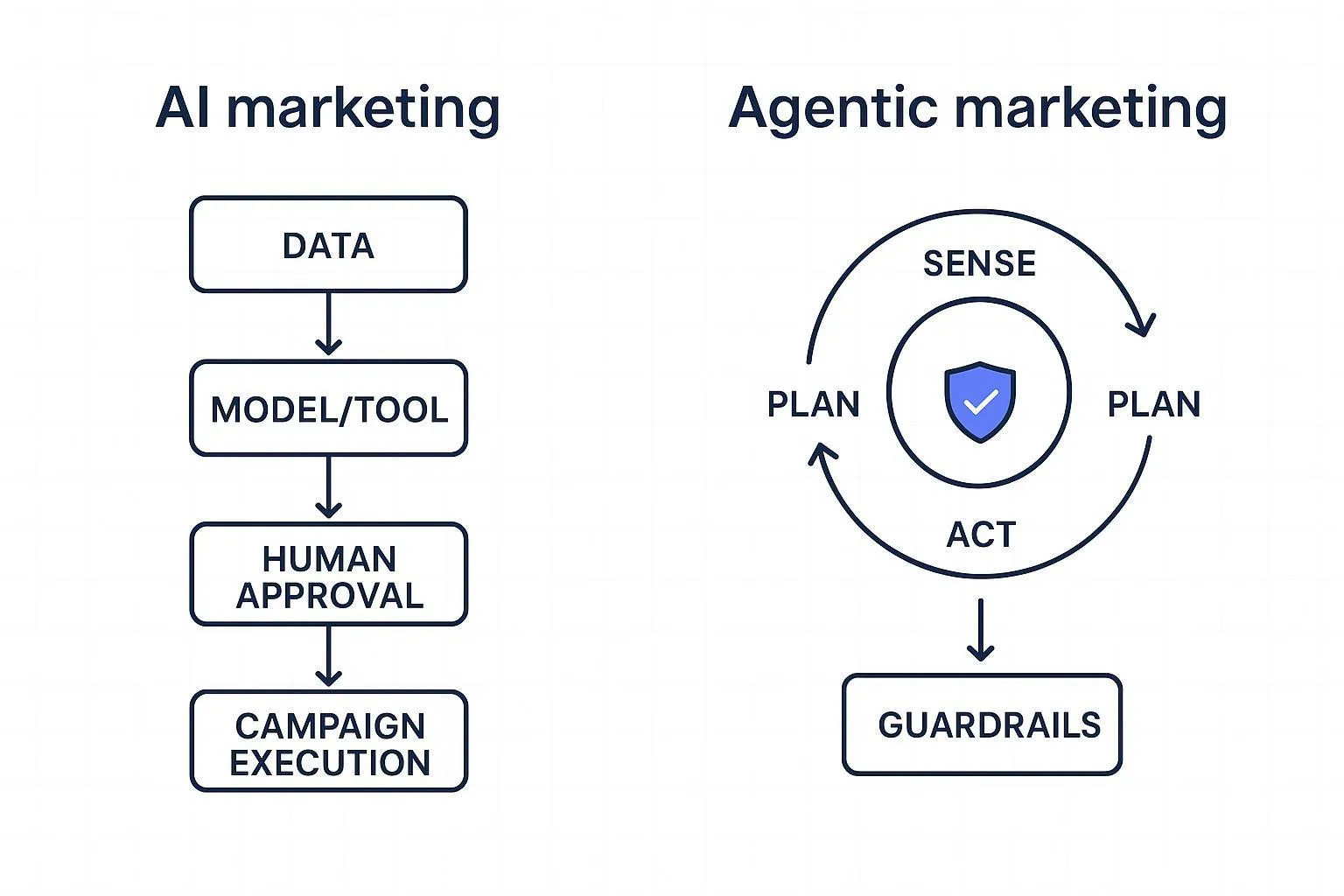
Prompting is great when the work can be expressed and completed in one shot (or a small back-and-forth).
Agentic workflows are built for jobs that require planning, multi-step tool use, iteration, and verification.
This article compares agentic AI vs prompting for scaling SMB marketing teams: where agents tend to win, how the benchmark evidence supports that, and where the approach still breaks.
A quick comparison matrix (agentic AI vs prompting)
Evaluation criterion | Prompt-only workflow tends to win when… | Agentic workflow tends to win when… |
|---|---|---|
Task horizon (how many steps) | It’s 1–3 steps and you can eyeball the result | It’s 5+ steps and mistakes compound without checkpoints |
Tool surface area | No tools, or one tool with simple inputs | Multiple tools (docs, web, CMS, analytics, sheets) and brittle UI steps |
Verification needs | “Good enough” is fine and stakes are low | You need citations, provenance, brand rules, or reproducibility |
State & handoffs | Context is stable and short | Work spans stages (brief → research → draft → optimize → publish) |
Overhead (latency/cost) | You need speed right now and the task is the one-off | You’ll repeat this weekly/monthly and can amortize setup |
Failure tolerance | A wrong answer is harmless | Wrong outputs create risk (brand, compliance, SEO, time waste) |
Criterion 1: Task horizon (compounding error is the real enemy)
A lot of “agents are better” claims collapse into one mechanism: they introduce checkpoints.
In prompt-only workflows, you ask for a full deliverable. If any intermediate assumption is wrong, the whole output inherits it.
Agentic workflows, when designed well, split the work into stages:
plan the approach
gather evidence
draft
critique/verify
revise
That doesn’t guarantee correctness. But it gives you places to catch errors before they become an expensive mess.
One reason benchmarks for long-horizon tasks are so harsh is that each additional step is a new chance to fail. That’s also why many LLM agent benchmarks are less about “writing quality” and more about whether the system can keep its plan intact across a chain of tool calls. The DABstep benchmark for multi-step data analysis is a clean illustration: it reports roughly 76% accuracy on “easy” tasks vs ~14.55% on “hard” multi-step tasks (hard tasks require multiple sources and at least six steps) in DABstep: Data Agent Benchmark for Multi-step Reasoning (2025).
That’s not a “marketing benchmark,” but the failure pattern is familiar: as soon as the job stops being a single query and becomes a small project, reliability drops fast.
Key Takeaway: Agentic AI outperforms prompting most consistently when the workflow needs multiple verification points, not just a better final draft.
Criterion 2: Tool surface area (agents are built to touch the messy world)
Marketing work rarely lives in one text box. It’s spread across:
web pages and competitor sites
your own CMS
spreadsheets and brief templates
analytics dashboards
brand docs and messaging guidelines
As soon as you involve tools and interfaces, you introduce a new kind of difficulty: the environment fights back.
The OSWorld benchmark makes this brutally visible. It evaluates computer-use agents in real OS environments and reports 369 tasks, where humans succeed ~72.36% but the best model succeeds ~12.24% on the NeurIPS poster page: OSWorld: Benchmarking Multimodal Agents for Open-Ended Tasks in Real Computer Environments (2024).
Again, OSWorld isn’t “a marketing suite.” But it’s a warning label: tool-using agents can be powerful, and they’re also fragile in UI-heavy environments.
So when do agents help marketing teams anyway?
They help when your tools are API-like (search, structured docs, analytics exports) or when you can constrain the environment (templates, controlled forms, consistent workflows). They struggle most when your workflow depends on unpredictable UI state.
Criterion 3: Verification, provenance, and factuality
Prompting can produce strong prose quickly. The problem is what happens next:
Which claims are grounded in sources?
Which numbers are real?
What changed during editing?
Agentic workflows can outperform prompts when they treat verification as a first-class step. For example:
a “research” step that collects sources
a “writer” step that binds claims to those sources
a “reviewer” step that checks for unsupported assertions
That’s one reason many teams adopt agentic scaffolds for content: not because the model “writes better,” but because the workflow fails safer.
If you’re curious what this looks like in a marketing context, QuickCreator’s comparison of AI agents vs AI writers frames the difference as governance + iteration + retrieval grounding (read it as an implementation pattern, not a verdict).
Criterion 4: State, memory, and handoffs (where agents can win—or implode)
Most marketing deliverables aren’t single outputs; they’re a chain:
define audience + angle
gather evidence
draft
edit for brand voice
optimize for search
publish and repurpose
Prompt-only workflows force you to manually carry state from step to step (copy/paste, re-explain, re-prompt).
Agentic workflows attempt to keep state inside the system. When that works, you see two practical advantages:
fewer “reset” prompts
fewer contradictions across sections
When it fails, it fails in predictable ways:
the agent forgets earlier constraints
the agent overfits to the last instruction and breaks consistency
the agent’s memory becomes a junk drawer (more context, less signal)
There’s also a measurement pitfall here: even benchmarks can mis-score success if the evaluator is brittle.
WebArena-Verified exists largely because web-agent evaluation can be noisy. The project audited 812 tasks and tightened evaluation to reduce false negatives, per WebArena Verified: Reliable Evaluation for Web Agents (NeurIPS 2025).
Practical translation: when you evaluate agents in your own workflow, don’t only track “did it finish.” Track why it failed (wrong plan, wrong tool use, lost state, wrong verification).
Criterion 5: Cost, latency, and operational overhead (the hidden breakpoint)
Agentic workflows are not free:
more tokens (multiple calls)
more latency (sequential steps)
more surface area for tool errors
more setup (defining stages, templates, evaluation checks)
That overhead is exactly why prompt-only workflows still win for many tasks.
If the work is truly one-off, prompting is often the rational choice.
If the work repeats (weekly reporting, monthly content ops, multi-asset repurposing), the overhead becomes an investment you amortize.
⚠️ Warning: If you “go agentic” without adding verification gates, you can end up with more confident mistakes at higher speed.
Breakpoints by scale: when agents start to outperform prompts
For scaling SMB marketing teams, the breakpoints usually aren’t about headcount alone. They’re about workflow complexity.
Here’s a practical way to think about it.
Breakpoint A: When the deliverable becomes a workflow
Prompting works best when you can describe the entire job in one tight spec.
Agents start to win when the real job looks like this:
Input (brief)
  -> research (collect sources)
  -> draft
  -> brand + claims check
  -> SEO pass (links, headings, intent)
  -> publish-ready format
Output (asset)
If you find yourself writing “do X, then do Y, then verify Z” in a single prompt, you’re already designing an agent. You’re just doing it manually.
Breakpoint B: When “quality” means consistency, not eloquence
Many teams chase better prompts because they want better writing.
But at scale, the bigger problem is consistency:
consistent structure across posts
consistent use of terms
consistent sourcing behavior
consistent brand voice
Agentic workflows can outperform here because they separate concerns: a “writer” doesn’t need to remember all brand rules if a “brand” step enforces them.
If you want a concrete marketing-team example of voice enforcement and guardrails, QuickCreator’s FAQ on maintaining brand voice across channels is a useful reference.
Breakpoint C: When you need repeatable decision-making (not just output)
A prompt produces output.
An agentic workflow can produce decisions plus artifacts:
why this keyword
which sources support which claims
what changed between drafts
That auditability becomes valuable the moment you have approvals, brand risk, or multiple stakeholders.
Edge cases: where prompt-only still wins
Agentic AI isn’t “prompting, but better.” It’s a different trade.
Prompt-only workflows often win when:
- The task is creative and under-specified
ideation, taglines, “give me 20 angles”
you want divergence, not convergence
- The environment is unpredictable
UI-heavy tasks with frequent layout changes
brittle automations where one failed click ruins the run
- The evaluation is subjective
brand “feel,” taste, narrative voice
a human should be the judge, quickly
- The cost of setup is larger than the job
one-time email
one landing page headline refresh
A practical upgrade path (without betting the farm)
If you’re a small team, you don’t need to jump from “prompts” to “fully autonomous agents.” A staged approach is safer:
- Prompting + templates
- standardize inputs (brief format, tone, constraints)
- Two-stage workflow
- separate research from writing; require sources before claims
- Add one verification gate
- brand check or citations check (pick the one that hurts you most today)
- Only then add tool automation
- CMS formatting, internal linking, repurposing
This is also where an agentic pipeline can be useful as a coordination pattern. If you want a concrete example of that pipeline framing in marketing terms, see QuickCreator and its breakdown of the multi-agent workflow in AI agents for marketing: how multi-agent systems work.
Next step
If you want to sanity-check whether your workflow is “prompt-sized” or “agent-sized,” write down the steps you actually do from brief → publish. If it’s more than a few steps, you’re already doing agentic work—just without guardrails.