If you’ve tried “just use AI” for blog posts, LinkedIn, and emails, you’ve probably seen the same three problems:
Everything starts sounding like the same vendor.
Facts get wobbly the moment you move beyond what’s on your homepage.
The tone that works on LinkedIn lands weirdly in a product email.
The fix isn’t a better prompt. It’s a system.
Before we jump in, one definition that prevents 80% of the confusion:
Brand voice is your brand’s consistent personality. Tone is how that voice adapts to context (channel, audience, moment). Column Five explains the distinction clearly in “Brand Voice vs. Tone”.
Below is the practical FAQ for small B2B SaaS teams that want consistency without handcuffing every writer.
Quick answer: can AI agents maintain brand voice across channels?
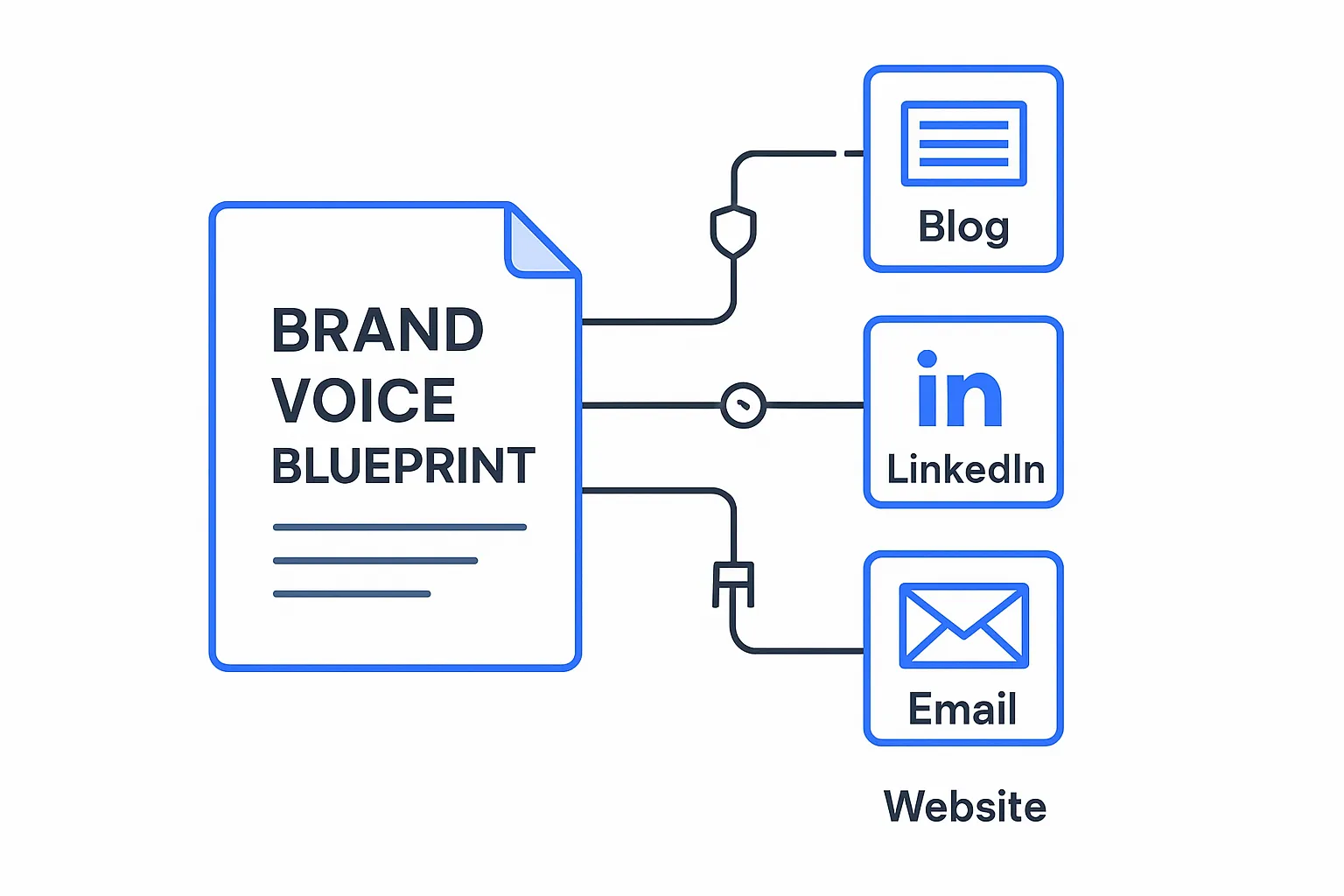
Yes—if you treat brand voice like production software: you need a spec (voice extraction), a data layer (knowledge base), automated tests (guardrails), and a release process (review gates). That’s the practical path to brand voice consistency across channels without rewriting everything by hand.
Without those, AI will default to generic patterns and you’ll get “off-brand drift” over time.
Brand voice basics (so the rest of this is actionable)
What’s the difference between brand voice and tone?
Voice stays consistent; tone changes by situation. Your brand can be “direct and candid” everywhere, while being more upbeat on LinkedIn and more reassuring in customer emails.
If you don’t separate voice from tone, you’ll either:
force one tone everywhere (channel mismatch), or
let the model “freestyle” tone until you no longer sound like you.
Why does brand voice break first when teams scale content?
Because voice is mostly a pattern problem.
As soon as you add more contributors (freelancers, PMM, founders, AI tools), you’re basically running a distributed system with no shared runtime.
AI accelerates the throughput—and the drift—unless you put governance in the loop.
How to maintain brand voice with AI (a governance workflow)
If you want the shortest useful answer, it’s this brand voice governance workflow:
Extract voice into a spec you can score
Ground facts in a knowledge base
Add brand voice guardrails (tests/validators)
Add review gates (human approval where it matters)
This is also the simplest way to turn broad AI brand voice guidelines into something enforceable.
Voice extraction (how to turn “our vibe” into something agents can use)
What does “voice extraction” actually mean?
It means converting your best existing writing into a usable voice spec—not adjectives.
Adjectives like “professional, friendly” are too vague. AI needs constraints it can test.
A practical voice extraction output looks like this:
Voice pillars (3–5): e.g., “direct,” “skeptical of hype,” “helpful to practitioners,” “precise with terms.”
Tone sliders by channel: e.g., LinkedIn = more conversational, Email = more empathetic, Blog = more explanatory.
Lexicon: preferred terms + “never say” list.
Examples: 3–5 “on voice” paragraphs + 3 “off voice” paragraphs with rewrites.
If you’re building this inside QuickCreator, the Brand Intelligence Agent is positioned as a way to extract and share those voice constraints across the rest of the content workflow.
How many examples do you need for voice extraction?
Enough to represent your range.
For most small B2B SaaS brands, start with:
5–10 strong blog paragraphs
5 solid LinkedIn posts
3–5 lifecycle emails
1 landing page section that you consider “peak you”
The goal is to capture what you repeat on purpose: sentence length, degree of certainty, how you qualify claims, and how you address the reader.
What’s a simple “voice rubric” you can use to score output?
Use a 1–5 score on four dimensions:
Point of view: Does it sound like your brand, or like a generic explainer?
Claim discipline: Does it avoid overpromising or inventing specifics?
Vocabulary: Does it use your terms (and avoid banned ones)?
Channel fit: Does the tone match the channel without changing the underlying voice?
Pro Tip: Put the rubric in your workflow so AI (and humans) must “pass” before publishing.
Knowledge bases (how to stop factual drift and keep messaging consistent)
Why do you need a knowledge base if you already have a style guide?
Because a style guide controls how you say things—not what’s true.
Factual drift happens when a model fills in missing details. That’s where hallucinations come from.
A knowledge base (often implemented as retrieval-augmented generation/RAG) gives the model a grounded source of:
product facts and terminology
positioning statements
pricing and packaging rules
compliance constraints
approved proof points and case studies
QuickCreator’s docs describe an AI Knowledge Base designed for this “private, brand-owned source of truth” layer.
What should you put in your knowledge base first?
Start with the assets that cause the most damage when they’re wrong:
Positioning doc (what you are / aren’t)
Product facts (what’s supported, limits, integrations)
Proof policy (what counts as an acceptable claim)
Pricing + plan naming conventions
Top 10 objections + approved responses
If you can only do one thing: write “we never claim X unless we can cite Y.” That single guardrail prevents 90% of the mess.
How does a knowledge base help maintain brand voice?
It stabilizes what your voice is about.
When the model consistently references the same product truths and positioning language, your tone variations by channel still feel like one brand—because the underlying “world model” is the same.
Guardrails (how to prevent off-brand drift automatically)
What are guardrails in an agent workflow?
Guardrails are the rules and validators that run before content is allowed to move forward.
Think of them like unit tests:
Does the draft use banned phrases?
Does it use required terminology?
Are there ungrounded claims (“best”, “guaranteed”, “perfect”)?
Does it match the channel’s constraints (length, structure, CTA policy)?
WordStream’s overview of AI brand guidelines gets at the same point: AI behaves better when you give it concrete, enforceable rules. The trick is turning “guidelines” into checks your workflow can actually run.
What guardrails matter most for small B2B SaaS teams?
The ones that stop expensive mistakes:
Claim guardrail: block unverifiable claims and invented customer stories.
Terminology guardrail: enforce product/feature names.
Tone guardrail (per channel): detect “LinkedIn-isms” in email and vice versa.
Risk words list: flag absolutes (“always”, “never”) unless intentional.
⚠️ Warning: If you don’t explicitly ban “fake specificity” (numbers, customer names, legal claims), AI will happily invent it.
Can you show an example of guardrails catching off-brand output?
Yes. Here’s a simple before/after.
Off-brand draft (too fluffy, too absolute):
“Our revolutionary platform seamlessly transforms your marketing and guarantees better results across every channel.”
On-brand rewrite (direct, specific, claim-disciplined):
“A coordinated workflow—shared voice rules, a grounded knowledge base, and review gates—reduces off-brand drift when you scale content across channels.”
Notice what changed:
removed empty adjectives (“revolutionary”, “seamlessly”)
removed absolute performance claim (“guarantees”)
replaced with a concrete mechanism
Review gates (how to keep humans in control without slowing everything down)
What are review gates in an AI agent workflow?
Review gates are explicit checkpoints where the output must be approved (or rejected) before it can proceed.
A lightweight gating model for small teams looks like:
Brand gate: does it match the voice rubric?
Facts gate: is every key claim grounded in the knowledge base or a cited source?
Channel gate: does it fit the channel’s tone and format constraints?
Publish gate: final human sign-off
QuickCreator positions this as “human-in-the-loop control” where you can review and edit the extracted brand profile and outputs before they ship (see the help article on editing and updating brand profile information).
How do you keep review gates from becoming a bottleneck?
Make the gates predictable and scoped:
Review the rubric score + top violations, not the whole doc every time.
Only escalate to a human when:
a claim is new or risky,
the tone classifier flags drift,
the draft introduces new positioning language.
In practice, this turns review into exception handling instead of constant rewriting.
Who should approve what in a 2–8 person marketing team?
A workable split:
Brand/voice owner (often Head of Marketing or PMM): approves voice spec changes + big campaign messaging.
Channel owner: approves channel-fit (email, social, blog).
Subject-matter reviewer (often PM/CS): approves product accuracy for technical posts.
If you can’t staff that: default to “brand + facts” approval for anything that will be indexed or reused.
Cross-channel examples (how to adapt tone without losing voice)
What does “same voice, different tone” look like in practice?
Assume your voice pillar is: direct, practical, skeptical of hype. Here’s how one idea changes by channel.
Core idea (same voice):
“You can’t enforce brand voice with adjectives. You need a spec, a knowledge base, and gates.”
LinkedIn (more conversational, punchier):
“If your AI content sounds generic, it’s not the model. It’s the missing system: voice spec + KB + gates.”
Email (more empathetic, supportive):
“If you’re worried AI will drift off-brand, you’re not being paranoid. A simple spec + knowledge base + review gates is usually enough to keep it consistent.”
Blog (more explanatory):
“Consistency comes from converting ‘vibe’ into enforceable rules, grounding outputs in brand-owned facts, and requiring drafts to pass review checkpoints before publishing.”
Same core personality. Different delivery.
Implementation checklist (copy/paste)
If you’re building an agent workflow (with QuickCreator or anything else), here’s the minimum viable setup:
Create a voice spec with do/don’t examples (not adjectives).
Separate voice vs tone and define tone by channel.
Stand up a knowledge base with product facts + positioning + proof policy.
Add guardrails: banned phrases, claim discipline, terminology enforcement.
Add review gates: brand, facts, channel fit, publish.
Run a weekly drift audit: sample 10 outputs across channels, score with the rubric, update the spec.
FAQ schema (JSON-LD)
{
  "@context": "https://schema.org",
  "@type": "FAQPage",
  "mainEntity": [
    {
      "@type": "Question",
      "name": "Can AI agents maintain brand voice across channels?",
      "acceptedAnswer": {
        "@type": "Answer",
        "text": "Yes—if you treat brand voice like production software: define a voice spec, ground outputs in a knowledge base, enforce guardrails, and require review gates before publishing. Without those, AI tends to drift toward generic language over time."
      }
    },
    {
      "@type": "Question",
      "name": "What is the difference between brand voice and tone?",
      "acceptedAnswer": {
        "@type": "Answer",
        "text": "Brand voice is your consistent personality; tone is how that voice adapts to context (channel, audience, moment). Voice stays stable across channels, while tone shifts so the content fits the situation without changing who you are."
      }
    },
    {
      "@type": "Question",
      "name": "What does voice extraction mean for AI?",
      "acceptedAnswer": {
        "@type": "Answer",
        "text": "Voice extraction converts your best existing writing into an enforceable spec: voice pillars, channel tone rules, lexicon, and do/don’t examples. This gives AI agents constraints they can follow and validators can test."
      }
    },
    {
      "@type": "Question",
      "name": "Why do teams need a knowledge base to stay on-brand?",
      "acceptedAnswer": {
        "@type": "Answer",
        "text": "A style guide controls how you write, but a knowledge base controls what is true. Grounding content in brand-owned facts reduces hallucinations and keeps messaging consistent across channels, even when tone changes."
      }
    },
    {
      "@type": "Question",
      "name": "What guardrails prevent off-brand drift?",
      "acceptedAnswer": {
        "@type": "Answer",
        "text": "High-impact guardrails include claim discipline (block unverifiable claims), terminology enforcement, banned-phrase lists, and channel-fit checks. Treat them like tests that a draft must pass before moving forward."
      }
    },
    {
      "@type": "Question",
      "name": "What are review gates and how do you avoid bottlenecks?",
      "acceptedAnswer": {
        "@type": "Answer",
        "text": "Review gates are checkpoints for brand, facts, channel fit, and publish approval. To avoid bottlenecks, review only rubric scores and violations, and escalate to humans only when risk flags trigger (new claims, tone drift, new positioning)."
      }
    }
  ]
}
Next steps
If you want a concrete example of a “voice system” rather than a static style doc, see how QuickCreator describes its Brand Intelligence Agent and how that connects to an AI knowledge base workflow. For a broader view of the end-to-end pipeline, their agentic workflow overview is a useful reference.