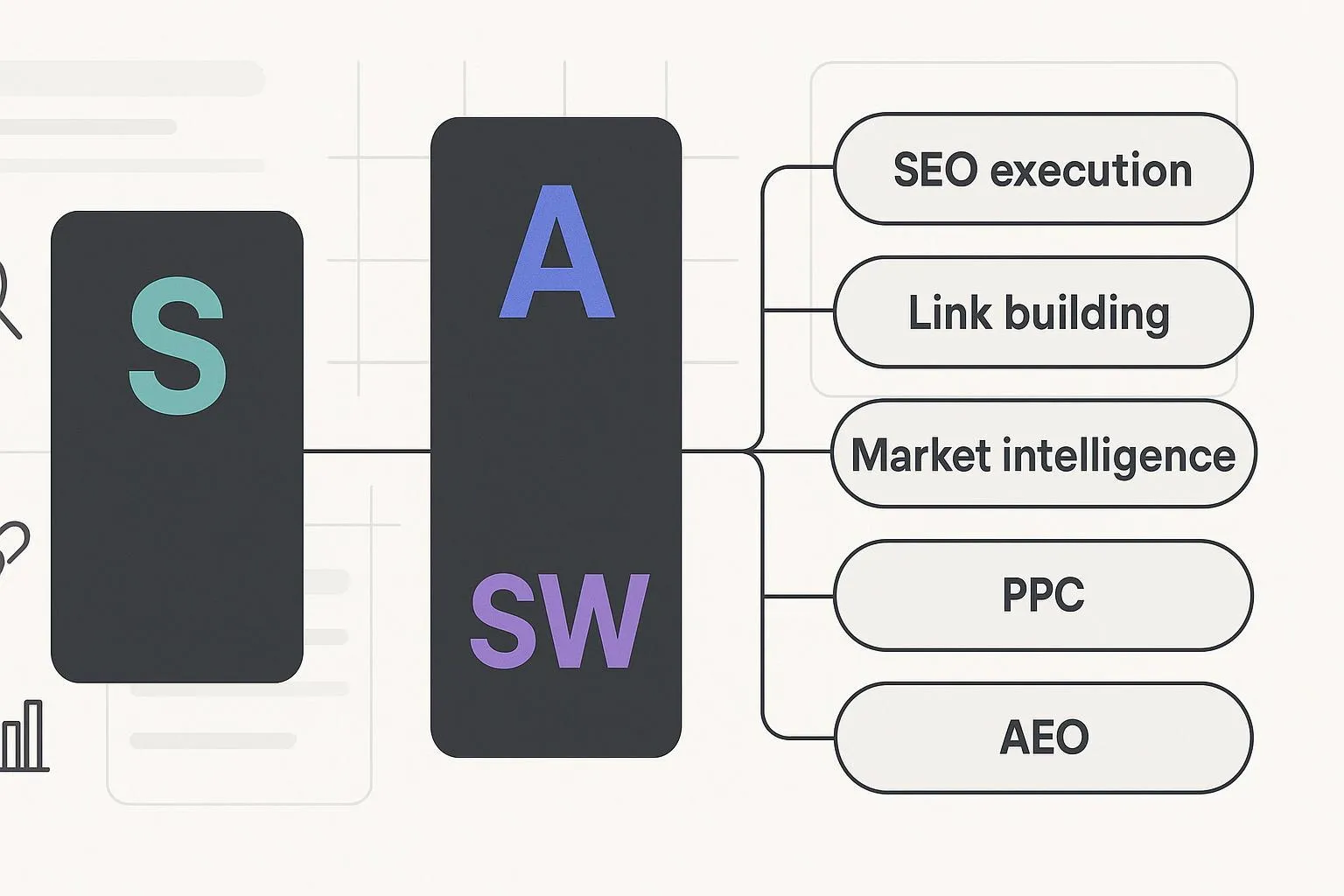
If you’re choosing between SEMrush, Ahrefs, and Similarweb in 2025, the fastest way to avoid buyer’s remorse is to match the tool to your job-to-be-done. SEMrush and Ahrefs are primarily SEO execution suites (keywords, audits, links, rank tracking), while Similarweb is a market-level digital intelligence platform for traffic benchmarking and share-of-voice across channels. Below, we compare them with recent updates, data coverage, pricing snapshots, and scenario-based guidance.
Quick summary
- SEMrush: Broad SEO + PPC toolkit with large keyword database, strong technical audit and position tracking, plus content and advertising modules.
- Ahrefs: Deep backlink and competitor research, robust Keywords/Site/Content Explorer, and 2025 upgrades like Rank Tracker 2.0 and Brand Radar AI.
- Similarweb: Market intelligence across websites and apps with AI-led insights (Web Intelligence 4.0), ideal for traffic/source benchmarking and executive strategy.
At-a-glance comparison (as of Nov 2025)
| Platform | Core purpose | Standout strengths | Key limitations | Typical pricing (verify at checkout) | Best for |
|---|---|---|---|---|---|
| SEMrush | SEO + broader digital marketing suite | Large keyword DB; solid Site Audit and Position Tracking; PPC/PLA research; content toolkit | Add-ons can raise total cost; backlink freshness not always equal to Ahrefs | Pro ~$139.95/mo; Guru ~$249.95/mo; Business ~$499.95/mo | SMBs/agencies needing one toolkit for SEO + PPC + content |
| Ahrefs | SEO platform focused on links, research, and tracking | Market-leading live backlink index; powerful Site/Keywords Explorer; Rank Tracker 2.0; Brand Radar AI | Higher-tier limits for history/credits; Starter/Lite caps; PPC coverage minimal | Starter $29/mo; Lite $129/mo; Standard $249/mo; Advanced $449/mo; Enterprise varies | Link-building, competitor backlink analysis, advanced keyword research |
| Similarweb | Digital market intelligence | Traffic share benchmarking across geos/channels; AI Agents; Web Intelligence 4.0 | Estimates (not exact) and less granular for technical SEO; premium pricing | Starter ~$199/mo; Team ~from $14k/yr; Business ~from $35k/yr; Enterprise custom | Market share analysis, competitive benchmarking, executive planning |
Pricing notes: Use these as directional snapshots; confirm current rates and caps on official pages before purchasing.
How their data works (and why it matters)
- SEMrush: Combines massive keyword and backlink datasets with site crawling and clickstream-based market research. 2025 roundups cite a keyword database in the 25–27B range and multi-trillion backlink counts; treat the exact figures as estimates and check coverage in your geography and niche. See methodology and limits in the SEMrush knowledge base.
- Ahrefs: Operates one of the largest web crawlers and a live backlink index updated frequently (minutes-level cadence). While Ahrefs doesn’t emphasize headline keyword counts, its Metrics like Parent Topic and Traffic Potential help prioritize keywords beyond raw volume.
- Similarweb: Uses a multisource estimation methodology (panels, partnerships, public data, and direct measurement) to model traffic and sources across sites and apps. It’s excellent for relative benchmarking and trend analysis but not a substitute for exact analytics on low-traffic websites.
Evidence anchors:
- SEMrush subscriptions, limits, and toolkits are outlined in the SEMrush knowledge base; pricing snapshots are summarized in the Backlinko pricing overview (2025).
- Ahrefs details its link index and tracking updates in product blogs and help docs, including Rank Tracker 2.0 (2025) and Starter plan specifics.
- Similarweb explains its data version and benchmarking approach in its support docs and 2025 product announcements.
Deep-dive capsules (parity format)
SEMrush
Overview: All-in-one SEO and digital marketing suite covering keyword research (Keyword Magic Tool), technical Site Audit (including Core Web Vitals/Page Experience checks), position tracking, backlink analytics, content toolkit, and advertising research.
Strengths:
- Broad toolkit spanning SEO, PPC, and content workflows.
- Large keyword coverage and practical research UX.
- Solid technical audit and rank tracking with location/device granularity.
Limitations:
- Total cost can rise with add-ons (e.g., premium toolkits).
- Backlink freshness and depth may trail Ahrefs for advanced link-building.
Who it’s for: SMBs, in-house teams, and agencies wanting one platform for planning, executing, and reporting SEO + PPC.
Pricing (as of Nov 2025): Pro ~$139.95/mo; Guru ~$249.95/mo; Business ~$499.95/mo. Confirm plan limits and current pricing on the SEMrush site.
Evidence:
- See the SEMrush knowledge base on subscriptions and limits in the SEO Toolkit Pricing & Limits (Semrush KB, 2025) and pricing snapshots in Backlinko’s 2025 Semrush pricing overview.
Ahrefs
Overview: Enterprise-grade SEO platform known for a market-leading live backlink index, deep competitor research via Site Explorer, and nuanced keyword analysis with Keywords Explorer. 2025 brought Rank Tracker 2.0 and Brand Radar AI.
Strengths:
- Exceptional backlink coverage and freshness.
- Powerful competitive research and keyword prioritization metrics (Traffic Potential, Parent Topic).
- Rank Tracker 2.0 improvements for accuracy and local visibility.
Limitations:
- PPC data minimal; relies on integrations or other tools for paid insights.
- Lower tiers can feel constrained for heavy workflows (credits/history/exports).
Who it’s for: Agencies and SEOs focused on link-building, competitor intelligence, and advanced keyword research.
Pricing (as of Nov 2025): Starter $29/mo; Lite $129/mo; Standard $249/mo; Advanced $449/mo; Enterprise varies. Verify current limits on the Ahrefs pricing page.
Evidence:
- Ahrefs outlines its link index comparison and tracking updates in “Rank Tracker 2.0” (Ahrefs blog, 2025) and discusses index methodology in “Link index comparison” (Ahrefs blog, 2025). Starter plan details are in Ahrefs Help (updated 2025).
Similarweb
Overview: Digital intelligence platform centered on traffic estimation, source breakdowns, audience insights, and competitive benchmarking across websites and apps. In 2025, Web Intelligence 4.0 and AI Agents introduced AI-led brand visibility and predictive insights.
Strengths:
- Market share and traffic benchmarking across geographies and channels.
- AI features that surface competitive trends and opportunities.
- Useful for executive reporting and category strategy.
Limitations:
- Modeled estimates can be less accurate for low-traffic domains.
- Less suited for technical SEO tasks (audits, on-page optimization).
- Pricing typically premium for full-featured access.
Who it’s for: Growth/strategy leaders and teams benchmarking competitors, channels, and geographies; analysts building market reports.
Pricing (as of Nov 2025): Starter ~$199/mo; Team from ~$14k/yr; Business from ~$35k/yr; Enterprise custom. Contact Similarweb for exact quotes.
Evidence:
- See the platform update and methodology details in “Web Intelligence 4.0” (Similarweb announcement, Oct 2025) and the Similarweb Developer Portal for API scope.
Scenario-based guidance
Keyword-heavy content planning
- Choose SEMrush for breadth and UX (Keyword Magic Tool, topic clustering, on-page ideas). For fundamentals, review a primer like Comprehensive guide to AI-generated content (QuickCreator, 2024) to understand how AI workflows intersect with SEO planning.
- Choose Ahrefs when you need depth and prioritization (Traffic Potential, Parent Topic) to avoid chasing low-value keywords.
For aligning queries with intent—especially when SERPs are thin or volatile—see intent alignment guidance (QuickCreator).
Technical site audits and on-page optimization
- SEMrush has a comprehensive Site Audit (CWV/Page Experience, internal link checks) and On-Page SEO Checker that maps tasks to pages.
- Ahrefs Site Audit is fast and flexible, with helpful issue grouping and prioritization.
- Pair either tool with practical content-quality checks. A useful companion list is Best AI SEO Chrome extensions (QuickCreator, 2025) for workflow enhancements.
Link-building and competitor backlink analysis
- Ahrefs is the standard for link prospecting, competitor gap analysis, and monitoring link growth and decay.
- SEMrush provides solid backlink analytics and outreach integrations; it’s adequate for many SMB use cases, but advanced link-builders often lean Ahrefs.
Rank tracking and reporting
- SEMrush Position Tracking handles multi-location/device tracking and annotations; good for client reporting.
- Ahrefs Rank Tracker 2.0 adds accuracy and local visibility options; strong for agencies.
- Similarweb doesn’t do granular rank tracking; it’s about market-level visibility, sources, and share.
PPC competitive insights and multi-channel management
- SEMrush includes Advertising Research (search ads, PLA insights) and social features, making it the better fit for marketers running integrated campaigns.
- Ahrefs focuses on organic; use other tools for paid.
- Similarweb can help benchmark paid traffic share and affiliate visibility but won’t replace ads platform analytics.
Market/traffic benchmarking across geographies
- Similarweb excels: category trends, traffic sources, audience demographics, and competitive comparisons across markets.
- SEMrush offers Trends and Traffic Analytics modules that are handy for directional checks, but Similarweb remains stronger for executive-level market readouts.
AI answer-engine optimization (AEO) / Generative search visibility
- Ahrefs introduced Brand Radar AI to monitor brand and competitor signals amid AI-driven SERP changes.
- SEMrush provides an AI Visibility Toolkit as a premium add-on to track AI-generated experiences.
- Similarweb’s Web Intelligence 4.0 adds AI Brand Visibility for market-level insights across AI experiences.
For broader context on generative search workflows, consider complementary reading like AI Blog Builder (QuickCreator) to see how teams operationalize content updates alongside SEO data.
Practical “how to choose” checklist
- Define your primary job-to-be-done: execution (SEO/PPC/content) vs market intelligence vs link-building.
- Confirm data coverage for your geographies and languages: check sample keywords and domains in a trial.
- Inspect plan limits and add-ons: projects, tracked keywords, crawl credits, historical windows, user seats.
- Test workflow fit: audits, rank tracking, exports, reporting, and team collaboration.
- Consider integrations and APIs: will you need connectors to GA/GSC, Looker Studio, or custom dashboards?
- Validate budget: total cost of ownership, including add-ons and extra seats.
Also consider (complementary workflow tool)
If your team needs faster content production and on-page optimization alongside any of the above tools, QuickCreator offers AI-powered blog creation, automatic SEO suggestions, block-based editing, and WordPress publishing. Disclosure: QuickCreator is our product.
Official resources and evidence (selected)
- SEMrush subscriptions and limits: SEO Toolkit Pricing & Limits (Semrush KB, 2025); pricing snapshots: Backlinko Semrush pricing (2025); content toolkit pricing: Semrush KB (2025).
- Ahrefs features and plans: Rank Tracker 2.0 announcement (2025); Link index comparison (2025); Starter plan details (updated 2025); pricing page: Ahrefs Pricing.
- Similarweb platform updates and developer docs: Web Intelligence 4.0 (Oct 2025); Developer Portal; data methodology: Support doc on 2024 Data Version (updated 2025).
In short: pick SEMrush if you want one platform for SEO + PPC + content; pick Ahrefs if backlink/competitor analysis and advanced keyword research drive your work; pick Similarweb if you need market-level intelligence and traffic benchmarking. Test each against your data and limits before committing.