Best LinkedIn Post Hooks for B2B SaaS (United States, 2025)

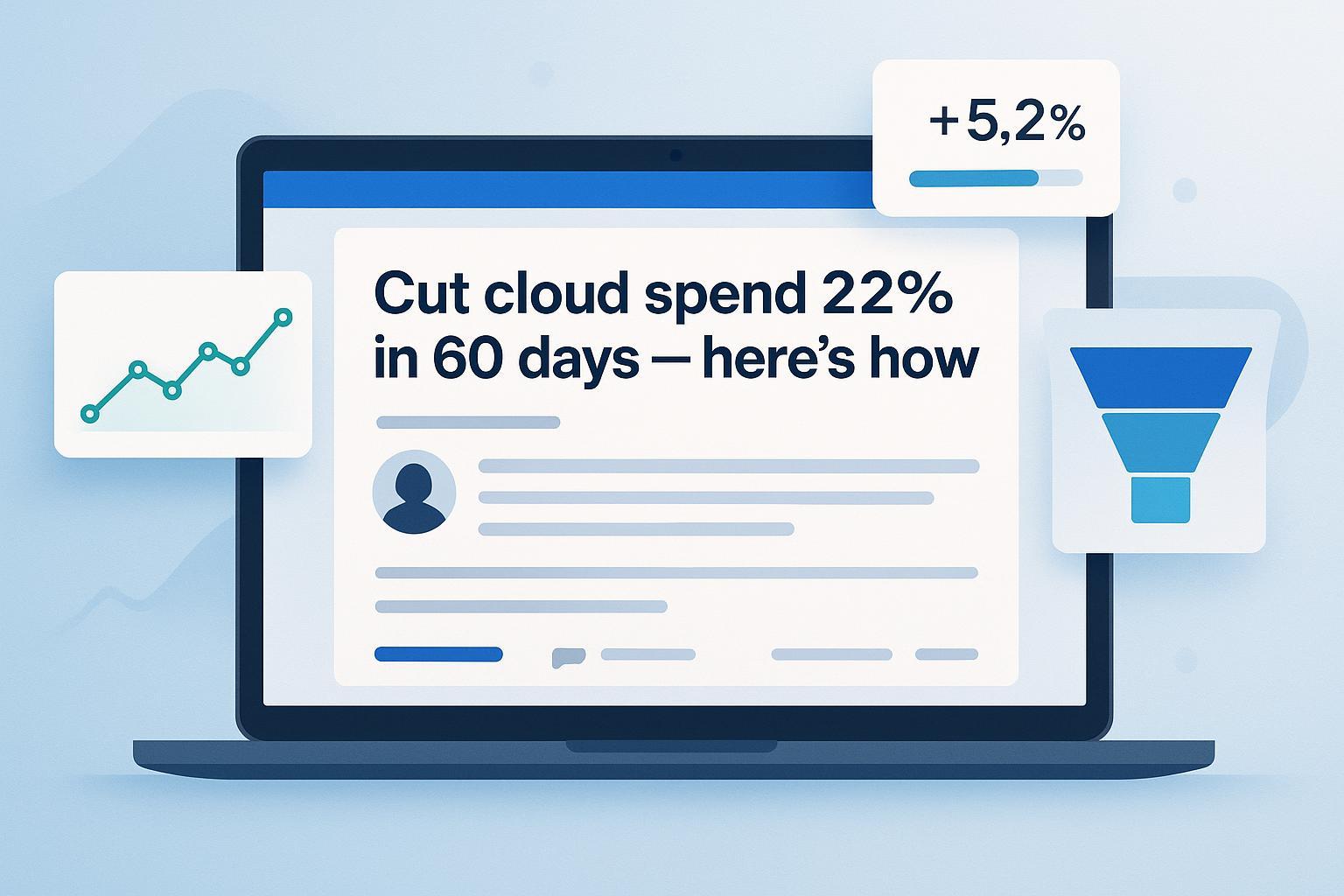
If your post doesn’t earn attention in the first line, nothing else matters. In 2025, LinkedIn distributes content based on signals like relevance, quality comments, and dwell time; practical hooks that keep qualified buyers reading are the lever you control. According to the 2025 explanation from Hootsuite, LinkedIn places increased emphasis on “time spent on post” and discussion quality, so your hook should immediately signal value to your exact buyer persona and invite substantive reactions (How the LinkedIn algorithm works in 2025 — Hootsuite). Sector context also matters: across 2024–mid 2025, engagement rates fluctuated near 4.5%–5.7% overall, with tech often below average, which means your opening line must work harder than generic advice suggests (2025 LinkedIn Benchmarks — Socialinsider).
A practical taxonomy of hooks for B2B SaaS
Below are twelve hook types that have consistently performed in US B2B SaaS contexts. Each includes a formula, where it applies, and copy-ready examples you can test as-is.
1) Problem → Agitate → Solve (PAS)
- When to use: Common industry pains your buyer already recognizes; you have a clear fix.
- Formula: Pain in 1 line → escalate consequence → promise a concrete remedy.
- Examples:
- “Your SOC 2 audit is dragging? Here’s the 3-step checklist that cut ours from 6 weeks to 12 days.”
- “Paying for seats no one uses? Trim your SaaS stack in 30 minutes—our exact script.”
2) Data shock (without hype)
- When to use: You’ve got credible numbers and an outcome buyers care about.
- Formula: Stat + timeframe → brief context → promise a breakdown.
- Examples:
- “28% cloud bill reduction in 60 days—2 FinOps changes did it. Here’s the math.”
- “Enterprise onboarding went from 21 days to 7. The checklist is yours.”
3) Contrarian POV (challenge a norm with evidence)
- When to use: Your audience is jaded by me-too advice; you have proof or strong reasoning.
- Formula: “Stop/Skip/Don’t X” → buyer-centric rationale → preview of your alternative.
- Examples:
- “Stop gating low-value PDFs. Ungated carousels drive better buyer conversations—our playbook inside.”
- “Don’t lead with features. Buyers remember outcomes; here’s a 3-line outcome-first opener.”
4) Decision‑maker direct (persona-first)
- When to use: You’re speaking to one role with a clear KPI.
- Formula: Role call‑out → KPI pain → timeframe-bound fix.
- Examples:
- “CFOs: if your cloud bill jumped last quarter, these two policy changes reverse it in 30 days.”
- “CTOs: migrating off legacy SSO without downtime—what worked for us.”
5) Story/lesson learned (human + operational)
- When to use: You have a real incident with a teachable moment.
- Formula: Short scene → pivotal decision → takeaway.
- Examples:
- “We shipped a pricing change that tanked MRR. Here’s the post‑mortem—and how we fixed the rollout.”
- “A 2am outage taught our team a better escalation path. The first 10 minutes, step‑by‑step.”
6) Curiosity question (benefit-forward)
- When to use: You can pose a tradeoff or decision that matters to buyers.
- Formula: “Would you…” / “Which would you…” → concrete tradeoff → promise resolution.
- Examples:
- “Would you trade 2% churn for +18% NRR? When that math works (and when it backfires).”
- “Which onboarding step causes most drop‑off? Our data says it’s not the one you think.”
7) Benchmark/mini‑case (credible specifics)
- When to use: You’ve run a comparative test or have process benchmarks.
- Formula: “We tested X vs Y…” → key outcome → learnings.
- Examples:
- “We tested 12 hooks across text, video, and carousels. Only one pattern beat baseline consistently—structure inside.”
- “3 vendors, 90‑day bake‑off: here’s the evaluation scorecard template we now use.”
8) Checklist/cheat sheet (utility first)
- When to use: Your audience wants a tool they can apply immediately.
- Formula: Promise the asset → specify scope → preview steps.
- Examples:
- “SOC 2 prep: the 17‑point checklist we actually use—steal it.”
- “SaaS cost review in 30 minutes: role‑by‑role questions and actions.”
9) Time‑sensitive/event hooks
- When to use: You’re aligning with cycles (budgeting, deployment) or major events.
- Formula: Event/time window → desired action → value proposition.
- Examples:
- “Heading to Dreamforce? Steal our 3 meet‑me lines that booked 27 meetings last year.”
- “Q4 budgeting: the 4‑line opener that actually gets your platform onto 2026 plans.”
10) Compliance/seasonal (risk reduction)
- When to use: Security, legal, or audit stakes are top of mind.
- Formula: Risk → timeframe → reduction plan.
- Examples:
- “SOC 2 Type II in 12 weeks: our weekly milestones (carousel).”
- “AI policies due by EOY? A lightweight template your legal team won’t hate.”
11) Launch/announcement (value, not vanity)
- When to use: You’re shipping something buyers value.
- Formula: New capability → outcome → how to realize it.
- Examples:
- “We shipped usage‑based discounts—here’s how customers are cutting bills without surprises.”
- “New SSO integration: 9‑minute setup video and the rollout plan we recommend.”
12) Human/values (earn trust without grandstanding)
- When to use: You want to humanize the brand with genuine service moments.
- Formula: Human moment → operational insight → lesson.
- Examples:
- “A customer success rep stayed on until the last data row reconciled. The habit that made it possible.”
- “The one behavior our support team practices daily to prevent escalations.”
Tip: Measure replies from your target persona, save rate, and comment length distribution—not just likes. Practitioners emphasize that reply quality and buyer presence in comments are better leading indicators than vanity totals (Top LinkedIn Hooks (+ Post Templates) — Letterdrop).
Format-specific opening tactics
Different formats change how hooks work. Optimize your first seconds or first slide.
Text posts
- Keep the first 1–2 lines under ~140 characters. Lead with the benefit or risk, not your company intro.
- Use whitespace: 1–2 line paragraphs, scannable bullets, and a plain‑English CTA.
- End with a micro‑prompt: “What would you cut first?” or “What did we miss for CFOs?” Invite expertise, not agreement.
Document/carousel posts (PDF)
- Your first slide is the hook. Use a 45–65 character headline plus a concise subhead.
- 5–8 slides max; each slide carries one step or insight. Final slide: CTA (comment with context, ask for the checklist, or DM for the template).
- Confirm specs and ad format guidance so your creative doesn’t get blocked or degraded; LinkedIn’s official page details acceptable document ad formats and recommendations (Document Ads — LinkedIn Marketing Solutions).
Video posts
- Deliver the promise in the first 6–10 seconds; show face‑to‑camera for trust, and overlay benefit‑forward text.
- Keep feed videos tight (often 15–60 seconds for snackable insights); ensure captions.
- For specs and creative considerations, start from LinkedIn’s official video guidelines, then layer proven creative best practices (Video Ads — LinkedIn Marketing Solutions; LinkedIn Video — The Complete Guide — Descript; LinkedIn Video Best Practices — Sprout Social).
Persona targeting cheat sheet
Hooks work best when they speak a decision‑maker’s language. Tailor your opening line to the KPI they guard.
-
CFO
- Care: cost certainty, ROI, risk exposure.
- Do: “CFOs: lock cloud costs before Q4. Two policy changes shaved 28% without throttling growth.”
- Don’t: Vague “save money” claims without a mechanism.
-
CTO / VP Engineering
- Care: reliability, time‑to‑value, integration complexity.
- Do: “CTOs: zero‑downtime SSO migration—what finally worked.”
- Don’t: Buzzwords; lead with the operational outcome.
-
Head of Ops / RevOps
- Care: process speed, data accuracy, adoption.
- Do: “RevOps: 21→7‑day enterprise onboarding—the checklist we now use.”
- Don’t: Feature lists; anchor on the operational gain.
-
Security / Compliance
- Care: audits, risk controls, vendor posture.
- Do: “Security leaders: SOC 2 Type II in 12 weeks—our weekly milestones.”
- Don’t: Over‑promise timelines without a plan.
-
Procurement / IT Sourcing
- Care: total cost of ownership, vendor reliability, compliance.
- Do: “Procurement: the 9 questions that cut SaaS renewal risk before EOY.”
- Don’t: Salesy intros; show evaluation utility first.
A/B testing and iteration workflow (copy‑ready)
The goal is to move from “nice post” to measurable pipeline impact without guessing.
-
Hypothesize hooks
- Define 2–3 hook variants per idea (e.g., PAS vs data shock vs contrarian).
- Tag each to a persona (CFO vs CTO) and outcome metric (comments, saves, demo form opens).
-
Split formats deliberately
- Test the same idea as text vs carousel over 2–3 weeks to isolate format effects.
- Keep posting windows consistent to reduce timing noise.
-
Prime early engagement
- Ask your team for insight‑rich comments (≥15 words) within 30–60 minutes of posting.
- Reply to qualified buyers quickly and add context; quality comments boost distribution.
-
Track the right metrics
- Impressions, engagement rate (reactions + comments + shares ÷ impressions), save rate, comment length distribution, link CTR (when used), demo form opens, meeting requests.
- Maintain a weekly review and a hook library tagged by persona, pain, and format.
-
Iterate ruthlessly
- Double‑down on the top 20% of hooks.
- Recycle the winning angle with fresh examples or a different format; turn high‑performers into carousels or short videos.
For overall post and cadence guidance, marketers consistently recommend aligning creative and scheduling to maximize authenticity and conversation quality rather than raw frequency (LinkedIn Best Practices for Marketing Professionals — Sprout Social, 2025).
Seasonal and event‑driven hooks (US, 2025)
Align hooks with buyer attention cycles and major events.
-
Q4 budgeting (Oct–Dec)
- Hooks: ROI mini‑cases, cost certainty, risk reduction.
- Example opener: “Q4 budgeting: if cloud overruns worry you, 2 policy changes stabilize spend in 30 days.”
-
Q1 deployment (Jan–Mar)
- Hooks: speed‑to‑value, integration ease, early momentum.
- Example opener: “New year rollout: our 7‑day enterprise onboarding plan (carousel).”
-
Pre‑event (4–8 weeks out) and at event
- SaaStr Annual + AI Summit (May 13–15, 2025, San Mateo County): use meet‑me hooks, session previews, and co‑marketing invites (SaaStr Annual 2025 — official site).
- Dreamforce (Oct 14–16, 2025, SF): live takeaways, micro‑stories, post‑event trend carousels (Dreamforce 2025 FAQ — Salesforce).
- Example openers:
- “Heading to SaaStr? ‘Meet me if…’ 3 lines that book real meetings.”
- “We captured 5 Dreamforce lessons we’re acting on next quarter—carousel inside.”
Pitfalls and boundaries (what to avoid)
-
- “Like if you agree” style prompts are low‑quality signals and risk suppression. Invite expertise instead.
-
Wall‑of‑text openings
- Dense paragraphs reduce dwell time. Use whitespace and scannable structure.
-
Outbound links in the post body
- External links can reduce reach. If needed, place the link in the first comment and keep the post self‑contained.
-
Persona genericness
- “We help teams do X” rarely works. Speak to one role, one KPI, one timeframe.
-
Over‑clever curiosity
- Hooks that hide the benefit frustrate buyers. Make the value explicit in line one.
What didn’t work for us (and why)
-
Cute wordplay with no concrete benefit
- It attracted likes but few qualified comments; buyers want substance.
-
Feature‑first openings
- Without an outcome or timeframe, decision‑makers skimmed and moved on.
-
Vague ROI promises
- Claims without a mechanism drew skepticism and weaker discussion quality.
Implementation checklist
Copy, paste, and run this weekly.
- Define 3 hook variants for your next idea (PAS, data shock, contrarian). Tag persona and KPI.
- Choose two formats (text vs carousel). Publish at consistent times.
- Prep 3 team comments (≥15 words) with insights and questions.
- Track impressions, engagement rate, save rate, comment length, CTR, demo opens.
- Archive winners in a hook library; recycle angles in new formats.
- Align with seasonal cycles (Q4 budgeting, Q1 rollout) and event calendars (SaaStr, Dreamforce).
- Maintain a bias for outcome‑first, role‑specific opening lines.
Credibility signals you can borrow in your posts
Executives use thought leadership to vet vendors: the 2024 joint study from Edelman and LinkedIn found that senior buyers act on content that delivers genuine, practical insight and vendor evaluation utility (2024 B2B Thought Leadership Report — Edelman + LinkedIn). Use hooks that promise real evaluation value—checklists, scorecards, and mini‑cases—rather than claims.
Finally, keep your format decisions grounded in official guidance and reputable creative advice so distribution isn’t limited by technical issues. Confirm specs on LinkedIn’s own pages for documents and video, and follow trusted creative best practices to optimize attention and retention (Document Ads — LinkedIn Marketing Solutions; Video Ads — LinkedIn Marketing Solutions; LinkedIn Video — The Complete Guide — Descript).
By applying these hook structures, aligning them to buyer psychology, and testing rigorously, you’ll turn first lines into conversations—and conversations into pipeline.
