Building a LinkedIn PPC Plan in the US with a $15,000 Monthly Budget (2025): How to Forecast Clicks, CPC & CPA

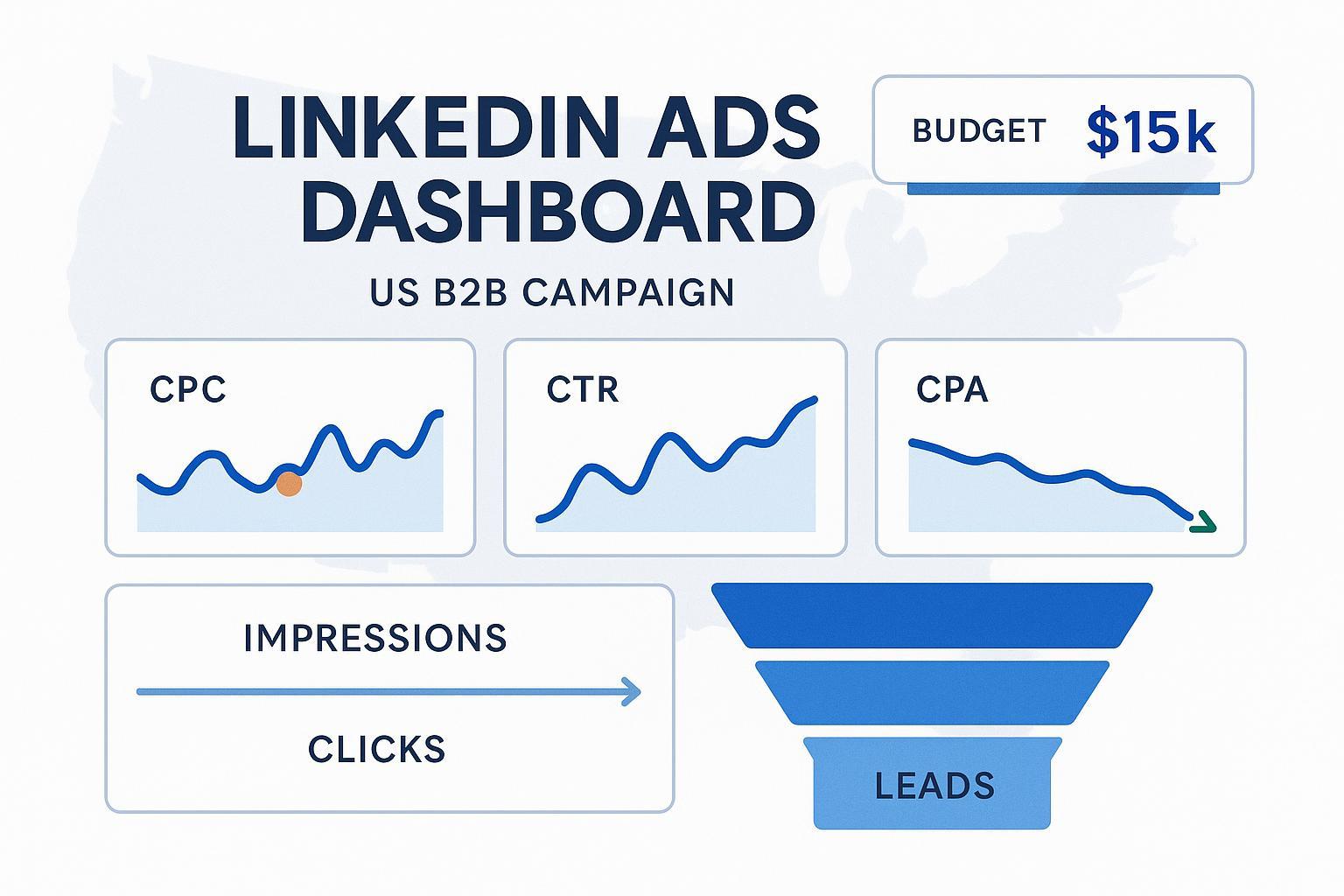
If you manage B2B demand gen in the US and need a pragmatic, forecast-driven plan for a $15,000 monthly LinkedIn Ads budget, this playbook is built from what consistently works in 2025 accounts. I’ll share the exact benchmark ranges I plan against, show the math for impressions, clicks, and leads under multiple scenarios, and lay out a campaign structure, bidding, pacing, and optimization cadence you can run tomorrow.
I’ll assume a US B2B/SaaS context, Sponsored Content as the core format, and tracking set up for both landing-page and native Lead Gen Form paths. Where I quote metrics, I link to the 2025 source so you can sanity-check against your own data.
Benchmarks to Plan By (US, 2025)
Here are the planning anchors I use this year, with ranges that reflect most US B2B/SaaS programs:
- CPC: $6–$9 planning band (common observations $5–$10). A large 2025 dataset in tech/SaaS puts many campaigns in the $5–$7 cluster, with CPLs commonly >$100; see the NAV43 analysis of 213M impressions in their NAV43 2025 SaaS/Tech benchmarks (213M impressions).
- CTR (Sponsored Content): 0.44%–0.65% typical, top quartile up to ~1%+. A consolidated 2025 view is summarized in Powered by Search’s 2025 LinkedIn stats & benchmarks.
- CPL/CPA: $120–$220 practical planning band for B2B/SaaS. NAV43 notes CPLs above $100 are common; PBS’s 2025 rollup echoes this range in US B2B contexts.
- CPM: $35–$50 planning band, aligning with 2025 B2B cost roundups like TripleDart’s 2025 LinkedIn ad costs.
- Lead Gen Form conversion rates: often 10–15% in 2025 aggregations (offer-dependent), as cited in the PBS 2025 benchmarks above.
Reality check:
- Senior decision-maker audiences and tight ABM lists tend to drive higher CPC than broad ICP segments; US-specific insights note $7–$10 CPC on senior titles as common (see Blue Atlas’s US context in Blue Atlas on US LinkedIn CPC averages (2025)).
- Expect variance by vertical, offer strength, and creative quality. Plan a mid-range scenario and a downside scenario so you can course-correct quickly.
Forecasting Clicks, CPC, and CPA from $15,000
Below is the math I actually use for planning. We’ll run three performance scenarios (Low/Mid/High) and show both a landing-page path and a Lead Gen Form path.
Formulas
- Impressions = Spend / (CPM / 1000)
- Clicks = Impressions × CTR
- Leads = Clicks × CVR (landing-page CVR 2–5%; Lead Gen Form CVR 10–15%)
- CPL = Spend / Leads
- CPC (sanity check) = Spend / Clicks
Scenario Assumptions
- Spend: $15,000
- CPM: $40 mid (with a planning band of $35–$50)
- CTR: 0.40% (Low) | 0.50% (Mid) | 0.65% (High)
- CPC (implied by CPM and CTR; cross-check with CPC bands):
- CPC ≈ CPM / (1000 × CTR). At CPM $40 and CTR 0.50%, CPC ≈ $40 / 5 = $8.
- CVR: Landing page 2% (Low), 3.5% (Mid), 5% (High). Lead Gen Forms 10%, 12%, 15%.
Step-by-step math (using CPM $40)
- Impressions (all scenarios): $15,000 / ($40 / 1000) = 375,000 impressions
- Clicks:
- Low CTR 0.40%: 375,000 × 0.004 = 1,500 clicks
- Mid CTR 0.50%: 375,000 × 0.005 = 1,875 clicks
- High CTR 0.65%: 375,000 × 0.0065 ≈ 2,438 clicks
- Sanity-check CPCs (Spend / Clicks):
- Low: $15,000 / 1,500 = $10.00 CPC
- Mid: $15,000 / 1,875 ≈ $8.00 CPC
- High: $15,000 / 2,438 ≈ $6.15 CPC These align with the $6–$9 planning band and source ranges above.
Leads and CPL: Landing Page vs Lead Gen Forms
-
Landing-Page Path:
- Low (2% CVR): 1,500 × 0.02 = 30 leads → CPL = $15,000 / 30 = $500
- Mid (3.5% CVR): 1,875 × 0.035 ≈ 66 leads → CPL ≈ $227
- High (5% CVR): 2,438 × 0.05 ≈ 122 leads → CPL ≈ $123
-
Lead Gen Form Path:
- Low (10% CVR): 1,500 × 0.10 = 150 leads → CPL = $100
- Mid (12% CVR): 1,875 × 0.12 = 225 leads → CPL ≈ $67
- High (15% CVR): 2,438 × 0.15 ≈ 366 leads → CPL ≈ $41
Notes on interpretation
- If you’re running premium BOF offers (e.g., demo requests), expect the landing-page CVR to be lower but the lead-to-SQL quality to be higher than Lead Gen Forms. For mid-funnel content, LGFs can deliver volume and test creative resonance quickly, then you filter via qualification.
- If your historical CPC routinely runs above $9 (tight ABM, C-level only), use CPM $50 and re-run the math; your Mid scenario becomes closer to the Low scenario here.
Budget Allocation Blueprint for $15,000/month
A starting split that consistently balances volume and efficiency in US B2B/SaaS:
- Top of Funnel (TOF) Prospecting — $6,000
- Audiences: Broad ICP (industry, company size, function, seniority), lookalikes from high-quality customers.
- Formats: Single Image, Video, Thought Leader Ads, Document Ads for educational assets.
- Middle of Funnel (MOF) Consideration/Retargeting — $4,000
- Audiences: Site visitors (last 90 days), 50%+ video viewers, Lead Gen Form openers, asset downloaders.
- Formats: Carousel for feature storytelling, Document Ads for case studies, Single Image with proof points.
- Bottom of Funnel (BOF) Conversion — $5,000
- Audiences: Pricing/demo page visitors, high-intent segments, Tier 1 matched accounts.
- Formats: Lead Gen Forms (short), Single Image with clear CTA (demo/consultation), occasionally Conversation Ads.
Guardrails and pacing
- Daily pacing: Use daily budgets initially, then consider lifetime budgets if you see uneven delivery day-to-day.
- Learning windows: Make changes weekly; avoid thrashing more than twice per week so the algorithm can stabilize.
- Frequency discipline: For awareness-only campaigns, LinkedIn added frequency capping controls in 2025—set 5–10 impressions/member/7 days to minimize fatigue; feature announcement detailed in PPC Land on LinkedIn frequency capping (2025).
Campaign Setup: A Practitioner’s Checklist
Objective selection
- TOF: Brand Awareness or Website Visits (if CTR testing is the goal).
- MOF: Website Conversions or Engagement (depending on asset and tracking confidence).
- BOF: Leads (Lead Gen Forms) or Website Conversions (demo/contact), depending on your sales process.
Audience design (ABM + ICP)
- Start with ICP: industry, headcount, function, seniority, geography.
- Add Matched Audiences: upload Tiered account lists (T1/T2/T3) and high-intent contacts; refresh monthly from your CRM/CDP.
- Exclusions: customers, competitors, employees, students/junior roles, recent converters, and over-frequented users (to manage fatigue).
- Retargeting pools: site visitors (last 90–180 days), 50%+ video viewers, Lead Form openers/completers.
Creative and offer mapping
- TOF: Insights-first (industry report key findings, problem framing), 15–30s videos, carousel storytelling, documents with skimmable value.
- MOF: Proof and depth (case studies, ROI snippets, product walk-throughs), strong visuals with 1–2 benefit bullets.
- BOF: Conversion clarity—short copy, singular CTA, social proof snippet, and minimal distraction. Lead Gen Forms with 3–5 fields max.
- Ads per ad set: 3–5 variants to balance learning and distribution.
- Refresh every 2–4 weeks, or sooner if CTR drops 20% from baseline or frequency >8 with declining engagement.
- Keep a running concept backlog: hooks, formats, and angles to slot into the next refresh.
Bidding and Cost Control: What to Use, When
The platform’s bidding options have matured. Here’s how I stage them in 2025:
- Maximum Delivery (automated): Use to establish baselines and when you need scale fast. Once you see stable CPC/CPL, transition select campaigns to cost controls.
- Cost Cap: Once you know your viable CPL or CPC band, use cost caps to keep averages near target while preserving volume.
- Manual bidding: Reserve for niche ABM segments or controlled tests where you want strict CPC governance; it requires active adjustments.
For a refresher on how these options map to Campaign Manager settings and strategy, see the 2025 overview in Hootsuite’s LinkedIn Ads guide (2025). If you need canonical configuration details at the API level (for teams building automation), Microsoft’s LinkedIn Marketing API docs outline campaign and bid controls in the 2025 spec.
Weekly optimization rhythm
- If CPC drifts >15% above your plan for 5–7 days: tighten audience-message fit (new angles), test manual bid below suggestion, and rotate creatives.
- If CTR <0.45%: refresh headline/hook and try a new format (document/video); ensure creative mirrors the audience’s pain point, not just features.
- If Cost Cap throttles delivery: relax the cap slightly or temporarily switch to Maximum Delivery to rebuild momentum.
Tracking & Attribution That Actually Works in 2025
Server-side tracking is non-negotiable if you want reliable CPA and optimization signals.
- Implement the LinkedIn Conversions API (CAPI) to send conversion events server-to-server (online and offline). Official implementation details, scopes, and payload specs are documented in Microsoft Learn: LinkedIn Conversions API (2025 spec).
- Map events: Lead, Qualified Lead, Demo Booked, Opportunity Created—tie these to your funnel and associate them to campaigns.
- Use offline conversions for pipeline events that happen after the click (e.g., meetings held, SQLs, opportunities). This closes the loop for CPL vs. CP-SQL truth and lets the algorithm learn from real outcomes.
- Validation: After deployment, confirm event receipt in Campaign Manager within 24–72 hours; reconcile counts with your CRM weekly.
Why it matters
- In many accounts, CAPI and offline conversions materially improve what Campaign Manager “sees,” which stabilizes optimization and prevents the platform from favoring vanity events. Better signals lead to better delivery and, over a month or two, to lower effective CPA.
Optimization Playbooks for Common Problems
When CPC > $10 and CTR < 0.45% for a week
- Audience-message surgery: Split out a narrower role/seniority, rewrite the hook to lead with the job-to-be-done or risk avoided.
- Format pivot: Test Document Ads (summary of a report or checklist) or short video with a strong first 2 seconds.
- Bid control: Switch to manual bidding 10–15% below the suggested bid to find an efficient floor while testing new creative.
- Exclusions: Add competitors, students, and recent converters; cap frequency to avoid fatigue.
When CPL > $230 for two weeks
- Shift budget to top-performing segments (audiences × creative)
- Double-check tracking: verify CAPI event de-duplication and form integrations; broken tracking masks optimization signals.
- Offer calibration: For BOF, try a shorter Lead Gen Form and sharpen the CTA; for MOF, use higher-perceived value assets.
- Sales feedback loop: Review lead quality quickly with SDRs and exclude poor-fit titles or company sizes.
When delivery is throttled or erratic
- Budget pacing: Switch between daily and lifetime to stabilize; maintain at least 3–5 active ads per ad set.
- Learning resets: Bundle changes weekly rather than daily; avoid changing objective or optimization event mid-flight.
- Cost Cap easing: If hitting caps, relax slightly or run Maximum Delivery for 5–7 days to regain volume, then reintroduce control.
Scaling from $15k to $30k
- Expand Tier 2 account lists and lookalikes based on your best converters.
- Duplicate winning ad sets into adjacent geos or seniorities.
- Introduce complementary formats (Thought Leader Ads, webinars) while maintaining frequency discipline.
- Refresh creative concepts on a 2–3 week cadence to avoid rising CPC from fatigue.
A 30/60/90-Day Operating Plan
Days 1–30: Prove the baseline
- Stand up three-funnel structure with the $6k/$4k/$5k split.
- Run Maximum Delivery or light Cost Caps; launch 3–5 ads per ad set.
- Implement CAPI and at least one offline conversion (e.g., SQL). Validate within 72 hours.
- Report weekly: CPC, CTR, CPL, plus early quality proxy (MQL rate).
Days 31–60: Tighten cost control and creative
- Transition strongest ad sets to Cost Cap based on baseline CPL/CPC.
- Retire bottom quartile creatives; ship 2–3 new concepts per ad set.
- Normalize frequency with capping on awareness-only campaigns.
- Add negative audiences (customers, competitors) and refine title seniorities.
Days 61–90: Scale the winners
- Shift 10–25% of budget into winners (audience × creative × offer) and new lookalikes.
- Layer in BOF experiments (shorter Lead Gen Forms, demo incentives) and MOF proof assets.
- Expand matched account lists; keep weekly QA on lead quality with Sales.
- Publish a pipeline view: Leads → MQL → SQL → Opportunity → Revenue. Make the next quarter’s plan on real stage conversion, not guesses.
How to Judge Success (Beyond CPL)
- Stage-based conversion: CPL is meaningful only in context. Track Lead → SQL → Opportunity rates by segment to find which audiences and creatives actually drive pipeline.
- Time-to-MQL/SQL: If LGF volume is high but time-to-qualification is long, adjust the offer to lift intent.
- Frequency vs. CTR curve: If frequency rises while CTR falls, you’ve hit fatigue. Refresh creative or expand audiences.
- Contribution to revenue: Use offline conversions to attribute actual pipeline. Report spend-to-pipeline ratio alongside CPL.
Quick Reference: Source Ranges Used in This Plan
- CPC/CTR/CPL planning anchors built from 2025 datasets: NAV43 2025 SaaS/Tech benchmarks (213M impressions) and Powered by Search’s 2025 LinkedIn stats & benchmarks.
- CPM planning band cross-checked with TripleDart’s 2025 LinkedIn ad costs.
- Bidding strategy usage mapped via Hootsuite’s LinkedIn Ads guide (2025).
- Frequency capping update (2025): PPC Land on LinkedIn frequency capping (2025).
- US CPC nuance by seniority: Blue Atlas on US LinkedIn CPC averages (2025).
- For implementation teams, the canonical CAPI spec is here: Microsoft Learn: LinkedIn Conversions API (2025 spec).
Final Notes
- No single benchmark fits all. Use the three-scenario model, watch the first 14 days closely, and let CAPI-fed signals guide your budget shifts.
- If your audience is particularly niche or senior, plan toward the Low/Mid scenarios; if you have strong creative-market fit and LGF offers, the Mid/High scenarios are realistic.
- The fastest wins in 2025: cleaner offers, tighter titles/seniorities, creative refresh discipline, and server-side conversion signals.
