
B2B SaaS influencer marketing: a practical playbook for AI SaaS teams
A practical MOFU guide: creator selection scorecard, offers, ROI, attribution setup, and FTC disclosure checklist for B2B SaaS.
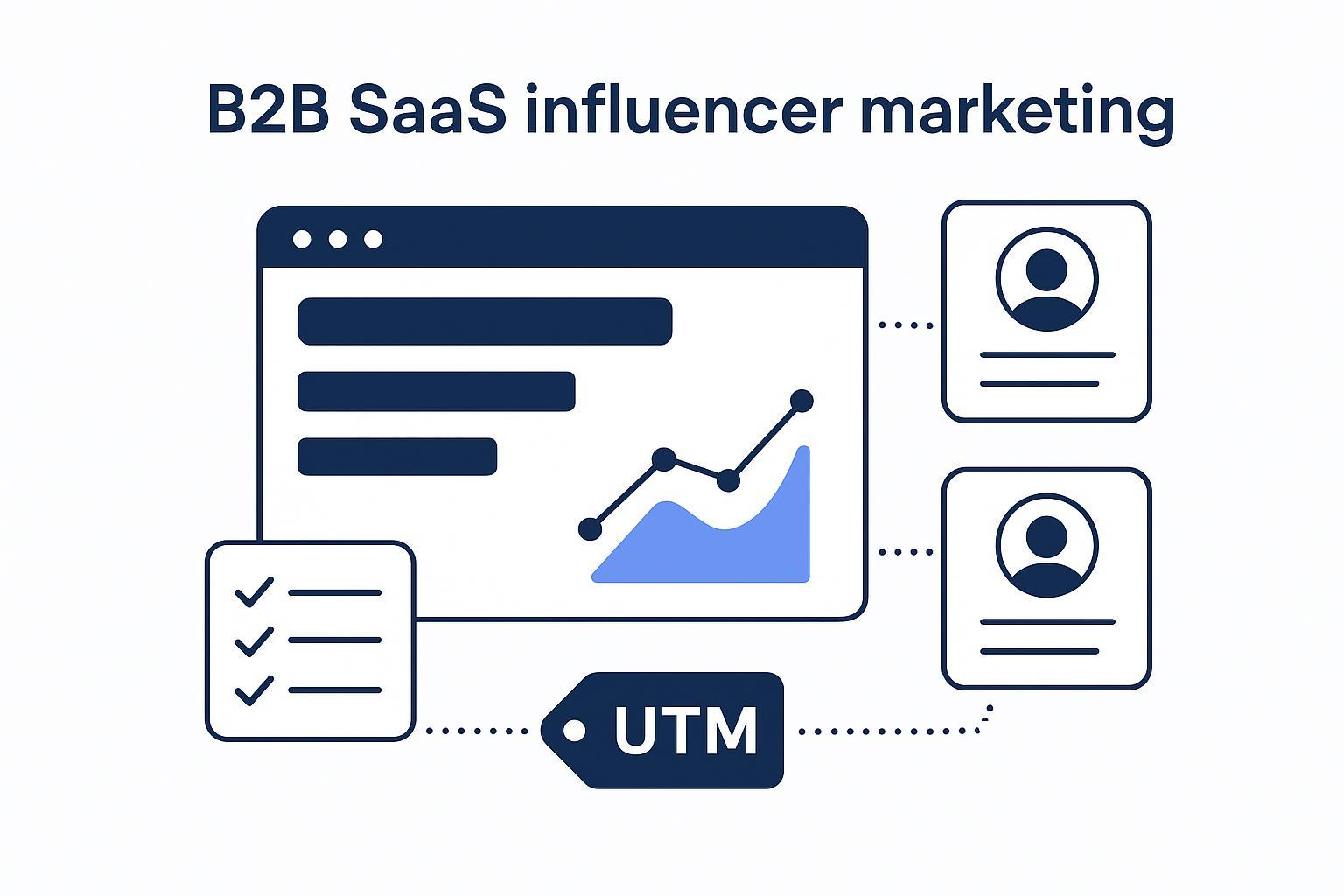
If you’ve tried “influencer marketing” in B2B SaaS and it felt like a black box, you’re not alone. The fix usually isn’t a new platform or a bigger creator. It’s treating the program like a pipeline system: clear selection criteria, a realistic offer model for long sales cycles, and an attribution setup that can survive scrutiny.
This guide is written for marketing leaders at small B2B SaaS teams who are already sold on the idea of third‑party voices — but want a repeatable way to run a creator program without wasting budget or hand-waving the ROI.
Start with the right program type for B2B SaaS influencer marketing
This isn’t about celebrity endorsements. In B2B SaaS influencer marketing, you’re usually buying trust and distribution inside a professional niche.
Most B2B SaaS programs work better when you stop thinking in terms of “influencers” and start thinking in terms of trusted practitioners:
Creators: publish consistent content to a niche audience (often LinkedIn, newsletters, podcasts, YouTube).
Operators: hands-on experts with credibility (revops, product marketing, demand gen, growth). They may have smaller audiences but higher buyer trust.
Educators: teach frameworks and tooling; strong for MOFU because buyers want evaluation criteria.
TechTarget’s overview of B2B influencer best practices emphasizes a full‑funnel approach — i.e., different content formats for different stages, not one generic “sponsored post” playbook (TechTarget’s overview of B2B influencer best practices).
For a consideration-stage audience, your job is to produce decision support:
help buyers form an opinion
reduce perceived risk
create internal alignment ammo (someone can forward the content to a CFO, a VP Eng, or a founder)
A creator program for B2B SaaS: the selection scorecard
Follower count is a weak signal in B2B. Build a scorecard your team can use in 10 minutes per candidate.
The 7 criteria that actually matter
ICP overlap
Do their followers look like your buyers (role, seniority, company type)?Trust density
Are comments thoughtful? Do people ask for advice? Or is it mostly drive-by engagement?Content-to-outcome fit
Does the creator’s format naturally support your goal (demo signups, webinar attendance, pipeline acceleration)?Evidence behavior
Do they make careful claims and cite sources, or do they rely on hype?Narrative discipline
Can they explain tradeoffs (not just “tool X is amazing”) — the hallmark of credibility in MOFU.Collaboration reliability
Do they ship on time? Do they have a repeatable production process?Commercial comfort
Do they already run partnerships in a way that doesn’t alienate their audience?
PartnerStack’s guide to recruiting right-fit B2B influencers puts audience overlap and authentic engagement at the center of selection (PartnerStack’s guide to recruiting right-fit B2B influencers). It’s also a good reminder that B2B programs need a realistic evaluation window; for many teams, ~3 months is a more honest trial period than 30 days.
Pro Tip: Ask for a screenshot of the creator’s audience analytics (roles, geos, seniority). In B2B, this single artifact often tells you more than their media kit.
Red flags (especially for small teams)
Sudden follower spikes with no corresponding engagement pattern change
Comments that read like bots (“Nice post!”, “Great share!” repeated)
“Everything is the best” tone (hurts your brand by association)
No consistent format (you’re buying chaos)
Influencer marketing ROI in B2B SaaS: flat fee, hybrid, affiliate
B2B SaaS has two constraints most creator programs ignore:
Attribution is delayed and multi-touch
The buying committee is real (a creator may influence a champion, but procurement still wins)
So “pay purely on last-click revenue” is often a bad deal for both sides.
Three models that work in MOFU
1) Flat fee per deliverable
Best when you’re testing fit and need predictable execution.
Why it works: removes attribution debates while you learn.
Failure mode: you optimize for content volume, not pipeline impact.
2) Hybrid: base fee + performance kicker
A base fee respects the creator’s work; a kicker aligns incentives.
Performance anchors that are fair in B2B: webinar signups, qualified demo requests, or engaged account visits (not just clicks).
Failure mode: you set a kicker tied to an outcome the creator can’t control (e.g., closed-won).
3) Affiliate / partner program (commission)
Works best when your product has short time-to-value and the creator is already aligned with the category.
Why it works: creators compound over time.
Failure mode: you underinvest in enablement (no landing pages, no messaging, no tracking) and then blame the creator.
A good default for small B2B SaaS teams: hybrid model for 1–2 creators, with a clear 90-day test window.
The influencer outreach email template you actually need
Here’s a starter influencer outreach email template you can copy. It’s short on purpose — B2B creators get flooded.
Subject: Quick question about a collab
Hi {{FirstName}} — I’ve been following your work on {{specific topic/post}}. We’re putting together a small creator series for {{audience}}.
Would you be open to a paid collaboration where you teach {{one specific framework}} (not a promo) and we handle the ops (brief, tracking links, disclosure language)?
If yes, I can send a 1‑page brief + proposed deliverables and timeline.
— {{YourName}}
Content formats that move buyers in consideration
Consideration-stage content isn’t about reach; it’s about reducing decision friction. That usually means:
Format 1: “How to evaluate X” frameworks
Ask the creator to teach:
selection criteria
tradeoffs
what to measure
where programs fail
This works because it’s credible even when your product isn’t mentioned.
Format 2: Workshop-style webinars with real artifacts
A webinar is useful in B2B when it produces something concrete:
a scorecard
a brief template
an implementation checklist
If the creator can’t produce an artifact, it’ll likely become a generic talk.
Format 3: Mini-case narratives without performance claims
You don’t need “we grew 10x” stories. You need believable narratives:
what the team tried
what they measured
what changed in their process
If you can’t substantiate outcomes, keep it about process rather than results.
Influencer marketing attribution: how to attribute influence without lying to yourself
Most B2B creator programs die in a spreadsheet because the tracking was bolted on after launch.
Treat measurement like product analytics: define events, define fields, define what “good” means.
The minimum viable attribution stack
UTM discipline (every creator, every asset)
Dedicated landing page per creator (or per campaign)
CRM fields that survive the handoff (campaign source, creator name, first touch vs. influenced)
Self-reported attribution (“How did you hear about us?”) to catch dark social
Time window rules aligned to your cycle (e.g., 90 days)
Here’s a simple system diagram you can hand to RevOps:
Creator content
     |
     |  (UTM links + landing page)
     v
  Website + form
     |
     |  (store creator_id + campaign_id)
     v
  CRM lead/contact
     |
     |  (MQL/SQL + pipeline stages)
     v
  Pipeline report
What to measure (MOFU-friendly)
Qualified conversions (demo requests that meet your ICP filters)
Pipeline influenced (opportunities where the creator touch happened in the journey)
Sales feedback (“prospects referenced this creator’s framework”) — messy but real
And what to stop over-weighting:
likes
raw impressions
click-through rate without conversion context
Compliance and disclosure: the FTC rules you need in your contract
If you’re running creator partnerships in the US, don’t treat disclosure as optional.
The FTC’s Endorsement Guides emphasize that material connections (payment, free products, commissions, employment relationships) must be disclosed clearly and conspicuously (see FTC’s Endorsement Guides Q&A (updated in 2023)). For the canonical text, see the Federal Register publication of the revised FTC endorsement guides (2023).
A practical disclosure checklist
Require disclosure up front, not buried after “more” or in hashtag soup.
Prefer plain language like “ad” / “sponsored” / “paid partnership”.
For video, require on-screen + spoken disclosure.
Put disclosure requirements in the contract, not just a friendly email.
Require creators to avoid claims you can’t substantiate.
⚠️ Warning: If your program relies on claims you can’t prove, disclosure won’t save you — it just makes the unsupported claim more visible.
Operating model: a lightweight workflow your team can actually run
Small teams don’t fail because they lack ideas. They fail because the program creates too many new “one-off” tasks.
Here’s a simple operating model:
Step 1: Build a one-page creator brief
Your brief should include:
goal (one sentence)
audience (one sentence)
the asset(s) to produce
the one message you want them to teach (not sell)
tracking requirements (UTMs + landing page)
compliance requirements (FTC disclosure)
Step 2: Run one approval gate (only where it matters)
Don’t micromanage tone. Do gate:
factual claims
disclosures
tracking links
brand safety topics
Step 3: Repurpose the best fragments
The highest ROI move isn’t more creators. It’s turning a single strong creator collaboration into:
a blog post summary
a short email
a few LinkedIn posts
a sales enablement snippet
This is where workflow orchestration matters. If your content system already has structured steps from research → draft → optimization → distribution (for example, a coordinated pipeline like QuickCreator), you can treat creator collaborations as just another “source input” into that pipeline rather than a separate project.
If you want a concrete reference for what an orchestrated content lifecycle can look like, see content workflow orchestration (research to distribution) and how QuickCreator works.
Next steps: the 30-minute checklist
Use this to go from “we should do creators” to “we can run a test responsibly.”
Pick 1 program goal (pipeline influenced, qualified demos, or webinar signups).
Define your creator scorecard (ICP overlap + trust density + format fit).
Shortlist 10 creators; interview 3.
Choose an offer model (hybrid is usually the safest start).
Set up UTMs + landing page + CRM fields before the first post goes live.
Add FTC disclosure requirements to the contract.
Commit to a 90-day learning window.
If you’re building a creator program for B2B SaaS right now, what’s your biggest unknown: selection, offer design, or attribution?