
Agentic marketing vs AI marketing: definitions and workflows
Clear definitions, workflow diagrams, and use cases to choose between AI marketing tools and agentic marketing systems for SMB teams.
If you’ve ever tried to “add AI to marketing,” you’ve probably hit the same wall: you can get a tool to generate something, but you still spend most of your time deciding what to do next, stitching steps together, and doing risk checks before anything goes live.
That gap—between a smart tool and an end-to-end system—is where “agentic marketing” is trying to land.
This guide compares agentic marketing vs AI marketing in practical terms: precise definitions, workflow diagrams, governance patterns, and real-world use cases for scaling SMB marketing teams.
Quick comparison: agentic marketing vs AI marketing
Dimension | AI marketing (tool-based) | Agentic marketing (agent-based) |
|---|---|---|
Primary unit of work | A task (e.g., generate copy, score leads) | A goal (e.g., increase SQLs, reduce churn) |
Who owns sequencing? | Humans design the workflow and choose the next step | Agents can plan and choose the next step within guardrails |
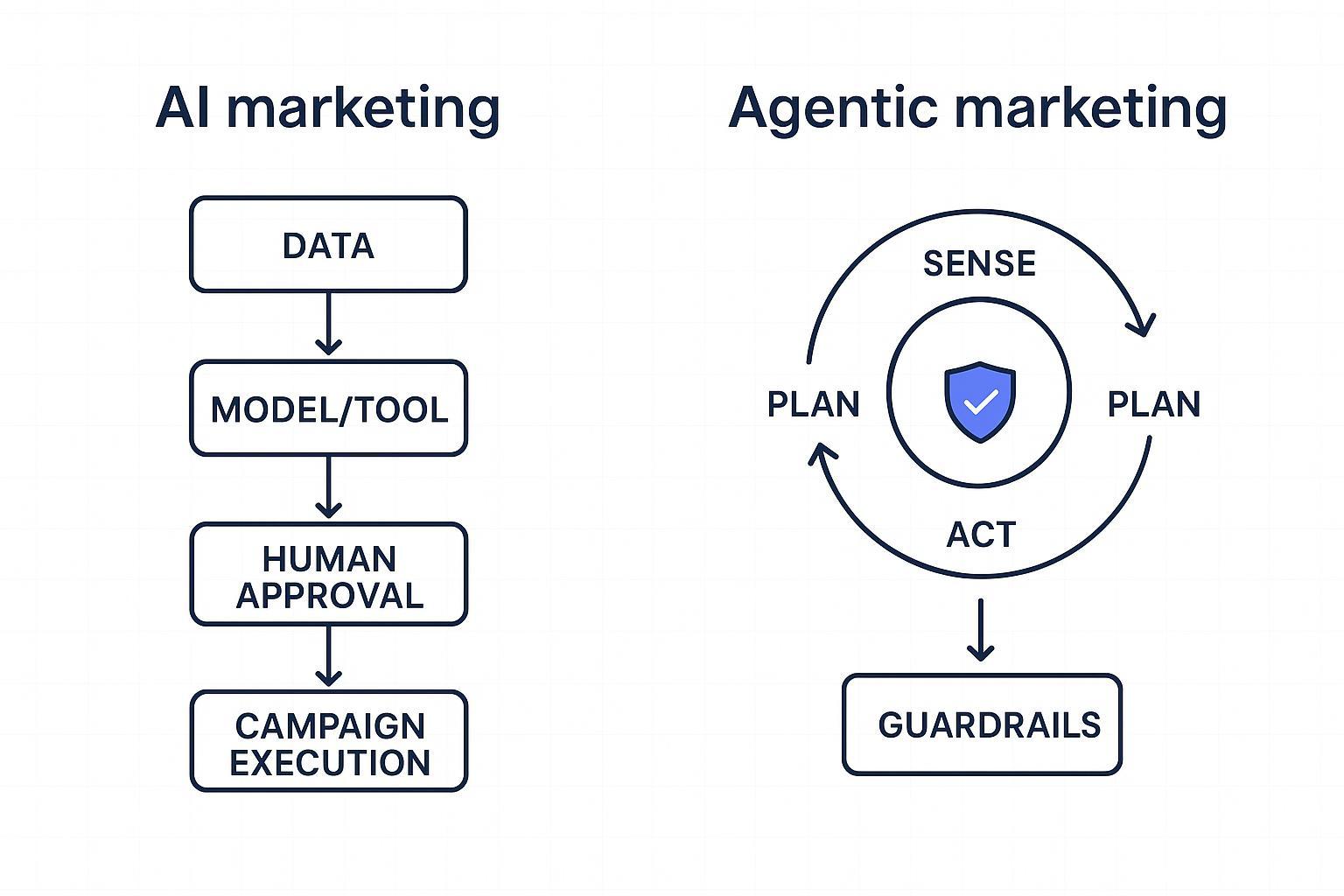
Workflow shape | Mostly linear toolchain | Closed loop: sense → plan → act → learn |
Adaptation | Often periodic and manual | Continuous or near-real-time optimization |
Risk control | Review happens “around” the tools | Review gates are designed into the system |
Definitions: what each term actually means
AI marketing: AI as tools inside a human-run system
AI marketing is the use of AI techniques (like machine learning, NLP, predictive models, and generative AI) to improve marketing tasks such as segmentation, personalization, content generation, and optimization—typically as tools inside a workflow humans design and run.
In other words: AI marketing often makes a step faster or smarter, but it doesn’t necessarily own the whole job.
Agentic marketing: AI agents that can plan and act toward goals
Agentic marketing definition (operational): using AI agents—systems that can perceive context, reason about what to do next, and take multi-step actions—to plan, execute, and optimize marketing work toward a goal, within defined constraints.
A useful “careful” way to think about agents is MIT Sloan’s description of agentic systems as semi- or fully autonomous systems that can perceive, reason, and act in digital environments (MIT Sloan, “Agentic AI, explained”).
From a marketing-ops perspective, a concrete definition is CDP.com’s framing: agents that can autonomously plan, execute, and optimize campaigns across channels, grounded in unified data (CDP.com’s “Agentic Marketing” glossary).
Key Takeaway: AI marketing describes what technologies you use. Agentic marketing describes how work gets done—goal-driven, multi-step, and (partly) autonomous.
Evaluation criterion 1: autonomy and control (who owns “the next step”?)
The cleanest distinction is not “better writing” or “more automation.” It’s who owns sequencing:
In AI marketing, humans decide the next step (even if AI recommends it).
In agentic marketing, an agent can decide the next step and carry it out—within guardrails.
This is why many teams feel like they’re “doing AI” but still drowning in coordination.
Evaluation criterion 2: workflow shape (toolchain vs closed loop)
Typical AI marketing workflow (human-orchestrated toolchain)
In many SMB teams, “AI marketing workflow” looks like a toolchain with human handoffs. That’s useful—just different from agentic systems, where AI agents in marketing can own multi-step execution within gates:
AI MARKETING (toolchain)

  Inputs
    └─ Customer/market data + a prompt + brand notes

  Flow
    1) Analyze / segment (model or analytics tool)
    2) Generate drafts (GenAI tool)
    3) Human edits + approvals
    4) Launch (ads/email/social/CMS)
    5) Report (dashboards)

  Decision point
    └─ Humans decide what to change and when to rerun steps 1–4
This can be extremely effective—especially when the process is stable and the team has strong SOPs.
Typical agentic marketing workflow (goal loop with guardrails)
Agentic systems are designed as a loop: sense, decide, act, learn.
AGENTIC MARKETING (closed loop)

  (1) SENSE
      Pull signals: performance, CRM, site behavior, constraints

  (2) PLAN
      Choose next-best actions + create an execution plan

  (3) ACT
      Execute via tools (create assets, configure campaigns, route approvals)

  (4) LEARN
      Measure outcomes → update plan → repeat

  Guardrails + approvals wrap every stage (especially ACT).
MarTech summarizes the practical shift as moving beyond “traditional marketing automation” toward systems that can plan, execute, and optimize across channels with less step-by-step supervision (MarTech on how agentic AI differs from traditional marketing automation).
Evaluation criterion 3: data and context (what the system needs to work)
Both approaches depend on data. The difference is how much context the system must carry across steps.
AI marketing: context is often fragile
Toolchains frequently lose context across handoffs:
The segmentation tool doesn’t “know” what your content tool wrote.
The content tool doesn’t “know” what sales is seeing this week.
The dashboard doesn’t translate metrics into next actions.
So humans become the glue.
Agentic marketing: context is a first-class artifact
Agentic workflows work best when you define—and preserve—artifacts:
objective + guardrails
audience assumptions
evidence/source pack
approved brief
approved outline
draft + change log
optimization pack
publish checklist + measurement loop
Evaluation criterion 4: governance (guardrails + human-in-the-loop gates)
If you’re a scaling SMB team, governance isn’t a corporate luxury. It’s how you avoid:
off-brand messaging
inaccurate claims
compliance headaches
wasted spend
“we shipped it, but it didn’t move pipeline” drift
A practical governance model is to add approval gates at the points where mistakes are expensive. This is the heart of human-in-the-loop marketing automation: the system can move fast, but it can’t skip accountability.
GOVERNANCE LAYER (works for both, mandatory for agentic)

  - Define guardrails: claims, tone, budget limits, exclusions
  - Insert gates:
    - brief approval
    - outline approval
    - brand voice / safety gate
    - budget-change approval
    - final publish approval
  - Require an audit trail: what changed, why, and based on what signal
⚠️ Warning: If an “agentic” system can publish or spend without review gates, you don’t have agentic marketing—you have uncontrolled automation.
Evaluation criterion 5: what a small team can realistically automate
Here’s the practical truth for a 1–8 person marketing team:
You rarely need maximum autonomy.
You need less coordination work.
So aim for “agentic where it reduces handoffs,” not “agentic everywhere.”
Good early candidates:
turning performance signals into prioritized next actions
drafting briefs/outlines with source packs
producing variant creative with consistent constraints
packaging outputs for review (diffs, checklists, risk flags)
Real-world use cases (with workflows)
Use case 1: content operations (research → publish → refresh)
AI marketing approach: use AI tools for topic ideas, draft generation, and on-page optimization—humans still own sequencing and QA.
Agentic approach: an agent (or agent team) owns the loop.
Agentic AI marketing workflow (content)

  Goal → Plan → Execute → QA gates → Publish → Measure → Repeat
Agentic content ops loop

  Goal: publish 2 high-quality posts/week without brand drift

  SENSE: rankings + GSC/GA4 + pipeline attribution + competitor moves
  PLAN: pick 2 topics + outline angles + required evidence
  ACT: build source pack → draft brief → draft outline → draft post → create optimization pack
  GATES: human approves brief + outline + final draft
  LEARN: measure performance → generate refresh backlog → repeat
Use case 2: lifecycle email (nurture with guardrails)
AI marketing approach: triggers + templates, with AI generating copy variants.
Agentic approach: agent adjusts messaging strategy based on response and constraints.
Agentic lifecycle loop

  Goal: increase activation rate in 30 days

  SENSE: onboarding events + email engagement + support tickets
  PLAN: choose next-best message per segment; propose test plan
  ACT: generate variants → route for approval → schedule sends
  LEARN: evaluate lift → retire losers → iterate

  Guardrails: prohibited claims, frequency caps, brand voice rules
Use case 3: paid search (controlled experimentation)
AI marketing approach: rules + bid automation + AI-written ad variants.
Agentic approach: agent proposes experiments and reallocations, but within strict budget gates.
Agentic paid search loop

  Goal: reduce CAC while protecting lead quality

  SENSE: spend, CVR, CPL, lead quality signals
  PLAN: propose keyword + creative experiments; forecast risk
  ACT: launch small-bet tests; pause waste; shift budget (within caps)
  GATE: human approval for budget cap changes
  LEARN: incorporate outcomes into next plan
Example workflow map: neutral “agentic pipeline” reference (QuickCreator)
This is an example of how a coordinated, agent-based workflow can be mapped. The point isn’t the tool—it’s the handoffs and gates.
Example: coordinated content pipeline (agentic)

  HUMAN OWNER
    - Defines outcome + guardrails
    - Approves brief + outline
    - Final publish decision

  SPECIALIZED AGENTS
    - Brand agent: voice rules + terminology guardrails
    - Topic agent: keyword + angle + intent
    - Research agent: sources + claim map
    - Writer agent: draft
    - Optimization agent: SEO/GEO improvements + metadata
    - Distribution agent: scheduling + channel repurposing

  SYSTEMS
    - CMS, analytics, CRM, ad platforms
A concrete illustration of this style of pipeline (with handoff artifacts and approval gates) can be found in QuickCreator’s content workflow orchestration guide.
How to choose: decision rules for SMB teams
Use these rules to decide what to adopt first.
Choose AI marketing (tools + SOPs) if…
Your workflows are stable and repeatable.
Your biggest bottleneck is production speed (drafting, variants, basic optimization).
You can document clear SOPs and your team is disciplined about using them.
Choose agentic marketing (agents + gates) if…
Your biggest bottleneck is handoffs and coordination.
You need the system to carry context across steps (brief → outline → draft → publish).
You want continuous iteration—but with explicit approval gates.
Start here if you’re unsure
Map your current workflow as artifacts + owners.
Identify where context gets lost.
Add agentic behavior only at the loss points (e.g., packaging source packs, proposing next actions).
Put a human gate in front of anything that can harm brand or spend.
Pro Tip: If you can’t explain “what gets approved, by whom, and based on what evidence,” you’re not ready for autonomy—you’re ready for better artifacts.
Next steps
If you want a concrete template for mapping a research-to-distribution workflow with handoff artifacts and approval gates, start with QuickCreator’s content workflow orchestration guide.
And if your current stack is mostly “prompt-based writing,” this comparison can help clarify the difference in workflow responsibility:
QuickCreator’s AI agents vs AI writers comparison