Defining Social Media Content Pillars for Ecommerce Fashion Brands in the U.S.

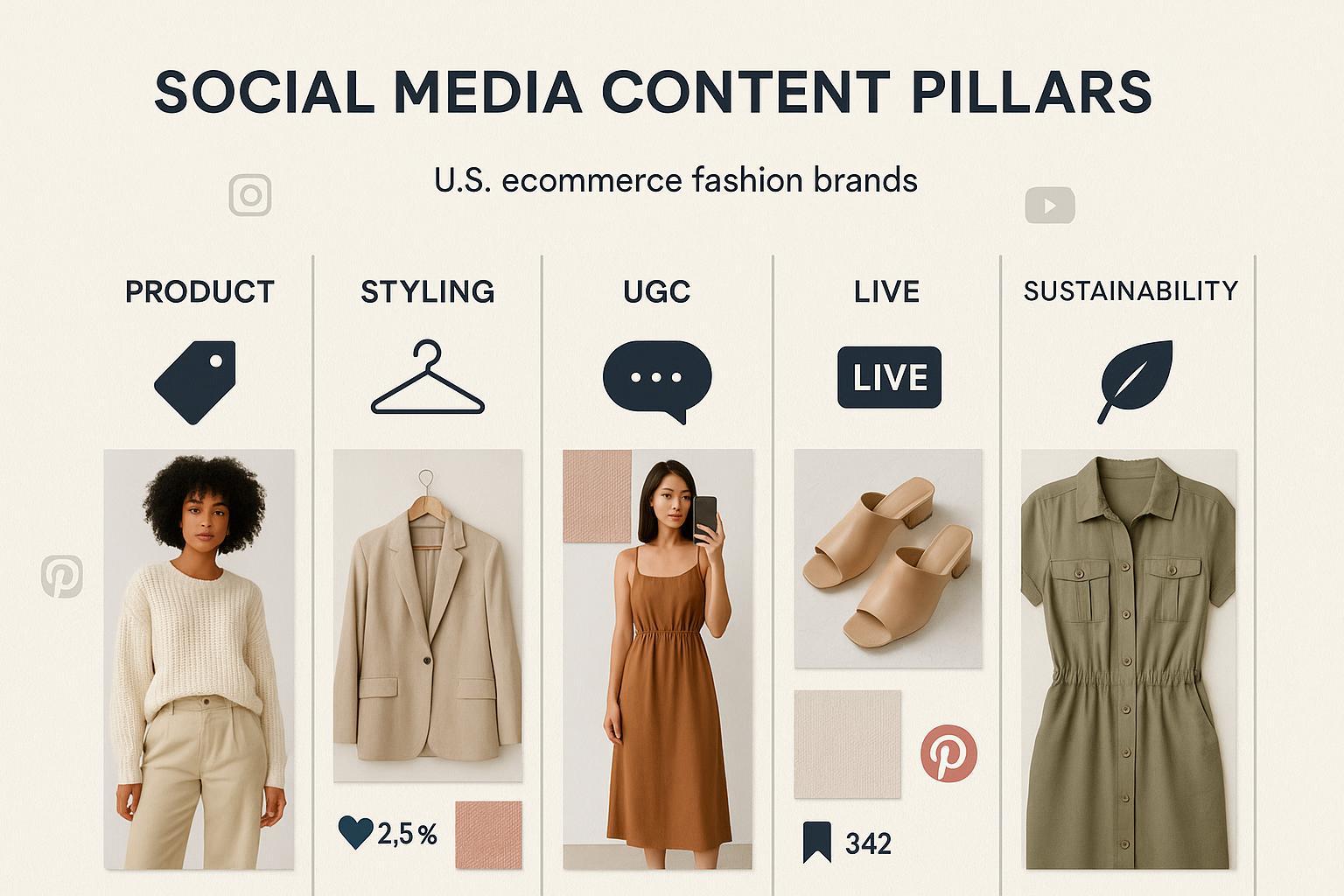
Fashion brands don’t win on social by posting “whatever’s ready.” They win by committing to a small set of content pillars—repeatable themes that align with business goals, audience needs, and platform-native behavior. In practice, pillars keep teams focused, fuel consistent storytelling, and make performance measurable. Importantly, fashion as a category often starts from lower baseline engagement on major platforms, which means your pillars must be built for scroll-stopping creative and commerce-native features rather than generic brand posts. Rival IQ’s 2024 industry benchmarks show fashion’s engagement trailing many categories across Instagram, Facebook, and X, reinforcing the need for disciplined, pillar-led execution according to the Rival IQ 2024 benchmark summary (publisher: Rival IQ; year: 2024).
What Content Pillars Are—and Why They Matter for Fashion Ecommerce
Content pillars are the 3–5 core themes your social team commits to producing week in, week out. Each pillar is a promise: a clear audience benefit, a set of formats, and a path to measurable outcomes (engagement, traffic, sales). Pillars reduce decision fatigue, improve creative quality through repetition, and make calendar planning and reporting far more efficient.
In fashion, content pillars do extra heavy lifting:
- They translate visual storytelling (style, fit, finish) into platform-native formats that convert.
- They combat engagement volatility with repeatable hooks and series.
- They systematize live shopping, UGC, and social proof—elements strongly linked to conversion and buyer confidence.
For foundational context and examples, Shopify’s guidance on pillar selection and implementation remains practical and up-to-date; see the Shopify content pillars framework (publisher: Shopify; guidance published and maintained 2024–2025).
A Fashion-Specific Pillar Framework (Choose 3–5)
Most U.S. ecommerce fashion brands succeed with a mix from the following. Pick three to five based on your brand goals, margin structure, and resource reality.
- Product Promo & Launches
- Purpose: Drive discovery and sales for new arrivals, drops, and bundles.
- Formats: Short-form videos with product tags; carousels; creator try-ons; limited-time offer posts.
- Trade-off: Over-use can fatigue audiences. Pair with inspiration and education pillars.
- Style Inspiration
- Purpose: Outfit ideas by occasion/season; trend-led styling; creator collaborations.
- Formats: Reels/TikToks featuring “3 ways to wear,” #ootd, #fitcheck, seasonal lookbooks; Pinterest boards.
- Trade-off: High creative demand; requires nimble trend alignment.
- Education & Fit
- Purpose: Reduce returns, increase confidence through sizing guidance, care tips, fabric stories.
- Formats: Size guides, try-on comparisons, tailoring/alteration tips, fabric close-ups, YouTube tutorials.
- Trade-off: Less “viral,” but significant impact on conversion and return rates.
- UGC & Community
- Purpose: Leverage customer photos/videos, ratings & reviews, and creator affiliates to build trust.
- Formats: Duets/stitches, reposts with product tags, review highlights, community challenges.
- Trade-off: Requires consistent solicitation and rights management.
- Social Proof (Press, Influencers, Certifications)
- Purpose: Showcase testimonials, earned media, sustainability badges.
- Formats: Quote cards, press features, certification explainers.
- Trade-off: Works best supporting other pillars; avoid boilerplate repetition.
- Live Shopping & Events
- Purpose: Drive urgency and interactivity via TikTok/Instagram Lives, drops, and behind-the-scenes events.
- Formats: Live streams with host; timed offers; Q&A; backstage previews.
- Trade-off: Operationally intensive; needs hosts, scripts, and consistent cadence.
- Sustainability & Ethics
- Purpose: Share materials, supply-chain transparency, repair/upcycling programs.
- Formats: Process stories, Q&A with sourcing, impact metrics, certifications explained.
- Trade-off: Must be substantive and verifiable; avoid greenwashing.
Practical tip: Treat pillars as constraints that boost creativity. Name each pillar, write a one-sentence audience benefit, list 3–5 formats you’ll rotate, and define a “done-right” checklist.
Step-by-Step: Define Your Pillars the Right Way
- Align with Business Goals and ICPs
- Revenue priorities: New customer acquisition vs. repeat purchase.
- Margin realities: Which categories can carry paid amplification?
- Audience segments: Occasion wear vs. everyday basics vs. athleisure.
- Pull the last 90–180 days across Instagram, TikTok, Pinterest, and YouTube.
- Rank posts by saves, shares, click-throughs, add-to-cart, and conversion.
- Cluster posts into themes—these clusters are your proto-pillars. Keep only those with both engagement and commerce signals.
- Draft Pillar Statements
- Format: “Style Inspiration—helps shoppers visualize outfits for key moments and drives saves and product clicks via Reels and creator try-ons.”
- Add 3–5 formats per pillar, 2–3 hook examples, and the primary CTA type (e.g., product tag tap, Live reminder, board follow).
- Governance and Brand Voice Guardrails
- Brand voice adjectives: e.g., “confident, inclusive, modern.”
- Visual guardrails: color grading, shot distance, text overlay rules, music usage.
- Acceptance criteria: A post ships only if it meets hook clarity, fit/detail visibility, product tagging, and CTA requirements.
- Assign owners: creator partners, in-house studio, community manager.
- Cadence: 3–5 posts per week across pillars, plus 1 live per fortnight.
- Buffer: Maintain a 2-week content buffer and a rapid “trend window” slot for timely ideas.
Platform Adaptations: Express Each Pillar Where It Works Best
Different platforms reward different creative choices and commerce setups. Map pillars accordingly.
| Pillar | Instagram (Reels/Shop) | TikTok (Video/Live/Shop) | Pinterest (Product Pins/VMP) | YouTube (Video/Live/Shopping) |
|---|---|---|---|---|
| Product Promo & Launches | Reels with 1–5 tagged products; carousels for collections | Fast-cut product demos; live launches with exclusive bundles | Product Pins with lifestyle imagery; collection boards | 3–5 min launch walkthroughs; product tagging on videos |
| Style Inspiration | “3 ways to wear” Reels; creator collabs | Trend-native #ootd/#fitcheck; creator stitches | Outfit boards by occasion/season | Lookbook videos; chapters and tags |
| Education & Fit | Size-guide carousels; fabric close-ups | Try-ons comparing sizes; care tips | Pins linking to size guides; fabric explainers | Tutorials; laundering/care; fit series |
| UGC & Community | Reposts with product tags; reviews highlights | Duet/stitch customer clips; creator affiliates | Boards featuring customer looks | Compilation videos of customer try-ons |
| Live Shopping & Events | Live streams tied to drops | Scheduled Lives with Q&A and timed offers | Announce event and pin post-event recaps | Live collection previews; product tagging |
| Sustainability & Ethics | Q&A carousels; certification explainers | Process stories; supply chain snippets | Impact boards; certification guides | Deep dives into materials/process |
Commerce features to enable:
- Instagram: Business profile + Meta Commerce + product catalogs + shoppable tags. See Meta’s Instagram Shopping help (publisher: Meta Business Help; ongoing official documentation).
- TikTok: Seller eligibility, in-app checkout, live shopping. Refer to the TikTok Shop Seller Center (publisher: TikTok; official seller portal).
- Pinterest: Verified Merchant Program (VMP), product feed integration. Details in the Pinterest Verified Merchant Program help (publisher: Pinterest Help; official policy page).
- YouTube: Product tagging eligibility via YouTube Shopping. Start with the YouTube Shopping help topic (publisher: YouTube Help; official documentation).
Social Commerce Setup: A Quick Checklist
- Compliance: Confirm eligibility and policies for each platform commerce program.
- Catalog integrity: Titles, variants, size charts, price accuracy, stock sync.
- Tagging hygiene: Always tag featured products; avoid irrelevant tags.
- Landing experience: PDPs with fast load, clear size/fit info, robust reviews/UGC.
- Live readiness: Hosts, run-of-show, offers, moderation, follow-up highlights.
- Attribution: UTMs, platform analytics, assisted-conversion tracking.
Measurement: Make Pillars Measurable and Iterative
Define KPIs per pillar and set baselines:
- Attention: hook retention (first 3 seconds), view-through rate.
- Engagement: saves, shares, comments; engagement rate per follower.
- Commerce: click-through rate, add-to-cart, conversion rate, AOV.
- Confidence: return rate, fit-related support tickets.
Use industry context cautiously. For example, fashion’s lower median engagement on key platforms means your first-party baselines matter more than “generic” social averages; see the Rival IQ 2024 summary linked above. Track benchmarks monthly and compare pillars against each other, not only against industry medians.
Why UGC/Reviews Belong in Your Pillars
UGC consistently boosts conversion and revenue per visitor. PowerReviews’ 2024 guidance cites dramatic lifts when shoppers interact with reviews and user-submitted media, including triple-digit conversion increases for photo/video reviews; details in the PowerReviews Complete Guide to Ratings & Reviews (publisher: PowerReviews; year: 2024). Complementing this, Bazaarvoice’s 2025 Shopper Preference signals that nearly half of consumers trust customer testimonials and peer reviews on social platforms; see the Bazaarvoice Shopper Preference Report (publisher: Bazaarvoice; year: 2025). The takeaway: make UGC & Community and Social Proof pillars central rather than optional.
TikTok Shop Momentum: Treat as a Test-and-Learn Opportunity
Social commerce is accelerating. Market tracking indicates significant U.S. GMV growth for TikTok Shop in 2024–2025; Statista’s consolidated topic page summarizes the rise of TikTok Shop in the U.S., including high-level sales figures; refer to the Statista TikTok Shop U.S. topic (publisher: Statista; topic maintained 2024–2025). Instead of relying on generic conversion rates, instrument your own funnel per pillar and format—particularly for Live Shopping & Events.
Troubleshooting: If a Pillar Underperforms
When a pillar stalls, diagnose with a structured pass:
- Are the first 2–3 seconds crystal-clear about value? Try text-on-screen hooks and tighter openers.
- Is the format native to the platform (e.g., fast-cut vertical video on TikTok; Reels pacing on Instagram)?
- Do models/creators match your core audience? Test age/body diversity and creator credibility.
- Are creator edits aligned with voice and visual guardrails?
- Fit and Confidence Content
- Are size/fit cues strong enough (try-on comparisons, close-ups, measurements)?
- Is there enough UGC to set expectations and reduce returns?
- Commerce Enablement
- Are product tags present and accurate? Are PDPs fast and detailed?
- For live formats: Is the run-of-show tight, with timed offers and clear CTAs?
- Timing and Cadence
- Are you posting when audiences are active? Are Lives scheduled consistently?
- Are you balancing pillars, avoiding promo overkill?
- A/B Testing and Iteration
- Test hooks, thumbnail frames, caption structures, and creator variants.
- Run 2-week sprints per hypothesis; keep only what moves your KPIs.
Lightweight Templates You Can Use Today
Pillar Definition Worksheet
- Pillar name:
- Audience benefit (one sentence):
- Priority formats (3–5):
- Hook examples (2–3):
- Commerce feature(s) to enable:
- “Done-right” checklist: hook clarity; fit/detail visibility; product tagging; CTA present; platform-native pacing.
- KPIs: attention, engagement, commerce, confidence.
Two-Week Starter Calendar (Mon–Sun Rhythm)
Week 1
- Mon: Style Inspiration — “3 ways to wear [product]” Reel (tagged products)
- Tue: Education & Fit — Size comparison try-on (captioned measurements)
- Wed: UGC & Community — Customer #ootd repost (rights cleared; product tags)
- Thu: Product Promo — New arrival carousel (collection CTA)
- Fri: Live Shopping & Events — TikTok Live teaser (countdown)
- Sat: Live — Host-led drop with timed bundle offer
- Sun: Sustainability & Ethics — Fabric/process story Q&A carousel
Week 2
- Mon: UGC & Community — Review highlight with photo/video
- Tue: Style Inspiration — Creator collab “date-night looks”
- Wed: Education & Fit — Care tip tutorial (YouTube short or Reel)
- Thu: Product Promo — Limited-time discount post (clear CTA)
- Fri: Live Shopping & Events — Instagram Live preview
- Sat: Live — Collection walkthrough; Q&A
- Sun: Social Proof — Press feature or certification explainer
Pillar-to-Platform Hook Prompts
- Product Promo: “New drop, 3 looks in 15 seconds—tap to shop.”
- Style Inspiration: “Work-to-weekend: style the same piece three ways.”
- Education & Fit: “Size S vs. M on two body types—see the differences.”
- UGC & Community: “Real customer try-on—would you wear look #2?”
- Live Shopping & Events: “Only during this Live: bundle save + free shipping.”
- Sustainability & Ethics: “What ‘organic cotton’ really means in our tees.”
Operational Tips From Practice
- Build a reusable shot list per pillar to speed production.
- Keep a “trend window” slot every week to ride relevant audio or memes without derailing your calendar.
- Standardize captions: hook in first line, benefit, product tags, CTA.
- Maintain a creator roster with clear briefs and voice guardrails; rotate talent to avoid fatigue.
- Automate rights and UGC intake via clear prompts on PDPs and post-purchase emails.
Keep Evolving: Pillars Are Stable—but Not Static
Your pillars should remain stable for at least one quarter to build momentum. Revisit them monthly in a 60-minute review, looking at attention, engagement, commerce, and returns. Retire or refactor a pillar only after testing alternative formats and hooks. Social commerce features and platform rules change quickly; confirm shopping/tagging eligibility and best practices in the official documentation linked above before major campaigns.
By committing to a small set of fashion-specific pillars, expressing them natively across platforms, and measuring relentlessly, you’ll build a social engine that both inspires and sells—without burning out your team or your audience.
