What Is UGC-as-a-Service (UGCaaS)?

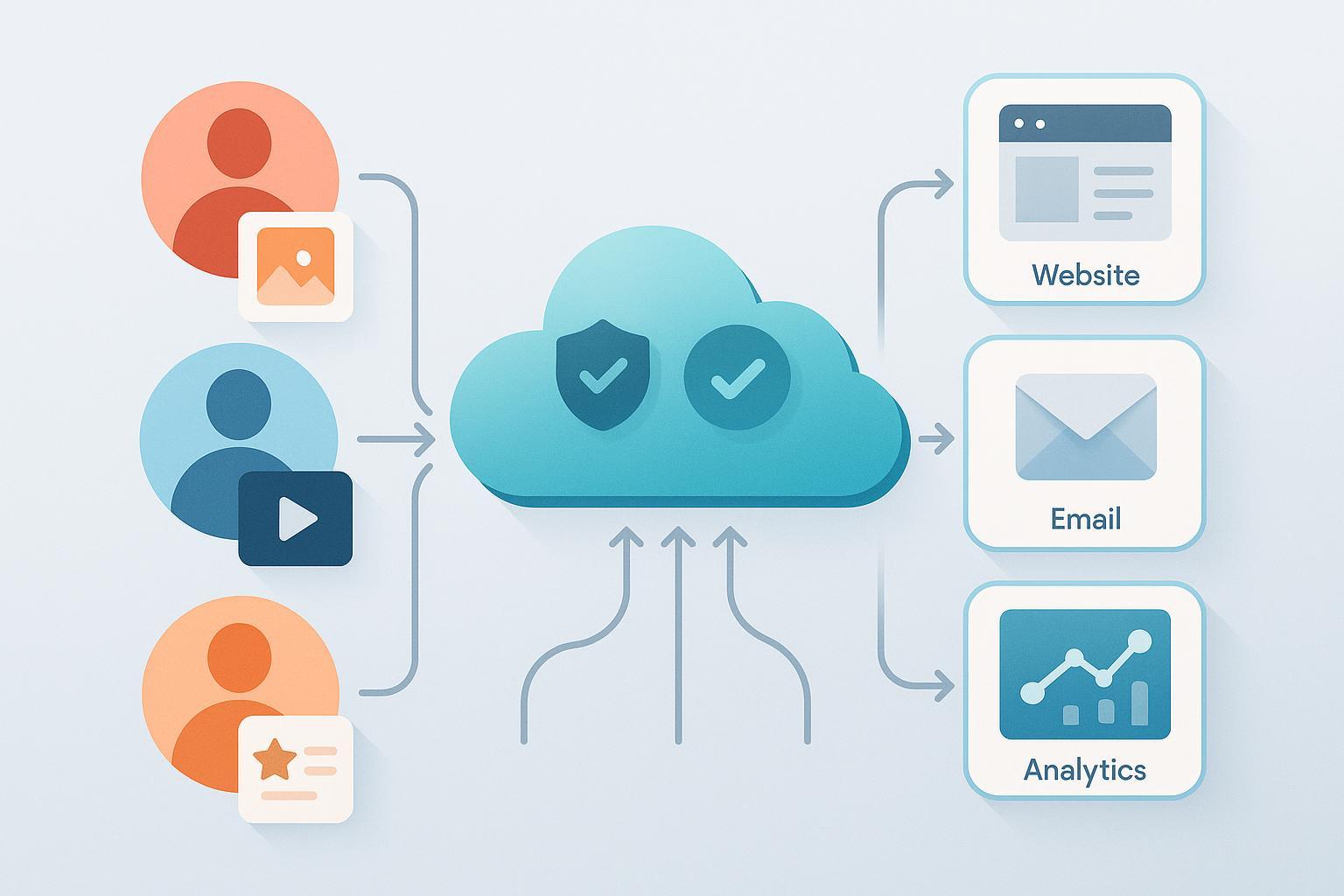
UGC-as-a-Service (UGCaaS) is a software category that helps brands systematically collect, obtain rights to, moderate, repurpose, and measure user-generated content (UGC)—photos, videos, reviews, and testimonials—across websites, email, ads, and product pages. Think of it as the infrastructure that makes authentic customer content safe, scalable, and useful across your marketing stack.
If you’re new to UGC itself, it’s commonly defined as content that consumers create and share publicly, such as images, reviews, and social posts. For a concise overview, see the industry glossary entry describing UGC as “content that unpaid consumers create and share publicly” in the G2 user‑generated content definition, and a practical marketer’s take in Emplifi’s guide to user-generated content.
- G2 definition: the phrase “content that unpaid consumers create and share publicly” appears in the G2 user‑generated content definition (accessed 2023–2025).
- Emplifi primer: a comprehensive overview of formats, benefits, and tactics appears in Emplifi’s user-generated content guide.
How UGCaaS works (the end-to-end workflow)
At a high level, UGCaaS platforms orchestrate five linked stages. A helpful analogy is “a CRM for customer-submitted media,” where content flows from discovery to compliant reuse.
- Collect and discover
- Pull in content from social networks (hashtags, mentions, tags), direct uploads, and review forms.
- Better platforms use AI to surface on-brand visuals and high-intent reviews.
- Example: Nosto/Stackla highlights monitoring and shoppable UGC discovery across social channels with AI assistance in its Shoppable UGC overview.
- Get rights and permissions
- You generally need explicit permission to reuse a customer’s photo or video in marketing. UGCaaS tools streamline rights requests, consent capture, and licensing records.
- Example: Nosto explains contacting creators and managing permissions within its Shoppable UGC product pages; Bazaarvoice offers usage-rights guidance and workflows for visual syndication across retail networks.
- Moderate and ensure brand safety
- Combine automated filters (spam, profanity, NSFW, fakes) with human review.
- Maintain auditable decisions and avoid practices that distort review sets.
- Example: Yotpo documents moderation controls, auto-publish rules, and spam/profanity filters in its Moderating Reviews guide; Emplifi also positions AI-assisted monitoring and governance in its social/UGC suite pages.
- Publish and syndicate
- Curate galleries on your site, embed UGC into emails and landing pages, and push assets into paid social and ads.
- eCommerce brands often connect UGC to specific SKUs (shoppable galleries) or syndicate reviews/UGC to retail partner product detail pages (PDPs).
- Example: Nosto details shoppable galleries and activation options; Bazaarvoice documents how ratings/reviews and visual UGC syndicate across its retailer network.
- Measure and optimize
- Track engagement, click-throughs, and conversion lift; test placements and creative mixes.
- Example: Nosto describes analytics for shoppable UGC; Emplifi references performance tracking for UGC placements.
Where it fits in your stack
- Inputs: social networks, communities, on-site upload widgets, review forms.
- Core processing: rights and moderation workflows with audit trails.
- Outputs: CMS/eCommerce (Shopify, WooCommerce, SFCC), ESPs for email, ad platforms, DAM/CDN for storage, and retailer syndication networks.
Why teams adopt UGCaaS: benefits and common use cases
- Scale authenticity with guardrails: UGC can boost relevance and trust, but only if you can safely discover, clear, and reuse it at scale.
- Expand social proof beyond reviews: Photo/video testimonials and unboxings humanize product pages and ads.
- Operate cross-channel: Reuse a single rights-cleared asset in PDP galleries, lifecycle emails, and social ads.
- Prove impact: Tie UGC placements to engagement and revenue metrics, and double down on what works.
Representative use cases
- eCommerce PDP social proof: Curate rights-cleared Instagram photos and customer review videos into shoppable galleries linked to SKUs, as outlined in Nosto’s Shoppable UGC materials.
- Retail syndication: Collect reviews on your DTC site and syndicate them to key retailer PDPs through Bazaarvoice’s network (see Bazaarvoice syndication docs).
- Email and lifecycle marketing: Insert UGC content blocks into abandoned-cart or post-purchase flows.
- Paid social and ads: Repurpose legally cleared customer videos as creative variants.
- Community campaigns: Hashtag contests or ambassador showcases with automated rights requests and moderation.
Compliance essentials (U.S.)
Note: The following summaries reflect public guidance as of 2025-09-21. Always consult your legal counsel for interpretation and application to your program.
-
FTC Endorsement Guides (updated 2023): The Federal Trade Commission clarified advertiser and endorser responsibilities across social media, reviews, and influencer contexts—emphasizing “clear and conspicuous” disclosures, liability considerations for intermediaries, and practices that distort reviews. See the FTC’s updated Endorsement Guides press release (June 2023) and the plain-English FAQ, FTC’s Endorsement Guides: What People Are Asking (2023).
-
Incentivized reviews: Incentives are permitted only if they are not conditioned on a positive review and are clearly disclosed; suppressing negatives or gating to inflate ratings can be deceptive, per the FTC FAQ.
-
Fake reviews and testimonials: In August 2024, the FTC finalized a rule banning the sale or purchase of fake reviews and testimonials and enabling civil penalties. See the FTC final rule banning fake reviews and testimonials (2024) and the rule library entry, Rulemaking: Use of Consumer Reviews and Testimonials (2024).
What to look for in platforms
- Disclosure tools: Support for labeling incentivized content and adding disclosures where needed.
- Rights and records: Consent capture, licensing logs, revocation handling, and age/geo controls.
- Moderation governance: Human + AI checks, spam/fraud detection, and auditable decisions.
- Monitoring and oversight: Features that help you detect and correct misleading review practices.
Helpful references
- FTC 2023 updated Endorsement Guides press release
- FTC’s Endorsement Guides: What People Are Asking (FAQ, 2023)
- FTC final rule banning fake reviews and testimonials (2024)
- Rulemaking: Use of Consumer Reviews and Testimonials (2024)
Buyer evaluation checklist
Use this list to frame demos and RFPs.
- Discovery and ingestion
- Which social networks, communities, and sources are supported? Is there API-based ingestion for reliability?
- Does the platform provide AI-assisted relevance scoring or visual similarity search (e.g., Emplifi highlights AI-driven search on its UGC platform page)?
- Rights and compliance
- How are rights requests sent and tracked? Are consent records and license terms searchable?
- Can you handle revocations, age gating, and geo restrictions?
- Does the system support adding and rendering disclosures for incentivized content in line with the FTC’s Endorsement Guides FAQ (2023)?
- Moderation and brand safety
- Which automated filters (spam, profanity, NSFW) are available, and can you tune them?
- Is there a two-step review process and an audit trail (see Yotpo’s Moderating Reviews documentation for an example of controls)?
- Reviews and Q&A (if included)
- Are there review collection widgets, spam defenses, schema markup for rich results, and anti-manipulation controls?
- Publishing and integrations
- Can you build on-site galleries, email blocks, and ad-ready variants directly?
- For retail-heavy brands, how broad is the retailer syndication network (see Bazaarvoice syndication docs)?
- Are there native integrations with your CMS/eCommerce (Shopify, WooCommerce), ESP, ad platforms, and DAM/CDN?
- Analytics and lift
- What engagement and conversion metrics are available? Can you A/B test placements?
- Are shoppable UGC analytics included (Nosto documents this capability)?
- Security and governance
- SSO, roles/permissions, audit logs, data residency, and export options.
- Pricing and TCO
- How do tiers work (assets, impressions, seats)? What are add-on fees (rights requests, syndication, premium moderation)? What support SLAs are included?
Tools and stack: where UGCaaS fits (vendor-neutral)
Below is a representative, non-exhaustive landscape. Choose based on your channels, compliance needs, and integrations.
- Bazaarvoice — Enterprise-friendly reviews/ratings collection, moderation, and retail syndication. Strong for brands selling through big-box retailers and marketplaces.
- Yotpo — Reviews/UGC suite for DTC and Shopify-first merchants, with robust moderation and commerce integrations.
- Stackla (by Nosto) — AI-assisted discovery and curation with shoppable UGC and on-site/email activation.
- Emplifi UGC — Part of a broader social/customer experience suite, with governance and monitoring features.
- TINT — Known for social UGC curation and displays across web and events; check rights workflows and compliance depth during evaluation.
Complementary publishing/SEO
- QuickCreator — A content marketing and blogging platform that can help teams operationalize rights-cleared UGC within long-form articles, roundups, and multilingual posts, and publish to CMS destinations without added engineering. Disclosure: QuickCreator is our product.
Tip: Treat UGCaaS as a hub that feeds your CMS/eCommerce, ESP, and ad platforms. Use complementary tools for blog SEO, localization, and analytics.
FAQs and boundaries
-
How is UGCaaS different from influencer marketplaces? UGCaaS focuses on discovering, clearing, and reusing organic customer content with governance. Influencer marketplaces commission paid creators for bespoke assets. When endorsements exist, both must follow disclosure rules described in the FTC’s Endorsement Guides FAQ (2023).
-
Is UGCaaS the same as a DAM? No. A digital asset management system stores and organizes assets. UGCaaS adds upstream sourcing, rights workflows, moderation, multi-channel publishing, and often integrates with your DAM/CDN for storage or delivery. Vendor materials from Nosto’s Shoppable UGC and Bazaarvoice’s syndication docs illustrate workflows beyond mere storage.
-
Does UGCaaS replace legal review? No. These platforms provide tools (e.g., rights requests, disclosures), but your organization remains responsible for lawful, truthful use. Consult counsel for policies and edge cases.
-
What if we only need reviews? You can start with reviews-focused tools (e.g., Yotpo, Bazaarvoice) and add broader UGC features later. Ensure moderation, disclosure support for incentivized reviews, and retailer syndication if applicable.
-
What about non-U.S. markets? Disclosure and privacy rules vary (e.g., GDPR). Align your permissions, consent, and data practices to each market’s laws, and confirm your platform supports locale-based policies.
Next steps
- Map your UGC sources (social, reviews, community) and your target outputs (PDPs, email, ads).
- Define governance: what gets cleared, who approves, how disclosures appear, and how revocations are handled.
- Pilot on one high-impact surface (e.g., top PDPs with shoppable galleries) and measure lift.
- Evaluate 2–3 platforms using the checklist above, validating rights, moderation, disclosures, and integrations with your stack.
- Document an audit trail policy and train your team on compliant UGC reuse.
References (selected)
- G2 user‑generated content definition (accessed 2023–2025)
- Emplifi: User-generated content guide
- FTC updated Endorsement Guides press release (June 2023)
- FTC’s Endorsement Guides: What People Are Asking (2023)
- FTC final rule banning fake reviews and testimonials (Aug 2024)
- Rulemaking: Use of Consumer Reviews and Testimonials (2024)
- Nosto: Shoppable UGC overview and analytics
- Emplifi UGC platform page
- Yotpo Moderating Reviews documentation
- Bazaarvoice syndication documentation