Back-to-School Campaign (U.S.) — 2025 Strategy with E-E-A-T and a Persuasive CTA

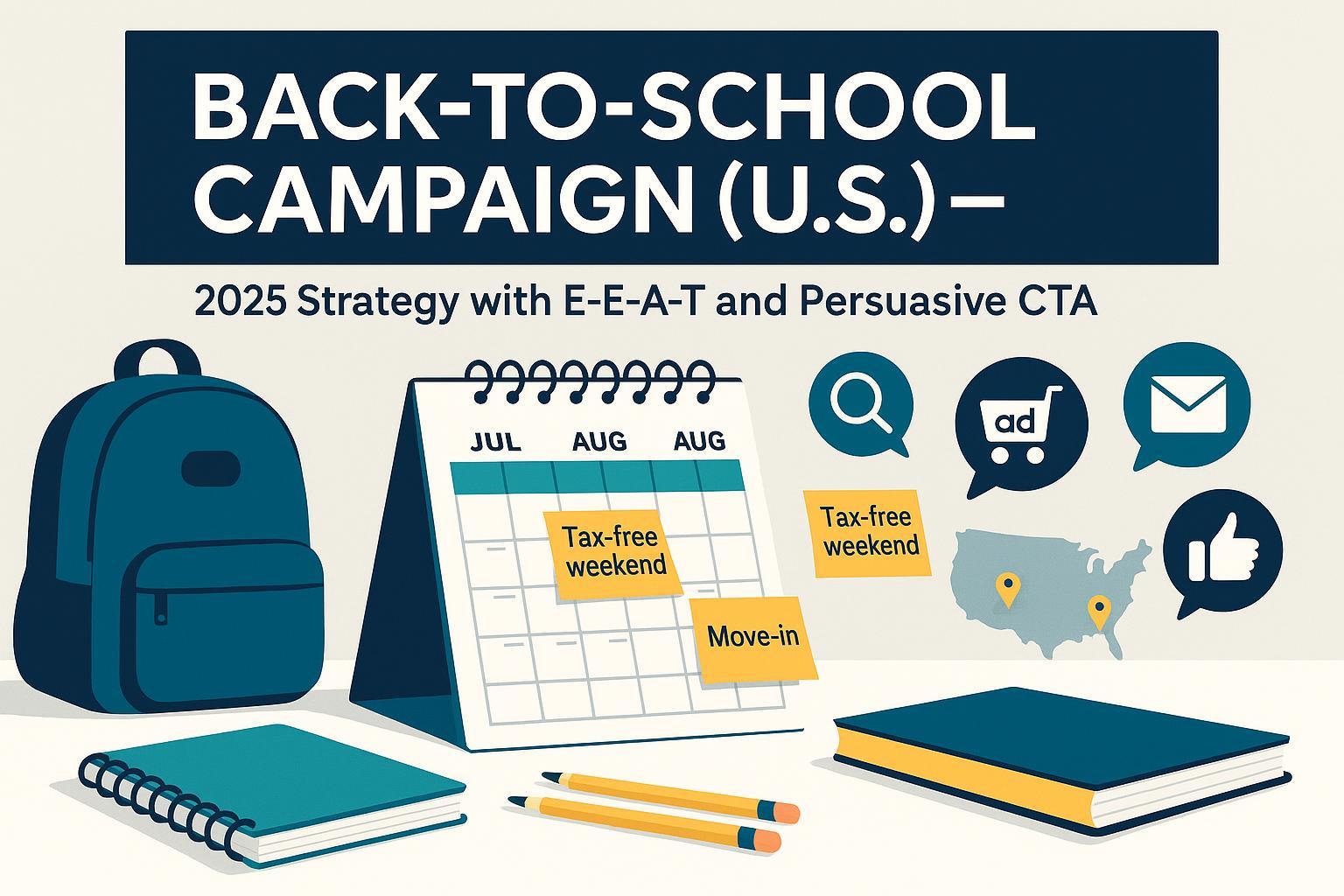
If you only run one seasonal retail push outside the holidays, make it back-to-school. In 2025, the season starts early, value drives choices, and the best results go to marketers who align timing, offers, and operations. This guide distills what’s working now—grounded in recent data and practical playbooks—so you can launch fast and scale responsibly.
According to the National Retail Federation (NRF), two-thirds of shoppers had already started back-to-school purchasing by early July 2025, underscoring how early the window opens in the U.S. (NRF press release, July 15, 2025): two-thirds had begun shopping by early July. And Insider Intelligence/eMarketer noted in 2024 that total U.S. back-to-school retail sales would reach $81.16B, up 3.2% year over year—helpful context for channel planning and inventory posture: U.S. back-to-school sales $81.16B (+3.2% YoY).
1) Timing Windows You Can’t Miss
In my experience, 80% of performance is decided by timing, value proposition, and product availability. The BTS calendar has consistent pulses you can plan around:
- Pre-July warm-up: Collect intent (wishlists, checklists), build remarketing pools, line up teacher/student verification.
- Prime Day adjacency (mid-July): Use the halo to promote value-forward bundles and “set up for success” kits. Amazon reported Prime Day 2024 as its biggest event to date, which reliably primes consumers for deals: Prime Day 2024 recap (Amazon newsroom, July 18, 2024). Don’t speculate about 2025’s exact dates—watch announcements, then mirror the surge.
- State sales tax holidays (late July–August): Geo-target messaging where relevant. For example, Florida’s 2025 Back-to-School Sales Tax Holiday runs August 1–31 with item thresholds (e.g., clothing ≤$100; school supplies ≤$50): Florida DOR TIP #25A01-08 (July 16, 2025). Texas runs August 8–10, 2025 for qualifying items: Texas Comptroller overview.
- Peak: Late July through mid-August (K–12). College move-in runs late August into early September—dorm/apartment needs spike.
Practical play: Build a geo-calendar for tax-free states; schedule paid search and retail media budget surges to those ZIPs during the windows. Rotate creative—“tax-free savings” in eligible regions, “bundle-and-save” elsewhere.
2) Audience, Offers, and Merchandising
Segment by life stage and mission:
- K–12 parents: Essentials first (supplies, basics, shoes), then nice-to-haves.
- College students: Big-ticket electronics, small appliances, bedding, storage, personal care.
- Teachers: Classroom supplies, bulk buys, loyalty perks.
Offer architecture that wins in 2025:
- Value-first: Threshold promos ($75 get $10), kits/bundles (grade-level packs), and price-match where competitive.
- Student/teacher programs: Verified discounts; keep data collection minimal and compliant.
- Flexible payment: Accept major cards and BNPL responsibly; disclose costs clearly.
- Durable and sustainable options: Emphasize longevity (reinforced backpacks, refillable pens); this blends value with values.
- Refurbished/used electronics: Position as budget-wise and eco-friendly; include clear warranty terms.
- Curate top-20 SKUs per audience and ensure depth of inventory.
- Feature checklists by grade/major—printable and shoppable.
- Cross-sell “setup” bundles (laptop + sleeve + headphones + backup drive; dorm bedding + storage + lamp).
- Prominent “Under $25” and “Under $50” collections to anchor value.
3) Channel Mix and Budget Heuristic (70/20/10)
Allocate most spend to what’s proven for your brand, keep momentum in value channels, and reserve room to test:
- 70% Core: Paid search (brand + non-brand) and retail media networks (e.g., Amazon, Walmart, Target) for high-intent reach. Advertisers are still increasing investment here—Insider Intelligence estimated U.S. retail media spend surpassing $62B in 2025, highlighting the channel’s scale and maturity: retail media will exceed $62B in 2025 (Jan 31, 2025).
- 20% Growth: Paid social (short video, carousels), email/SMS, and affiliates/influencers (especially campus ambassadors) to build demand and capture mid-funnel.
- 10% Test: CTV with shoppable overlays, new RMN betas, or emerging creators. Kill or scale weekly based on leading indicators.
Tactical notes:
- Sync your Prime Day halo plan: escalate budgets 2–3 days before and after.
- Geo-weight bids to tax-holiday states; align store hours and BOPIS speed in local ads.
- Use audience exclusions to avoid overserving deal-seekers who already purchased.
4) Creative and Messaging That Converts
Principles that travel well across K–12 and college:
- Lead with value and clarity: “All the essentials, under $50.”
- Bridge value with quality: “Durable notebooks that last all year.”
- Reduce decision friction: Checklist creative, size guides, “good/better/best” tiers.
- Social proof ethically: Reviews from parents/teachers; avoid pressure tactics for minors.
Subject line and CTA ideas (mix and match):
- “Ready, Set, School: Save on the essentials”
- “Dorm-ready in a day: BOPIS now, move in stress-free”
- “Teacher perks inside: Extra 10% with verification”
- “Bundle and save: Tech + study setup kits”
- CTAs: “Build your kit,” “Get verified & save,” “Shop tax-free dates,” “Reserve for pickup.”
5) CRO and Operational Readiness (Don’t Skip This)
Conversion rate often hinges on operational basics. Before you scale spend:
Site and PDPs
- Compress images and defer non-critical scripts to keep pages fast; keep core pages accessible on mobile.
- Show stock status, pickup eligibility, delivery ETA, and return policy above the fold.
- For electronics: specs comparison, warranty, compatibility notes, and student pricing callouts.
Fulfillment and service
- BOPIS/curbside: Publish cutoff times and pickup windows clearly; message “order by X for move-in.”
- Inventory buffers: Add 10–20% above forecast on hero SKUs where feasible and set substitutes.
- Returns: Make policies easy to find and generous enough to reduce hesitation.
Accessibility and inclusion
- Provide alt text, captions on video, keyboard operability, and adequate color contrast; align with WCAG 2.2 guidance from W3C (2023 recommendation): WCAG 2.2 specification.
6) Measurement: Proving What Worked
Define success by audience and margin guardrails before launch. Then instrument, monitor leading indicators, and validate outcomes.
Instrumentation and standards
- Use server-side conversion APIs where available. For retail media, align with industry guidance to ensure apples-to-apples reporting; the IAB/MRC’s 2024 explainer helps standardize definitions and methods: IAB/MRC Retail Media Measurement Guidelines (Jan 2024).
KPIs
- Leading: CTR, CPC/CPM, product detail page view rate, add-to-cart rate, store visit lift.
- Outcomes: Gross-margin ROAS, new-to-file customer rate, repeat purchase rate by October.
Tests
- Run incrementality studies (geo-holdout or matched-market) on retail media or paid social. Use clean-room partners when possible.
- Treat MMM for cross-channel planning and MTA for within-channel optimization—neither is a single source of truth.
7) Compliance and Ethics (Marketing to Families and Students)
If you engage minors or collect student data, elevate your privacy and accessibility standards.
- COPPA: The FTC finalized updates in 2025 that tighten parental consent for targeted advertising and expand data protections for children. Review the FTC’s final rule and press materials to align your practices: FTC finalizes changes to the Children’s Online Privacy Protection Rule (Jan 16, 2025).
- FERPA: For education records, coordinate with institutions and follow U.S. Department of Education guidance: FERPA overview.
- ADA/WCAG: Ensure accessible web content and campaigns; see W3C’s specification above and ADA.gov for broader obligations.
Ethical guardrails: Minimize data collection from minors, avoid manipulative scarcity, and provide clear opt-outs for email/SMS.
8) A Fast-Start 10-Day Sprint (If You’re Late)
Day 1–2: Lock calendar, tax-holiday geo list, and top-20 SKUs. Draft offers and landing pages.
Day 3–4: Build search and retail media campaigns with tax-holiday geo boosts. Prep social/video with checklist creative.
Day 5: QA site speed, PDP details, BOPIS messaging, and accessibility basics.
Day 6–7: Launch with conservative bids; monitor CTR, PDP view rate, ATC rate. Fix friction within 24 hours.
Day 8: Scale winners 20–30%; cut losers. Enable email/SMS to remarket browsed items.
Day 9–10: Add bundle pages and teacher/student verification flows. Set up an incrementality test for at least one channel.
Wrap-Up and Next Step
2025 back-to-school success comes from getting the calendar right, leading with value, and making buying effortless. The data is clear—shopping starts earlier, and value resonates. Put this playbook to work now, and keep your eye on leading indicators so you can scale winners quickly while protecting margin.
Ready to turn this plan into revenue? Start with your geo calendar, top-20 SKUs, and a value-forward bundle—and launch your first campaigns in the next 72 hours. Then iterate weekly based on the metrics above. Your best-performing BTS season is built, not guessed.
