Affiliate Recruitment Email Outreach Best Practices for the United States (2025)

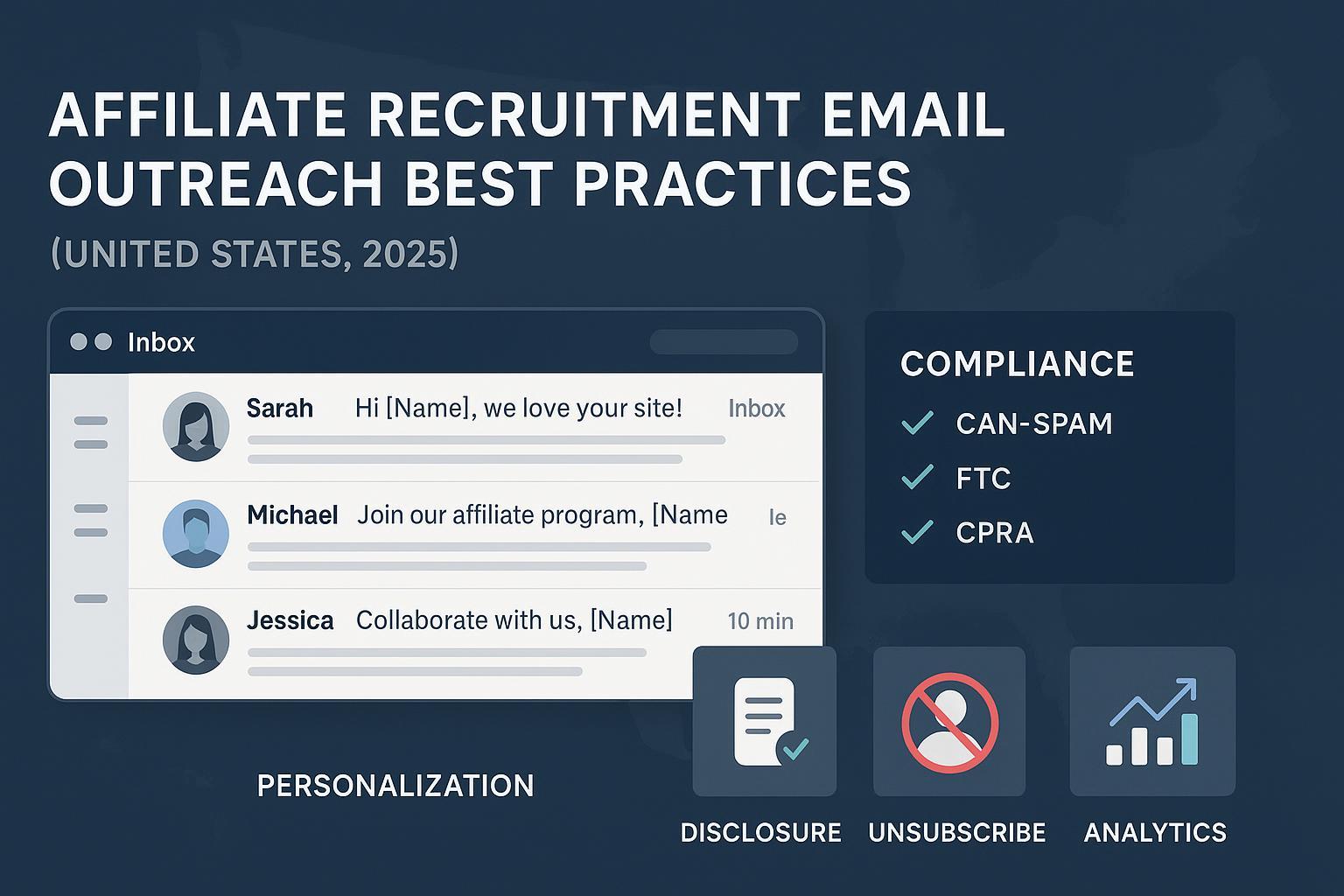
If your affiliate recruitment emails aren’t consistently generating qualified replies and sign‑ups, it’s rarely a “copy problem” alone. In 2025, US affiliates expect three things up front: a crisp value proposition, proof you run a fair and compliant program, and respectful, personalized outreach that recognizes their audience and business model.
As a US-based affiliate manager, I’ve iterated hundreds of sequences since 2023. Below is the exact process I use today—grounded in CAN-SPAM, FTC, and CPRA requirements—so you can launch a compliant campaign that converts without getting flagged as spam or eroding trust.
US-Compliant Foundations You Must Bake Into Every Email
Compliance isn’t a footer—build it into message structure from the start. Here’s what I require in every recruitment sequence and why.
-
CAN-SPAM essentials in every outreach:
- Accurate “From,” “To,” and routing; truthful subject lines; identify the message as a solicitation; include a physical postal address; and provide a visible, functional unsubscribe. See the FTC’s guidance in the CAN-SPAM Act compliance guide for business (FTC, 2025).
-
Endorsement and disclosure readiness (for onboarding and enablement):
- Train affiliates to use clear, conspicuous disclosures whenever there is a material connection and to avoid misleading claims. The FTC clarifies practical standards in its Endorsement Guides FAQ (FTC, revised 2023).
-
Digital disclosure placement principles:
- Keep disclosures close to the claim or link, prominent on desktop and mobile, and in plain language. The FTC’s “.com Disclosures” guide outlines “clear and conspicuous” requirements (FTC, original guidance PDF).
-
California CPRA/CCPA transparency for prospect lists:
- If you collect affiliate prospect emails via forms, provide a Notice at Collection listing categories, purposes, retention, and sale/share status, and link to your privacy policy. Format requirements are detailed in the CPPA regulations PDF (California Privacy Protection Agency, current rules).
Trade-offs to accept:
- More transparency can slightly reduce short-term response rates, but it dramatically lowers spam complaints and increases long-term program trust.
- Identifying the email as a solicitation may reduce curiosity opens, yet it keeps you aligned with CAN-SPAM and screens in serious partners.
Build a Value Proposition Affiliates Actually Care About
In 2025, generic “high commission” claims don’t move the needle. Anchor your pitch with details that reduce risk for the affiliate and increase confidence in earning potential.
Core elements to specify (choose 4–6 that match your program):
- Economics: Base commission, tiered accelerators, performance bonuses, exclusive rates for top performers.
- Conversion drivers: Average order value, US checkout optimizations, shipping/returns speed, seasonal offers with proven lift.
- Attribution fairness: First-party or server-side tracking, realistic attribution windows (30–60+ days), code-based attribution for social channels.
- Enablement: Dedicated US account manager, partner kit with proven angles, regular promo calendar, product seeding for reviews.
- Transparency: Real-time dashboard access, weekly or biweekly payouts, clear promo rules (e.g., bidding restrictions, coupon policies).
How to prove it without hype:
- Reference actual ranges and policies you can honor (e.g., “30-day attribution window with code-based social tracking”).
- Offer a quick audit call and share anonymized benchmarks by partner type.
- Avoid earnings claims; invite prospects to test with a small activation plan and share early conversion signals.
A Four-Touch US-Compliant Email Sequence That Converts
Target audience: US-based content creators, publishers, influencers, and deal sites. Timing assumes weekdays and non-holiday weeks.
- Touch 1 — Initial Outreach (Day 0)
-
Purpose: Establish fit and value in under ~120 words; identify solicitation; include unsubscribe.
-
Structure:
- Personalized lead-in referencing recent content.
- One-sentence program fit and 2–3 value props.
- Clear, low-friction CTA.
- Compliance lines.
-
Example copy:
Subject: Invitation to a paid affiliate partnership with [Brand]
Hi [Name], I loved your recent piece on [topic/URL]—your audience lines up with our US customers (AOV ~$[X], fast shipping, easy returns). We run a transparent program with [base %], tiered bonuses, and 30-day attribution (code-based for social).
Would you be open to a 10‑minute call to see if it’s a fit? I can share US conversion benchmarks by partner type.
This message is a solicitation to join a paid affiliate partnership with [Brand]. Our postal address is [Street, City, State ZIP]. If you’d prefer not to receive partner invitations from us, click here to unsubscribe.
- Touch 2 — Value and Social Proof (Day 3–4)
-
Purpose: Add concrete evidence and a test plan; keep short.
-
Structure:
- One proof point (e.g., seasonal promo lift).
- Activation plan offer.
- Compliance footer maintained.
-
Example copy:
Subject: Quick data point + simple activation plan
[Name], quick follow‑up. Partners promoting our [flagship product] saw a [X%] lift during last month’s US promo. If you’d like, we’ll set you up with unique codes, a 2‑week content test, and a clear FTC disclosure example to make it easy.
Opt out of partner invitations anytime here. Postal address: [Street, City, State ZIP].
- Touch 3 — Incentive or Angle (Day 7–8)
-
Purpose: Offer an exclusive rate or creative angle tailored to their audience.
-
Structure:
- One personalized angle.
- Limited-time incentive details.
- Compliance lines.
-
Example copy:
Subject: Exclusive rate for [Site/Channel] this quarter
[Name], since your audience buys [category], we can extend a [base %+X%] for Q[1/2/3/4] and provide US‑specific creative focused on [benefit]. You’ll get server‑side tracking and weekly payouts.
If not interested, you can unsubscribe here. Postal address: [Street, City, State ZIP].
- Touch 4 — Breakup or Alternate Path (Day 12–14)
-
Purpose: Close politely; offer a non-email path.
-
Structure:
- Graceful exit.
- Alternate channel (application page or calendar link).
- Compliance lines.
-
Example copy:
Subject: Should I close the loop?
[Name], I don’t want to crowd your inbox. If affiliate is low priority now, no worries. If you’d like, here’s a calendar link for a 10‑minute fit check, or apply via our program page.
Unsubscribe here. Postal address: [Street, City, State ZIP].
Practical notes:
- Keep emails scannable; reply rates tend to improve with shorter copy. In 2025, one dataset showed cold outreach reply rates around ~5% with opens ~28–32%, depending on list quality. See the Martal summary in the 2025 B2B cold email statistics (Martal, 2025) for directional context.
- Use truthful subjects; avoid gimmicks like “Quick question” when pitching a paid program—this violates CAN-SPAM’s non-deceptive subject requirement.
Tailor Messaging by Affiliate Type
One-size outreach fails. Adapt your pitch to the partner’s business model.
-
Content sites and niche publishers
- Lead with audience fit, editorial angles, and long cookie/server attribution.
- Offer sample briefs and research packets.
-
Influencers and creators
- Emphasize code-based attribution, unique landing pages, same-week payouts, and content seeding.
- Provide disclosure examples optimized for mobile formats.
-
Coupon/deal partners
- Focus on unique, rotating codes and strict coupon policies; share rules upfront.
- Offer bonus tiers tied to verified redemptions.
-
Review/SEO affiliates
- Provide structured spec sheets, comparison data, and deep links; highlight 30–60‑day attribution.
- Offer product samples for hands-on testing.
Vetting and Fraud Prevention Before and After Acceptance
Protect program quality by screening and monitoring.
Pre-acceptance checks:
- Verify content quality, engagement patterns, and audience alignment.
- Confirm channel ownership and identity; match tax/payment details to the applicant.
- Review existing disclosure practices and avoid partners making exaggerated or deceptive claims.
Post-acceptance monitoring:
- Watch for abnormalities like cookie stuffing, forced clicks, bot traffic, or unauthorized coupon leakage; enforce strict T&Cs and rotate codes. Practical countermeasures are outlined in impact.com’s prevention guidance (impact.com, current recommendations).
- Delay commission approvals until refund windows pass; validate lead quality with QA rules.
Onboarding and Activation: 30‑60‑90 Roadmap
Give new partners the path to first conversion and beyond.
-
First 30 days
- Welcome call or email, partner kit, disclosure examples, tracking setup, and one activation campaign with clear angles.
-
60 days
- Review early performance, refine landing pages and creatives, introduce tiered bonuses, and schedule next promo.
-
90 days
- Share quarterly calendar, discuss exclusive rates, and set goals for content cadence or code rotations.
Tip: Creators often scale faster with structured enablement and frequent check-ins; broader evidence of creator-affiliate growth has been reported in recent years by industry platforms, underscoring the value of systematic activation.
Measurement: Baselines, Targets, and Iteration
Track the full funnel, not just opens.
- Prospecting KPIs: delivery rate, open rate, reply rate, positive replies, acceptances.
- Post-acceptance KPIs: time-to-first conversion, activation rate, revenue per recruited partner, refund/chargeback rate.
- Iteration loop: Every 2–4 weeks, adjust value props, subject lines, send times, and partner segments; document compliance changes.
Reasonable starting targets for cold outreach (adjust by niche):
- Opens: ~25–35%
- Replies: ~3–6%
- Acceptances: ~1–3%
Common Pitfalls and How to Fix Them
-
Vague value props
- Fix: Specify commission mechanics, attribution window, enablement resources, and payout cadence.
-
Non-compliant subject lines or missing unsubscribe
- Fix: Identify solicitation in the body, keep subjects truthful, include physical address and a functional opt‑out in every email per the FTC CAN-SPAM guide.
-
Overpromising earnings
- Fix: Avoid earnings claims; invite a small test and share anonymized benchmarks. Align content with the FTC Endorsement Guides FAQ.
-
Disclosures buried or unclear on mobile
- Fix: Place disclosures near claims or links, make them prominent, and confirm mobile rendering, following the FTC’s “.com Disclosures” principles.
-
Collecting prospect emails without proper notice
- Fix: Add a Notice at Collection to your forms per the CPPA regulations PDF, and reflect any sale/share status and retention in your privacy policy.
Short Email Templates You Can Use Today
Use these as starting points; personalize heavily.
-
Ultra‑short (influencers/creators)
Subject: Paid affiliate invite for [Channel]
Hi [Name] — Your [recent video/post] on [topic] is a strong fit. We offer [base %] + weekly payouts, code‑based attribution, and a 2‑week test with seeded product. Open to a quick fit check?
This is a solicitation from [Brand]. Our address: [Street, City, State ZIP]. Unsubscribe here.
-
Short (content sites/publishers)
Subject: [Brand] affiliate program—US audience fit
Hi [Name], your coverage of [topic] aligns with our US customers (AOV ~$[X], fast shipping). Program highlights: [base %], 30‑day attribution, partner kit, and quarterly promos. Interested in a 10‑minute call?
This is a solicitation. Address: [Street, City, State ZIP]. Opt‑out here.
-
Follow‑up (value + activation plan)
Subject: Quick plan to test [product/category]
[Name], we can provide unique codes, deep links, and disclosure examples. Let’s run a 2‑week test and share early conversion signals. If not interested, unsubscribe here. Address: [Street, City, State ZIP].
Compliance Checklist (US, 2025)
- CAN-SPAM: truthful headers + subjects; solicitation identification; physical address; clear, functional unsubscribe in every email; opt‑out honored promptly. Reference: FTC CAN-SPAM compliance guide.
- FTC Endorsements: clear, conspicuous disclosures; avoid misleading claims; provide examples and monitor affiliate content. Reference: FTC Endorsement Guides FAQ (revised 2023).
- Digital disclosure placement: proximity, prominence, mobile-first rendering. Reference: FTC “.com Disclosures” guide.
- CPRA/CCPA: Notice at Collection on prospect forms; data categories/purposes/retention; sale/share status; privacy policy links and rights. Reference: CPPA regulations PDF.
- Fraud prevention: vet applicants, prohibit cookie stuffing/bots/unauthorized coupons, monitor anomalies, rotate codes, validate leads/sales. Reference: impact.com fraud prevention guidance.
Final Notes on Iteration and Ethics
Compliant outreach does more than keep you safe—it signals professionalism. Affiliates notice when a program is transparent, pays fast, and supports proper disclosures. That level of integrity compounds: it attracts better partners, reduces disputes, and ultimately improves revenue per recruited affiliate.
Use the sequence above for two weeks, measure results, and iterate. If reply rates lag, shorten copy, strengthen your proof, and segment by partner type. If complaints rise, re-check solicitation identification, subject line accuracy, and opt‑out visibility against the FTC materials cited above.
Your best partners are busy and skeptical. Respect their time, prove your value, and show you run a fair, compliant program. The sign‑ups will follow.
