
If you’re noticing fewer clicks from traditional search—even when you rank well—you’re not imagining it. Buyers are increasingly getting answers directly from AI-powered interfaces: Google AI Overviews, ChatGPT, Perplexity, and whatever comes next.
That shift changes the goal from “rank #1” to something more subtle:
Make your brand a source that these systems trust and cite.
That’s Generative Engine Optimization (GEO). And in B2B, LinkedIn is one of the fastest places to build the kind of visible expertise and authority that makes GEO work.
What generative engine optimization really means (and what it doesn’t)
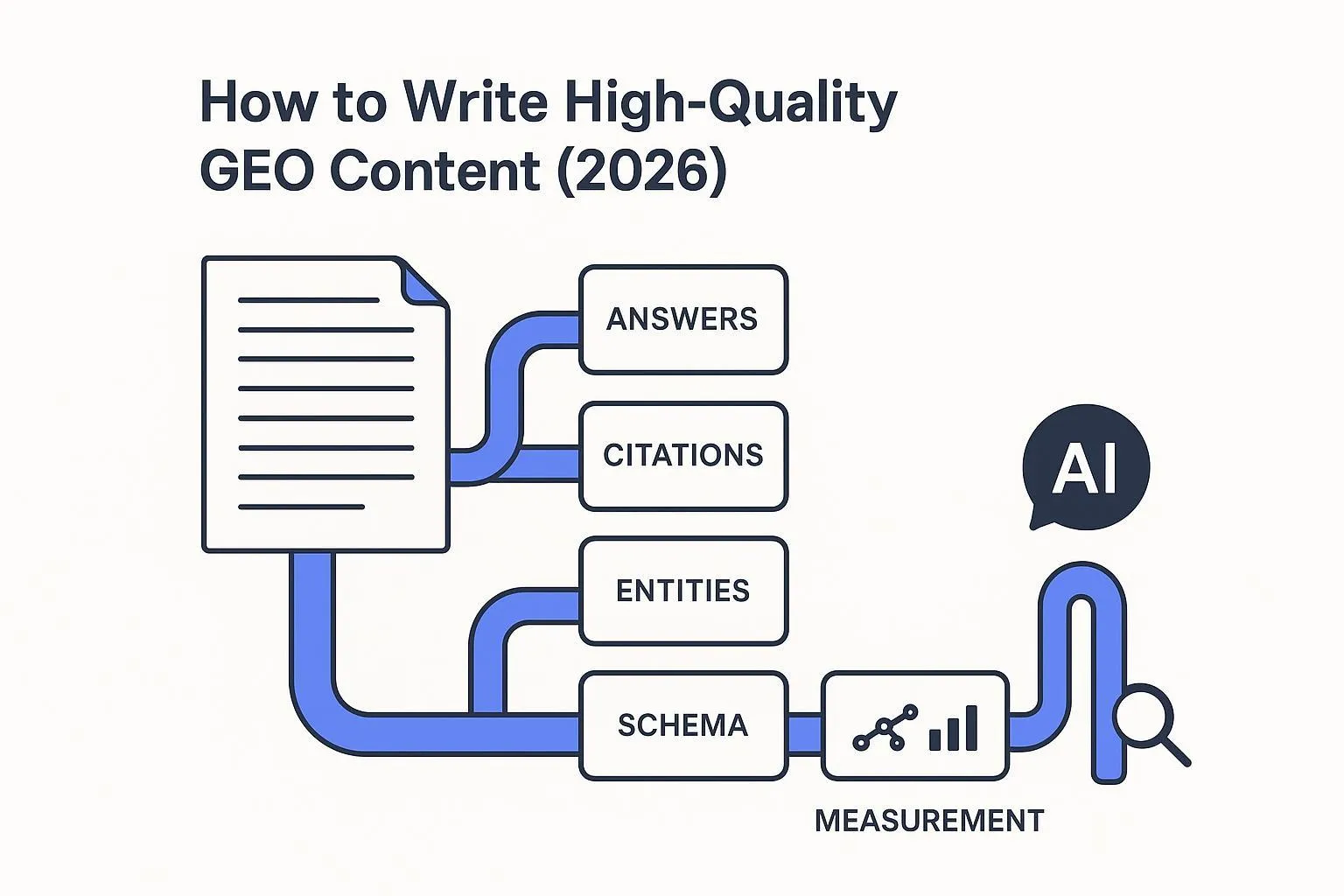
Generative engine optimization is the practice of increasing the odds that answer engines include your ideas, frameworks, and brand in generated responses.
Two important clarifications:
GEO isn’t a replacement for SEO. Your website still matters because it’s where you can publish durable, linkable, deeply detailed content.
GEO also isn’t “social media marketing with a new name.” The point isn’t vanity engagement. The point is credible, consistent signals that your brand knows what it’s talking about.
A useful mental model: SEO is earning a seat in the search results. GEO is earning a seat in the answer.
LinkedIn thought leadership is an authority surface that compounds in B2B
LinkedIn isn’t just a distribution channel. It’s an “authority surface”—a place where your expertise becomes legible to both humans and machines.
In practical terms, LinkedIn thought leadership is one of the simplest ways for a small team to broadcast consistent expertise signals without needing a massive content operation.
Here’s why it compounds:
It’s where B2B attention already is. In a Forrester analysis of B2B social media priorities, LinkedIn “far outranks other platforms,” with 87% of surveyed respondents indicating they have a paid relationship with the platform, underscoring how central it is to B2B marketing investment (see Forrester’s “LinkedIn Is Clearly King Of B2B Social Media” (2024)).
It’s where expertise is expected. LinkedIn is built around professional identity: roles, companies, projects, and informed opinions. That context makes thoughtful content feel native—not promotional.
It creates durable “who said what” signals. GEO is not only about what you publish, but also who consistently publishes it. LinkedIn makes authorship obvious.
Key Takeaway: In GEO, credibility is an input. LinkedIn is one of the cleanest places to show it—repeatedly.
How LinkedIn supports E‑E‑A‑T and brand authority signals (Experience, Expertise, Authority, Trust)
Google’s E‑E‑A‑T framework (Experience, Expertise, Authoritativeness, Trustworthiness) is designed for evaluating content quality, especially when correctness matters. Google formally added the “Experience” component in 2022 to better value first-hand knowledge (see Google Search Central’s “E‑A‑T gets an extra E for Experience” (2022)).
Even if your primary GEO target isn’t Google, the idea generalizes: answer engines prefer sources that look experienced, specific, and trustworthy.
LinkedIn helps you express those signals in practical ways:
Experience: proof you’ve actually done the work
On LinkedIn, “experience” can look like:
A post explaining a campaign you ran, what changed, and what you’d do differently
A teardown of a landing page test you shipped last week
A short story about a pipeline target you missed—and the lesson
These are not press releases. They’re “I’ve been in the arena” signals.
Expertise: repeatable frameworks, not hot takes
Expertise isn’t having opinions. It’s being able to explain why something works.
A simple test: could someone on your team apply the idea without asking you five follow-up questions?
Examples that read as expertise:
A 5-step checklist for turning one research insight into three assets
A clear definition of a new term (GEO, AIO citations, entity authority) with an example
A “decision tree” for when to publish on-site vs. on LinkedIn
Authority: being consistently referenced in a category
Authority isn’t self-declared. It’s earned through repetition and recognition.
On LinkedIn, authority grows when:
You publish around a narrow set of themes (instead of being randomly “about marketing”)
Others in your space comment, quote, or build on your frameworks
Your profile and company page clearly connect you to the category
Trust: fewer claims, more receipts
Trust increases when your content is:
Specific (dates, constraints, what you tried)
Transparent (what you don’t know, what didn’t work)
Consistent (same POV, same standards, no bait-and-switch)
The LinkedIn → website loop that improves “citability”
LinkedIn matters for GEO because it helps you build demand and credibility, then route that attention to assets on your site that are easier to cite.
Think of it like this:
LinkedIn creates visible expertise and distribution.
Your site captures durable, structured knowledge (guides, definitions, templates, research).
Those site pages become the citation targets when answer engines assemble responses.
This is also why structure matters. Research on AI Overviews suggests citations often pull from content that’s easier to extract and found earlier on the page—especially when the answer is clear and well-sectioned (see CXL’s AI Overviews citation-source study (2026)).
LinkedIn accelerates the loop because it’s a consistent place to:
test messages and angles quickly
see what objections appear in the comments
turn the best-performing ideas into on-site pages that are citation-friendly
If you want a practical workflow for coordinating those pieces without turning your feeds into spam, QuickCreator’s multi‑agent content distribution playbook lays out a quality-gated way to orchestrate blog/SEO and LinkedIn launches.
A first-week LinkedIn plan for GEO (for small teams)
You don’t need a daily posting schedule to get value. You need consistency around a few themes.
Here’s a realistic “Week 1” plan for a 1–8 person marketing team:
Day 1: pick 2–3 authority themes
Choose themes that map to revenue outcomes. Examples:
“GEO for B2B SaaS”
“Content ops for small teams”
“SEO measurement when clicks decline”
Write them down. These become your editorial guardrails.
Day 2: write one definition post
Define one GEO-adjacent term clearly:
What it is
Why it matters
One example
One misconception
Then link (softly) to a deeper on-site explainer if you have it.
Day 3: publish one “experience” post
Share something you did:
the constraint (budget, timeline, team size)
the decision
what happened
what you’d change
This is where the “Experience” part of E‑E‑A‑T becomes real.
Day 4: turn comments into a FAQ outline
Copy recurring questions and objections into a doc. Those are future sections for your site content.
Day 5: publish one framework post
Take one repeatable piece of thinking—like a content repurposing workflow—and write it as a compact framework.
If you want a system to keep this brand-consistent (and grounded in real SEO + GEO standards), QuickCreator’s guide on E‑E‑A‑T best practices for GEO is a strong reference.
Common mistakes that break GEO value on LinkedIn
Mistake 1: posting “content,” not expertise
If your posts could have been generated by anyone, they don’t build authority. GEO rewards specificity.
Mistake 2: chasing reach at the expense of trust
Over-claiming, baiting, or pretending certainty destroys the very signals you need for GEO.
Mistake 3: treating LinkedIn and your site as separate worlds
The compounding effect comes from the loop:
LinkedIn tests + distributes
your site stores + earns citations
LinkedIn points back to the best on-site assets
Mistake 4: assuming tools replace judgment
Tools help you ship. They don’t automatically create credibility.
Next steps
If you want to get serious about GEO, your goal is simple: become consistently cite-worthy in a narrow category. LinkedIn is one of the best places to start building that surface area—fast.
A low-commitment next step: audit your last 10 LinkedIn posts and ask:
Do they show experience, or just opinions?
Could a buyer repeat the idea without you?
Is there one post that deserves a deeper, on-site version?
If the bottleneck is turning those insights into a steady, brand-safe content system, take a look at QuickCreator (and the Pricing page if you’re comparing options). It’s built to help small teams run a full content workflow—topic strategy, research, writing, optimization, and distribution—without adding headcount.