
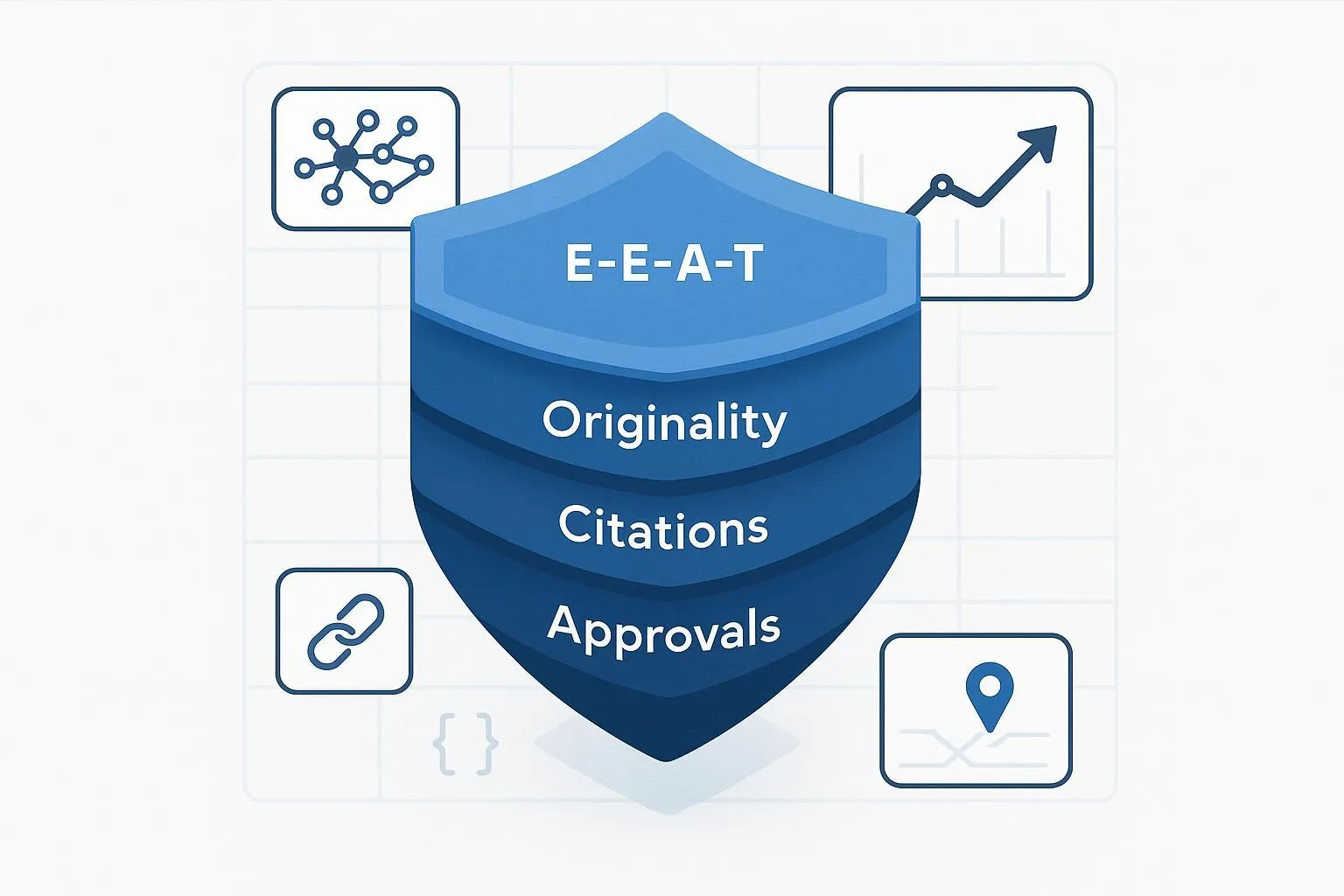
If you’re scaling content with agentic AI, the fastest way to lose visibility isn’t a missing keyword—it’s eroding trust. Weak authorship, thin sourcing, and fuzzy provenance invite quality demotions and lock you out of AI Overviews. This playbook centers on E-E-A-T safeguards and makes pre-publication controls the backbone, so you can scale confidently without sacrificing rankings or GEO presence.
Why E-E-A-T is the primary ranking risk when using agentic AI
Google states that appropriate use of automation is fine, but systems reward original, people-first content that demonstrates experience and authority. See Google’s stance in the 2023 guidance on AI-assisted content, which reiterates E-E-A-T and originality as the north star in the Google Search Central note on AI content. In 2024, Google tightened spam policies to reduce scaled low-value pages, reporting major reductions in derivative results, a reminder that volume without substance backfires; details are in the March 2024 core update and spam policies overview.
For AI Overviews and related AI features, there’s no secret markup. Eligibility mirrors normal search: indexable, high-quality pages with clear answers and credible sources. Google’s 2025 guidance explains how to be included by shipping authoritative, parseable content; see Succeeding in AI Search. Bottom line: when agentic AI accelerates production, E-E-A-T gaps are the risk to manage first.
The backbone pre-publication workflow for SEO/GEO safeguards agentic AI
Your safeguard stack should start before anything goes live. Here’s a reproducible gate that blocks low-value drafts and records provenance.
Step 1 — Originality and duplication controls. Run a plagiarism and near-duplicate scan on every draft. Flag high-similarity passages for remediation—either quote and cite, rewrite with unique insights, or cut. Avoid relying on a single “AI score”; expert roundups advise hybrid scanning plus human review, as summarized by Search Engine Land’s detector guidance.
Step 2 — Citation enforcement and fact-checking. Require inline citations for non-obvious facts, stats, and quotes. Prefer primary sources or authoritative publishers. Add a fact-check pass for numbers and sensitive claims. Clear sourcing strengthens “Who/How/Why” transparency emphasized in the Google AI content guidance.
Step 3 — Human-in-the-loop approvals. Assign role-based gates: an SME for accuracy and first-hand experience; an SEO editor for structure, links, and schema; and a managing editor for final sign-off. Capture reviewer names and dates.
Step 4 — Provenance and author credentials. Log the byline, an experience statement, evidence links, the originality scan reference, and a content hash of the approved text. This creates a durable audit trail.
Neutral example with QuickCreator. As a reference, a platform like QuickCreator’s Brand Intelligence Agent can ground drafts in a private knowledge base and route them through a Quality Analysis panel scoring Experience, Originality, Accuracy, Trust, Authoritativeness, and Expertise before human approval. For tone polish inside the gate, teams sometimes pass the draft through the AI Humanizer tool, then re-check citations and originality. Treat this as workflow support—not a substitute for expert review.
Policy thresholds you can adopt today. Originality: remediate any block with >10–15% verbatim overlap unless it’s a quoted, cited excerpt. Citations: link all non-obvious stats and third-party claims to primary or canonical sources. Approvals: never publish without SME + SEO editor sign-offs logged. Provenance: include an author bio and experience statement on the page, and capture the audit log pre-publish.
On-page E-E-A-T signals and minimal markup
Make trust visible to readers and parsable to engines. Keep the visible byline consistent with structured data, and add a concise expertise statement near the top or in a persistent author module.
Minimal Article JSON-LD example
{
  "@context": "https://schema.org",
  "@type": "Article",
  "headline": "SEO/GEO Safeguards with Agentic AI: The Playbook That Protects Rankings",
  "author": {
    "@type": "Person",
    "name": "Your Author Name",
    "url": "https://example.com/authors/your-author-name",
    "sameAs": ["https://www.linkedin.com/in/your-author/"]
  },
  "publisher": {"@type":"Organization","name":"YourOrg"},
  "dateModified": "2026-03-15"
}
Optional when you explicitly evaluate public claims, match visible content with ClaimReview. Validate snippets using Google’s Rich Results Test referenced from the structured data hub.
Internal linking governance that scales with publishing velocity
High-velocity teams suffer link decay—orphans, broken anchors, and shallow clusters. Define simple rules that ship with every page. Map each new page to a topical cluster and add 2–3 contextual links to higher-priority hubs and sibling articles using descriptive anchors, not “click here.” Ensure reciprocity by adding at least one link from an existing hub back to the new page during publish week. Enforce crawl hygiene by repairing broken links, consolidating duplicates with canonicals, and keeping important pages within a few clicks. Google’s starter guidance underscores clarity and crawlability; start from the SEO Starter Guide. For fundamentals, see Moz’s internal linking primer.
GEO tactics that improve citation likelihood
Think of GEO as “earn citations by being the cleanest answer.” AI Overviews draw from pages that standard ranking already trusts, and that present clear, sourceable language.
Answer-first composition. Open key sections with a 40–60 word direct answer. Use question-style H2/H3s and keep paragraphs tight. Practical advice aligns with step-by-step AEO playbooks like Search Engine Land’s guide to optimizing for AI search.
Eligibility hygiene. Keep pages indexable, fast, and accessible; allow Googlebot. Google’s AI features documentation stresses that standard Search eligibility applies; see AI features overview.
llms.txt as an adjunct. Use llms.txt to declare high-signal content for model ingestion. It’s not a blocker like robots.txt; treat it as a discoverability hint.
# Example llms.txt (adjunct signal, not an access control)
Collection: /guides/seo-geo-safeguards
Summary: Curated, updated playbooks on E-E-A-T, internal linking, and GEO
URL: https://example.com/guides/seo-geo-safeguards
If you need a primer, this explainer offers practical context on usage and limits: llms.txt best-practice overview. Write with explicit, cite-backed statements that models can quote. Short lists and compact tables help parsers and readers alike. That’s how your SEO/GEO safeguards agentic AI approach translates into real citations.
Measurement that proves the safeguards work
Define KPIs before rollout so you can show impact. Track indexation health, visibility, and GEO presence on a weekly cadence. For diagnostic workflows when visibility drops, this step-by-step resource can help you triage issues: Fix website impression drop.
Illustrative before and after mini-case (synthetic example for demonstration only). Two quarters of safeguards on a 200-page B2B blog.
KPI | Before | After |
|---|---|---|
Non-indexed pages | 38 | 14 |
Cluster impressions per week | 42,000 | 55,500 |
AI Overview presence across 30 queries | 4 | 11 |
Editorial defect rate | 27% | 9% |
How to collect the GEO presence metric. Maintain a fixed query list per cluster. Every two weeks, record whether an AI Overview appears and if your page is among the cited sources. Keep screenshots or logs to back up changes.
30–60–90 day rollout
Day 1–30: Implement the pre-publication gate—originality scans, citation checks, SME and SEO approvals, and a provenance log. Ship author bios and experience statements across top pages.
Day 31–60: Normalize internal linking rules and fix orphans and broken links. Add minimal JSON-LD on priority pages. Start your GEO query set and baseline checks.
Day 61–90: Publish answer-first refreshes for top clusters, add llms.txt as an adjunct map, and review KPI trends. Tighten thresholds where defects persist.
A final note on agentic AI and safeguards. Agentic systems can speed research and drafting, but safeguards keep you safely in the “original, helpful, trustworthy” zone. When in doubt, privilege first-hand experience, cite primary sources, and log your approvals. That’s how SEO/GEO safeguards agentic AI at scale.
—
Looking for a platform example to centralize knowledge grounding and pre-publication approvals? Consider QuickCreator as an implementation reference for these safeguards without changing your CMS.