If you’ve ever flipped on an automation and watched engagement dip while complaints tick up, you know the problem: scale without safeguards becomes noise. The promise of multi-agent systems is speed and coverage; the risk is channel fatigue, policy violations, and off‑brand copy amplified across every surface. Here’s the deal—spam isn’t just about frequency. It’s the absence of consent checks, pacing, personalization fit, and factual grounding. When those guardrails are missing, a product launch that should feel coordinated turns into a barrage.
This best‑practice guide shows how to run multi-agent content distribution automation that segments intelligently, respects platform and legal constraints, and ships only launch‑grade assets. We’ll anchor on a product launch syndicated across Blog/SEO, Email, and LinkedIn, and we’ll bake in content quality review, hallucination prevention, and brand intelligence so the whole campaign sounds like you—at scale.
Orchestration that won’t spam: the orchestrator–adapter–gate pattern
A resilient architecture for multi-agent content distribution automation starts with a clear separation of concerns.
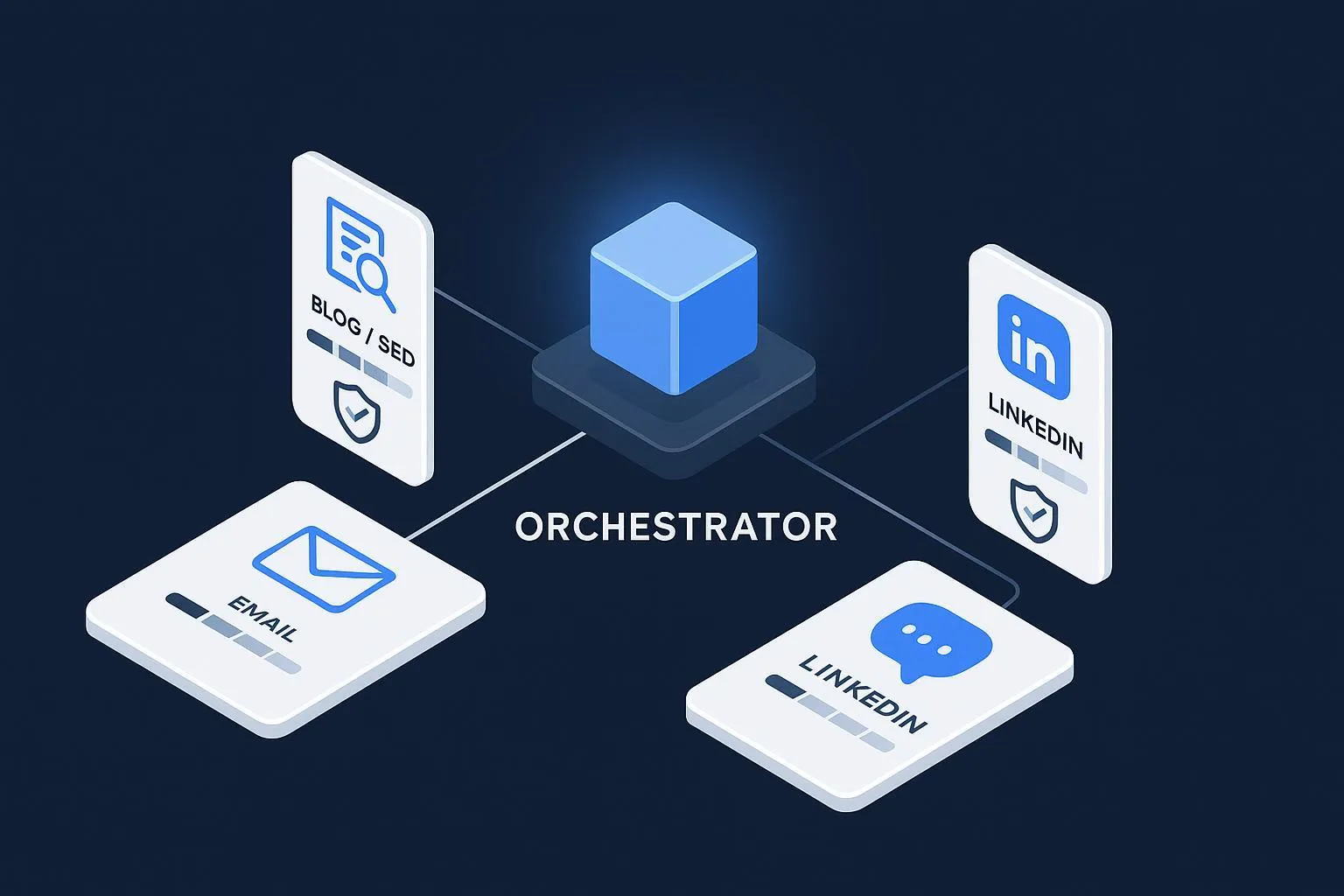
Begin with a campaign orchestrator that holds the canonical brief (launch goals, audiences, assets, and timing). It emits intents like “T‑0 publish launch blog,” then schedules dependent actions—email waves and LinkedIn announcements—while maintaining backpressure via queues and global rate controls. Under the orchestrator, channel adapters translate the canonical plan into channel‑native payloads: OpenGraph and schema metadata for the blog; ESP template variables and MIME assets for email; post objects and UTM governance for LinkedIn. Between the adapters and the outside world, pre‑flight gates enforce quality, consent, and policy compliance before anything leaves the system.
Think of the data flow like a diagram in words: a single source content node feeds the orchestrator; three edges connect to Blog/SEO, Email, and LinkedIn adapters; each edge passes through a shield (quality/compliance gate) and a metered valve (rate limiter) before reaching the destination. The shields prevent off‑brand or unsubstantiated claims; the valves prevent floods and platform penalties.
For resilience, combine asynchronous job queues with token‑bucket limits so bursts never overwhelm your ESP or social endpoints. This pattern mirrors how cloud platforms throttle requests and recommend backoff with jitter to avoid synchronized retries, as described in Google’s SRE guidance on handling overload and AWS’s documentation on request throttling. See Google’s overview on overload management in Handling Overload and AWS API Gateway’s request throttling guidance for concrete parameters and behaviors.
Timing & sequencing algorithms for safe rollout
Staging matters more than most teams realize. Start with your most engaged audiences, then widen. Use proven pacing algorithms to keep throughput healthy and complaint rates low. The table below summarizes safe defaults and when to use them in a launch scenario.
Algorithm | What it does | When to use | Starter parameters |
|---|---|---|---|
Token bucket | Smooths throughput with controlled bursts; drops or defers when the bucket is empty | ESP sends; API‑bound actions where brief bursts are okay | r = 60–120 emails/min per pool; B = 2–5× r for short spikes |
Sliding window | Caps actions over a rolling interval to prevent spikes | Social posting cadence; webhook fan‑out | window = 15–30 min; max = 1–2 actions/window |
Staged rollout | Expands audience in waves based on health signals | Launch day email waves; LinkedIn cadence | Wave 1: 10–20% most engaged; expand if complaint rate <0.3% after 24–48h |
Backoff + jitter | Spaces retries to avoid thundering herds | Any transient 429/5xx from ESP/social API | exponential backoff (2^n) with ±20% jitter; max retry budget |
Citations for these patterns come from cloud and reliability engineering sources: AWS explains token‑bucket enforcement and request throttling in API Gateway, while Google’s SRE book details client‑side throttling, retry budgets, and jitter for overload protection.
Personalization with quality gates (and zero tolerance for hallucinations)
Personalization earns attention when it’s respectful and relevant. At launch, prioritize the segments already signaling interest (recent clickers, users of adjacent features), then adapt copy to the segment’s context. Critically, require evidence for claims and route low‑confidence assertions to human review. Technical overviews from Google Cloud and IBM outline why large models hallucinate and how retrieval and validation mitigate the risk; use those principles here to ground every variant in facts from your release notes, docs, or the canonical launch post.
Three copy‑ready micro‑templates you can adapt today:
Email (announcement, engaged users): Subject: New in [Product]: ship [Outcome] without the work Preview: Live now—what changes for your team today Body lead: You asked for [capability]; today it ships. Here’s how it removes [pain] in under 10 minutes, with docs and examples linked below.
Blog/SEO meta (title/description): Title: [Product] launch: [Capability] for [Audience] — examples and setup Description: Rolling out [Capability] with real‑world examples, performance notes, and a fast start guide for teams on [stack].
LinkedIn post (company page): Lead: Today we’re shipping [Capability] to help [Audience] do [Outcome]. Value hook: 2 examples + a 90‑second walkthrough. Link: Canonical blog post with UTM governance.
A short gating checklist to keep variants honest: require inline links for any quantitative claim, enforce brand‑voice guardrails and minimum quality score before release, verify consent/suppression, and confirm canonical/UTM parameters for analytics alignment. QuickCreator’s Content Quality Score can serve as the measurable threshold for “launch‑grade” content and is documented publicly for transparency; see the Content Quality Score help page for evaluation dimensions aligned to E‑E‑A‑T.
For deliverability posture, treat complaint rate as a primary health signal and expand waves only if it remains comfortably below industry caution lines often cited by ESPs and deliverability experts; Litmus explains why deliverability discipline—not just raw delivery—matters for long‑term inbox placement.
Compliance and platform constraints you can’t ignore
Email is governed by both platform rules and law. In the United States, the CAN‑SPAM Act requires accurate headers, non‑deceptive subject lines, a physical postal address, and a working unsubscribe that functions for at least 30 days; opt‑outs must be honored within 10 business days. The Federal Trade Commission’s CAN‑SPAM compliance guide outlines these duties, and the agency’s enforcement actions underscore the stakes.
If you operate in the UK/EU, GDPR and PECR add strict consent and transparency requirements for electronic mail. Consent must be freely given, specific, informed, and unambiguous; records must be maintained, and withdrawal must be easy. The UK Information Commissioner’s Office publishes detailed guidance on when consent is appropriate and the specific rules for direct marketing via electronic mail. Because legal setups vary, coordinate with counsel before launch.
Quiet hours are best practice rather than a legal mandate for email; schedule sends during recipient‑friendly local business hours to reduce complaints. For SMS, by contrast, quiet hours can be mandated—another reason channel‑specific policies matter.
On LinkedIn, automation must respect documented rate limits and developer policies. Public documentation describes application‑level and member‑level quotas, with HTTP 429 responses on overage and midnight UTC resets. Critically, automation for organic posting is not broadly exposed via public APIs; teams should plan for native scheduling or approved partner workflows and adhere to current Developer Terms and the Marketing API changes documentation.
Rate limiting and fallbacks you can trust
Rate limiting is your safety valve. In practice, a token bucket per channel adapter, plus a global cap at the orchestrator, prevents both accidental floods and policy violations. When limits hit, defer to an internal queue rather than dropping or hammering retries. Use exponential backoff with jitter to spread retry attempts in time, and cap total retries with a budget so sick endpoints don’t cause cascading failures.
Here’s concise pseudocode you can adapt to a worker that fans out email sends or social posts:
init limiter = TokenBucket(rate=r_per_minute, burst=burst_multiplier * r_per_minute)
init retry_budget = 8

for job in queue.consume():
  if !limiter.allow():
    queue.defer(job, delay=random(5..15) seconds)
    continue

  resp = adapter.send(job.payload)

  if resp.status in [429, 503, 504]:
    if job.retries < retry_budget:
      backoff = min(2 ** job.retries, 600) * (0.8 + rand(0,0.4))
      queue.defer(job.increment_retries(), delay=backoff)
    else:
      metrics.emit("retry_budget_exhausted", job)
  elif resp.status >= 400:
    dlq.push(job)  # inspect and remediate
  else:
    metrics.emit("sent", job)
For authoritative context on these mechanisms, see Google’s SRE chapter on Handling Overload for client‑side throttling and jitter, and AWS API Gateway’s request throttling for token‑bucket semantics.
Governance: brand voice guardrails, evidence binding, and approvals
Governance turns speed into durable trust. Before distribution, attach metadata to every asset that proves it cleared the right gates: brand‑voice conformance, evidence for claims, consent/suppression snapshots, and approver details. A minimal schema might look like this:
{
  "campaign_id": "launch-2026-q2-alpha",
  "content_id": "post-001-email-wave1",
  "brand_score": 86,
  "evidence_links": [
    "https://yourdomain.com/blog/launch-alpha",
    "https://yourdomain.com/docs/release-notes-2026-q2"
  ],
  "consent_check_id": "consent-verify-9f2a",
  "suppression_snapshot_id": "suppress-2026-03-06T10:02Z",
  "qa_status": "approved",
  "approver_id": "mops-amy",
  "approved_at": "2026-03-06T10:15:00Z",
  "utm_version": "v3"
}
A neutral product example for context: teams often use a governance gate that evaluates brand voice and factual support before a job enters distribution. Platforms like QuickCreator expose a Content Quality Score aligned to E‑E‑A‑T dimensions and can block or flag assets below a threshold; see the public documentation for the Content Quality Score for how those dimensions are computed. In orchestrations where a CMS is the source of truth, an adapter such as the QuickCreator Distribution Agent can publish the canonical blog post to your site while downstream email and LinkedIn steps proceed via your ESP and native scheduling tools; this keeps governance centralized without locking you into a single channel stack.
Internal references: review the Content Quality Score help page and the Distribution Agent overview for implementation details that may map to your stack.
Product launch playbook across Blog/SEO, Email, and LinkedIn
Set the blog as your canonical source and build outward. On T‑0, publish the launch article with complete metadata: accurate title, meta description, OpenGraph images, and canonical tags. The orchestrator records the URL and UTM schema for downstream use, then opens the Email and LinkedIn tracks.
Email track: Wave 1 targets your most engaged cohort (e.g., 90‑day clickers, recent trials) at conservative pacing. Use a token bucket with a measured rate tuned to your ESP’s health, and measure complaint rate after the first few thousand sends. If complaints remain below your threshold (for many senders, practitioners treat ~0.3% as an upper caution band), expand to Wave 2 the next day. Keep subject lines descriptive—not teasing—and link to the canonical blog for claim support. If any endpoint returns 429 or you see temporary bounces rise, your queue should pause expansions automatically until health normalizes.
LinkedIn track: Announce on the company page with a value‑first hook and a short clip or carousel that demonstrates the capability. Because public APIs for organic posting are limited, schedule natively or via approved partners and mind member feedback and cadence; one strong post on launch day plus an engineering or customer spotlight a few days later typically beats a flurry.
Timing matrix in prose: T‑0 09:30 local time—Blog live; T‑0 10:00—Email Wave 1 (20% engaged cohort); T‑0 10:30—LinkedIn company post; T‑0 +24h—evaluate complaint and click‑through signals; if green, Email Wave 2 (35% mixed cohort); T‑0 +48h—Email Wave 3 (remaining opted‑in cohort) and second LinkedIn post featuring an example or short demo. Throughout, the orchestrator updates campaign health and halts expansion if complaint or bounce signals exceed thresholds.
Decision points for personalization tiers: high‑intent users (recent evaluators) get outcome‑forward copy and deeper setup links; existing customers get upgrade guidance; low‑engagement subscribers receive a lighter touch or a later wave. Your adapters enforce these tiers without branching your entire creative into dozens of brittle variants—the goal is clarity, not complexity.
One consolidated checklist to operationalize the playbook
Source of truth first: Publish the canonical blog post with clean OG/schema and canonical tags; capture the URL in your orchestrator with UTM governance.
Quality and brand gate: Require evidence‑linked claims and a passing brand‑voice score before distribution; log approver and timestamp.
Consent and suppression: Verify consent basis for region; enforce suppression for bounces/complaints; confirm unsubscribe mechanics.
Pacing and limits: Configure token buckets per channel adapter plus a global cap; use backoff with jitter and queue‑first fallbacks on 429/5xx.
Sequencing: Start with engaged cohorts; widen only when complaint and bounce signals stay healthy; schedule LinkedIn natively or via approved partners.
Measurement: Track complaint rate, unique CTR, and deliverability posture; if any cross a red line, auto‑pause expansions and trigger incident review.
What to do next
Stand up the orchestrator–adapter–gate pattern with your current stack and add rate limits before scale‑up. For governance, adopt a measurable content‑quality threshold and require evidence binding for claims; QuickCreator’s publicly documented Content Quality Score can serve as a useful reference point, and its Distribution Agent overview may help you pattern CMS‑centric publishing without overhauling your ESP or social workflows. For compliance specifics, rely on primary sources: the FTC’s CAN‑SPAM compliance guide, the UK ICO’s guidance on consent and direct marketing under GDPR/PECR, LinkedIn’s rate‑limit and policy documentation, and cloud reliability materials on throttling and backoff. When in doubt, have counsel review your regional setup—and keep your automation human‑in‑the‑loop for launch‑grade moments.
References (selected, descriptive anchors):
FTC’s CAN‑SPAM compliance guide for businesses: https://www.ftc.gov/business-guidance/resources/can-spam-act-compliance-guide-business
UK ICO on consent and direct marketing via electronic mail: https://ico.org.uk/for-organisations/uk-gdpr-guidance-and-resources/lawful-basis/consent/when-is-consent-appropriate/ and https://ico.org.uk/for-organisations/direct-marketing-and-privacy-and-electronic-communications/guidance-on-direct-marketing-using-electronic-mail/what-are-the-rules-on-direct-marketing-using-electronic-mail/
LinkedIn developer rate limits and quotas (member/app levels): https://learn.microsoft.com/en-us/linkedin/shared/api-guide/concepts/rate-limits
AWS API Gateway request throttling (token bucket semantics): https://docs.aws.amazon.com/apigateway/latest/developerguide/api-gateway-request-throttling.html
Google SRE chapter on Handling Overload (client‑side throttling, retry budgets, jitter): https://sre.google/sre-book/handling-overload/
M3AAWG on spam‑trap hygiene and remediation: https://www.m3aawg.org/help-i-hit-a-spam-trap
Litmus on why deliverability discipline matters: https://www.litmus.com/blog/why-email-deliverability-matters
Internal resources for further reading:
QuickCreator Distribution Agent overview: https://quickcreator.io/distribution-agent
QuickCreator Content Quality Score doc: https://docs.quickcreator.io/docs/seo-optimization-tools/content-quality-score