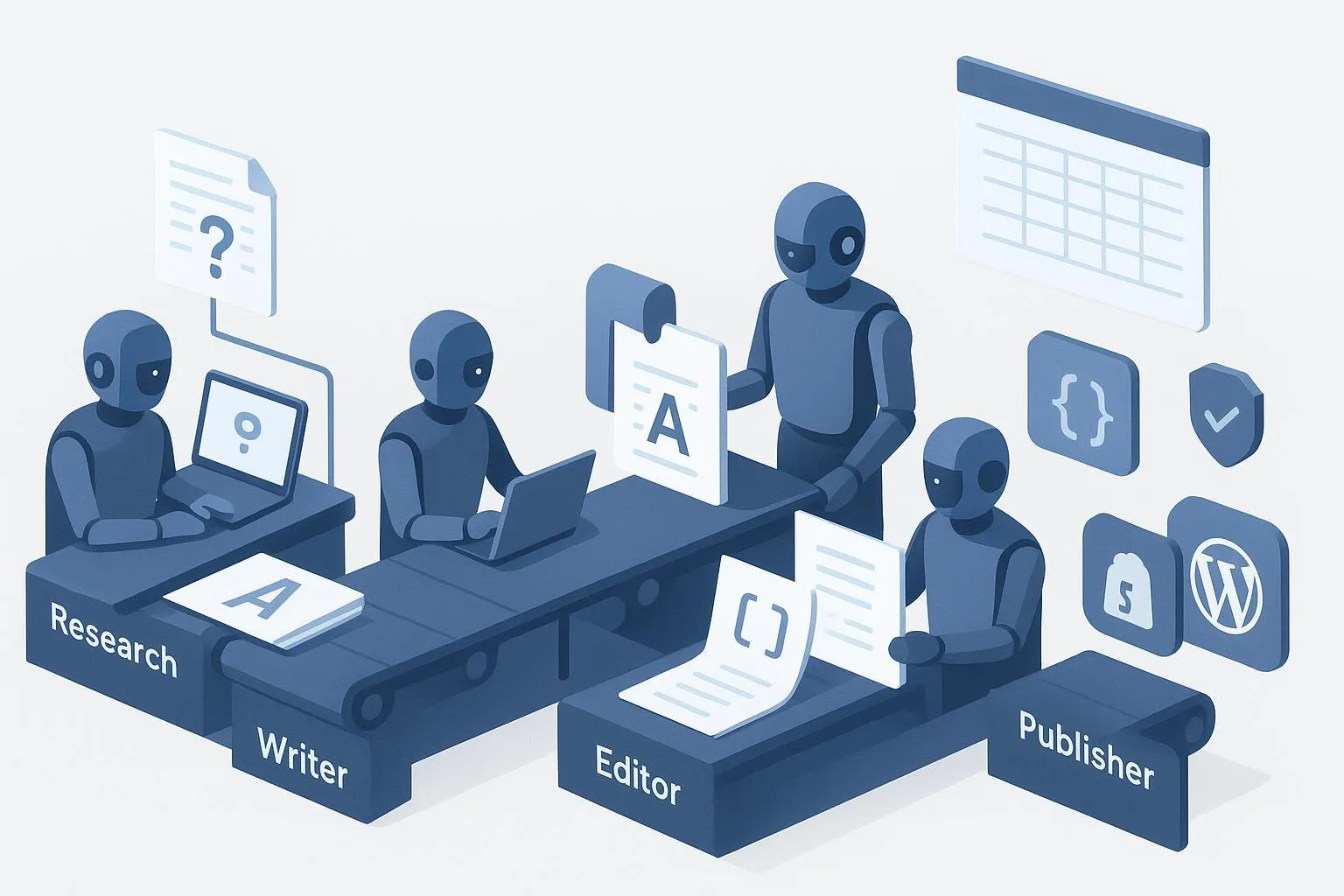
If you run a 1–5 person DTC brand, you don’t have time for bloated processes or vague promises. You need a simple, reliable way to publish 8–12 posts per week that protect your brand voice, avoid plagiarism risk, and show up in both classic search and AI surfaces. This guide shows exactly how to replace an agency with a compact AI “content team,” automate Shopify/WordPress publishing, and make each page Generative Engine Optimization (GEO) ready—without turning your site into a content farm.
What Generative Engine Optimization Means in 2026 (and why it matters)
Generative Engine Optimization is the practice of structuring content so large language models and AI search experiences can extract and cite it accurately. In practical terms, GEO‑ready pages: lead with direct answers to specific questions, reinforce the right entities with internal and external signals, and present clean metadata and schema for machines to parse. Google’s 2025 guidance emphasizes the same core as traditional SEO—useful, original, people‑first content with strong page experience—now expressed in AI surfaces as well as classic results. See Google’s overview on how to succeed in AI search experiences for the current stance and implications for content design: the focus remains on helpfulness, originality, and speed across devices, not tricks or loopholes. Source: Google Search Central, “Succeeding in AI Search” (2025) — linked here as the official guidance: Google’s guidance on succeeding in AI search experiences.
Industry best practices converge on question‑first formatting and entity clarity. Helpful overviews include Search Engine Land’s 2026 GEO primer, which details extractable structures and measurement ideas, and Directive’s tactical guide that connects entity work to on‑page patterns: Search Engine Land’s 2026 GEO guide and Directive’s GEO best practices.
Here’s the deal: you don’t have to change everything you do. You do need to be more deliberate about how you answer questions, name entities, and expose metadata so AI systems can find and cite you.
The 8–12 Posts/Week Pipeline
This pipeline is designed for a founder‑led or one‑marketer team. Batch work where possible and protect two roles: a human editor with final sign‑off and a technical operator who owns schema, publishing, and measurement.

Research and Briefs (question‑first, entity‑clear)
Start from buyer questions and conversational phrasing. Group topics into small clusters (4–6 posts each) anchored to a product or use case. For each post, define: one primary entity, 3–6 supporting entities, 5–8 core questions (write them as H2/H3), a 40–80‑word direct answer for the intro, internal links to your entity hub, and 1–2 authoritative external references you’ll cite in the body.
For discoverability in AI systems, add a curated llms.txt at your domain root with links to your best answers and product pages. llms.txt isn’t a standard like robots.txt, but reputable sources outline how it can guide model crawlers to quality resources; it’s a lightweight win with little downside. A practical overview is available via Search Engine Land’s explainer and supporting docs cited later in this article.
Drafting with Guardrails (brand‑voice safe by design)
Feed your briefs—plus a small corpus of brand voice examples and negative rules—into your drafting workflow. Require the draft to open with a concise, direct answer, then expand with evidence and examples. Keep paragraphs varied in length, use contractions naturally, and avoid padding.
A neutral example of an agentic drafting step that accepts brand voice inputs and private knowledge base grounding is available from QuickCreator. Whether you use that or another equivalent agent, the non‑negotiables are the same: no raw, unreviewed output; clear prompts; and drafts grounded in your own product facts.
Human QA and Originality (the non‑negotiable gate)
Appoint a named editor to perform line‑by‑line checks for effort, accuracy, experience, and originality. Require citations for third‑party facts with descriptive anchors and avoid over‑linking. If you quote numbers, include the year and source in the sentence. Maintain a small change log per post so you can trace provenance later.
Google’s policy allows automation but penalizes scaled content abuse regardless of tool. The safest path is consistent human oversight with visible authorship and evidence. See the official stance on AI content and spam policies here: Google’s guidance on AI‑generated content and spam policies.
GEO and On‑Page Optimization (extractable and entity‑first)
Refactor headings into questions. Put a crisp 40–80‑word direct answer immediately below each question‑style H2/H3. Reinforce your primary entity in the intro and conclusion and link to an internal entity hub. Use one descriptive external link for a definition or standard when it strengthens trust. Keep FAQ/HowTo schema expectations realistic; Google no longer shows those rich results beyond limited cases, so focus on Article and Product schema.
Publish and Automate (Shopify/WordPress)
Ship fast and consistently. Create templates for titles, excerpts, schema blocks, and internal link slots so the operator can publish in 10–20 minutes per post. Use scheduling for weekly cadence and keep an audit log of who pushed what and when.
WordPress: Use the REST API (POST /wp‑json/wp/v2/posts) to create or schedule posts and let your SEO plugin handle canonical tags; override via filters when necessary. Official docs explain the fields and scheduling behavior clearly: WordPress REST API routes and endpoints.
Shopify: Prefer the Admin GraphQL API and the articleCreate mutation to publish to your blog, including tags and metafields for schema blocks. Shopify’s reference covers required fields and scheduling nuances: Shopify Admin GraphQL articleCreate.
Measure and Refresh (GEO, SEO, ops)
Track three buckets: GEO visibility (AI citations/mentions and “share of model” proxies), SEO KPIs (clicks, impressions, ranking deltas), and operational throughput (hours per post, posts per week). Refresh top performers quarterly with new data and visibly update the “Last updated” stamp on the page. Think of it like routine maintenance—short, frequent touch‑ups beat wholesale rewrites.
Comparison: AI Agents vs. Common AI Writers vs. Manual
Capability | AI Agents (orchestrated) | Common AI Writers (single‑tool) | Manual Workflow |
|---|---|---|---|
Throughput at quality | 8–12 posts/week with QA gates and scheduling | 2–6 drafts/week; quality varies without strong prompts/oversight | 2–4 posts/week; consistent but slow |
Brand‑voice safety | Enforced via voice charter + agent checks | Prompt‑dependent; drift risk | Strong but time‑intensive |
Originality safeguards | Citations, evidence prompts, provenance logs, optional scans | Often missing unless manually added | Naturally higher; still needs citations |
GEO readiness | Question‑first structure and entity reinforcement baked in | Basic H2/H3; GEO patterns not guaranteed | Depends on team expertise |
Schema & metadata | Templated; Article/Product JSON‑LD injected | Usually plugin‑dependent | Manual copy/paste |
CMS automation | REST/GraphQL publishing, scheduling, audit logs | Export/import or plugins; limited ops controls | Manual or ad‑hoc scripts |
Governance & QA | Human‑in‑the‑loop with checklists and sign‑off | Minimal by default | Strong but slow |
Cost & risk | Software + light human time; low plagiarism risk with process | Low cost but higher drift/plagiarism risk | High human cost; low automation |
Brand‑Voice Safety Without Slowing Down
Treat your voice like a product requirement. Keep three simple artifacts and one clear role so speed doesn’t erode consistency.
Voice charter: 5–7 lines that define persona, tone, banned phrases, and sentence rhythm. Include 2–3 short exemplar paragraphs.
Negative rules: Words you never use, topics you avoid, and formatting no‑gos (e.g., don’t stuff lists; vary paragraph length).
Editor role: One human signs off on tone, claims, and citations.
A neutral QA helper that scores effort, experience, accuracy, and originality and assists with line‑by‑line fixes is documented here: QuickCreator Content Quality Score (overview). Use any equivalent approach if you prefer; the goal is a consistent checklist and a clear stop/go gate.
Originality and Citation Discipline
Your reputation depends on shipping work that’s clearly yours. Build a visible standard that anyone on your team can follow.
Evidence first: Add at least one first‑party element to every post—mini benchmarks, a product micro‑test, or a founder quote. When you cite third‑party data, name the source and year in the sentence and link to the canonical page (avoid link stuffing).
No raw AI: Require human edits and a named byline. Keep a short change log to show provenance.
Optional scans: For high‑stakes pieces, run a plagiarism scan and a semantic de‑duplication check against your own site. Fix overlaps before publishing.
Google’s structured data documentation is the canonical reference for how to mark up authorship and dates in Article/BlogPosting schema. Use it to make your signals unambiguous: Google’s Article structured data documentation.
Shopify and WordPress: Push‑Button Publishing
The goal is to make publishing the least interesting part of your week. Standardize field mappings, store your schema as a reusable block or metafield, and script the handoff so creators don’t touch the CMS until final review.
Example: Article JSON‑LD snippet you can adapt and inject at publish time (validate in Google’s Rich Results Test):
{
  "@context": "https://schema.org",
  "@type": "BlogPosting",
  "headline": "How DTC founders replace an agency with an AI content team",
  "image": ["https://yourdomain.com/images/ai-team.jpg"],
  "datePublished": "2026-03-03T09:00:00-05:00",
  "dateModified": "2026-03-03T09:00:00-05:00",
  "author": {
    "@type": "Person",
    "name": "Editor Name",
    "url": "https://yourdomain.com/authors/editor-name"
  },
  "mainEntityOfPage": {
    "@type": "WebPage",
    "@id": "https://yourdomain.com/blog/ai-content-team"
  },
  "publisher": {
    "@type": "Organization",
    "name": "Your Brand",
    "logo": {
      "@type": "ImageObject",
      "url": "https://yourdomain.com/images/logo.png"
    }
  }
}
Operational pointers for CMS automation:
WordPress: Use the REST API to create/schedule posts (status=future, date ISO‑8601). Let your SEO plugin handle canonicals or override via filters when needed; keep internal links absolute and descriptive.
Shopify: Use Admin GraphQL’s articleCreate with blogId, title, body (HTML), tags, and publishedAt for scheduling; store JSON‑LD in a metafield and render it in your theme/blog template.
If you maintain a curated domain‑root llms.txt to help AI systems discover your best content, a simple way to generate it is a template‑driven tool. For a neutral example, see the public generator from QuickCreator LLMS.txt Generator. Again, any equivalent workflow is fine as long as the file is accurate and maintained.
Troubleshooting and Rollback
Even good systems misfire. Here are pragmatic fixes you can apply quickly when signals go sideways.
AI systems aren’t citing you, even on topics you cover well. Tighten question‑first structure, refresh dates, and reinforce entities with internal links to your hubs. Add one authoritative external reference that supports your definitions. If you maintain llms.txt, update it with your new or refreshed posts and ensure it’s reachable at the root.
Article schema validates but doesn’t produce rich results. That’s normal for some features in 2026. Keep Article/BlogPosting correct and avoid relying on deprecated features (e.g., broad FAQ/HowTo rich results). Validate in Google’s tools and move on.
CMS field mismatches or failed publishes. In WordPress, confirm taxonomy term IDs exist before assigning them via REST. In Shopify, double‑check blogId and metafield namespace/key/type. Log each publish action and keep a simple rollback (revert to draft, unpublish, or hotfix template) ready.
Brand drift shows up in comments or support tickets. Pause the pipeline for that topic cluster. Tighten your voice charter and negative rules, add a second editor review for the next two cycles, and sample older posts for similar drift.
Next Steps: Make the Workflow Yours
Start with one cluster this week: six tightly scoped posts anchored to a product use case. Build your brief template, draft with guardrails, enforce human QA, and publish on a schedule with schema injected at the template level. Measure GEO citations and SEO clicks; adjust your cadence based on hours per post.
If you want to examine a neutral example of an agentic drafting step with brand‑voice inputs and private KB grounding, the AI Writing flow from QuickCreator is one option among several that can fit this playbook. For generating or updating a curated llms.txt at your domain root, the public QuickCreator LLMS.txt Generator shows how a template‑driven approach can keep it current.
Finally, for broader context on Generative Engine Optimization mechanics and why question‑first, entity‑clear pages help AI systems extract and cite your content, pair Google’s AI search guidance with a reputable industry overview like Search Engine Land’s 2026 GEO guide and Directive’s best‑practice explainer. Those three links, plus your own measurement discipline, will keep your system grounded and adaptable.
Author: A content ops lead who’s implemented GEO‑aware pipelines for DTC brands on Shopify and WordPress.