If you lead marketing, you don’t just care whether AI answers exist—you care whether they’re accurate, cite the right pages, and increasingly reference your brand. That’s the real meaning of Bing AI performance for teams today: how reliably Bing Copilot grounds its answers in credible sources and when your content is chosen as one of them.
This guide explains how Copilot retrieves and cites sources, what the new AI Performance report in Bing Webmaster Tools actually measures (and what it doesn’t), and gives you a repeatable benchmarking workflow to analyze competitors, close content gaps, and track progress without overpromising traffic.
What Bing AI performance really measures today
Bing Copilot uses retrieval‑augmented generation: it enhances a user query, performs a Bing search, pulls in relevant pages, validates provenance, and composes a summary with citations. Microsoft’s documentation on using public websites for generative answers details this retrieval and grounding process and shows how citations surface in answers. See Microsoft’s guidance on public web grounding and citation display in Copilot Studio docs (2025–2026) for the mechanics of RAG and references: Using public websites for generative answers and Knowledge in Copilot Studio.
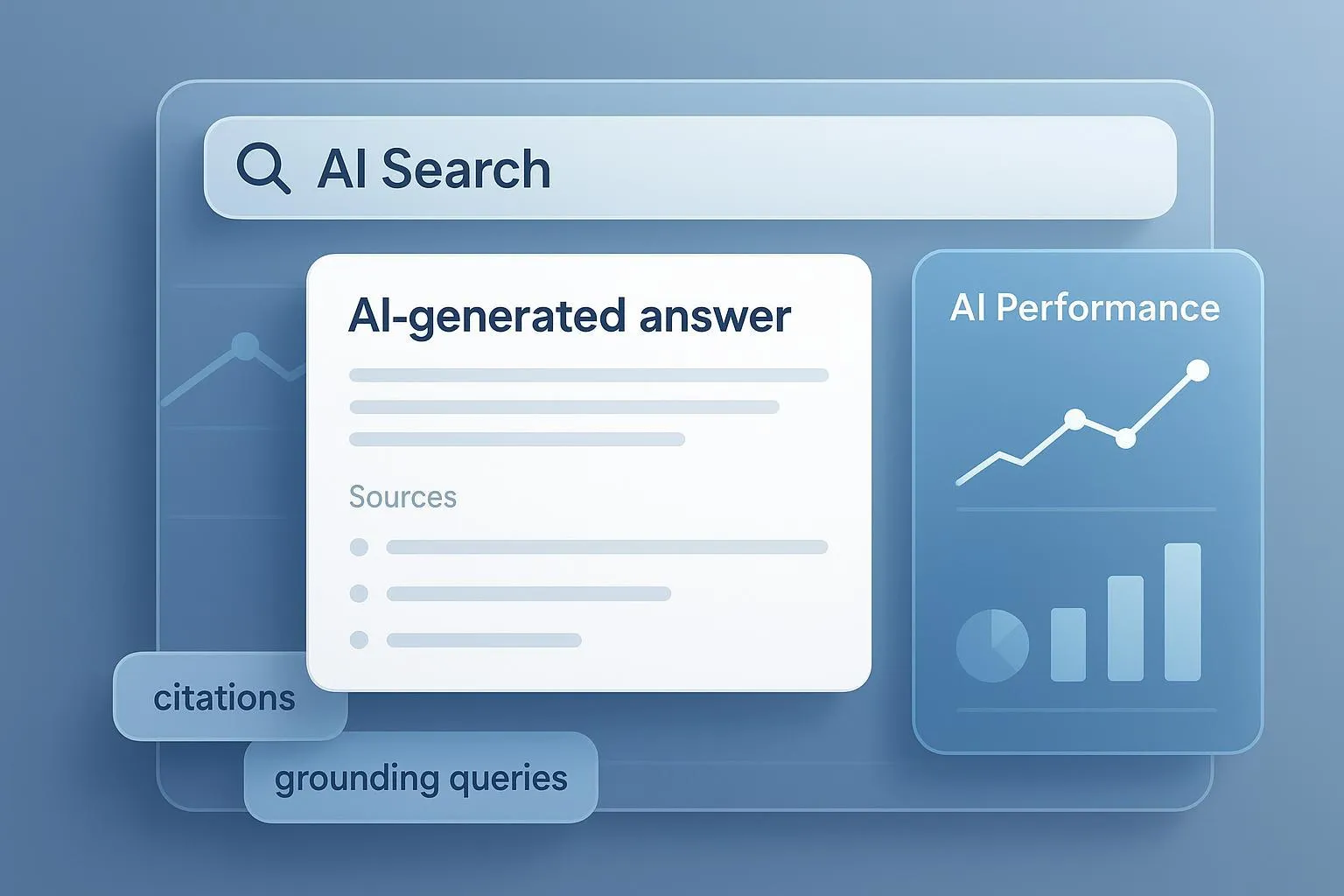
On the measurement side, Microsoft introduced the AI Performance report in Bing Webmaster Tools in public preview in 2026. According to the Microsoft Bing Webmaster Blog (Feb 2026), the report shows when your site is cited in AI‑generated answers across Microsoft Copilot and Bing’s summaries, including:
Total citations over a selected period
Average cited pages per day
Page‑level citation timelines
Sampled grounding queries that Copilot used to retrieve your content
Read Microsoft’s announcement: Introducing AI Performance in Bing Webmaster Tools (Public Preview). Early trade coverage emphasizes that clicks are not included, so you cannot compute CTR or direct revenue impact from this view; see Search Engine Land’s 2026 summary: Bing Webmaster Tools testing new AI Performance report.
Two essential caveats for every executive:
Visibility ≠ visits. Citations indicate eligibility and trust signals, not traffic or conversions. Use them as GEO telemetry, not as a revenue proxy.
Grounding queries are sampled and aggregated. Treat them as directional hints, not exhaustive logs, as noted in multiple practitioner walkthroughs (e.g., Momentic’s report guide).
Quick wins to protect accuracy and increase citation eligibility
You can move on these in a week or less and immediately improve “citation‑readiness.”
Structure content for extractable evidence Break complex paragraphs into atomic, verifiable claims with primary‑source links. Use clear H2/H3s, concise definitions, and FAQ/HowTo blocks when appropriate. Why this matters: Bing’s LLMs use structured cues to understand and ground content; Microsoft’s Fabrice Canel stated in 2025 that schema markup helps its LLMs learn and interpret pages. See Search Engine Land’s coverage of schema and Bing Copilot.
Push freshness and recrawl When you publish substantive edits, push updates via IndexNow and request recrawl. Fresh, crawlable pages are more likely to be retrieved and cited promptly. Reference: IndexNow and freshness best practices summarized in the same SEL report above.
Prioritize provenance and primary sources Link out to original research, official docs, and dated evidence. Copilot’s grounding filters benefit from clear provenance signals. Microsoft’s Copilot Studio documentation underscores that when web search is on, the system interleaves web results and attaches references. See Copilot Studio guidance.
Here’s the deal: none of these changes guarantees more citations tomorrow—but they reduce friction in retrieval and make your pages easier to “quote” correctly.
The competitive benchmarking playbook
Make factual accuracy and source grounding measurable with a five‑step loop that blends WMT exports with SERP observation.
Establish your baseline In Bing Webmaster Tools → AI Performance, export: total citations (30–90 days), average cited pages, page‑level citation counts, and grounding queries. Practitioners provide walk‑throughs and screenshots of exports; see Momentic’s guide and Cadence SEO’s review. In WMT → Search Performance, pull rankings for priority topics. Correlate classic SEO with AI citation visibility to spot mismatches.
Observe Copilot citations on live SERPs Run your priority queries in Bing/Copilot. Record which domains get cited, how often sources are shown, and whether “Show all sources” expands to broader references. Microsoft emphasized prominent, clickable citations when Copilot Search rolled out in 2025–2026; see Search Engine Land’s coverage of Copilot Search and citations.
Diagnose structural and entity gaps Compare your non‑cited pages vs. competitor‑cited pages for: atomic claims, FAQ/HowTo blocks, criteria‑based tables, schema coverage (Article/FAQ/HowTo/Breadcrumb/Organization/Product as relevant), freshness signals, and internal links that reinforce entities. Microsoft’s guidance on using public websites for generative answers and grounding reinforces the value of clarity and provenance; see Using public websites for generative answers.
Close technical hygiene and freshness gaps Ensure indexability (no accidental noindex/nofollow, robots.txt allowing crawl), consider dynamic rendering for heavy JS, push updates via IndexNow after structural edits. Microsoft and practitioner sources reiterate this; see schema and freshness notes.
Re‑measure, annotate, and iterate Re‑export AI Performance monthly. Annotate your change log (what changed, when) and track deltas in total citations, average cited pages, and the spread of grounding queries by topic. Expect sampling noise—look for multi‑week trends, as trade coverage warned when the preview launched; see Search Engine Land’s preview note.
Tip: Think of this loop as GEO instrumentation. You’re optimizing for eligibility and correctness signals, not guaranteed traffic.
KPIs and an executive dashboard you can actually maintain
Use a compact set of KPIs you can pull every month in under an hour. Below is a concise table you can replicate in a sheet.
KPI | What it means | Where it comes from | Cadence |
|---|---|---|---|
Citation frequency | Count of AI citations referencing your site in period | WMT → AI Performance export | Monthly |
Average cited pages | Avg. daily unique URLs cited | WMT → AI Performance export | Monthly |
Grounding query coverage | Share of sampled grounding queries that map to target topics/entities | WMT → AI Performance export | Monthly |
Cited‑page ratio | Cited pages ÷ total indexed pages in topic cluster | WMT AI Performance + index estimates | Quarterly |
Time‑to‑citation | Days from major update to first new citation | Change log + WMT AI Performance | Monthly |
Accuracy risk flags (YMYL) | Incidents of questionable or incorrect AI references | Manual SERP checks + SME review | Ongoing |
How to interpret
Rising citation frequency with a stable or declining number of sources in the answer often signals stronger eligibility for your pages.
A widening set of grounding queries aligned to your entities suggests your semantic coverage and structure are working.
Time‑to‑citation helps validate freshness workflows (IndexNow, recrawl requests). If it balloons, your update pipeline may be slowing retrieval.
Mini‑case: What a cited competitor page does differently
Consider two B2B SaaS guides targeting the same intent: “SOC 2 compliance checklist for startups.” One page leads with a crisp definition that cites the AICPA, follows with a short numbered checklist of atomic steps, and includes an FAQ that answers six common questions in one or two sentences each. It closes with a criteria table mapping controls to audit artifacts and links to the primary source. The page shows a recent update date, uses Article and FAQ schema, and the team pushed an IndexNow ping immediately after edits.
Now contrast that with a narrative post that buries definitions in long paragraphs, uses few outbound references, and lacks structured elements. When you run the query in Bing/Copilot, the first page is more likely to be cited because its evidence is easier to extract and verify. Use your WMT grounding queries to confirm the retrieval terms, then ship edits to your page—add the criteria table, convert dense paragraphs into atomic claims with primary sources, and push the update. Track whether the page enters the cited set within 30–60 days.
Remember: for YMYL topics like security, law, or finance, add SME review and ensure every claim points to authoritative, current sources.
Governance for high‑risk topics
Some claims can’t tolerate ambiguity. Build a lightweight governance track for YMYL content. Require SME review before publishing or materially editing medical, legal, or financial guidance. Demand citations to primary, dated sources—statutes, official standards, government or recognized bodies—rather than relying on news recaps. When Copilot cites one of your pages with an outdated or risky claim, activate a rapid correction SOP: update the page, add a brief clarifying note if needed, push via IndexNow, and recheck SERPs within 48–72 hours. Keep an audit log that ties each edit to the triggering issue and verification source. This isn’t red tape; it’s brand safety.
Tools that help operationalize the workflow (neutral)
Teams often stitch this together with spreadsheets and calendar reminders. A content ops platform can reduce manual effort by standardizing checklists, enforcing EEAT guardrails, and keeping change logs consistent across editors. For example, you can use an internal workflow or a platform like QuickCreator Content Quality & Optimization Agent to standardize “AI‑citation readiness” checks—structuring atomic claims, ensuring outbound provenance links, and organizing SME reviews and change logs. Pair this with your WMT exports for measurement. For keyword coverage or rank spot‑checks that correlate with topic visibility, free utilities such as QuickCreator’s Keyword Density Checker can help during drafting.
No tool today guarantees more Bing Copilot citations. Tooling simply makes the operational discipline repeatable.
Your 30/60/90‑day plan
Days 1–30: Stand up the loop. Verify WMT access, export AI Performance and Search Performance baselines, select 10 priority queries, and perform manual Copilot citation checks. Create a change log template and assign owners. Ship quick wins on five pages: add schema (Article plus FAQ/HowTo as relevant), convert dense paragraphs to atomic claims with primary sources, and push via IndexNow.
Days 31–60: Run competitive gap analysis on the 10 queries. For each, compare your page to the top cited competitor page and ship one structural improvement—an FAQ block, a criteria table, or an entity‑rich definition—each week. Re‑export WMT AI Performance and annotate deltas. Watch citation frequency and grounding query coverage by topic.
Days 61–90: If the first cohort shows improvement, expand to 10–20 more pages. Introduce time‑to‑citation tracking and a monthly executive dashboard review. For YMYL topics, formalize SME checklists and a 72‑hour correction SOP.
What’s next? Keep the loop running; think in quarters, not days. Generative engines reward consistent clarity and provenance over time.
References and further reading
Microsoft Bing Webmaster Blog (2026): Introducing AI Performance in Bing Webmaster Tools (Public Preview)
Search Engine Land (2026): Bing Webmaster Tools testing new AI Performance report
Microsoft Copilot Studio Docs (2025–2026): Using public websites for generative answers; Knowledge in Copilot Studio
Search Engine Land (2025): Schema markup helps Bing’s LLMs understand content
Practitioner walkthroughs: Momentic Marketing’s AI Performance guide; Cadence SEO’s review