
How AI marketing agents boost B2B SaaS SEO automation
Best-practice guide for using AI marketing agents to automate B2B SaaS SEO—research, briefs, internal linking, GEO, metrics & brand-safety guardrails.
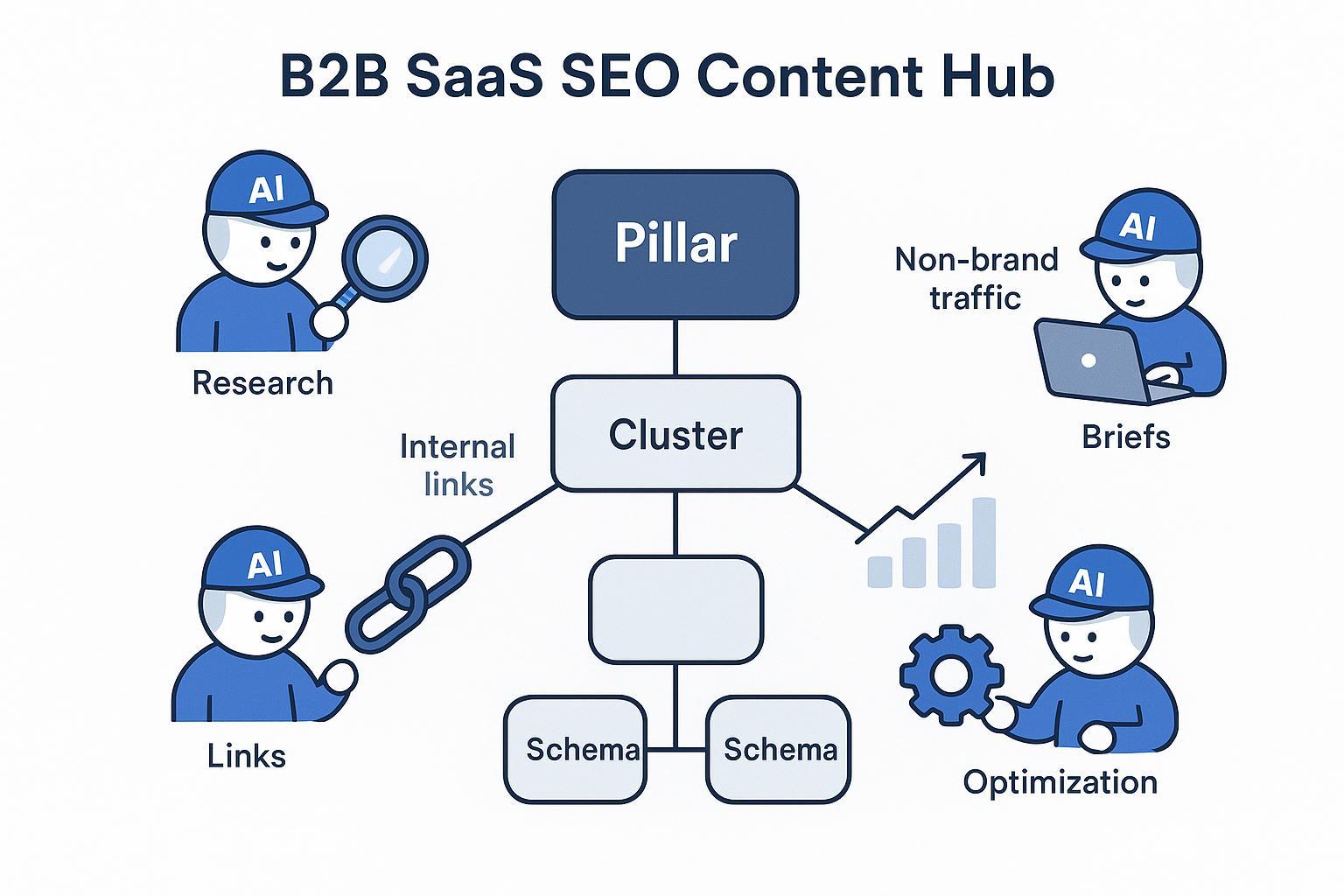
Non-brand organic traffic growth q/q is the north star for most lean B2B SaaS teams. This guide shows, in practical detail, how AI marketing agents boost B2B SaaS SEO automation by orchestrating a feature pillar plus six to ten supporting pages. You will see exactly which agents to deploy, how to structure briefs and internal links, how to prepare for GEO, and which metrics and guardrails keep output safe and on brand. Templates and copy‑paste prompts are included so you can move from idea to indexed pages faster—without sacrificing quality.
What AI marketing agents actually do for SEO
When people ask how AI marketing agents boost B2B SaaS SEO automation, the answer is coordination. Each agent handles a defined slice of the workflow and passes structured outputs forward with human approvals baked in.
Research and Topic Intelligence
The Research Agent clusters seed keywords by intent, snapshots the SERP, maps entities, and surfaces opportunity gaps. Outputs include a cluster map for the feature pillar and the six to ten supporting pages. Google’s own guidance highlights that a clear site structure and internal links help crawlers understand importance and discover content; use descriptive anchors and logical hierarchies, not manipulative patterns, as explained in the updated SEO Starter Guide and sitelinks overview from Google Search Central (see Google’s SEO Starter Guide and the sitelinks documentation for the canonical framing).
Briefing and Content Planning
The Briefing Agent produces structured briefs with H1 and H2 outlines, primary and secondary terms, intent notes, meta guidance, internal link targets, schema suggestions, and acceptance criteria. Practitioners have shown that stepwise headings and explicit definitions make content easier for both readers and generative systems to parse; see discussions on how LLMs interpret content structure in industry analyses.
Internal Linking
The Internal‑Linking Agent proposes a candidate link graph connecting pillar to clusters, suggests descriptive anchor variants, flags orphan pages, and warns about over‑linking. Practitioner playbooks from Ahrefs and Moz emphasize hub‑and‑spoke structures, fixing orphan pages, and avoiding repetitive exact‑match anchors to maintain naturalness and equity flow across the cluster.
GEO and Schema
The GEO/Schema Agent prepares JSON‑LD for Article or FAQPage where eligible, keeps markup in parity with visible copy, and validates before publish. Google’s documentation notes that structured data helps systems understand a page but doesn’t guarantee any specific presentation; eligibility for AI features aligns with core ranking signals like helpful content, indexability, and internal links.
Optimization and Quality
The Optimization Agent scores on-page elements, checks E‑E‑A‑T signals, reviews Core Web Vitals suggestions, and confirms indexability and internal link discoverability. Recent reporting on core updates underscores that scaled, low‑value content underperforms while experience‑led, well‑cited work earns visibility.
How AI marketing agents boost B2B SaaS SEO automation: end‑to‑end workflow
This section demonstrates how AI marketing agents boost B2B SaaS SEO automation by launching one feature pillar and six to ten supporting pages. The workflow is designed to improve non‑brand organic traffic q/q while preserving brand safety and factual accuracy.
Discovery and clustering
Inputs include seed keywords, ICP pain points, competitor URLs, and Search Console queries filtered for non‑brand. The Research Agent clusters by intent, snapshots the SERP for the pillar and each cluster page, maps entities, and runs a gap analysis. The output is a topic cluster map naming the feature pillar, defining six to ten supporting pages, and assigning a primary plus several secondary terms to each page. A reasonable SLA is four to eight hours to deliver brief‑ready clusters for an established domain.
Well‑formed clusters later feed internal links. Clear hierarchies and descriptive anchors align with Google’s framing on internal linking and sitelinks in the SEO Starter materials, which stress clarity and discoverability over tactics designed to manipulate rankings. See the SEO Starter Guide and sitelinks pages for canonical details from Google Search Central.
Briefs that search and LLMs can parse
Using the cluster map, brand voice rules, private knowledge base facts, and KPI targets, the Briefing Agent generates per‑page briefs: H1 and H2s, keyword mapping, meta title and description guidance, URL slug, internal link targets by URL with anchor variants, schema recommendations, visual suggestions, and acceptance criteria. Expect one to two hours to produce and route briefs for approval.
Industry analyses explain that clear hierarchical headings and explicit task steps correlate with inclusion in featured snippets and AI summaries when content is helpful and original. See practitioner explainers on how AI Overviews choose content and how LLMs interpret structure for details and examples.
Draft to optimize to approve
With the brief and private KB, the drafting agent produces copy, inserts citations near factual claims, proposes internal links, and runs on‑page checks for headings, alt text, and schema parity. Human‑in‑the‑loop SLAs keep quality high: editor review within 24–48 hours and SME approval within three business days for technical claims. Outputs include a change log and an E‑E‑A‑T scorecard; drafts with low confidence are rerouted for revision.
Large‑scale analyses of Google updates in 2024–2025 highlight that thin, scaled content often loses visibility while experience‑backed work fares better—another reason to maintain approvals and KB grounding instead of chasing speed alone.
Build the internal link graph
Input a site crawl, page importance scores, and the new pillar and cluster URLs. The Internal‑Linking Agent generates a prioritized list of contextual links from existing related posts and from each cluster page back to the pillar; it provides descriptive, varied anchor text, warns if anchors become repetitive, and identifies orphan pages for fixes. Outputs are a link insertion plan with source, target, and anchor suggestions, plus QA checks after publish.
This mirrors respected guidance from Ahrefs and Moz on hub‑and‑spoke structures, descriptive anchors, and orphan‑page remediation—tactics that improve discoverability and topical authority without resorting to manipulative patterns.
GEO readiness and schema
For each page, the GEO/Schema Agent prepares JSON‑LD—Article for most guides and FAQPage if real Q&A exists in the visible copy—ensuring strict parity with on‑page content and validation before publish. Google is explicit that there is no special switch for AI features; eligibility follows core ranking signals such as helpful content, indexability, and strong internal links. Structured data clarifies meaning but doesn’t guarantee presentation in search or AI features.
{
    "@context": "https://schema.org",
    "@type": "Article",
    "headline": "How AI Marketing Agents Boost B2B SaaS SEO Automation",
    "datePublished": "2026-03-05",
    "author": {"@type": "Person", "name": "Editorial Team"},
    "publisher": {"@type": "Organization", "name": "Your Company"}
  }
A neutral micro example using QuickCreator
In practice, an agentic platform can compress the brief‑to‑link‑graph handoff. For example, QuickCreator’s AI Writing Agent accepts a cluster map and private knowledge base references to produce structured briefs and suggest initial internal link targets for the pillar and supporting pages. Editors then review anchors and finalize insertions before scheduling posts. See the overview of the AI Writing Agent for a description of brief generation and internal‑link suggestions in a coordinated workflow: QuickCreator AI Writing Agent.
Metrics, dashboards, and guardrails that keep you safe
Primary KPI
Non‑brand organic traffic growth q/q = ((current quarter non‑brand sessions − prior quarter) ÷ prior quarter) × 100. Use Search Console to filter out brand queries and corroborate with GA4 non‑paid organic segments.
Secondary metrics and realistic targets (expressed in prose to avoid list bloat)
Track velocity (briefs per week and pages per week), time to brief (hours from discovery to approved briefs for the cluster), and draft‑to‑publish latency (days from first draft to live URL). Monitor internal link density by averaging links to and from the pillar per cluster page and watch your orphan‑page count trend down. For GEO/AIO, use proxies such as the count of eligible FAQ or HowTo snippets and observed AI‑generated answer appearances where measurable. Finally, watch publish‑to‑index lag in days via Search Console; shorter lags often correlate with healthier technical and link structures.
Target ranges and reality checks
On an established B2B SaaS domain, a conservative goal for a well‑executed feature pillar launch is mid‑teens percentage growth in non‑brand organic traffic q/q within one to two quarters, provided content quality and technical health are strong. Treat this as a scenario target, not a promise. Also remember that ranking takes time: large‑scale research shows only a portion of pages earn top positions within months and many never do within a year, reinforcing the value of sustained quality and smart internal linking over one‑off pushes.
Guardrails for brand safety and factual grounding (kept concise and enforceable)
Ground all drafts in a private knowledge base and require citations for every statistic or definitional claim. Enforce human‑in‑the‑loop SLAs—editor review in 24–48 hours and SME approval within three business days for technical assertions. If factual confidence or citation coverage falls below threshold, block publishing and reroute to a subject‑matter expert. Maintain change logs and prompt/version history for audits. Avoid storing PII in the KB and restrict crawler scopes and integrations to what’s necessary.
Reviewer micro‑checklist (compact)
Confirm the draft matches the brief’s H1/H2 map and includes the primary keyword in the title and at least one H2 without stuffing. Ensure authoritative citations are present and linked inline. Verify internal links connect every cluster page to the pillar and relevant siblings using varied, descriptive anchors. Validate schema parity with visible content. Finally, confirm author credentials and other E‑E‑A‑T signals are accurate and visible.
Copy‑paste prompts and checklists
Prompts
Research seed: Cluster keywords for [feature] targeting [ICP]. Segment by intent. List entities and FAQs. Map to one pillar and six to ten supporting pages.
Brief generator: Using this cluster and our KB facts, create a brief with H1 and H2s, primary and secondary keywords, intent notes, meta guidance, internal link targets with anchor variants, schema recommendations, and word count targets.
Internal link suggester: Given our site map and the new cluster URLs, propose ten contextual internal links with descriptive varied anchors from related legacy pages. Avoid duplicates and repetitive exact‑match anchors.
Internal link QA checklist (short)
Each cluster page links to the pillar at least once and to two to four relevant siblings.
Anchors are descriptive and varied with no sitewide exact‑match patterns.
No orphan pages remain and click depth for cluster pages stays reasonable.
Hreflang cross‑links are present for localized variants where applicable.
Schema stub (FAQPage example)
{
    "@context": "https://schema.org",
    "@type": "FAQPage",
    "mainEntity": [
      {
        "@type": "Question",
        "name": "What is an AI marketing agent",
        "acceptedAnswer": {"@type": "Answer", "text": "An AI marketing agent is a task‑specific system that automates parts of research, briefing, linking, schema, and optimization with human approvals."}
      }
    ]
  }
Tooling map and integration tips
Use a keyword clustering and SERP snapshot tool that supports intent segmentation and entity insights; vendor guides on on‑page structure and audits are useful for aligning briefs with best practices. Ensure your CMS exposes APIs and workflow states so you can insert structured data, automate safe internal links, and track approvals. Keep a private knowledge base to ground drafts in proprietary product facts and attach provenance to each claim. Connect analytics and Search Console to segment non‑brand traffic q/q and monitor index coverage and rich‑result eligibility. Finally, run internal‑link graph utilities to identify orphan pages, prioritize hubs, and enforce descriptive anchors without repetitive patterns.
What to do next
Publish your first feature pillar cluster using the workflow above, then track non‑brand traffic q/q and iterate. For publishing orchestration and multi‑channel distribution, see the overview of the QuickCreator Distribution Agent.
Sources and further reading (authoritative, linked inline above)
Google’s SEO Starter Guide and sitelinks overview clarify internal linking, structure, and discoverability; see the canonical resources from Google Search Central: SEO Starter Guide and Learn about sitelinks.
Google explains eligibility for AI features is based on core quality and ranking signals—there is no special “AIO SEO” switch. See Google’s AI features documentation.
Practitioner guidance on internal links and on‑page structure: Ahrefs on on‑page SEO and internal links and Moz’s internal linking guide.
Context on algorithm and quality emphasis in 2024–2025: Search Engine Land’s core‑update coverage.
Ranking timelines perspective: Ahrefs’ study on how long it takes to rank.