
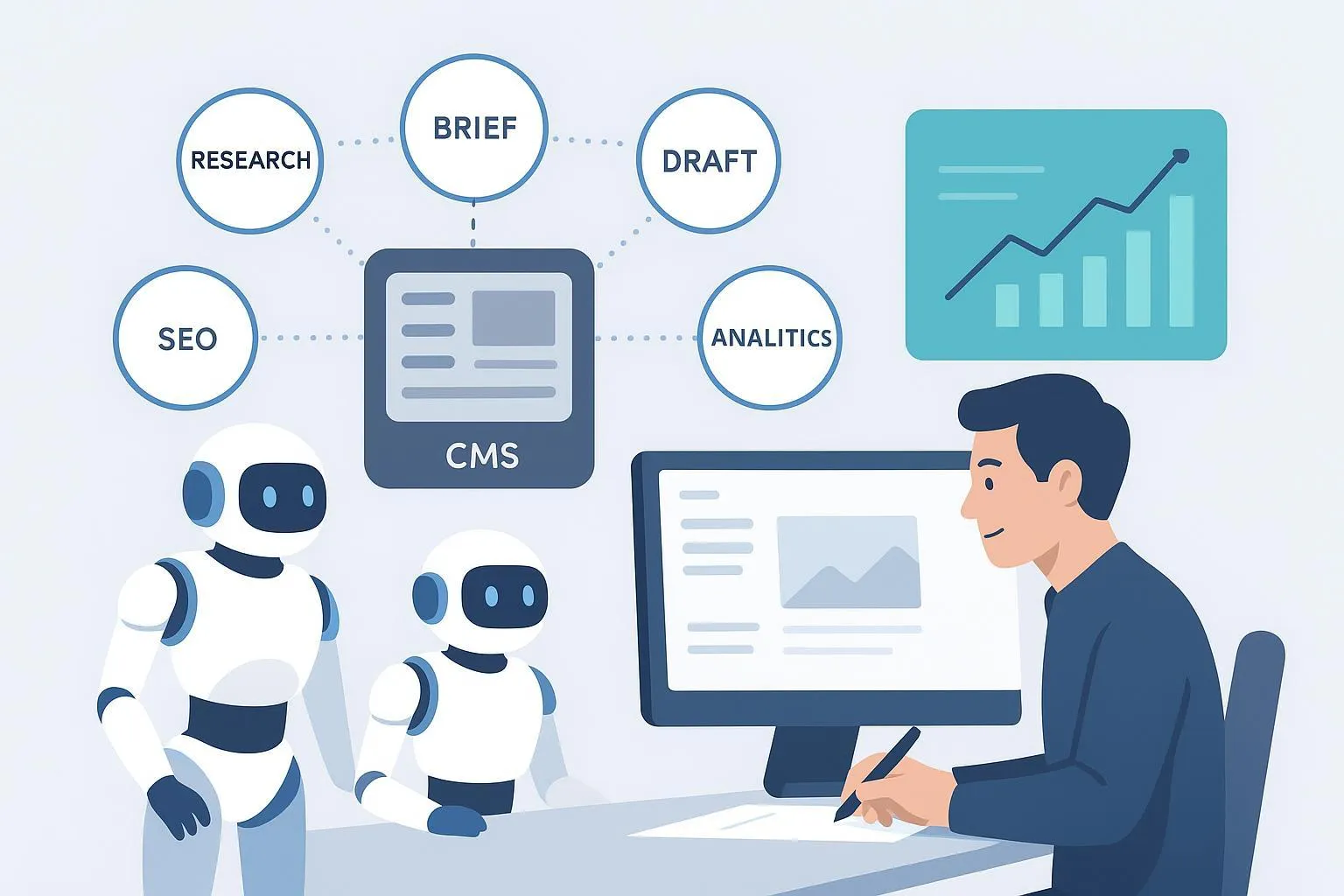
Most small marketing teams don’t struggle for ideas—they struggle for consistency. Hand-offs between freelancers, ad‑hoc briefs, and last‑minute edits slow everything down and let brand voice drift. This guide shows how to replace that fragility with governed, human‑in‑the‑loop (HITL) AI agent workflows connected to your CMS and GA4. The aim: a credible path toward 10x content velocity without adding headcount. It’s an ambition, not a promise—but with the right workflow, it’s within reach.
We’ll define what AI agents for content marketing actually do, how to design an approval‑first pipeline, how to wire it into WordPress/Webflow/HubSpot and GA4, and how to measure velocity, quality, SEO/GEO, and pipeline impact.
Why standardize with agentic workflows instead of a freelancer chain
Freelancers are valuable, but fragmented processes create bottlenecks and variability. Agentic workflows standardize the path from idea to publish: agents propose; humans approve. Governance and measurement are built in.
Dimension | Fragmented freelancer chain | HITL agentic pipeline |
|---|---|---|
Lead time per asset | Highly variable; coordination tax | Predictable stages; parallelizable subtasks |
Brand consistency | Depends on individual writers | Enforced through brand profiles + KB grounding |
Governance | Manual checklists (if any) | Explicit approval gates, audit logs, provenance |
Cost visibility | Bursty invoices; rework costs | Stable unit economics; lower rework via QA prompts |
Analytics & ROI | Often detached from ops | Events and IDs flow into GA4/Search Console |
Short answer: standardization turns content from an artisanal process into an instrumented system.
What “AI agents for content marketing” actually do
At a high level, agentic systems decompose goals into steps and coordinate specialized roles—research, brief creation, drafting, SEO/GEO optimization, and distribution—while a human editor controls approvals. For a concise intro to the planner–orchestrator–executor pattern and how it differs from single‑prompt writing, see the comparison in the internal explainer, AI agents vs. AI writers.
Quality and compliance aren’t optional. Google is clear that AI‑assisted content must be helpful and people‑first; scaled, low‑value pages risk penalties. See Google’s guidance on using generative AI content (updated 2026) and the Search Central perspective on succeeding in AI experiences like AI Overviews in Top ways to perform well in Google’s AI experiences on Search (2025). In practice, that means: keep human review in the loop, ensure originality, cite or validate facts, and publish only what meets your editorial bar.
Design a governed HITL pipeline (roles, SOPs, QA)
Think of your pipeline as a set of roles with explicit decision rights and evidence trails. Here’s a vendor‑neutral blueprint you can adapt:
Brand Intelligence and Voice: Centralize style, tone, glossary, compliance notes, positioning, and examples. Enforce these within prompts and approvals. If you want a concrete reference, the Brand Intelligence Agent describes one way teams encode voice and private knowledge bases for consistent outputs.
Research and SERP Analysis: Agents collect sources, analyze SERP intent, and flag gaps. Require source notes and links with each brief.
Briefing Agent: Converts strategy into prescriptive, on‑page briefs (H1/H2s, questions to answer, internal links to include, CTA intent, schema opportunities).
Drafting Agent: Produces a first draft grounded in the brief and brand profile. Must cite or log sources for factual claims.
SEO/GEO Optimizer: Aligns with people‑first SEO and AI Search readiness (titles, meta, schema that reflect on‑page content), plus internal linking suggestions and FAQ/HowTo opportunities.
Human Editor: Reviews for accuracy, originality, and voice; requests revisions with clear notes; approves or rejects.
Publisher: Creates a CMS draft, attaches schema and media, ensures canonical tags and internal links, triggers final review.
Governance and QA principles you should operationalize:
Approval gates: No content advances without human sign‑off at key stages (brief, draft, publish). NIST’s Human–AI oversight patterns in NIST AI RMF Appendix C are a solid design reference.
Provenance & auditability: Log prompts, source lists, diff history, and reviewer signatures.
QA prompts and failure checks: Include explicit instructions to flag low‑confidence facts, request citations, and surface ambiguous claims for human review.
Compliance: Disclose material connections where needed and never fabricate reviews; the FTC’s rules on reviews and endorsements apply to AI‑assisted content just as they do to human‑written content.
Integrate agents with your CMS (draft‑first) and GA4 (measurement loop)
To keep humans in control, integrate at the draft level only—agents propose drafts; editors approve and publish.
WordPress (REST API, draft‑first)
curl -X POST https://your-site.com/wp-json/wp/v2/posts \
  -H "Content-Type: application/json" \
  -u user:app_password \
  -d '{
    "title": "Agentic Workflow Pilot: Week 1",
    "content": "<p>Body content here</p>",
    "status": "draft"
  }'
- Authenticate with Application Passwords or JWT; the user must have edit_posts capability. Create the draft, attach schema (FAQ/HowTo/Article) that mirrors visible content, and leave “publish” to a human. Useful references include WordPress’s developer docs for REST endpoints and authentication.
Webflow CMS (staged items)
- Use the Data API v2 staged endpoints to create items with isDraft:true, then publish only after human approval. See the Webflow Data API documentation for create and publish staged items.
HubSpot CMS (Blog Posts v3)
- Create a draft via POST /cms/v3/blogs/posts (required fields: name, contentGroupId), then route approvals through HubSpot’s UI. Treat programmatic approval as out‑of‑scope; publish from the UI after editorial sign‑off.
Instrument content attribution with GA4 Measurement Protocol
Complement client‑side tagging with server‑side events so engagement and conversions can be tied back to content IDs.
POST https://www.google-analytics.com/mp/collect?measurement_id=G-XXXX&api_secret=SECRET
Content-Type: application/json

{
  "client_id": "123456789.1234567890",
  "events": [
    {"name": "content_engagement", "params": {
      "content_id": "article_123",
      "content_group": "blog_posts",
      "engagement_time_msec": 45000,
      "session_id": 1234567890123456789,
      "timestamp_micros": 1672531200000000
    }}
  ]
}
- Follow Google’s GA4 Measurement Protocol overview and validation guide; include client_id and session_id to align with front‑end sessions. For end‑to‑end reporting, Google outlines how to bring GA4 together with Search Console in their integration guidance.
Measurement and ROI without the hype
Your goal is to prove that standardization—not just “more content”—improves output and outcomes. Establish a pre/post baseline and run a 30‑day pilot.
Velocity: Throughput per week and cycle time from brief to publish; percent of drafts approved on first pass.
Quality: Editor acceptance rate; factual correction rate; adherence to voice checklist; GA4 engagement rate/time for organic sessions.
SEO/GEO: Clicks, impressions, CTR, and average position in Search Console; monitor inclusion and citations in AI experiences where available; ensure Article/FAQ/HowTo markup is valid and reflects on‑page content. Google’s AI features overview explains expectations for pages that show up in AI experiences.
Pipeline: Assisted conversions from content CTAs, UTM‑based attribution, and influenced opportunities in your CRM.
Set success thresholds before you start. For example, a realistic phase‑one target might be 2–3x throughput with equal or better editor acceptance rates. Over time, as SOPs mature, teams can push toward the 10x content velocity goal responsibly.
Example: Moving from freelancers to a governed agent workflow in practice
Here’s how a small team typically standardizes without adding headcount:
Week 1–2: Centralize brand voice and product facts into a private knowledge base; define approval gates; stand up the CMS draft connector; choose a pilot topic cluster.
Week 3–4: Agents generate research summaries, briefs, and first drafts; editors run QA prompts, request revisions, and approve; drafts flow into CMS with schema; events report engagement to GA4.
One way to operationalize this is with a coordinated agent platform. For instance, QuickCreator supports brand‑aligned agents, draft‑first WordPress distribution, and a “you approve, then publish” posture. For voice enforcement and grounding, see the Brand Intelligence Agent; to standardize CTA placement and attribution, the Conversion Agent explains a governed approach. Treat these as implementation references—you can build similar patterns with your existing stack.
For AI/LLM indexing readiness (beyond traditional SEO), tools like an LLMS.txt generator can help you curate AI‑friendly links to your most authoritative pages. Use judiciously and always pair with high‑quality, on‑page content.
30/60/90‑day rollout plan
30 days: Prove the pipeline on one topic cluster
Define the HITL SOP, approval gates, and audit log requirements.
Instrument GA4 events and confirm Search Console integration.
Produce 6–10 assets (brief → draft → edit → CMS draft) with consistent schema.
Review baselines vs. pilot results; document lessons learned.
60 days: Expand the footprint and tighten governance
Add adjacent clusters; scale to 3–4 assets per week with the same editorial bar.
Introduce controlled automation for low‑risk updates (e.g., internal links, minor headline tests) with human review.
Sharpen QA prompts to reduce correction rates; refine editor checklist.
90 days: Harden for scale and attribution
Standardize ROI dashboards (Looker Studio joining GA4 + Search Console) and weekly operating reviews.
Extend distribution (email, LinkedIn) with consistent voice; coordinate CTAs and UTM frameworks.
Run update experiments: refresh underperforming posts; track gains in clicks, CTR, and engagement.
FAQ
Do I need human‑in‑the‑loop if agents are getting “good enough”?
HITL is your quality and compliance backstop. It protects brand voice, prevents subtle hallucinations, and aligns with risk frameworks like NIST’s Appendix C on Human–AI interaction. It also improves editor acceptance rates over time.
Will this approach comply with Google’s rules on AI‑assisted content?
Yes—when implemented as helpful, original content reviewed by humans. Google states that AI use is permissible when you meet people‑first standards and avoid scaled, low‑value pages. See Google’s generative AI content guidance for details.
How do I avoid off‑brand outputs?
Centralize voice in a living style profile and ground drafts in a private knowledge base. Enforce that profile in prompts and in the approval checklist. A reference implementation is the Brand Intelligence Agent approach—but the principle applies to any stack.
What if my CMS can’t support a publish‑from‑API workflow?
Use a draft‑first integration. WordPress and Webflow support draft/staged items via API. For HubSpot, create drafts with the API and perform final approvals/publishing in the UI.
How do I connect content to pipeline and revenue?
Standardize CTAs and UTMs, and instrument server‑side events for content engagement and key conversions. Google’s GA4 Measurement Protocol and the Search Console + GA4 integration guidance show how to build the loop.
Where to go next
If you’d like to see a governed, agentic workflow in action, browse the short demos and adapt the patterns to your stack. Prefer to self‑build? Start by codifying your HITL SOP, wiring a draft‑only CMS connector, and instrumenting GA4 events—then scale one cluster at a time.