
Agentic Marketing vs Marketing Automation (2026): Differences, Use Cases, and How to Choose
Agentic marketing vs marketing automation compared—autonomy, governance, TCO, speed, and SMB use cases. Quick picks, migration checklist, and decision guidance.
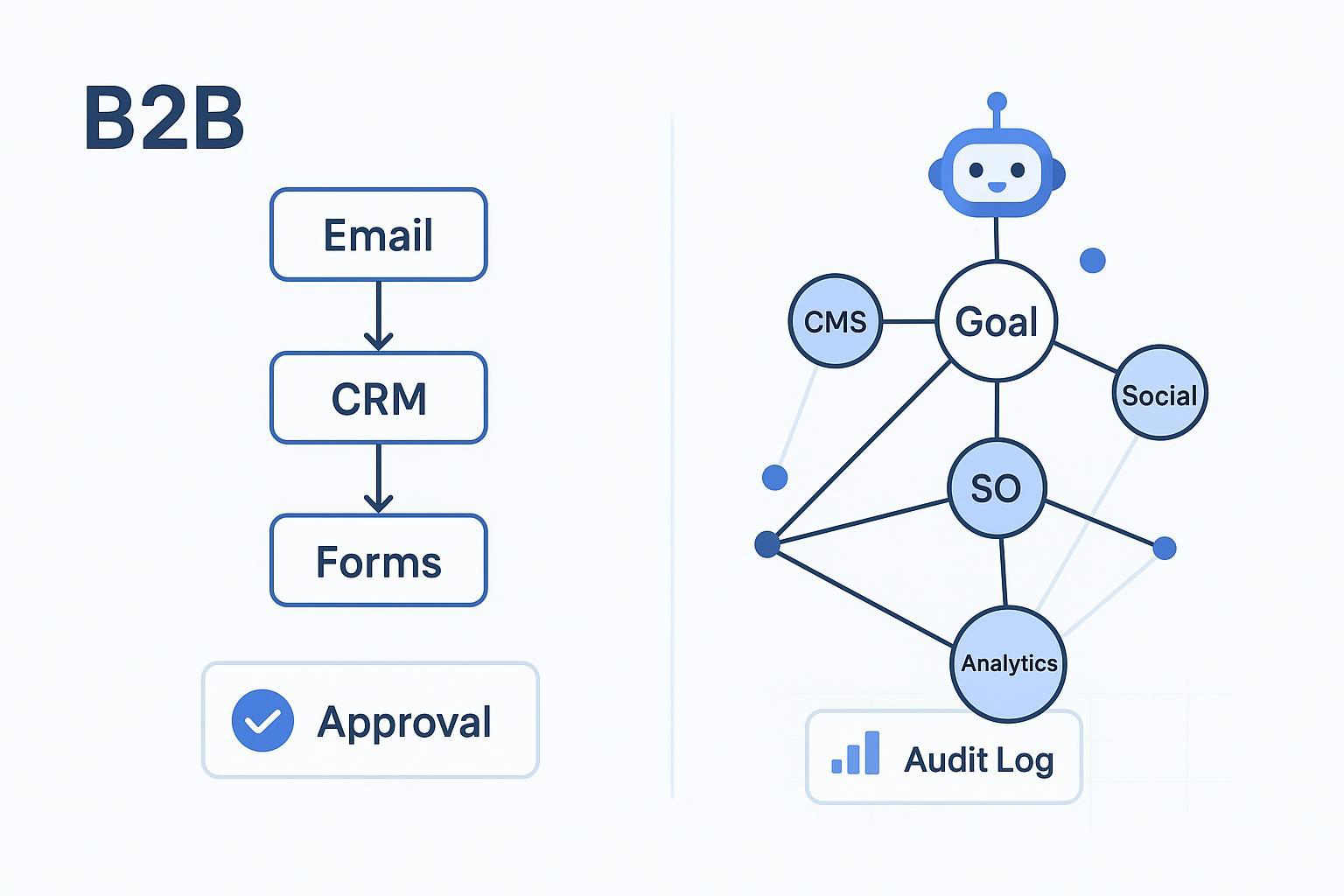
Choosing between agentic, goal-seeking AI and traditional rule-based automation isn’t just a tech preference—it changes how your team plans, executes, and learns. The hero differentiator is autonomy: dynamic agents that reason and adapt vs fixed workflows that follow predefined rules. To keep things practical, we’ll anchor everything to a common SMB use case: an SEO blog-to-distribution pipeline from brief to conversions.
TL;DR verdict: If you need end-to-end content operations that plan, create, distribute, and iterate with minimal rule edits, agentic approaches typically win—provided you implement guardrails. If you need deterministic, auditable sequences with strict approvals and stable journeys, traditional marketing automation remains your safest, most predictable choice. Many teams will land on a hybrid: agentic assistants inside governance-heavy workflows.
Quick compare: agentic marketing vs marketing automation
This section summarizes agentic marketing vs marketing automation across ten evidence-backed dimensions. Use it to spot where autonomy helps (planning, orchestration, personalization, speed) and where rule-based tools still shine (determinism, auditability, compliance).
Dimension | Agentic marketing (goal-seeking agents) | Traditional marketing automation (rule-based workflows) |
|---|---|---|
Autonomy & planning | Decomposes goals into sub-tasks; adapts plans as data changes | Executes predefined flows; changes require manual edits |
Orchestration & tool use | Coordinates multiple tools/APIs with stateful context across channels | Strong native connectors; orchestration mostly linear and pre-specified |
Personalization granularity | Moves toward 1:1, context-aware variants at scale | Segment-level and rule-driven dynamic content |
Governance & brand safety | Requires explicit guardrails and approvals to manage AI risks | Mature approvals, roles/permissions, and audit trails |
Data integration & memory | Uses unified profiles/KBs to reason and act | Integrates CRM/CDP; deterministic data paths |
Speed & cycle time | Accelerates brief→publish and iteration loops | Predictable, but slower to change at scale |
Total cost of ownership (TCO) | License + model/ops; can consolidate point tools | Tiered licenses + implementation; familiar admin model |
Reliability & observability | Emerging best practices; needs monitoring and rollback | Mature logs, inspectors, and error handling |
Analytics & attribution | Tighter feedback loops power autonomous optimization | Robust reporting; optimization via human rule updates |
Compliance & security | Enterprise platforms document controls; governance varies by setup | Well-understood certifications and procedures |
In 2024–2026, enterprise vendors formalized “agentic” capabilities—systems of agents that reason, plan, and act. Adobe describes agents that decompose goals and orchestrate actions across applications, and has introduced Agent Orchestrator and Journey Agent to operationalize this vision (see Adobe’s 2026 overview of agentic AI and the 2025 Journey Agent introduction). Salesforce’s 2024 general availability of Agentforce documents autonomous campaign planning and execution across channels. Bloomreach has chronicled how dynamic agents outperform static workflows in certain marketing tasks and shared measured lifts in personalization contexts. On the automation side, governance remains a strength: HubSpot documents content, social, and email approvals and account-level audit histories, while Marketo Engage provides Audit Trail and admin logging.
According to Adobe’s 2026 explainer on agent-first systems in the enterprise, agents are designed to reason, plan, and act across workflows, distinct from simple text generation. See the publisher’s definition in Adobe’s “What is agentic AI?” (2026).
Adobe’s productization includes Journey Agent (2025 introduction), which plans and optimizes journeys via natural language, and the Agent Orchestrator documentation (2026 Experience League).
Salesforce detailed autonomous marketing capabilities at the Agentforce general availability announcement (2024).
Bloomreach outlines the shift from static workflows to dynamic agents and reports performance gains in commerce personalization in its agentic orchestration series (2024–2026).
For approvals and auditability, HubSpot’s KB covers content approvals (2026) as well as social and email gates, and Marketo Engage documents Audit Trail (Experience League, 2025–2026).
Anchor use case: the SEO blog-to-distribution pipeline
Let’s run the same pipeline under both approaches—brief → draft → optimize → publish → distribute → repurpose → convert.
Brief and planning
Agentic: A goal like “Publish a 1,500-word blog for [keyword], then repurpose for LinkedIn and newsletter” is decomposed into sub-goals and tasks. Journey-style agents can map dependencies and propose a plan, drawing on unified profiles and knowledge bases. Adobe’s Journey Agent framing shows natural-language planning and optimization, while Salesforce’s Agentforce highlights agent skills that plan and execute multi-step campaigns across channels.
Automation: A content brief template is created manually; a project is kicked off in the CMS and marketing automation platform (MAP). Workflows are set to send notifications, create tasks, and schedule emails/social posts when content reaches specific statuses.
Drafting and optimization
Agentic: Multi-agent collaboration drafts the article, proposes internal links, and optimizes structure and metadata. Predictive assistants surface opportunities for variants. Bloomreach’s documented assistants and predictive features illustrate how analytics and recommendations feed back into content.
Automation: Templates and approval gates help ensure consistency. Drafts are edited by humans and moved through predefined stages. Optimization relies on checklists and separate SEO tools; the MAP doesn’t autonomously refactor copy.
Publishing and distribution
Agentic: An orchestration layer pushes content to CMS, queues social variants, and prepares newsletter segments—adapting timing based on observed performance signals. Agents can reschedule or test alternates with minimal human rule changes.
Automation: Deterministic workflows publish once content is approved. Distribution follows fixed schedules and audience rules. Changes require manual edits to the workflow or content assets.
Repurposing and iteration
Agentic: Agents generate LinkedIn snippets, email intros, and a short FAQ, then watch metrics to iterate. As outcomes arrive, agents adjust content variants and cadence without a human editing flowcharts.
Automation: Teams manually repurpose according to SOPs. Reporting informs future campaigns, but optimization means humans revise workflow logic.
Conversions and attribution
Agentic: Feedback loops tie outcomes to the initial goal. Agents attribute results and adapt the next cycle. Salesforce documentation highlights unified analytics feeding optimization; Bloomreach demonstrates measurable conversion lifts in commerce contexts.
Automation: The MAP tracks contacts and opportunities, offering multi-touch reports and dashboards. Insights are strong, but optimization remains human-driven via rules.
A pragmatic note on governance: Agentic systems benefit from strong guardrails—human approvals, audit trails, private knowledge base grounding, and rollback plans. Traditional automation excels here out of the box: HubSpot’s 2026 knowledge base shows content, social, and email approvals with detailed account activity logs, and Marketo Engage’s Audit Trail documents user and asset histories for compliance.
Contextual product note for SMB content ops: If your goal is brand-safe, on-voice content that moves quickly from brief to publish with built-in distribution, agentic content platforms can help. For example, QuickCreator emphasizes a coordinated agent pipeline and private knowledge-base grounding for brand voice, with on-site conversion widgets to close the loop. See the Brand Intelligence Agent for how brand voice is preserved using a private knowledge base and the Conversion Agent for converting traffic into leads. Use these as conceptual references while you evaluate vendors.
Best for whom? Scenario-based picks
Small team scaling SEO and multi-channel distribution: Choose agentic. You’ll gain autonomy in planning, content iteration, and distribution, which shortens cycle time and reduces manual edits. Keep approvals in place and monitor changes.
Complex ABM nurture with many stakeholders and compliance constraints: Choose traditional automation or a hybrid. Deterministic, auditable journeys and role-based approvals are hard to beat for change control.
Rapid experimentation for a product launch: Choose agentic. Agents can spin up and evaluate many creative variants in real time. Guard with sandbox modes and clear rollback.
Regulated industries with strict approvals and provenance: Choose traditional first. Augment with agentic assistants only where auditability and content provenance are demonstrably enforced.
How to move from workflows to agents safely (migration checklist)
Start with a narrow, high-frequency use case (e.g., blog→newsletter→LinkedIn) and define success metrics upfront.
Implement human-in-the-loop gates: approvals before publish, with audit logs and version diffs.
Ground agents in a private knowledge base for brand, product facts, and compliance guidance.
Validate integrations in a sandbox: CMS, email, social, analytics, CRM/CDP identity resolution.
Establish observability: runbooks for errors, retries, timeouts, and incident review.
Pilot A/B policies: cap changes per day, require sign-off for major plan shifts, keep a rollback workflow.
Measure and report: time-to-publish, revision count, engagement/conversion deltas, and ops hours saved.
Governance and brand safety essentials (checklist)
Approvals mapped to asset types (content, social, email) with named approvers and SLAs.
Audit trails enabled for users, assets, and system changes; exportable logs.
Private knowledge base (RAG-style grounding) to enforce brand voice and factual accuracy.
Human-in-the-loop on high-impact actions (publishing, segment changes, budget shifts).
Sandboxed testing, rate limits, and anomaly alerts; scheduled incident postmortems.
Pricing and TCO notes (as of 2026-03-05; subject to change)
Enterprise agentic suites (e.g., Adobe Experience Platform agents; Salesforce Agentforce) are often quote-based. Model total cost as licenses plus implementation, enablement, and ongoing AI operations (including model tokens and monitoring). Expect stronger capabilities—and higher enablement needs.
Traditional MAPs (e.g., HubSpot, Marketo) follow tiered licensing with seat and contact-based pricing. Governance features such as advanced approvals/audit trails may require higher tiers and onboarding services.
SMB-focused agentic content platforms can consolidate point tools. For a transparent benchmark while budgeting, review QuickCreator’s pricing to understand how credit-based tiers can predict content ops costs before you scope larger suites.
FAQ
What is the difference between agentic marketing and marketing automation? Agentic marketing uses autonomous, goal-seeking agents that can plan and adapt across tools; traditional automation executes predefined, rule-based workflows. The former optimizes dynamically; the latter is deterministic and auditable.
When should SMBs prefer agentic approaches? Choose agentic when you need faster cycle times and large-scale personalization across channels—especially for content pipelines—so long as you have approvals, auditability, and grounding in place.
Where does traditional marketing automation still win? When you need predictable, audited sequences—such as complex ABM nurtures or regulated communications—rule-based workflows with strict approvals and logs remain the gold standard.
How much time can agentic approaches save? Savings vary by stack and governance. Public vendor stories highlight faster analysis and iteration; your results depend on approvals, integrations, and measurement rigor. Treat early claims as directional until you collect your own before/after benchmarks.
What governance controls are non-negotiable? Approvals, audit trails, private knowledge-base grounding for brand and facts, sandbox testing, and a documented rollback plan.
If you’re weighing agentic marketing vs marketing automation, consider a two-week pilot on your SEO blog-to-distribution flow. Measure time-to-publish, edit cycles, and conversions—and keep strict governance in place. Then scale what actually works.