
Agentic content workflows for 11–50 person B2B SaaS teams: a step‑by‑step rollout to launch your first SEO topic cluster
Step-by-step guide to deploy agentic content workflows for small B2B SaaS—RACI, stage gates, sample SLAs, and capacity math to speed time-to-publish.
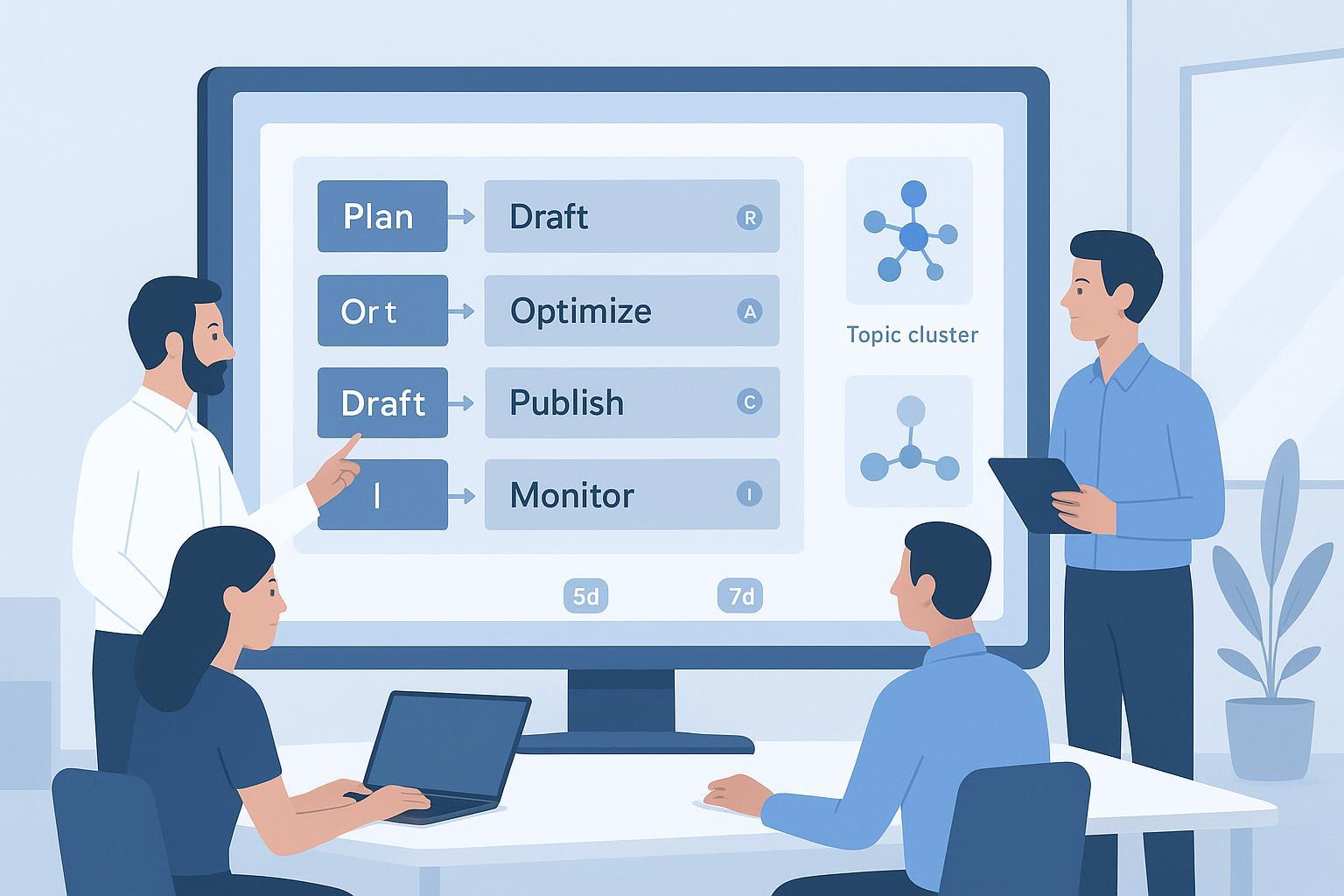
If you lead a lean B2B SaaS marketing team, speed matters. This guide shows how to stand up a practical, agent‑assisted workflow that gets a net‑new SEO topic cluster from kickoff to published with clear SLAs, single‑gate approvals, and fewer bottlenecks. We’ll focus on outcomes you can measure—cycle time, SLA adherence, and an on‑time cluster launch—while keeping governance intact.
Agentic content workflows blend AI agents for research, outlining, and QA with human accountability for approvals and brand voice. The anchor use case here is simple: publish a pillar page first, then roll out 5–8 supporting pages over 6–8 weeks with tight handoffs and consistent internal linking. Industry guides describe why topic clusters work and how hub‑and‑spoke structure builds topical authority; for a solid primer, see the overview of hub–spoke structure and reciprocal linking in the Search Engine Land guide to topic clusters and pillar pages, and Semrush’s explanations of how to structure a comprehensive pillar and link spokes back to it: Search Engine Land’s topic clusters guide and Semrush on pillar pages and internal linking.
Phase 1 — Plan the cluster and set a single approval gate
Start with a concise plan that locks scope and approval paths before any drafting.
Inputs: business goals for the cluster, target personas, seed keywords, competitive SERP snapshots, and a short list of subtopics.
Outputs: a pillar outline, 5–8 supporting page titles with search intent notes, an internal linking map, and a single approval gate owner.
Recommended SLAs to reduce cycle time (guidance, not industry standards): Research to outline in 3–5 business days; pillar outline to first draft scoped at 10–14 days. Keep one accountable approver for this phase to avoid review loops, consistent with RACI guidance that emphasizes one “A” per task to prevent bottlenecks, as explained in the Atlassian RACI overview: Atlassian on RACI and having a single accountable owner.
Phase 2 — Draft the pillar then queue spokes
Draft the pillar first so it can anchor the cluster and serve links to forthcoming spokes. Then draft spokes in parallel with staggered due dates.
SLAs: Outline to first draft in 5–7 business days per spoke; pillar takes longer at 10–14 days. Draft to approval in ≤5 business days through a combined SEO+brand review and a single approver.
Stage gate: A single approval gate per page (one accountable approver), with any SME input managed asynchronously to protect the SLA.
Writer enablement: Provide SERP snapshots, competing H2s, and what to do differently. Require sources for any claims and log them inline.
Phase 3 — Optimize agentic content workflows for SEO and governance
Move from “a good draft” to “ready to ship” by validating intent match, technical checks, and internal links. Google’s foundational practices—helpful content, clear headings, descriptive links, and accessible structure—remain the baseline; see the Search Central SEO Starter Guide for the essentials: Google’s SEO Starter Guide. For internal linking specifics inside clusters, Semrush’s guidance on anchor text and pillar↔spoke reciprocity is helpful: Semrush on internal links within clusters.
Use a lightweight optimization checklist:
Confirm intent alignment and coverage versus the top results; add unique expertise where competitors are thin.
Implement the internal linking plan: pillar links to every spoke; each spoke links back to the pillar near the top and cross‑links to siblings where relevant.
Validate on‑page basics: titles, meta, headings, alt text, schema where applicable, and clean URLs.
As context on governance in agent‑assisted work, this brand‑neutral comparison explains why orchestrated agents need human review gates for accuracy and voice: AI agents vs. AI writers comparison on governance and review gates.
Phase 4 — Publish, interlink, and ship within your SLA
Treat publishing as an operational handoff, not an afterthought. Your Approval→Live SLA should be ≤7 days when templates and linking updates are ready.
Prepare CMS entries using pillar and spoke templates; add canonical tags and ensure staging is noindex.
Publish the pillar first; add a “coming soon” list with placeholders that will become live links as spokes ship.
On each spoke publish, add links from the spoke back to the pillar (near the introduction) and update the pillar to link to the new spoke; resubmit sitemaps and request indexing.
A neutral, practical example of an agentic handoff: a writer handoffs the approved draft to an optimization agent for on‑page and link checks, then to a distribution agent that prepares CMS fields and creates an audit log for the approver to sign off before going live. A coordinated platform such as QuickCreator can orchestrate multiple specialized agents to run an end‑to‑end SEO content workflow—from research and outlining to drafting, optimization, and CMS handoff—while keeping humans accountable for approvals. Just as important, process logging creates a clear audit trail so you can trace what changed, when, and who approved it. If you also need CTA consistency during publishing, its Conversion Agent illustrates how prompts and templates can standardize placement without adding review rounds. Use any comparable tooling you prefer; the key is a single accountable sign‑off and a recorded audit trail.
Phase 5 — Monitor early signals and adjust in the first 30 days
Instrument early KPIs at the cluster level: time‑to‑publish per page, SLA adherence rate, index coverage, impressions, CTR, and average position. Expect variability in rankings; large‑scale analysis indicates only a small fraction of new pages reach top‑10 within a year, with a portion of those that do breaking through in the first month, underscoring the advantage of strong internal linking and steady updates while authority builds. See the methodology and timelines in the Ahrefs study of one million URLs: Ahrefs on how long it takes to rank and the age of top pages.
Capacity math that protects your SLAs
For an 11–50‑person B2B SaaS, a lean content pod might include one Head of Marketing as the accountable owner, one SEO, and one to two writers with SME input as needed. A conservative starting cadence is one pillar plus 5–8 spokes over 6–8 weeks, sustaining 4–6 high‑quality pieces per month. Plan for the pillar to consume outsized time; stagger spokes weekly post‑pillar to maintain velocity. Reserve reviewer capacity so the draft→approval gate reliably meets the ≤5 business‑day SLA. Track rework after publication; if change‑failure rates rise, tighten QA or add temporary consults without expanding approvers.
Troubleshooting common bottlenecks
Approval delays: Reaffirm the single approver, convert comment chaos into a structured feedback form, and enforce the ≤5‑day SLA with automatic reminders and an escalation path.
Weak drafts or accuracy gaps: Inject SME comments asynchronously and require citations; add a spot‑check for facts before the approval gate.
Linking and indexing gaps: Re‑run a link check after each spoke goes live, refresh pillar links, resubmit sitemaps, and validate schema and coverage.
RACI matrix for a small B2B SaaS rollout
Below is a compact RACI showing a single accountable owner per phase and minimal reviewers to keep cycle times tight.
Phase | Head of Marketing | SEO Specialist | Writer(s) | SME | Marketing Ops/Editor | Sales/RevOps | Dev/CMS Admin |
|---|---|---|---|---|---|---|---|
Plan | A | R | C | C | I | I | I |
Draft | A | C | R | C | I | I | I |
Optimize | A | R | C | I | C | I | I |
Publish | A | C | I | I | R | I | I |
Monitor | A | R | I | I | C | I | I |
Note: Keep exactly one “A” per row to avoid conflicting approvals. This aligns with widely used RACI practice emphasizing a single accountable owner to prevent bottlenecks, as summarized in the Atlassian guidance linked earlier.
Close and next steps
Pilot a single cluster using the SLAs and gates above, measure time‑to‑publish and rework, and then tune the cadence. Once your first cluster ships on time, expand the same agentic content workflows across adjacent topics while maintaining the single‑gate policy and an auditable trail.