What if your three-person team could plan, draft, optimize, and publish on schedule without living in spreadsheets and Slack all week? That’s the promise of agentic content operations—when autonomy meets guardrails.
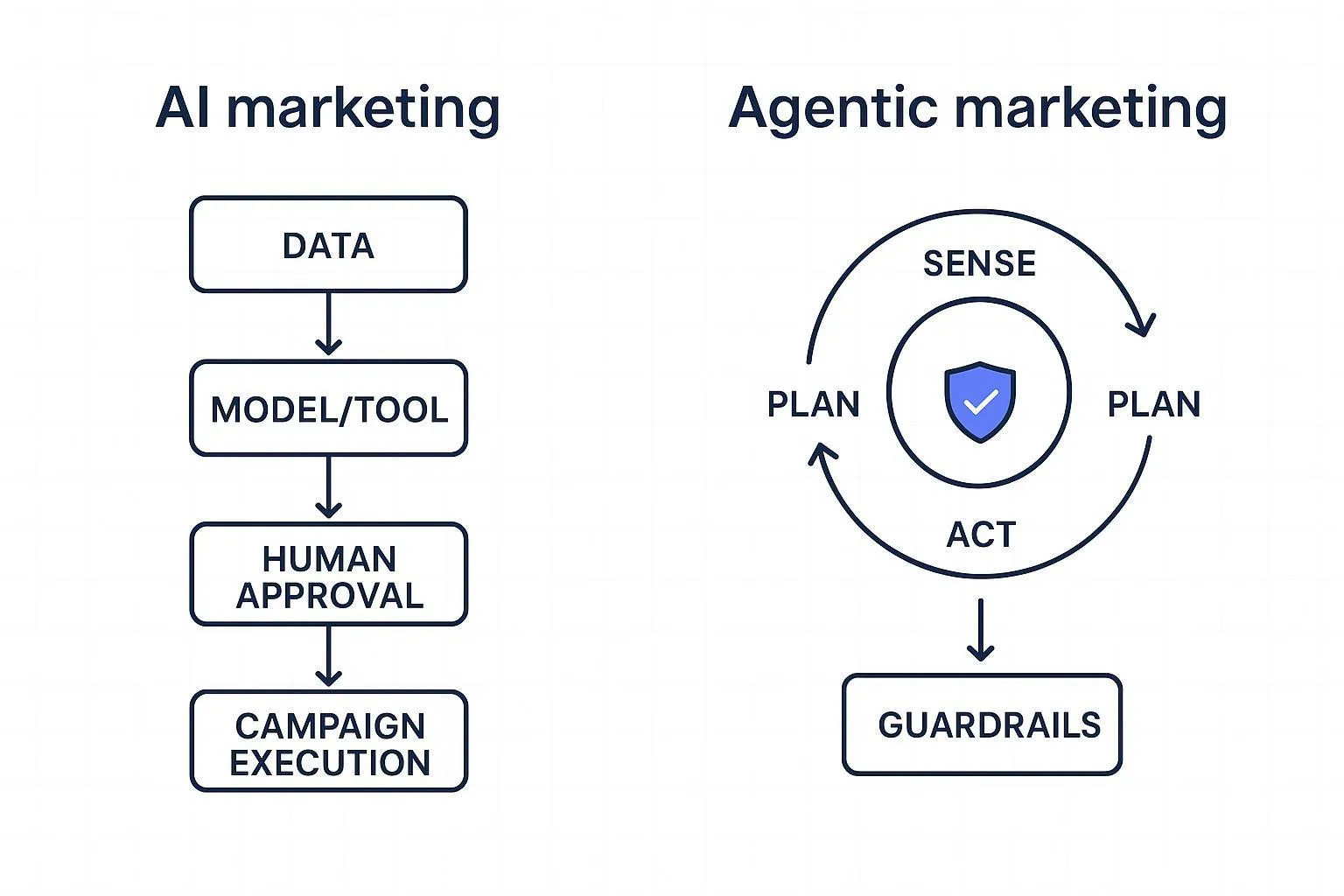
Definition: Agentic content marketing is the use of autonomous, collaborative AI agents to plan, create, optimize, and distribute content end to end—governed by human-in-the-loop approvals and grounded in your brand, data, and compliance rules. It differs from generic AI writing tools because agents don’t just respond to one-off prompts; they coordinate multi-step work, use private knowledge, and route drafts through approval gates before anything ships. This framing aligns with enterprise definitions of agentic systems that reason, plan, and act under oversight from organizations like Adobe’s overview of agentic AI, IBM’s guidance on agentic AI vs. generative AI and governance, and McKinsey’s explainer on AI agents.
Agentic content marketing vs. generic AI writing tools
Think of a single AI writing tool as a helpful copy assistant. Useful, but reactive. Agentic content marketing behaves more like a compact, always-on content team that shares context, passes work between specialists, and asks for approvals at key moments.
Capability | Agentic content marketing | Generic AI writing tools |
|---|---|---|
Autonomy | Proactive agents plan and execute tasks toward goals with oversight | Reactive to prompts; no goal-directed planning |
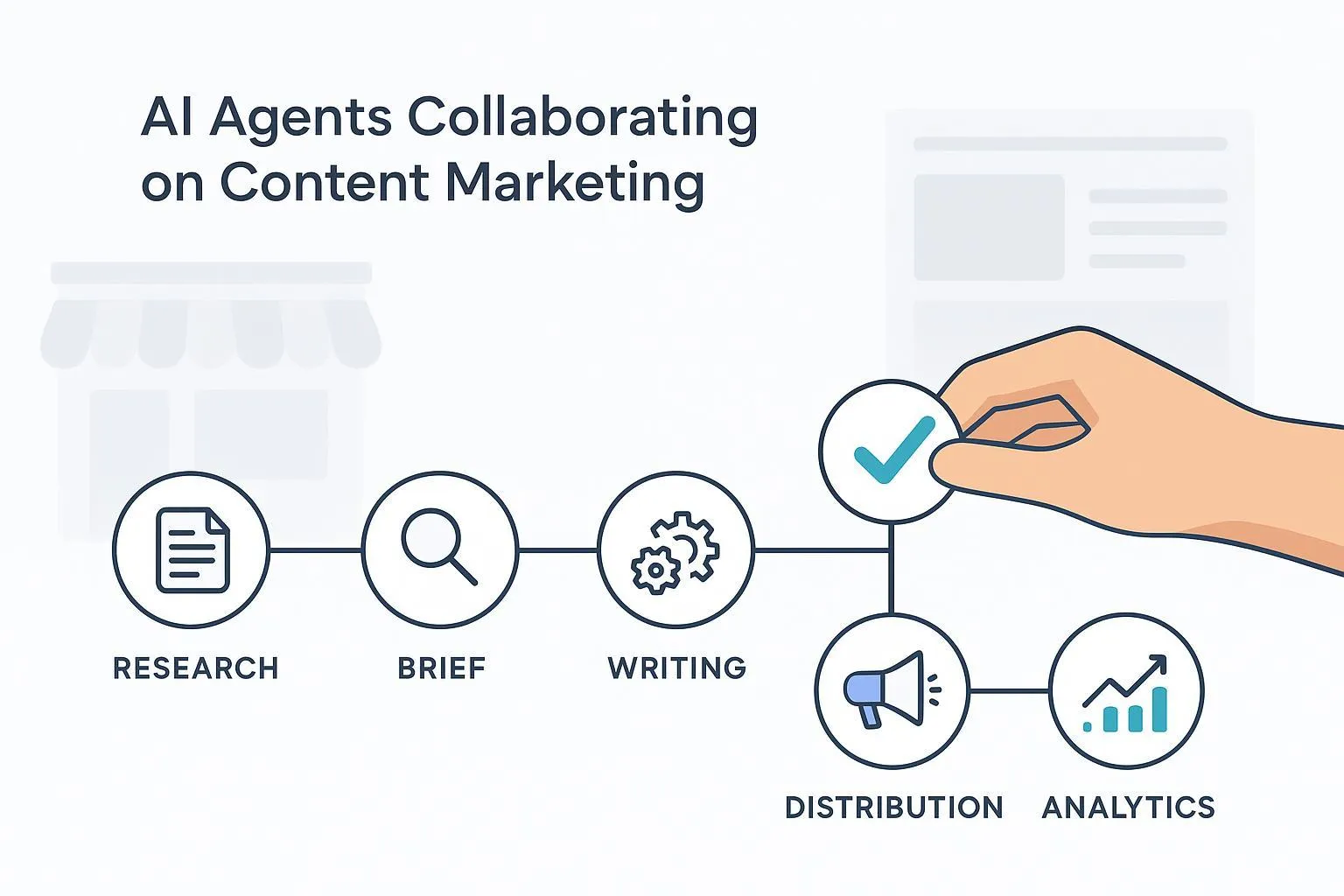
Orchestration | Multi-agent handoffs across research → brief → draft → SEO → distribution | Single-step generation; manual coordination by humans |
Memory & data | Uses private knowledge bases (RAG), analytics, and CMS context | Little or no persistent memory; limited context window |
Governance | Human-in-the-loop approvals, audit trails, exception routing | Few explicit guardrails; ad hoc review |
Outcomes | Higher content velocity, consistency, and safer publishing | Speedy drafts but variable quality and brand fit |
For marketing implications of agentic orchestration across stacks, see MarTech’s discussion of agentic AI in marketing.
A weekly ecommerce workflow (SEO blog + product page refresh)
Below is a realistic cadence for a three-person ecommerce team shipping one SEO blog and a product page refresh each week. Approvals happen at the brief and final draft.
Topic and intent mapping
- A Topic/Research agent clusters queries, reviews SERPs and People Also Ask, and pairs a target keyword with a specific product or collection. It drafts a brief with H2s, FAQs, schema, and internal link targets.
Draft the article in your brand voice
- A Writing agent pulls product facts from your private knowledge base, applies the style guide, and drafts the post. It flags any claim that needs a citation for human review.
Optimize for SEO and AEO/GEO
- An Optimization agent checks title/meta/H1–H3, schema, image alts, internal links, and adds concise answer snippets that support Answer Engine Optimization (AEO) and Generative Engine Optimization (GEO). For background, see Moz’s introduction to GEO and Semrush’s AEO guide.
Refresh the mapped product page
- The agent proposes copy updates (features, FAQs, alt text) aligned with the blog’s target intent and suggests cross-links to related products/collections using your internal link map. Helpful references on internal linking include Search Engine Land’s best practices and Moz’s internal link fundamentals.
Publish and distribute
- A Distribution agent posts to the CMS, schedules social snippets and a promo email, and applies UTM parameters for tracking. It notifies the owner for a final approval click before publish.
Measure and learn
- The system logs velocity (assets/week), monitors early SEO signals in GA4 and Search Console, and proposes next-week topics based on gaps and impressions.
Neutral example: An agentic platform like QuickCreator’s Brand Intelligence Agent can support brand voice enforcement and private-knowledge grounding in steps 2–3 while keeping human approvals at the brief and final draft.
The data your agents need to work safely and well
To be useful—and safe—agents need structured inputs and guardrails. Provide: brand voice and style guides, ICP profiles, product specs and FAQs, sales enablement and past top performers, keyword clusters and SERP snapshots, GA4/Search Console/CRM access, CMS taxonomy and an internal link map, plus governance artifacts (approval gates, escalation rules, compliance notes, and an audit trail). Strong data and clear rules reduce rework and keep outputs on-brand.
Benefits for SMBs (with content velocity as the north star)
Content velocity—how many quality assets your team ships per week—is the clearest hero metric for SMBs. Agentic workflows often help small teams sustain at least one net-new asset per week while shortening handoffs.
Directional evidence: Industry roundups report meaningful production gains from AI-enabled workflows. For example, a 2026 vendor summary cites 30–40% reductions in long-form writing time and roughly 70% savings across the total blog production effort; treat these as directional, not guaranteed, and verify against your own baselines. See the Elementor AI SEO statistics (2026) and the qualitative workflow impacts discussed by MarTech.org.
What improves first: predictable cadence (assets/week), cycle time from brief to publish, and consistency of on-page SEO hygiene. Secondary effects may include steadier impressions for new content within 30–90 days, assuming crawl and indexing are healthy.
Caveat: Results depend on data quality, governance maturity, and process discipline—principles emphasized in IBM’s AI governance guidance.
FAQs
What is agentic content marketing in one sentence?
- It’s a governed system of collaborative AI agents that plan, write, optimize, and distribute content end to end, using your brand and performance data with human approvals at key gates.
How is this different from “using an AI writer”?
- A single AI writer generates text from prompts; an agentic approach orchestrates multiple specialized agents with memory, tools, and approval workflows so work moves from research to publish with less manual coordination.
Can small teams adopt this without heavy setup?
- Yes—start with a narrow workflow (e.g., weekly SEO blog + one page refresh), define approval gates, and connect only the data you trust first. Expand integrations as quality holds steady.
How do we measure success?
- Track content velocity (assets/week) and cycle time first. Layer in SEO leading indicators (indexing, impressions), and tie assists to pipeline where applicable using UTM conventions and CRM attribution.
Where to go next
If you’re evaluating agentic content marketing for a small team, pilot the weekly workflow above for four weeks and baseline your velocity and cycle time. For a guided look at a governed, multi-agent setup, explore the platform overview and demos from vendors in this space—for example, you can request a QuickCreator walkthrough to see how approvals and brand intelligence fit your process.