What Is an SEO Agency?

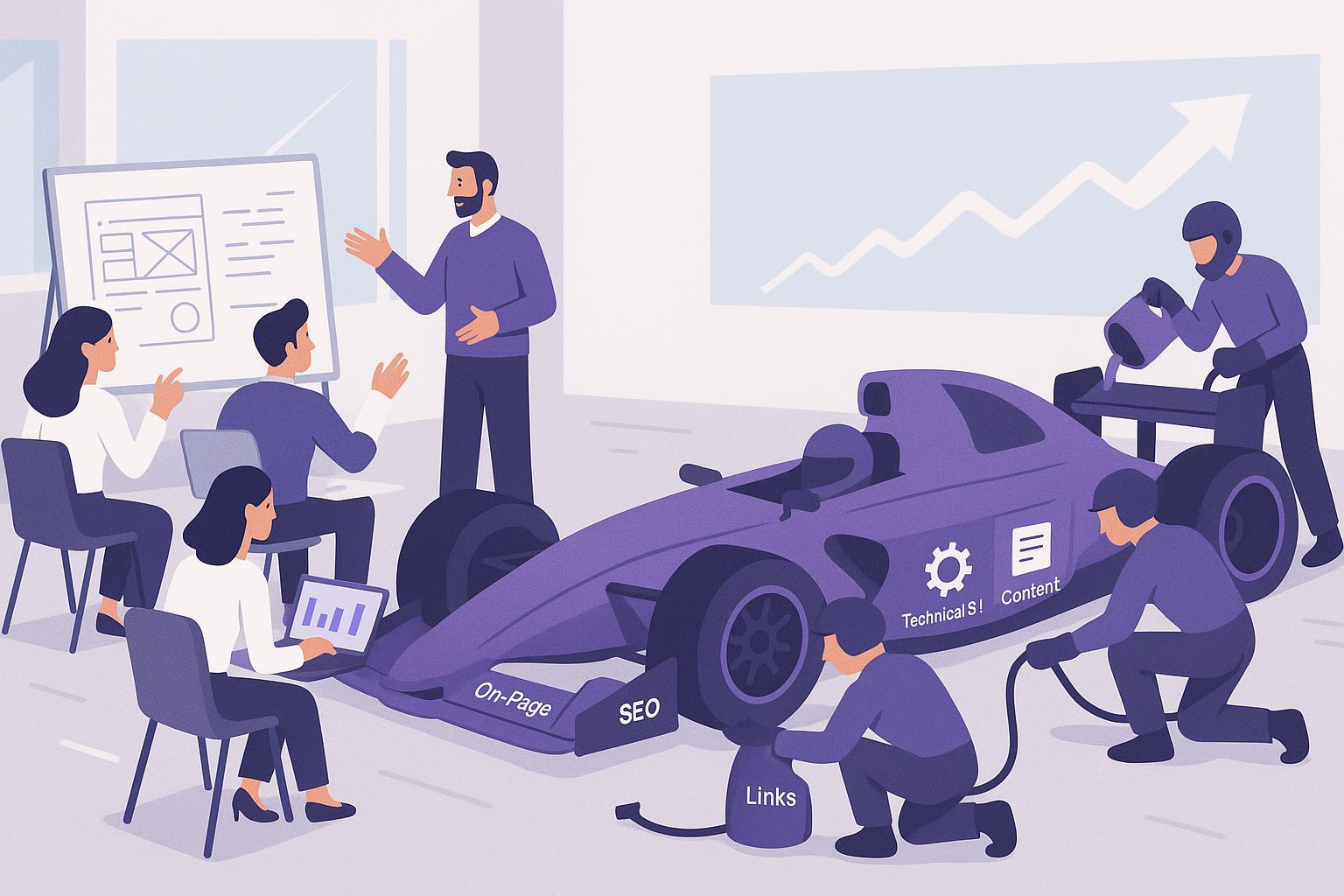
An SEO agency is a professional services firm that plans and executes strategies to increase your website’s organic visibility and conversions. In practice, that means combining on-page, technical, content, and off‑page (links/PR) work into a cohesive growth program.
If you’re new to the topic, you can also see our beginner-friendly SEO explained overview.
Think of growth like racing: an SEO agency is your pit crew and race strategist—diagnosing issues, planning the track strategy, and performing high-skill tasks. Your day‑to‑day “vehicle” is your site and content engine; modern platforms act like a high‑performance car with navigation and diagnostics. Many SMBs win by driving that platform daily and calling the pit crew for specialized moments.
What SEO Agencies Do (and why it matters to your business)
Here’s what a credible SEO agency typically delivers—and how each item ties to outcomes you care about.
Comprehensive audit and roadmap
What it is: A diagnostic covering technical health, content gaps, and competitive landscape, translated into a prioritized plan.
Why it matters: Focuses effort on the highest‑leverage fixes and opportunities.
Keyword and topic research
What it is: Mapping the questions and queries your ideal buyers use across the journey.
Why it matters: Aligns pages and content to real demand, improving qualified traffic.
Content strategy, briefs, and editing
What it is: A plan for articles, product/category pages, and resource hubs, plus structured briefs and editorial QA.
Why it matters: Increases content velocity and quality so you publish the right pieces faster.
On‑page optimization
What it is: Titles, meta descriptions, headers, internal links, media, and schema tuned for intent and experience.
Why it matters: Improves relevance, click‑through, and user engagement.
Technical SEO fixes
What it is: Crawlability, indexing, site architecture, performance, mobile experience, structured data, and redirects.
Why it matters: Ensures search engines can discover and understand your site efficiently, supporting stable rankings.
Digital PR and link acquisition
What it is: Earning high‑quality editorial links via outreach, partnerships, and content worth citing.
Why it matters: Builds authority and trust signals that can lift competitive rankings.
Reporting and iteration
What it is: Regular performance reviews, KPI dashboards, and roadmap updates.
Why it matters: Keeps effort tied to revenue‑relevant outcomes rather than vanity metrics.
This service mix mirrors how modern SEO is defined by recognized educators such as the Digital Marketing Institute’s 2024 overview of SEO’s on‑page, technical, and content pillars and Moz’s 2025 “What Is SEO?” guide.
For a deeper look at how briefs, drafting, and QA work together, see our guide to content workflows with briefs and on‑page QA.
What Does an SEO Agency Cost?
Agencies price work in a few common ways: monthly retainers (most typical for SMBs), hourly consulting, and project‑based engagements (audits, migrations, content hubs). What you’ll pay varies with competition level, link acquisition intensity, technical complexity, and desired content velocity.
Typical SMB retainer ranges: Many small and midsize businesses invest roughly $2,000–$6,000 per month for a balanced program, with broader market bands stretching lower for very local/lightweight scopes and above $10,000 for competitive national campaigns. As of 2025, WebFX describes many businesses paying around $2,500–$7,500 per month in its SEO pricing overview.
Hourly and project work: Hourly consulting can range widely by expertise and region; project pricing depends on scope (e.g., a one‑time technical audit or a site migration).
Budget staging tips for SMBs
Around $1k/month: Focus on an audit, foundational technical fixes, and a small content pilot. Avoid heavy link acquisition at this tier.
Around $3k/month: Add steady content briefs and production, on‑page optimization, and selective outreach.
$5k+/month: Introduce PR‑grade link campaigns, larger content sprints, and experimentation with new formats (guides, tools, data pieces).
How to Measure Agency Impact (beyond rankings)
Rankings are directional, but business value shows up elsewhere. Consider:
Qualified organic sessions and non‑branded clicks: Are the right people finding you, not just brand-name searches?
Conversions and lead quality from organic: Demo requests, trials, purchases—tracked in analytics.
Content velocity and quality: How many optimized pieces are shipping, and how strong is the intent match?
Technical health: Core Web Vitals, indexing/crawl status, redirect hygiene. Google outlines the user‑experience metrics in its Core Web Vitals documentation (2025).
Link quality and authority: A few relevant, editorial links often beat a pile of low‑value links.
If you use an E‑E‑A‑T‑aligned framework for content evaluation, tools like our E‑E‑A‑T‑based Content Quality Score can help standardize quality checks across your team.
Reporting cadence for most SMBs
Monthly: KPI review, insights, next‑month plan
Quarterly: Strategy refresh and roadmap reprioritization
Ad hoc: Technical incidents and launch checks
Agency vs. In‑House vs. Platform vs. Hybrid
Use this quick decision framework to choose the right mix for your stage and constraints.
Choose an SEO agency when:
You face complex technical debt, a site migration, or international SEO
You need digital PR/authoritative links beyond your team’s capacity
Your internal bandwidth is near zero for program management
Build in‑house when:
You have a stable content pipeline and moderate technical needs
You want to retain institutional knowledge and day‑to‑day control
Use a platform when:
You need speed‑to‑publish, on‑page guidance, and consistent content output
You want managed technical basics (CDN, SSL, sitemaps, mobile) baked in
Adopt a hybrid model when:
You can execute 70–90% of content and on‑page work with a platform, and reserve agency hours for PR‑level links or high‑stakes technical projects
Myths to Avoid (and quick credibility tests)
“Agencies can guarantee #1 rankings.” Red flag. Google’s own documentation says, “No one can guarantee a #1 ranking,” as stated in its “Do I need an SEO?” guidance (2025). Prefer partners who discuss probabilities, scenarios, and dependencies.
“SEO is set‑and‑forget.” Sustainable results require ongoing content updates, technical hygiene, and periodic link earning. Look for a plan with both foundations and compounding activities.
“More content always wins.” Quality, intent match, topical architecture, and internal linking matter more than raw volume. Ask how the plan prioritizes topics and measures content performance.
Credibility tests you can apply
Will they explain their methods and provide examples of deliverables (briefs, technical tickets, outreach plans)?
Do they tie KPIs to revenue outcomes and user intent rather than vanity rankings alone?
Are they transparent about link acquisition ethics and editorial standards?
A Practical, SMB‑Friendly Workflow (with a platform)
Here’s how a lean team can ship optimized pages fast using a modern, all‑in‑one platform—then add an agency for specialized lifts like PR‑grade links or complex migrations.
Generate an SEO brief for a target topic with search intent, headings, and internal link suggestions.
Draft the article or landing page from the brief.
Optimize titles, meta, headings, images, and schema; run a quality check.
Publish to a managed, fast, mobile‑friendly site with sitemaps and SSL handled.
Disclosure: QuickCreator is our product. If you want an integrated tool that covers briefs → draft → on‑page optimization → publish (plus managed technical basics), you can explore QuickCreator for this workflow. Use it for the day‑to‑day “driving,” and bring in an agency for the pit‑crew moments—digital PR or advanced technical projects.
Quick Start Plan (then decide on agency add‑ons)
Week 1: Pick 3 buyer‑relevant topics and publish one optimized article or landing page to set a baseline.
Weeks 2–4: Ship 2–4 more pieces; instrument conversions; review Core Web Vitals and indexing.
Month 2: Assess gaps—do you need PR‑level links, a deep technical audit, or migration help? If yes, engage a boutique agency while you continue to scale production.
Ready to try the platform path first? Start a free trial of QuickCreator, publish your first optimized piece, then decide where an agency adds the most value.
