What Is a Marketing Agency? A Simple, Practical Guide for SMBs

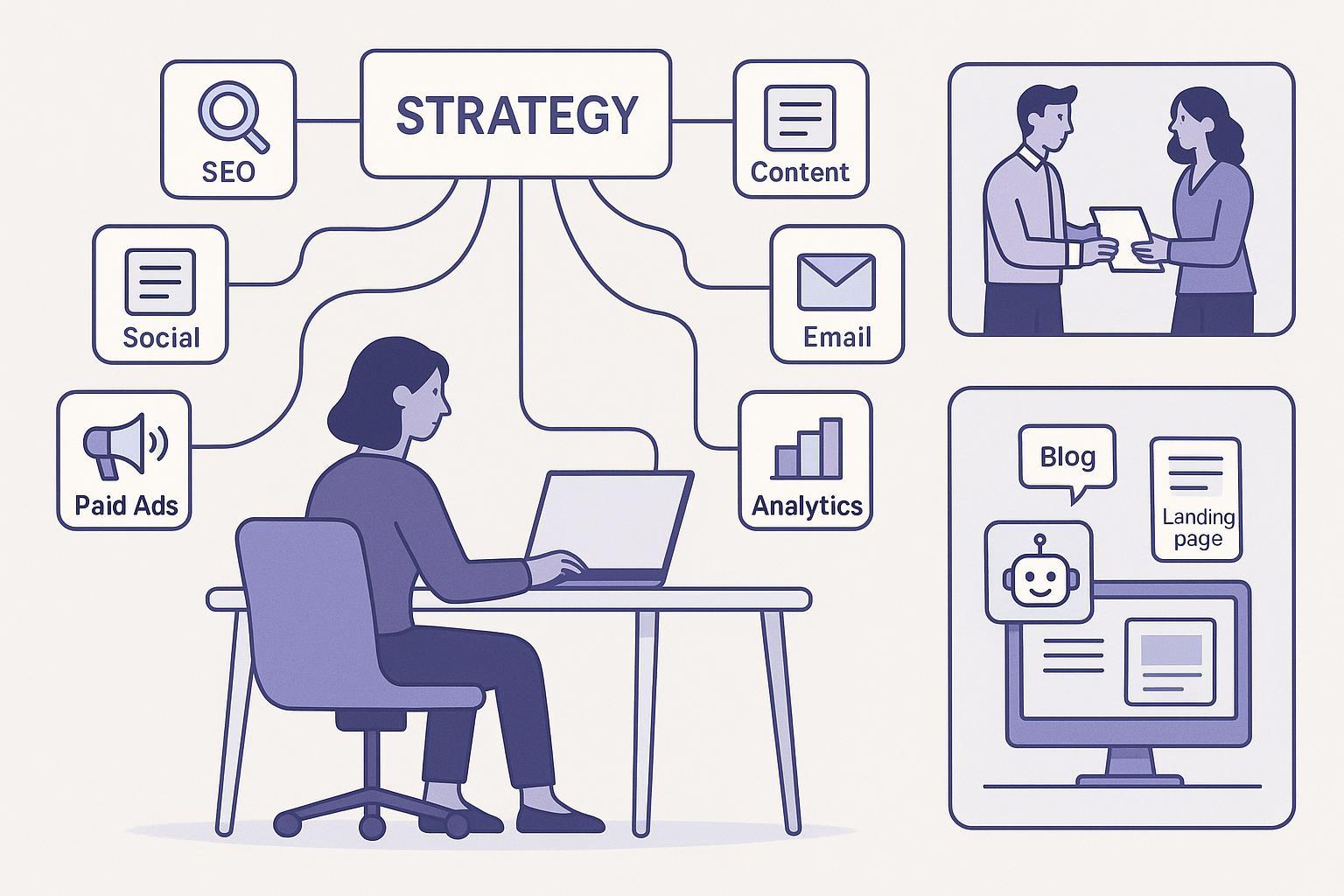
If you run marketing for a growing business, you’ve probably wondered: should we hire a marketing agency, build in‑house, or do a hybrid? This guide explains what a marketing agency is, how different agency types work, what they cost, how to choose one—and where AI fits into a modern workflow.
Plain‑Language Definition (and What It’s Not)
A marketing agency is an external partner that plans, creates, distributes, and optimizes campaigns across channels to help a business reach target audiences, generate demand, and drive revenue. Recent explainers position agencies as holistic go‑to‑market partners covering strategy, creative, channel activation, and analytics, as described in the 2024 “What is a marketing agency?” explainer by WebFX.
What it’s not: An “advertising agency” typically focuses on developing ad creative and running paid campaigns—a subset of marketing. The broader scope and key differences are summarized in the 2024 Hearst Bay Area/SFGate comparison of marketing vs. advertising agencies.
Types of Agencies (and What They Do)
Full‑service marketing agency: Strategy, creative, media (paid/owned/earned), analytics, and ongoing optimization.
Digital marketing agency: Online channels only—SEO, content, PPC, social, email, web/CRO.
Performance marketing agency: ROI‑driven paid acquisition, attribution, and conversion optimization.
Creative/branding agency: Brand identity, messaging, design systems, and content/asset production.
PR agency: Earned media, thought leadership, reputation/crisis management.
Media agency: Plans and buys placements across channels; often distinct from creative.
SEO/content agency: Search strategy, on‑page/technical SEO, content planning and production.
Social media agency: Organic/paid social strategy, content, community, and influencer programs.
Quick rule of thumb: If you need multi‑channel strategy and coordination, look at full‑service or a lead agency plus specialists. If you need specific channel depth (e.g., PPC), a specialist may be best.
Common Services You Can Expect
Strategy and planning: ICP, positioning, messaging, GTM roadmap, channel mix.
SEO and content marketing: Keyword and topic research, briefs, articles, multimedia, internal linking.
Social media: Content calendars, community management, paid social.
Email/CRM: Segmentation, lifecycle automation, deliverability, reporting.
Paid media: Search, social, display, YouTube; creative and landing pages for performance.
CRO and landing pages: Hypothesis‑driven testing, UX writing/design, A/B and multivariate tests.
Analytics and attribution: Dashboards, experimentation plans, tracking and QA.
Brand/creative: Identity systems, guidelines, ad creative, video, design.
PR/affiliate/influencer: Media outreach, partner programs, and brand advocates.
If you’re starting from strategy, build your foundation with a practical framework like this content marketing strategy development guide.
Pricing and Engagement Models (SMB Lens)
Pricing varies by scope, seniority, geography, and speed. As of 2025‑10‑12:
Monthly retainers: Common for ongoing, multi‑channel work; directional ranges often sit in the low‑to‑mid four figures per month for SMBs, with variability by channel complexity. See the 2025 WebFX marketing agency cost breakdown for directional context.
Project‑based: Fixed scope (e.g., brand identity, website build, campaign launch); can range from a few thousand to tens of thousands depending on deliverables and creative complexity—again, highly variable.
Performance‑based/commission: Fees tied to outcomes (leads/sales) in channels where attribution is clear. Use strong fraud controls and clear definitions.
Hourly/time‑and‑materials: Consulting, audits, or ad‑hoc support.
Hybrid: Mix of retainer + performance incentives or projects + on‑call hours.
Key cost drivers: channel mix, creative complexity, team seniority, tooling/tech stack, geography, and timeline.
When to Hire vs. Build In‑House vs. Go Hybrid
Hire an agency when you need specialist skills quickly, to ramp new channels, or to access playbooks and tools that would be costly to build internally. Guidance aligns with practitioner advice such as the 2024 Armanino guide to working with marketing agencies.
Build in‑house when brand knowledge and a consistent content engine are critical—especially for long‑term SEO/content programs.
Go hybrid when you can keep owned content and simple landing page tests internal, while outsourcing paid media or advanced analytics to specialists. This is a common, cost‑effective SMB model.
Mini scenarios:
Win (SaaS): A 12‑person SaaS team keeps SEO blogs and landing page tests internal while a performance agency runs paid search/social. Outcome: faster iteration and better creative/offer testing cadence.
Miss (E‑commerce): A brand hires a full‑service agency without clear ICP or goals. Engagement reports look good, but revenue impact is unclear. Fix: define ICP, set funnel KPIs, build a content hub, then restart as a 60‑day pilot with a shared dashboard.
What “Good” Looks Like in an Agency Engagement
Clear business goals and KPIs tied to revenue, not vanity metrics
Channel selection mapped to ICP and buying stages
Written briefs and a documented testing plan (creative, offers, audiences, pages)
Weekly/biweekly standups; monthly/quarterly reviews; experimentation budget
Shared dashboards with change logs and QA for tracking/landing pages
A single internal owner (DRI) empowered to approve and unblock
This process mirrors recommendations in the 2024 Armanino working‑with‑agencies guide.
KPIs by Channel (Examples)
SEO/content: Non‑brand organic sessions, rankings for target clusters, content‑assisted pipeline/opps
Paid media: CAC, ROAS, MER, qualified lead rate, payback period
Email/CRM: List growth, engaged segment percentage, revenue per send
Landing pages/CRO: Conversion rate, cost per lead, page speed, QA defect rate; for context, Unbounce reports a median landing page conversion rate around the mid‑single digits in its Conversion Benchmark reference (~6.6% median)
Want to measure incrementality, not just attribution? Start with this primer on causal lift experiments (geo/PSA) explained.
Pitfalls and Myths to Avoid
Myth: “Agencies = ads only.” Reality: Many are holistic partners across strategy, content, and analytics, as noted in the 2024 Hearst Bay Area/SFGate comparison.
Myth: “Agencies are only for big brands.” In reality, retainers and projects are often scoped for SMBs; see directional ranges in the 2025 WebFX cost breakdown.
Pitfalls: Vague goals, no internal owner, missing creative assets, no experimentation budget, and overreliance on vanity metrics.
How to Choose a Marketing Agency (SMB Checklist)
Shortlist criteria:
Vertical experience and relevant case studies
Team seniority and who actually does the work
Measurement stack (analytics, experimentation, source‑of‑truth dashboards)
Channel expertise that matches your ICP and buying journey
Realistic scope and clear deliverables with timelines
Selection process:
Write a lite brief/RFP (goals, ICP, channels, constraints, success criteria)
Invite 3–5 agencies for discovery calls and a short proposal
Check references (ask about responsiveness, quality, and results)
Run a pilot project (30–60 days) with a shared dashboard and exit criteria
How to Work Together (Onboarding + Rituals)
Onboarding checklist: access to accounts, brand and product docs, ICP/personas, past performance, tracking plan, content/creative library
Rituals: weekly/biweekly standups; monthly reviews; quarterly planning
SLAs: response times, deliverable definitions, revision cycles
Shared dashboards: one source of truth for KPIs and experiments
Content calendar alignment: campaigns, briefs, and publishing cadence
Feedback loop: fast approvals, clear change logs, QA for tags and pages
Where AI Fits (and How to Run a Hybrid Model)
Use AI to keep repeatable work in‑house, and invest agency time where expertise matters most.
In‑house with AI: Generate SEO blog drafts, briefs, and landing page tests; your team controls the content engine and speed.
Agency specialization: Paid acquisition, advanced analytics, and high‑stakes creative/brand work.
Example workflow with our platform: QuickCreator can be used to produce SEO‑optimized blog posts, structured content briefs, and no‑code landing pages, with integrated on‑page and technical SEO and integrations to CMSs like WordPress and Shopify. Disclosure: QuickCreator is our product. Use it to prepare higher‑quality inputs for your agency (clear briefs, draft pages, hypotheses) so they can focus on strategy and performance.
For step‑by‑step orchestration ideas, see this guide to AI content marketing automation and workflows.
Quick Copy‑Ready Checklist
Goals and KPIs tied to revenue, not vanity metrics
ICP, messaging, and content pillars documented
Channel mix mapped to funnel stages and budget
Test plan with creative/offer/page hypotheses and cadence
Measurement setup: tracking, QA, shared dashboard
Resourcing: internal owner + agency roles and SLAs
Hybrid plan: what stays in‑house with AI; what goes to the agency
30–60 day pilot with exit criteria and learning agenda
Ready to spin up your content engine and brief agencies with stronger inputs? Start for Free.
