U.S. Press Release Template Checklist (2025): Components, Formatting, and Distribution Essentials

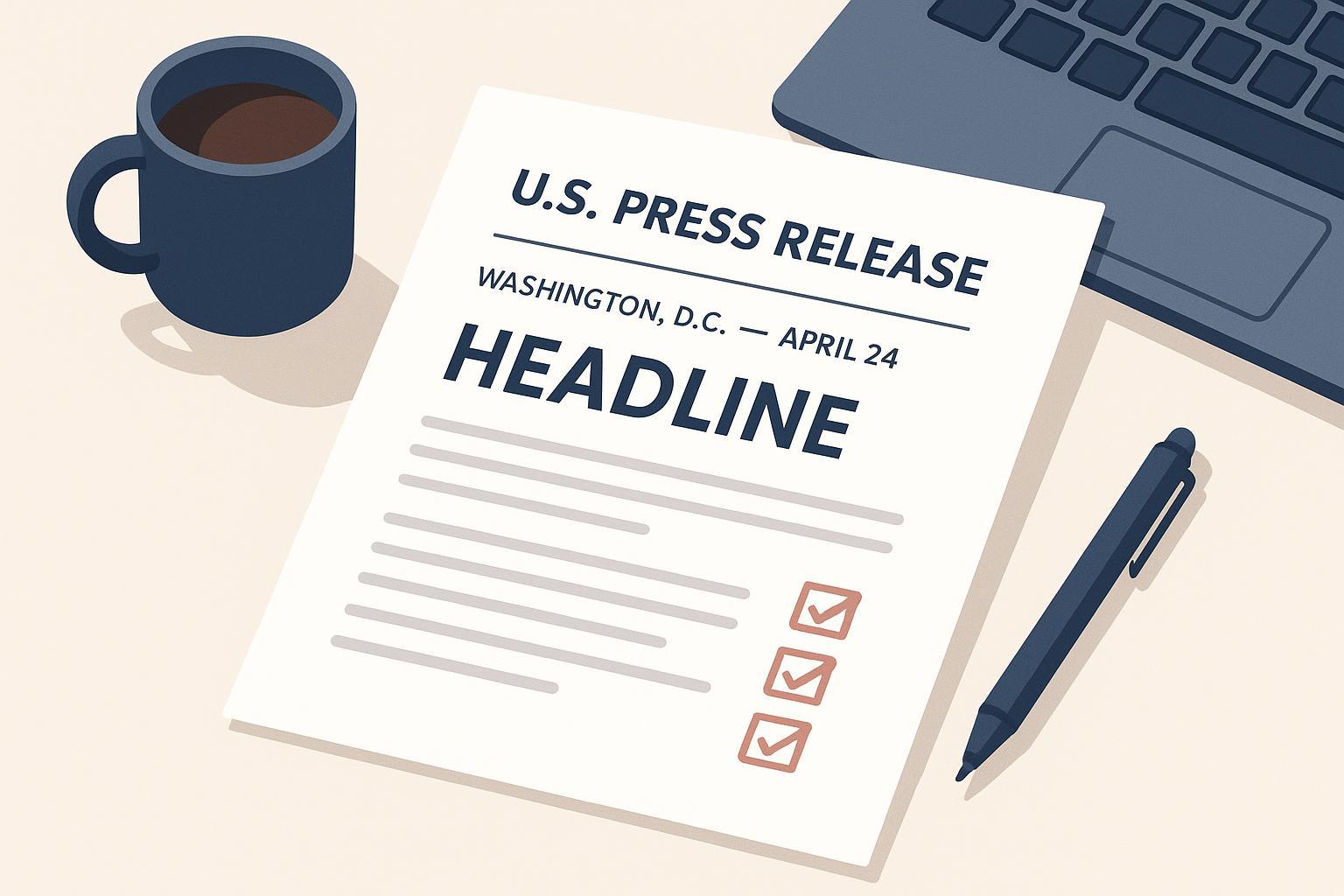
A newsroom-ready U.S. press release follows a well-worn path: clear structure, AP-style formatting, essential facts up top, human quotes, concise body copy, and a distribution plan that respects journalists’ time. Use this step-by-step checklist to draft, format, and ship releases that editors can use as-is—while avoiding common U.S. pitfalls (datelines, states, months, quotes, and more).
Who this is for: U.S.-based PR/communications teams, SMBs, nonprofits, and startups that need a dependable 2025 template and verification workflow. This guide reflects AP-style conventions and U.S. distribution norms.
Before You Draft: Pre-Work That Prevents Rewrites
-
Confirm the news value and angle.
- Verify the “why now” and who cares outside your organization. Tie to data, customer impact, timelines, or milestones.
-
Gather the 5Ws + H facts and proof points.
- Prepare names, titles, dates, locations, metrics, links, and third-party validations (partners, customers, awards).
-
Identify your primary audience and outlets.
- Define target beats (industry, local, national). This informs your lead and examples.
-
Select your spokesperson(s) and secure quote approvals early.
- Get legal/communications sign-off to avoid late-stage delays.
-
Decide on embargo status (if any) before writing.
- If using an embargo, agree on the lift date/time and list of trusted reporters. Label clearly at the top (see compliance section) and share sparingly.
-
Clarify sensitive claims and required disclaimers.
- Health/financial claims may require substantiation or legal review; public companies may need forward‑looking statement language.
-
Pick supporting assets and confirm usage rights.
- Headshots, product shots, charts, logos, and short video. Ensure licensing, captions, and credits.
-
Establish your boilerplate.
- Keep a canonical “About” paragraph consistent across releases and channels.
-
Define the call to action and link destinations.
- Ensure destinations are current, descriptive, and tracked (UTM parameters if appropriate).
-
Confirm contact details and availability window.
- Provide a reachable name, email, phone, and time zone; set expectations for response times on launch day.
Drafting & Formatting: The U.S. Template (AP-Style Friendly)
Use the structure below as your working template. Many U.S. wire guides align to these components; see the concise guidance in PR Newswire free press release templates and formatting best practices echoed by Business Wire’s press release dos and don’ts.
- Write a clear, benefit-oriented headline (Title Case or Sentence case).
- Be specific; avoid marketing fluff. Keep it under ~80 characters when possible. Numerals are fine and often preferred for 10+.
- Add an optional subheadline that sharpens the angle.
- Use it to add a key detail (audience, metric, market, date) without bloating the headline.
- Format the AP-style dateline at the start of the lead paragraph.
- Construction: CITY, State abbr. — Abbrev. Month Day, Year — Lead sentence begins here.
- Examples:
- NEW YORK, N.Y. — Oct. 7, 2025 — …
- LOS ANGELES — Sept. 15, 2025 — …
- KANSAS CITY, Mo. — June 18, 2025 — …
- States: Use AP abbreviations (not USPS). Certain states are never abbreviated (e.g., Alaska, Hawaii, Idaho, Iowa, Maine, Ohio, Texas, Utah) per the SJSU 2024 AP Style states handout. For ambiguous cities (e.g., Portland), include the state.
- Months/dates: Abbreviate long months with a specific date (Jan., Feb., Aug., Sept., Oct., Nov., Dec.); no ordinals; format “Oct. 7, 2025,” as summarized by the AP Stylebook Ask the Editors on months and dates.
- Em dash: Separate the dateline from the lead with an em dash. Wires frequently show spaced em dashes; match the platform’s preview.
- Craft the lead paragraph to answer the 5Ws + H in one or two sentences.
- What happened, who’s involved, where, when, why it matters, and how it works—front-loaded for editors.
- Write 2–4 short body paragraphs for context and details.
- Add data, customer examples, market context, or how-to-get-started steps. Aim for ~300–600 words total to stay scannable and wire-friendly.
- Insert human quotes with proper attribution.
- First mention: Full name, title, organization. Subsequent mentions: last name only. Quotes should add perspective, not repeat facts. See conventions summarized in the eReleases AP Style guide.
- Include links with descriptive anchor text.
- Avoid “click here.” Ensure links are accessible and trackable. Host large media externally vs. emailing bulky attachments.
- Add a clear call to action.
- Examples: “Download the report,” “Register for the webinar,” “View product specs,” “Apply by Nov. 1.”
- Place your standardized boilerplate (“About …”).
- Keep it consistent across all releases. One concise paragraph is typical.
- End with a complete media contact block.
- Name, title, organization, email, phone, time zone, and preferred hours.
- Optional: end marker.
- “###” is acceptable but not required for digital releases.
Common pitfalls to avoid
- Using USPS state codes (CA, NY) instead of AP abbreviations (Calif., N.Y.).
- Omitting the state for non-major cities; AP lists specific major cities (e.g., Los Angeles, Chicago, Washington) that stand alone.
- Using date ordinals (Oct. 7th) or inconsistent time-zone notation.
- Quotes that parrot the lead instead of adding viewpoint.
Pro tip: Keep paragraphs to one idea each. Editors often paste releases directly into CMS. Clean structure accelerates pickup.
Compliance, Style, and Accessibility Checks (U.S. 2025)
AP-style essentials (verify line by line)
-
State names and city handling
- For most cities, add the AP-style state abbreviation. For AP’s never-abbreviated states and city exceptions, refer to reputable summaries like the SJSU guide above and consult the AP Stylebook for edge cases.
-
Months, dates, times, and numerals
- Months/dates: Abbreviate long months when a date is present; no ordinals; “Oct. 7, 2025.”
- Times: Use a.m./p.m.; omit :00 for even hours (8 a.m.; 3:30 p.m.). Numerals in headlines are generally preferred for 10+. See the overview in PRSA’s Progressions AP quick guide.
-
Headline case and consistency
- Sentence case or Title Case are both acceptable for press releases—pick one and apply consistently across headline and subheadline.
Embargo etiquette (if applicable)
- Label clearly at the very top: “EMBARGOED UNTIL 8:00 a.m. ET, Oct. 15, 2025.” Share only with trusted beat reporters who agree to the timing. Do not mass-email embargoed material indiscriminately.
Legal and claims hygiene (consult counsel when needed)
- Forward-looking statements (public companies): Identify appropriately and include meaningful cautionary language; some situations (e.g., offerings) may exclude safe-harbor protection.
- Trademarks: Use ™/® correctly; attribute ownership and obtain permission for third-party marks when required.
- Regulated claims: Health or finance-related claims should be substantiated and reviewed.
Accessibility must-haves (WCAG-aligned)
- Publish an HTML version of the release and ensure accessible PDFs when used.
- Provide concise alt text for images and credits for photos.
- Use descriptive link text (no “click here”) and sufficient color contrast.
- Caption prerecorded video and provide transcripts for audio. These align with W3C WCAG 2.1 principles.
Asset Readiness (Images, Video, Files)
-
Prep a small, high-quality image set.
- One landscape hero image (JPEG/PNG), optional product shots, and a logo (SVG/PNG). Keep file sizes reasonable.
-
Write alt text and captions with credits.
- Alt text describes the image’s purpose; captions add context and credit the creator/source.
-
Confirm usage rights and releases.
- Ensure you have licenses/permissions for people, locations, and third-party marks.
-
Use clear, consistent filenames.
- Example: brand-product-release-2025-10-07.jpg
-
Host large files on your site or a public asset hub.
- Link in the release rather than attaching bulky files to pitch emails.
Distribution Essentials (Wire + Direct Pitching)
-
Scrub and segment your media list.
- Validate beats and recent coverage; remove irrelevant/outdated contacts; segment by industry and region. See structural guidance in BuzzStream’s anatomy of a press release, then tailor your outreach to each segment.
-
Choose your distribution path(s).
- Wire distribution (e.g., PR Newswire, Business Wire, GlobeNewswire) expands baseline visibility; direct pitching targets fit and context. Budget and goals determine the mix.
-
Time your send.
- Favor early weekdays and respect time zones (ET, CT, MT, PT). Avoid late Fridays and holiday eves unless strategic.
-
Pitch succinctly.
- Email subject lines should be clear and relevant. Keep bodies under ~100 words with a link to the hosted release and assets. Avoid heavy attachments.
-
Provide newsroom-friendly formats.
- Include the full release inline or link to your press page. Attach Word/PDF only when requested. The formatting practices in Business Wire’s press release dos and don’ts can help ensure readability.
-
Follow up once, thoughtfully.
- Wait 3–4 days before a brief, value-adding follow-up. Offer exclusive details only when appropriate and equitable.
Measurement, Responses, and Corrections
-
Tag links for analytics.
- Use UTM parameters for your CTA and newsroom links to track traffic and conversions.
-
Monitor coverage and social chatter.
- Track pickup, sentiment, and key quotes. Log reporter inquiries and your responses.
-
Prepare a corrections protocol.
- If errors surface, issue a prompt correction or addendum on your press page and notify key outlets.
-
Capture lessons learned.
- Note questions reporters asked, friction points, and timing outcomes to refine future releases.
Printable Quick Checklist
Copy/paste this compact list into your team’s workflow tool.
Pre-draft
- Define the news angle and audience.
- Gather 5Ws + H facts, metrics, links.
- Choose spokesperson(s); secure quote approvals.
- Decide on embargo terms (if any).
- Confirm legal/compliance needs (claims, disclaimers).
- Select assets; verify rights; plan captions/credits.
- Finalize boilerplate; confirm CTA and tracked links.
- Verify media contact details and availability.
Draft & format
- Headline: clear, specific; Title Case or sentence case.
- Subheadline (optional): adds key detail.
- Dateline: CITY, State abbr. — Abbrev. Month Day, Year — …
- Lead: 5Ws + H in 1–2 sentences.
- Body: 2–4 short paragraphs with proof/context.
- Quotes: full name + title first use; then last name only.
- Links: descriptive anchors; host large assets.
- Boilerplate: standardized “About …” paragraph.
- Media contact: name, email, phone, time zone.
- Optional end marker (###).
Compliance & accessibility
- AP states and major-city handling verified.
- Months/dates: abbreviations; no ordinals.
- Times: a.m./p.m.; omit :00 for even hours.
- Numerals/headline consistency checked.
- Embargo label at top if used.
- Trademarks/claims reviewed.
- Alt text, captions/credits, accessible links.
Assets & distribution
- Images/video sized; filenames standardized.
- Hosted assets linked; no bulky attachments.
- Media list updated and segmented.
- Wire vs. direct pitch plan defined.
- Send timing set (weekday mornings, time zones).
- One thoughtful follow-up after 3–4 days.
Measurement & follow-up
- UTM links in place.
- Monitor pickup and sentiment.
- Log inquiries; respond promptly.
- Corrections/addenda protocol ready.
- Document lessons for next release.
References and further reading
- Structural components: see PR Newswire free press release templates.
- Editorial do’s/don’ts: see Business Wire’s press release dos and don’ts.
- AP style specifics (states, datelines, quotes): see the eReleases AP Style guide and the state rules in the SJSU 2024 AP Style states handout; for months/dates, consult the AP Stylebook Ask the Editors on months and dates.
- Accessibility principles for web/PDF: see W3C WCAG 2.1.
- Anatomy and adaptation ideas: see BuzzStream’s anatomy of a press release.
