The Ultimate Guide to Building U.S.-Compliant Blog Outlines (FTC, ADA/WCAG, HIPAA, FINRA, FDA, Privacy)

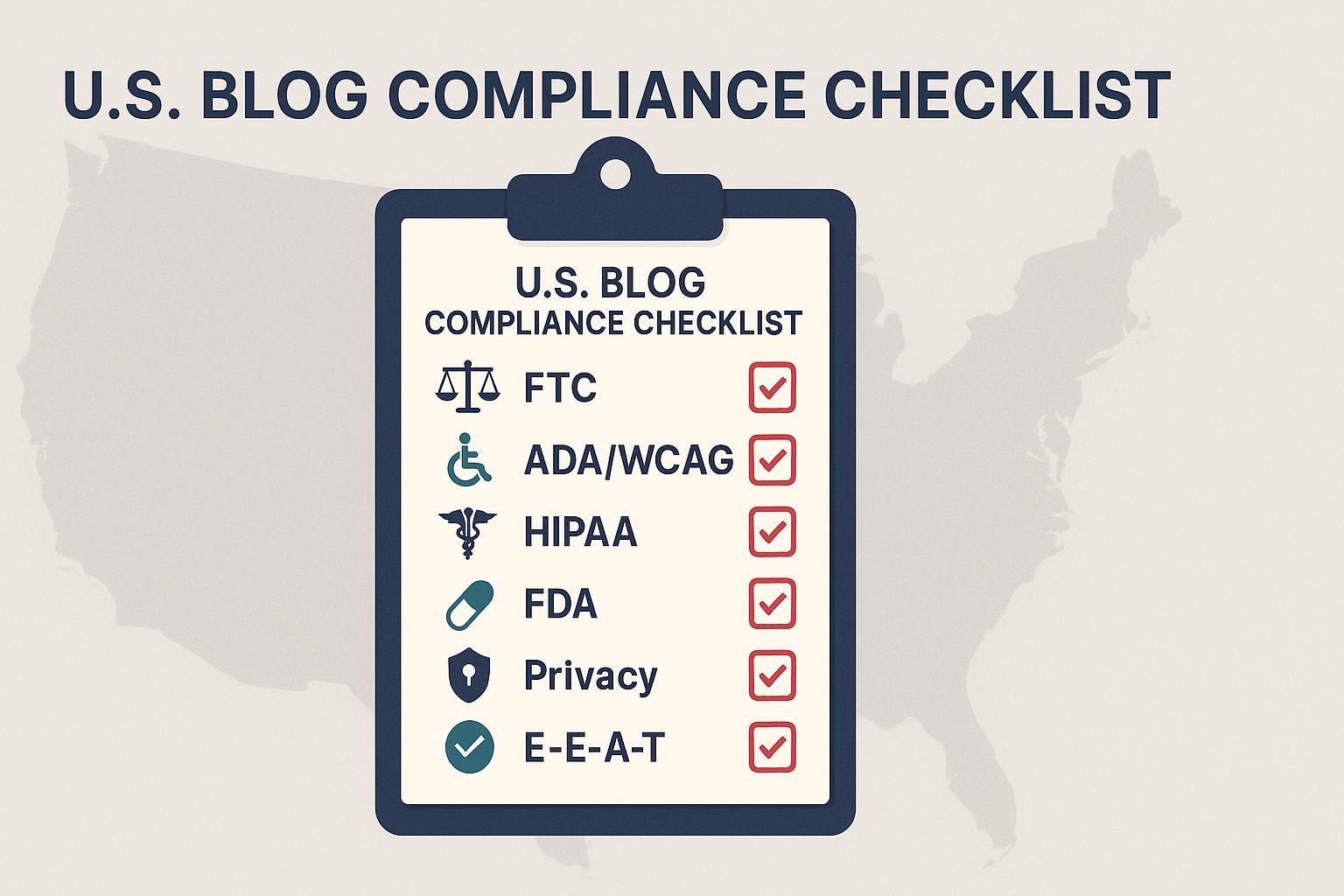
You’re here because you want to plan blog content that won’t create regulatory headaches later. Good instinct. The cheapest place to catch risk is at the outline stage—before writers commit words, designers add images, or developers wire in tracking.
In this guide, I’ll translate the big U.S. compliance regimes into practical outline checkpoints you can actually use. We’ll cover FTC disclosures, accessibility (ADA/WCAG), HIPAA nuances for health sites, FINRA vs SEC rules for finance content, FDA/OPDP constraints for pharma, and the privacy essentials (CCPA/CPRA, COPPA, CAN-SPAM, TCPA). We’ll also bake in Google’s E-E-A-T/YMYL expectations so your expert content wins trust.
Quick note: This is educational content, not legal advice. When in doubt—especially in edge cases—loop in counsel or your compliance officer.
How to Use This Guide
- Treat each H2 as a planning gate. Before a draft starts, confirm the relevant checkpoints.
- Use the sample disclosure language and accessibility basics as starting points and adapt to your audience.
- If you work in a regulated industry (healthcare, finance, pharma/devices), apply the sector guardrails and approval workflows.
- Document what you decided—disclosures, data practices, review sign-offs—so you’re audit-ready.
FTC Disclosures and Reviews: Make “Material Connections” Unmissable
If your blog contains endorsements, affiliate links, gifted products, or anything that might bias a recommendation, the FTC expects a “clear and conspicuous” disclosure placed where people will see it when it matters. The agency’s 2023 update emphasizes proximity and clarity: disclosures buried at the bottom of a page are often ineffective, and you should repeat disclosures in long content or across media types when necessary, as discussed in the FTC’s guidance Q&A (2023) in the resource titled FTC’s Endorsement Guides: What People Are Asking.
What this means at the outline stage
- Identify all endorsements/affiliations: sponsors, affiliates, free products, employee relationships.
- Decide exactly where the disclosure goes: place it above or immediately adjacent to each recommendation or affiliate link; mirror it inside embedded video/audio via on-screen text or audio notes.
- Write it plainly for your audience: simple labels like “Ad,” “Sponsored,” “Affiliate link — we may earn a commission.” Avoid jargon or ambiguous phrasing.
- Plan for mobile: ensure the disclosure is unavoidable on small screens.
Example disclosure language you can paste into your outline
- Affiliate: “This post contains affiliate links. If you buy through these links, we may earn a commission at no extra cost to you.”
- Sponsored: “This article is sponsored by [Brand]. Our views are our own.”
- Gifted product: “Thanks to [Brand] for providing the [product] for review.”
- Employee/insider: “I work for [Company]. The views expressed are my own.”
Reviews and testimonials: new penalty risk
- As of October 2024, the FTC’s Consumer Reviews and Testimonials Rule allows civil penalties for fake or deceptive reviews and for undisclosed insider/incentivized reviews. See the Federal Register’s Trade Regulation Rule on the Use of Consumer Reviews and Testimonials (2024). The FTC’s press release (Aug 2024) underscores enforcement intent.
At outline time, add a reviews plan
- If your post references user reviews, document how you obtained them (no suppression of negatives), how you’ll label incentives, and where you’ll place any required disclosures.
Accessibility: Build WCAG 2.1 AA Into Every Outline (and Prepare for 2.2)
Accessibility isn’t optional when you want inclusive reach and lower legal risk. For public entities, the DOJ’s 2024 Title II rule requires WCAG 2.1 AA conformance on websites and apps on a timeline through 2026–2027, as summarized in the ADA.gov fact sheet titled New Rule on Web & Mobile Accessibility (2024). While private-sector websites don’t have a codified technical standard, settlements and best practice revolve around WCAG 2.1 AA—and WCAG 2.2 adds important usability criteria adopted by W3C in 2023 at WCAG 2.2 W3C Recommendation.
Outline-level accessibility checkpoints
- Headings: One H1; logical H2/H3 structure; descriptive headings that map to your outline sections.
- Images: Write meaningful alt text in the outline for every essential image; mark decorative images to be ignored by assistive tech.
- Color/contrast: Plan color choices that meet WCAG AA (4.5:1 for normal text, 3:1 for large text). Avoid conveying meaning by color alone.
- Keyboard: Ensure all interactive elements are keyboard operable with visible focus states; note 2.2’s Focus Appearance.
- Links: Use descriptive link text that makes sense out of context; avoid “click here.”
- Forms: Include labels, instructions, clear errors, and programmatic associations; avoid CAPTCHA barriers or provide accessible alternatives.
- Skip links: Reserve space for a “Skip to main content” link in templates.
- Media: Plan captions for prerecorded video and transcripts for audio.
- Mobile and motor/cognitive: Avoid drag-only interactions; ensure touch target sizes meet WCAG 2.2 guidance; write in plain language and provide consistent help patterns.
CMS mini-steps to embed in your process
- WordPress: Add alt text in the Media Library or Image block; use Heading blocks properly; consult the WordPress Accessibility Handbook at WordPress Accessibility Handbook.
- Squarespace: Use the Alt Text field for images and proper heading styles; see Squarespace’s help resources such as Adding alt text to images for platform-specific instructions.
HIPAA for Blogs: PHI, Pixels, and Patient Privacy
If you’re a covered entity or business associate, blog and site behavior data can become PHI more often than you think. HHS/OCR’s updated bulletin (March 18, 2024) clarifies that identifiable information collected on a regulated entity’s website or app can be PHI—even on unauthenticated pages—when it relates to an individual’s health-related activities. The bulletin also underscores that disclosing PHI to tracking vendors without a BAA or authorization is not permitted. See HHS/OCR’s official resource titled Use of Online Tracking Technologies by HIPAA Regulated Entities (updated 2024).
Key nuances to capture at the outline stage
- Inventory sensitive pages: Symptom checkers, appointment forms, condition-specific posts, or pages likely visited for care decisions. Assume IP addresses and device IDs can be PHI in this context.
- Trackers and pixels: Remove or restrict trackers on sensitive/authenticated pages unless you have a BAA or individual authorization and can meet Security Rule safeguards.
- Notices and consent: Coordinate with your Notice of Privacy Practices and consent flows; ensure your privacy policy accurately describes tracking.
- Comments and UGC: Plan to moderate and avoid publishing PHI in comments. Add a note in your community guidelines and outline how you’ll handle removals.
Important caveat: Parts of OCR’s earlier interpretations were narrowed by litigation; the March 2024 bulletin adjusted examples. Because this is a fast-moving area, have counsel review edge cases involving unauthenticated pages or IP-only data.
Financial Content: FINRA Rule 2210 vs the SEC Marketing Rule
If you’re a broker-dealer, FINRA Rule 2210 governs “retail communications.” It requires that communications be fair and balanced, with material risks disclosed, and that a principal approve retail communications pre-use, with records retained for at least three years. See FINRA’s official overview at Advertising Regulation Overview.
Influencer oversight matters here: FINRA treated paid or endorsed social content as retail communication in a 2024 action fining M1 Finance $850,000, citing unfair/unbalanced presentations and supervisory/recordkeeping gaps, as described in the FINRA news release on M1 Finance (2024).
If you’re an investment adviser, the SEC’s Marketing Rule (Rule 206(4)-1) sets conditions on performance advertising and testimonials, requires written policies and procedures, and has a five-year recordkeeping period. The SEC provides official FAQs under the Division of Investment Management at Marketing Rule FAQs.
Outline decisions to capture
- Determine your regime: Broker-dealer (FINRA) or investment adviser (SEC). If both, meet the stricter requirements applicable to each communication.
- For broker-dealers: Build principal pre-approval into your workflow; ensure fair balance and audience-appropriate content; archive posts for three years; include influencer pre-approval and contracts.
- For investment advisers: Ensure net performance presentations and proper hypothetical performance controls (if applicable); maintain written policies; archive for five years.
Pharma, Devices, and Supplements: FDA/OPDP Guardrails
For prescription drugs, “fair balance” between benefits and risks is essential. FDA’s 21 CFR 202.1 and subsequent guidance require truthful, non-misleading promotion with appropriate risk information. In 2023, FDA finalized a rule for DTC TV/radio ads that requires the “major statement” of risks to be clear, conspicuous, and neutral, with dual modality (audio + text) and without distracting content. Review the Federal Register’s 2023 final rule under the entry DTC advertisements: presentation of the major statement (2023).
For devices, promotions must be truthful and non-misleading; device guidances and labeling apply. For dietary supplements, you can use structure/function claims with substantiation and the mandatory disclaimer; do not make disease treatment claims without FDA approval. See FDA’s page on Structure/Function Claims and its guidance on Label claims for dietary supplements.
Outline prompts for regulated health content
- Is this post promotional for a specific Rx brand? If yes, you’ll need fair balance, risk info, and legal/regulatory review prior to publication.
- If it’s disease awareness without brand promotion, keep a neutral tone, avoid implying treatment claims by unapproved products, and cite authoritative medical sources.
- For supplements: stick to structure/function claims with proper disclaimer; avoid disease claims and ensure substantiation.
Privacy Essentials for Blogs: CPRA/CCPA, COPPA, CAN-SPAM, TCPA
California’s CCPA/CPRA remains the baseline many teams follow. If your business is covered, you must offer an opt-out of “sale” or “sharing” (which includes cross-context behavioral advertising) via a link like “Do Not Sell or Share My Personal Information,” and you must honor global privacy control signals (GPC). The California Attorney General’s page describes these obligations and consumer rights at CCPA for businesses and consumers. The CPPA emphasizes recognition of opt-out signals, per a 2023 announcement available at CPPA announcement regarding opt-out signals (2023).
Outline-level privacy checkpoints
- Applicability: Confirm whether CPRA/CCPA thresholds apply. If yes, include an opt-out link in the footer and support GPC.
- Data subject requests: Plan a DSAR intake and fulfillment process; update your privacy policy with categories, uses, sharing, and rights.
- Email capture: Align with CAN-SPAM—no deceptive headers or subjects, identify ads, include a physical address, provide a one-click unsubscribe, and honor opt-outs within 10 business days. Details are in the FTC’s guide titled CAN-SPAM compliance guide for business.
- SMS capture: Comply with the TCPA—obtain prior express written consent for marketing texts, keep consent records, provide clear opt-out keywords, and honor revocation promptly. Refer to the FCC’s resource at Telephone Consumer Protection Act (TCPA).
- Children’s data: If your blog targets under-13 users or knowingly collects their personal information, you need verifiable parental consent under COPPA. See the FTC’s rule page at Children’s Online Privacy Protection Rule.
Note on other states: Many states beyond California now have comprehensive privacy laws with varying obligations (e.g., Virginia, Colorado, Connecticut). Treat CPRA/CCPA as a starting point, then check state-specific rules with counsel.
E-E-A-T and YMYL: Make Expertise Visible in Your Outlines
For health and finance (and other YMYL topics), your outline should plan for visible expertise, sourcing, and review. Google’s Search Quality Evaluator Guidelines (Nov 2023) explain how raters assess E-E-A-T: clear bylines, evidence of experience and expertise, site reputation, and accurate sourcing. You can review the official PDF at Google Search Quality Evaluator Guidelines (Nov 2023). Google’s Search Central also emphasizes people-first content and transparency about authorship and sourcing.
Outline-level E-E-A-T checkpoints
- Bylines and bios: Assign an author with relevant credentials; link to a bio; for YMYL, add “Reviewed by [Credential], [Date].”
- Citations: Identify authoritative sources you’ll cite in the draft (government sites, academic institutions, primary guidelines). Use descriptive link anchors and include years for clarity.
- Editorial transparency: Plan to include publication and “last updated” dates; if you have an editorial or corrections policy, link to it.
- Update cadence: For YMYL, schedule periodic review (e.g., quarterly or upon major guideline updates) in the outline itself.
Your Pre-Draft Compliance Workflow (Map This to Your Project Tool)
- What is the topic and audience? Is it YMYL?
- Which regimes apply (FTC, accessibility, privacy, HIPAA, FINRA/SEC, FDA)?
- Identify risk triggers
- Any endorsements, affiliates, gifts, or sponsorships?
- Any data collection (forms, pixels), or under-13 audience risk?
- Any health or finance claims, Rx brand mentions, or performance data?
- Insert safeguards into the outline
- Place disclosure language near endorsements and embeds.
- Add accessibility requirements to each section (headings, alt text, link text, media captions).
- Specify privacy actions (opt-out link, GPC support, email/SMS consent language).
- Add sector-specific review notes (HIPAA BAAs; FINRA principal approval; FDA legal/reg review).
- Plan approvals and recordkeeping
- Assign reviewers (legal/compliance/SME) and set due dates.
- Archive approvals and a final copy of the outline and post for retention (e.g., 3 years for FINRA retail communications; 5 years for SEC marketing materials).
- Ship and monitor
- Verify disclosures render on mobile.
- Run accessibility checks before and after publication.
- Confirm opt-out links and preference signals work; test unsubscribe/STOP flows.
- Monitor comments/UGC for PHI or endorsement issues and moderate per policy.
Platform Mini-Guides: WordPress and Squarespace
- Disclosures: Create a reusable block with your standard affiliate/sponsor disclosure. Insert it above the first affiliate link and near the end for long posts.
- Alt text: In the Media Library or the Image block’s settings, add accurate alt text describing the purpose of the image. See the WordPress Accessibility Handbook.
- Headings: Use Heading blocks with a single H1 and a logical H2/H3 hierarchy that mirrors your outline.
- Disclosures: Use a Text block adjacent to promotional content; check mobile visibility.
- Alt text and headings: Use built-in Alt Text fields and heading styles. Platform documentation is available at Squarespace Help Center.
Example Outline Templates (Copy, Then Customize)
- H1: [Topic]
- Intro: Who it helps and why
- H2 #1: Core concept (include citations plan)
- H2 #2: How to apply it (steps)
- H2 #3: FAQs and pitfalls
- Accessibility notes: Headings mapped; alt text for all images; descriptive link text; captions/transcripts if media.
- E-E-A-T: Author byline, credentials; review note if YMYL; last updated date.
- Affiliate roundup or product review
- H1: [Product category] — What we tested and recommend
- Intro: Trust note and methodology
- Disclosure (above first affiliate link): “This post contains affiliate links… we may earn a commission…”
- H2 #1: How we test (avoid cherry-picking; plan for balanced criteria)
- H2 #2: Top picks (each with pros/cons and any limitations)
- H2 #3: Alternatives and who they’re for
- Reviews plan: No suppression of negatives; mark gifted items; insider relationships disclosed.
- Accessibility: Ensure images of products have meaningful alt text; comparison tables meet contrast and header semantics.
- Health explainer (non-promotional)
- H1: Understanding [Condition]
- Intro: Scope and safety note
- H2 #1: Symptoms and when to seek care (cite reputable sources)
- H2 #2: Diagnosis/treatment overview (neutral tone; no brand promotion)
- H2 #3: Lifestyle considerations
- Accessibility: Plain language, headings; alt text; media captions.
- HIPAA note: If forms/comments are present, add moderation plan to avoid PHI disclosures; avoid tracking pixels on sensitive pages without safeguards.
- E-E-A-T: “Medically reviewed by [Credential], [Date].”
- Finance commentary (IA or BD)
- H1: What [market trend] means for [audience]
- Intro: Risk disclosures and scope
- H2 #1: Context and data (cite sources; no cherry-picking)
- H2 #2: Scenarios and risks (balanced presentation)
- H2 #3: Practical implications
- Compliance: For BDs, principal pre-approval and 3-year retention; for IAs, Marketing Rule controls and 5-year retention.
- Accessibility: Headings, alt text for charts, data table semantics, color-safe palettes.
- Pharma or device awareness (no brand promotion)
- H1: Talking to your doctor about [therapeutic area]
- Intro: Educational purpose; not a substitute for professional advice
- H2 #1: Questions to ask
- H2 #2: Treatment categories (high level, unbiased)
- H2 #3: Support resources
- FDA note: Avoid promoting specific Rx brand benefits/claims without fair balance and legal/regulatory review.
- Accessibility: Captions/transcripts for any patient stories; plain language.
Quick Checklists You Can Paste Into Any Outline
FTC disclosure checklist
- Identify all endorsements/affiliates and insider relationships.
- Place disclosures above or adjacent to recommendations and links; repeat if long or multi-format.
- Use plain, unavoidable wording; confirm mobile visibility.
- Plan UGC/review policy; avoid suppressing negative reviews.
Accessibility checklist
- Headings hierarchy; alt text complete; descriptive links.
- Color contrast AA; keyboard operability; visible focus states.
- Captions for video; transcripts for audio; skip link.
- Mobile target sizes; plain language; consistent help.
- Flag pages collecting or inferring PHI; inventory trackers.
- Remove/restrict trackers on sensitive/authenticated pages unless you have BAAs/authorizations and safeguards.
- Align privacy notices; moderate comments for PHI.
FINRA/SEC checklist
- Determine regime (BD vs IA); apply fair balance.
- BD: principal pre-approval; WSPs; 3-year retention; influencer oversight and recordkeeping.
- IA: Marketing Rule policies; net performance and hypothetical controls; 5-year retention.
FDA/OPDP checklist
- If promotional for Rx: fair balance, risk information, legal/reg review; avoid distracting elements.
- If non-promotional awareness: neutral tone; cite authoritative sources.
- Supplements: structure/function only + disclaimer; no disease claims.
Privacy checklist
- CPRA/CCPA applicability; opt-out link; GPC support; DSAR workflow.
- CAN-SPAM for email capture; TCPA consent and opt-outs for SMS.
- COPPA safeguards if child-directed.
FAQs and Edge Cases (Plan for These Before Drafting)
- Do I need a disclosure for every affiliate link? If links appear throughout a post, plan a disclosure above the first one and include brief reminders near clusters of links so users can’t miss it. The FTC’s 2023 Q&A stresses proximity and unavoidability.
- What if my site covers multiple jurisdictions? Use CPRA/CCPA as a baseline for U.S. and map additional state requirements. Consider region-aware banners for opt-out and consent.
- Can I embed a YouTube video with a spoken disclosure only? For mixed media, plan both in-medium text and audio. Don’t rely on one channel only.
- Are anonymous analytics okay on health pages? OCR emphasizes Security Rule compliance and the risk that identifiers like IP address can be PHI in context. Anonymization may be insufficient; consult counsel and consider BAAs or removal.
- How do I handle finfluencers? Treat paid or endorsed content as retail communications if you’re a broker-dealer: require pre-approval, fair balance, supervision, and recordkeeping, consistent with FINRA’s enforcement posture in 2024.
- Can supplements content ever mention diseases? Avoid disease treatment/prevention claims unless the product is FDA-approved as a drug. Stick to structure/function claims with the required disclaimer and substantiation.
Source Notes and Ongoing Updates
- FTC endorsements and reviews: see the FTC’s 2023 Q&A and the 2024 Consumer Reviews & Testimonials Rule in the Federal Register.
- Accessibility: see ADA.gov’s 2024 Title II web and mobile rule fact sheet and W3C’s WCAG 2.2 recommendations.
- HIPAA tracking tech: see HHS/OCR’s 2024 bulletin and the HIPAA Privacy Rule overview.
- Finance: consult FINRA’s Advertising Regulation resources and the SEC’s Marketing Rule FAQs.
- FDA: review OPDP FAQs and the 2023 DTC major statement final rule.
- Privacy: review CA AG’s CCPA/CPRA resources, the CPPA’s opt-out signals note, FTC’s CAN-SPAM, FTC’s COPPA, and the FCC’s TCPA page.
Remember to surface the year of key rules and guidance near the first reference in your draft to demonstrate freshness and credibility.
By front-loading compliance decisions in your outline, you reduce rework, protect users, and speed up approvals. Keep this guide handy, plug the checklists into your templates, and involve your compliance partner early—before the first draft begins.
