Transition Words: What They Are, Why They Matter, and How to Use Them (with Marketing Examples)

What are transition words?
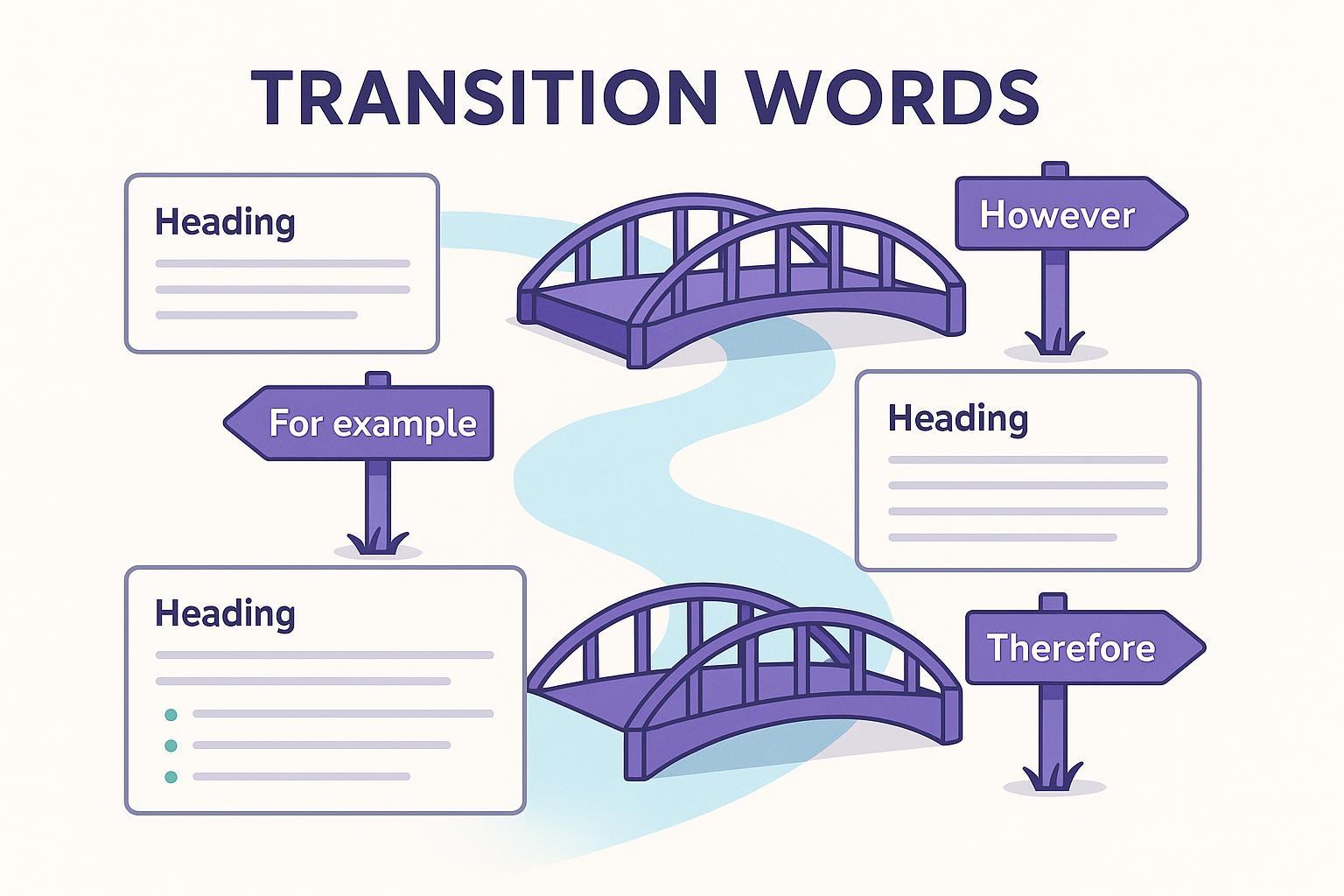
Transition words are the small bridges and signposts that guide readers from one idea to the next. In plain English: they’re words or short phrases (like however, for example, therefore) that signal the logical relationship between sentences and paragraphs so your writing flows.
Authoritative writing guides describe transitions as devices that help readers move between ideas at sentence, paragraph, and section levels—a key ingredient of coherence and clarity, as explained by the Harvard College Writing Center’s “Transitions” guidance.
Why they matter for readers and SEO-readiness
Better comprehension and flow: Clear transitions make it obvious how ideas connect (contrast, cause/effect, sequence). University writing centers emphasize matching the transition to the actual logic and using them to connect paragraphs as well as sentences; see the UW–Madison Writing Center’s “Connecting Ideas Through Transitions”.
Smoother user journeys: On the web, people scan. Section signposts and clear transitions help them follow your argument and find what they need; this aligns with Nielsen Norman Group’s findings on scanning behavior in “How People Read Online” (2019).
SEO-readiness without gaming it: Popular tools such as Yoast include a transition-words check. As of 2025-10-11, Yoast’s readability analysis describes thresholds (e.g., a “green light” when transitions appear in at least 30% of sentences), but it also encourages natural usage aligned to your logic, not stuffing; see Yoast’s “Transition words: why and how to use them”.
In other words, transitions primarily serve readers. When readers can follow the path you’re laying out, they’re more likely to stay, engage, and convert.
How transition words work (and where to place them)
Sentence to sentence: Often at the start (However, Therefore, For example) or mid-sentence set off by commas (… , however, …). Purdue OWL details common patterns in its overview of transitional devices.
Paragraph to paragraph: Use a transition in the opening line of the new paragraph to show how it relates to the previous one. You can also echo a keyword or summarize the prior point and pivot with a transition phrase.
Punctuation cues: Conjunctive adverbs (however, therefore, meanwhile) typically take a comma when they begin a sentence. When they appear mid-sentence, they are usually enclosed by commas or preceded by a semicolon.
Match word to logic: Choose a transition that reflects the actual relationship (contrast vs. cause; sequence vs. example). If the logic changes, the transition should change too.
Try these simple templates:
Transition + claim + because/result: “Therefore, we cut onboarding time by 40% because we automated setup.”
Old sentence. Transition, new angle: “We saw strong sign-ups. Meanwhile, churn spiked after trial day seven.”
Wrap-up + pivot: “That covers the basics. Next, let’s apply them to your pricing page.”
Categorized lists with SMB-focused examples
Use these as starting points; vary them so your prose doesn’t feel repetitive.
Addition: also, moreover, furthermore, additionally
Example: “Additionally, our funnel audit revealed missed retargeting opportunities.”
Contrast: however, on the other hand, nevertheless, yet, still
Example: “However, organic traffic lagged despite higher content output.”
Cause & effect: therefore, thus, as a result, consequently, because of this
Example: “As a result, the category page now ranks for three high-intent keywords.”
Sequence & time: first, next, then, meanwhile, afterwards, finally, subsequently
Example: “First, validate demand; next, build a lightweight MVP landing page.”
Emphasis: notably, importantly, above all, in fact, indeed
Example: “Notably, demo requests rose after we clarified the pricing tiers.”
Examples/illustration: for example, for instance, to illustrate, such as, in other words
Example: “For instance, replacing ‘Start’ with ‘Get My Free Report’ lifted CTR.”
Comparison: similarly, likewise, in the same way
Example: “Likewise, ecommerce brands see gains from clearer filter labels.”
Concession: although, even though, granted, admittedly
Example: “Although the campaign was late, it hit the revenue target.”
Summaries & conclusions: in short, to sum up, overall, ultimately
Example: “In short, the redesign simplified choices and removed friction.”
Place/position (UX copy): nearby, above, below, beyond
Example: “Below, compare plans and see what’s included.”
Tip: Phrases count too. “On the other hand,” “as a result,” and “in other words” are all transitions.
Before/after rewrites that show the difference
Realistic micro-examples for blogs and landing pages.
Blog intro → body
Before: “Content velocity matters. Many teams lack resources.”
After: “Content velocity matters. However, many teams lack resources to publish consistently.”
Section to section (how-to SaaS blog)
Before: “Audit your pages. Build topic clusters.”
After: “Audit your pages. Next, build topic clusters around the terms your customers actually search.”
Body → CTA (blog)
Before: “You can apply these steps in your next post. Try our template.”
After: “You can apply these steps in your next post. In fact, you can test them today with the template below.”
Landing page hero → value props
Before: “Launch pages fast. Built-in SEO tools.”
After: “Launch pages fast. Meanwhile, built-in SEO tools ensure your structure is sound from day one.”
Features → proof (landing page)
Before: “Automated internal links. Schema markup.”
After: “Automated internal links. As a result, key pages receive consistent crawl paths and context.”
Proof → CTA (landing page)
Before: “Brands report shorter time-to-value. Start your trial.”
After: “Brands report shorter time-to-value. Therefore, start your trial to see how fast you can publish.”
A quick, practical workflow
Use this when drafting blog posts or landing pages.
Draft freely, then map logic: Contrast? Example? Cause/effect? Mark the relationship for each sentence or paragraph.
Insert accurate transitions: Choose a word or phrase that matches the marked logic. Vary them to avoid repetition.
Read aloud and trim: If a transition doesn’t add clarity, cut it. If two sentences already connect clearly, you may not need a transition.
Check paragraph handoffs: Ensure the first sentence of each new section signals why it follows the previous one.
Align with readability tools—without gaming: If you use a plugin, treat its percentage as a cue, not a target.
Practical tool-assisted example:
Many teams draft with AI, then refine clarity and flow. You can create a working draft in QuickCreator and use it to structure sections, then manually edit transitions to match your logic. Disclosure: QuickCreator is our product.
Common mistakes and how to fix them
Stuffing transitions to “hit a percentage”: If every sentence starts with however or therefore, the writing feels robotic. Use transitions where they clarify logic, not as decoration. Yoast’s guidance underscores clarity over forcing the metric; see their page on transition words and readability.
Repeating the same transition: Rotate among accurate options (however, nevertheless, still) and consider phrases.
Mismatched logic: Don’t use therefore for mere contrast. Swap it for however, or rewrite the sentence so causality is true.
Forgetting paragraph-level signals: Add a setup line like “In contrast to the onboarding flow, the billing flow fails on mobile.”
Treating transitions as only single words: Phrases like in other words, as a result, on the other hand are often clearer.
Quick fixes:
Replace filler with logic-fit: “Also” → “More importantly,” if you’re emphasizing.
Upgrade vague pivots: “Anyways” → “Meanwhile,” if indicating time; “On a related note,” if adding context.
Mini plug-and-play templates
Contrast pivot: “However, [new limitation]—so we [response].”
Evidence add-on: “For example, [specific data point or customer quote].”
Cause → effect: “[Action]. Consequently, [measurable outcome].”
Sequence handoff: “First, [step]. Next, [step]. Finally, [result].”
Summary → CTA: “In short, [benefit]. Therefore, [action].”
Scope note: related terms without the jargon dive
Linking words and discourse markers: Overlapping terms for words/phrases that connect ideas in speech or writing.
Cohesive devices: A broader umbrella that includes repetition, pronouns, and substitution alongside transition signals. For an accessible overview, see EAPFoundation’s cohesion & coherence explanation.
Practical takeaway: In marketing copy, “transition words” are the subset you’ll use daily to signal relationships for readability and flow.
Responsible readability and SEO alignment
Use transitions to aid readers first. Tools help, but logic-fit matters more than a threshold.
Vary transitions, especially at paragraph openings.
Combine with web-friendly structure (clear headings, bullets) to support scanners, consistent with NN/g’s web writing best practices referenced above.
Where to go next
If you want a head start on structure and readability, you can draft faster and then fine-tune transitions. Create a readable, SEO-ready article with QuickCreator’s AI Blog Builder, then edit each paragraph opener to reflect the true logic.
References and further reading
Definition, functions, categories: Harvard College Writing Center — “Transitions”
Category patterns and cautions: UW–Madison Writing Center — “Connecting Ideas Through Transitions”
Transitional devices and punctuation: Purdue OWL — “Transitional Devices”
Readability check context and thresholds: Yoast — “Transition words: why and how to use them”
Web readers scan (design implications): Nielsen Norman Group — “How People Read Online”
