Understanding the Key Differences Between Transactional and Commercial Emails

One-Sentence Definition
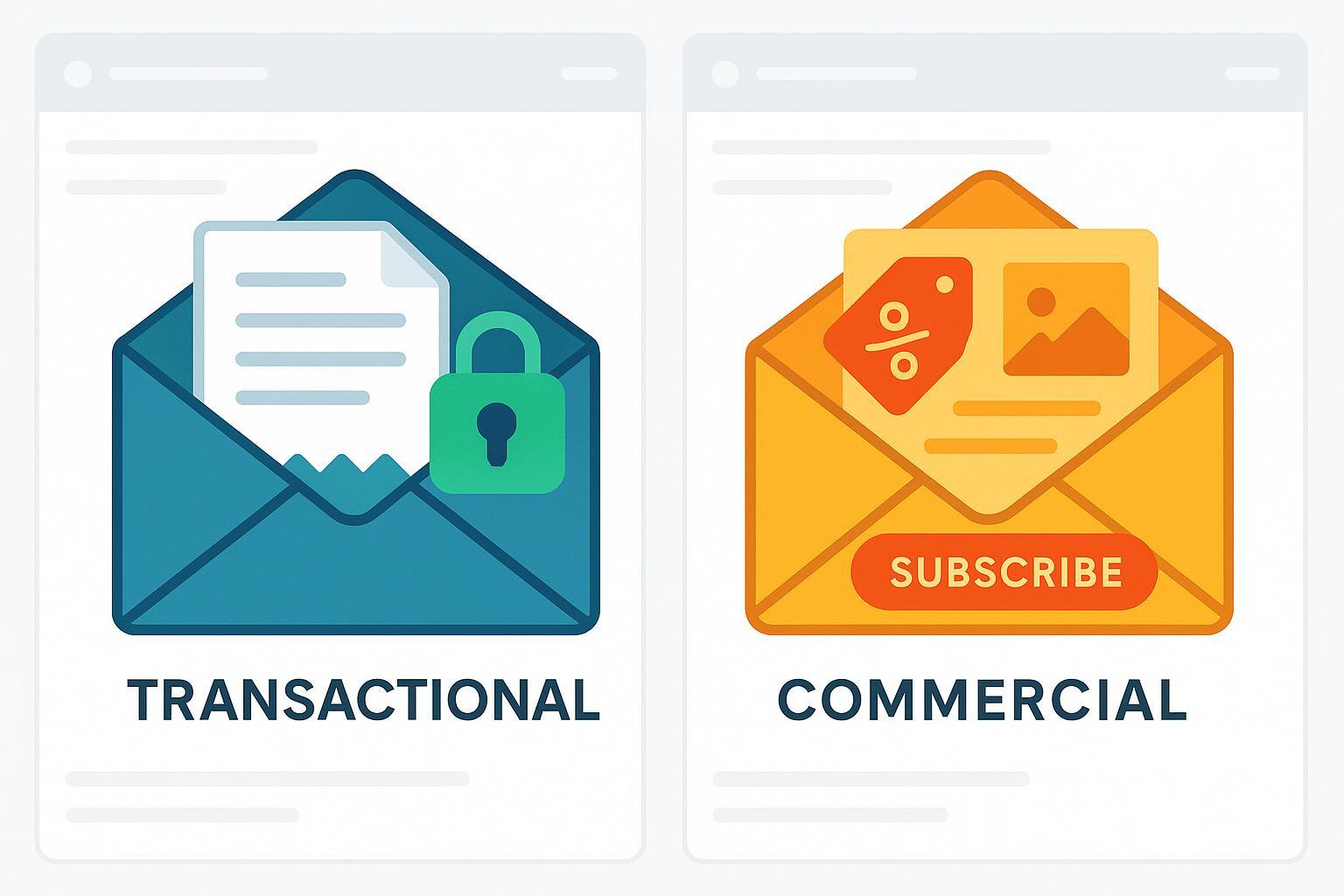
Transactional emails are automated, one-to-one messages triggered by specific user actions (such as a purchase or account change), while commercial emails are sent in bulk to promote products or services and require user consent and opt-out options.
Detailed Explanation
Transactional emails are functional messages sent in response to an individual’s action—think order confirmations, password resets, or shipping updates. By contrast, commercial emails (sometimes called marketing or promotional emails) are strategically sent in bulk to advertise, nurture leads, or retain customers—newsletters, sales promotions, and product announcements are prime examples. The distinction isn’t merely semantic: it affects compliance responsibilities, user expectations, and how each message may be delivered and designed.
Legal Context and Compliance
- United States: Under the CAN-SPAM Act, commercial emails must include an unsubscribe mechanism and cannot be sent without prior consent. Transactional emails, which facilitate or confirm an agreed-upon transaction, are exempt from many of these requirements, provided their primary content is transactional. Learn more at Airship.
- Global Considerations: The GDPR (EU) and CASL (Canada) further require explicit consent for commercial emails and have strict opt-in and record-keeping obligations. Transactional emails remain largely exempt internationally, but mixing promotional content can trigger additional compliance obligations.
Side-by-Side Comparison Table
| Feature | Transactional Email | Commercial Email |
|---|---|---|
| Trigger | User action/event (purchase, reset, etc.) | Campaign or marketing calendar |
| Recipient | One-to-one (unique to individual) | Bulk—subscriber or list-based |
| Content | Functional, informational | Promotional, advertising |
| Opt-in Required? | No (usually justified by transaction) | Yes (consent/opt-in essential) |
| Opt-out Option? | Not required (unless includes marketing) | Mandatory unsubscribe link |
| Key Legal Rule | Generally exempt (CAN-SPAM, GDPR, CASL) | Strictly regulated (CAN-SPAM, GDPR, CASL) |
| Examples | Receipts, password reset, shipping update | Newsletters, sale ads, product launches |
Practical Examples
- SaaS Platform: After a user signs up, they get a welcome email (transactional). Later, the company may send a monthly product update or promotional offer (commercial).
- E-commerce: When a customer completes a purchase, an order confirmation is sent (transactional). A week later, a sales promotion email is sent to all customers (commercial).
- Edge Case: A shipping confirmation includes a coupon for a future purchase. This is a mixed-content email; under many laws, it is treated as commercial and must include unsubscribe options.
Key Components
- Transactional Emails: Automated triggers, personalization, compliance-light, must be relevant to user action.
- Commercial Emails: Scheduled/bulk sending, opt-in management, unsubscribe compliance, engagement-focused content.
Related Concepts
- Promotional Email: A subset of commercial emails focused on limited-time offers and purchase incentives. (Reference)
- Bulk Email: Any email sent to large groups at once, typically commercial.
- Automated Email: Both transactional and commercial emails can be automated, but their triggers and content differ.
- CAN-SPAM Act: The primary U.S. regulation for commercial email.
Final Thoughts
Understanding the distinction between transactional and commercial emails is critical for compliance, user experience, and marketing effectiveness. Always clearly separate functional, account-driven messages from promotional content to maintain trust and avoid legal pitfalls.
