Technical SEO for Toys (2025): Crawl Budget, Faceted Navigation, and Page Speed That Actually Move Revenue

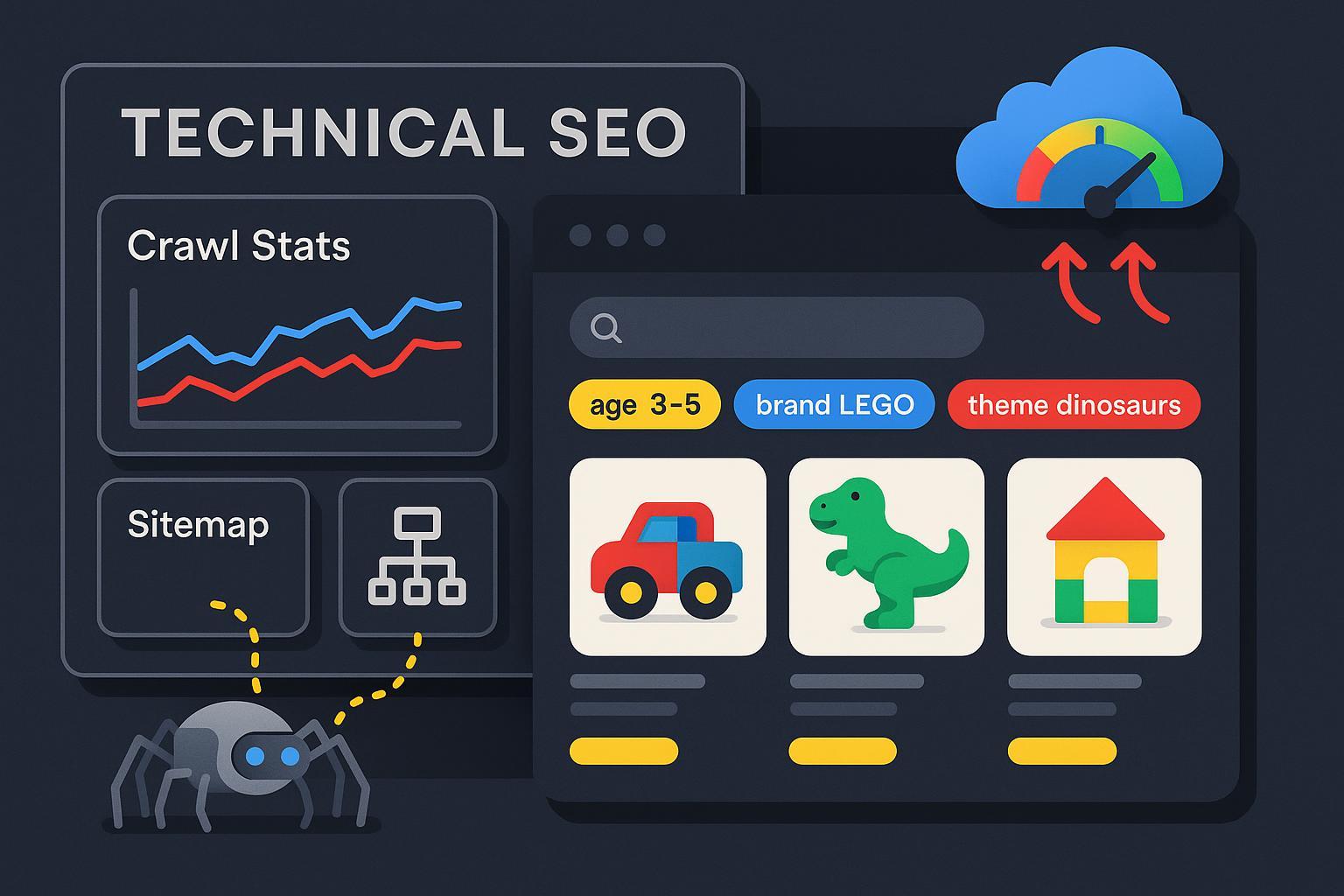
If you run SEO for a toy brand or retailer, you’re fighting three battles at once: massive variant catalogs (colors, bundles, limited editions), filter-heavy navigation (age, theme, brand/licensing), and media-rich PDPs (images, unboxing videos, sometimes 3D/AR). In 2025, winning organic growth in toys is less about adding more content and more about removing friction for crawlers and customers.
This playbook distills what consistently works in practice—where to tighten crawl budget, how to tame faceted navigation without tanking UX, and how to hit Core Web Vitals on pages packed with visuals. I’ll call out trade-offs, failure patterns, and the exact checks we run.
Key quick wins
- Cut crawl waste: block non-valuable filter combos; surface only canonical, indexable URLs in sitemaps. Guidance aligns with Google’s 2024 crawling series on faceted nav and caching, which explicitly flags facets as a top source of overcrawl issues according to Google Search Central’s December 2024 article on faceted navigation pitfalls.
- Prioritize performance: target LCP ≤ 2.5s, INP < 200 ms, CLS < 0.1 as defined in the Core Web Vitals overview by Google (2025 thresholds), noting that INP replaced FID on March 12, 2024 per web.dev’s INP launch posts.
- Keep seasonal inventory indexable: for temporary stockouts, keep PDPs live and mark availability accurately with structured data and Merchant Center, per Google’s guidance on temporary closures and ecommerce availability (2024–2025) and Merchant Center landing page requirements.
- Crawl budget: win the crawl before you win the rankings Crawl budget boils down to two levers: how many URLs Googlebot wants to fetch and how many your servers can comfortably serve. Google’s documentation emphasizes cutting duplicates, avoiding long redirect chains, and keeping servers fast to raise crawl capacity, as outlined in Google Search Central’s “Managing crawl budget for large sites” (2025).
Foundational practices
- Audit what Google is actually crawling: Combine Search Console crawl stats with a 30-day sample of server logs. Expect to see heavy crawling on parameterized category pages in toy catalogs (e.g., /lego/star-wars?age=8-12&color=black&availability=in-stock).
- Fix the big waste first: Kill long redirect chains (esp. migrated collection URLs and outdated seasonal promos) and ensure 200/301 stability. Google specifically warns redirect chains harm crawling in the same crawl budget guide.
- Sitemap hygiene: Ship only canonical, indexable URLs; split sitemaps by type and size; maintain lastmod accurately. This is consistent with Google’s sitemaps specification.
- Internal linking with intent: Prioritize high-value collections aligned to toy buyers’ mental models: Shop by age (3–5, 6–8, 9–12), brand/licensing (LEGO, Mattel, Pokémon), and themes (STEM, dinosaurs). Google’s ecommerce structure guide underscores clear internal linking for category understanding in “Help Google understand your ecommerce site structure” (2024 update).
Advanced controls
- Resource accessibility: Don’t block rendering-critical resources (CSS/JS) in robots.txt; Google’s December 2024 resources note explains how blocked resources impede rendering and waste crawl attempts, see “Crawling December: Resources” (Google, 2024).
- Caching for efficient recrawls: Set Cache-Control and Last-Modified to help Google fetch only what changed. This is explicitly recommended in Google’s December 2024 caching guidance.
- CDN to expand capacity: Stable, low-latency CDNs can increase sustainable crawl rate; see Google’s view in “Crawling December: CDNs” (2024).
- Parameter strategy: The old URL Parameters tool is gone; as of March 2022 deprecation, Google urges proper site-side handling, per Google’s deprecation notice.
Common pitfalls and fixes
- Noindex + robots conflict: If you Disallow a path in robots.txt, Google can’t see the meta noindex and may keep URLs in the index. Use allow-to-crawl + meta robots noindex on pages you want excluded but crawled, per Google’s robots meta tag documentation (2025).
- Canonical misuse: Don’t try to canonicalize via robots.txt or removals; use rel=canonical consistently and link to the canonical internally. See Google’s duplicate URL consolidation guidelines.
- Faceted navigation for toy catalogs: index only what deserves to rank Toy sites are facet factories: age, brand/licensing, theme, price, materials, battery-required, safety certifications, collector vs. child play. Google calls faceted navigation the most common cause of overcrawl and recommends deliberate allow/deny patterns as outlined in Google’s 2024 post on faceted navigation.
Decision framework (what to allow vs. suppress)
- Usually worth allowing (with optimization):
- High-intent, semantically rich combinations with real demand, e.g., “LEGO Star Wars sets ages 8–12” or “STEM kits for 5-year-olds.” These warrant unique titles/H1s, some intro copy, and curated internal links from the parent category.
- Usually suppress:
- Thin utility filters: color, in-stock toggle, minor material variants, sort orders, view=grid/list, price sliders when they explode combinations.
- Conditional:
- Price bands or age groups if backed by demand and you can scale unique content and internal links.
Implementation patterns
- Default suppression: Disallow non-valuable facet parameters in robots.txt (e.g., Disallow: /?color=, /?sort=, /?view=). Keep crawl paths tight; avoid infinite crawl spaces.
- Canonicals:
- If a facet adds no unique value, canonical to the base category (e.g., /lego/star-wars?color=black → canonical to /lego/star-wars).
- If you decide to allow a facet, use a self-referential canonical and ensure unique titles/H1s and some descriptive copy.
- Noindex usage: For navigable but non-index targets (like internal-only filtered states you still want users to use), allow crawling and add meta robots noindex; do not block via robots.
- Pagination and parameters: Keep page= paginated series crawlable when indexable; avoid appending non-canonicalizing sort or view params to paginated URLs.
- Internal linking: From the parent category, link to a small curated set of allowed facets (2–6 per category) that truly help discovery; this is reinforced by Google’s ecommerce structure guidance (2024).
Quality signals for allowed facets
- Unique value: distinct product set (not 95% overlap), demand signals from Search Console/keyword data, and unique intro copy (80–150 words is usually enough).
- Template hygiene: title/H1 templating that reflects facet intent: “STEM Kits for Ages 5–7 | Brand X” with matching schema ProductGroup audience age properties.
QA and monitoring
- Crawl budget guardrails: Re-crawl with your crawler after deploying robots and canonicals; track indexed page count vs. sitemap entries weekly for a month.
- Logs and GSC: Watch for spikes on suppressed parameters; if Google keeps trying to crawl, tighten disallows or eliminate internal links to those states.
- Page speed for media-heavy PDPs and collections (2025) Your goal is not just “passing.” It’s consistent p75 performance for real users in peak season. Targets: LCP ≤ 2.5s, INP < 200ms, CLS < 0.1 as defined by the Core Web Vitals documentation (Google, 2025) and the INP rollout described on web.dev (Mar 2024). The 2024 Web Almanac notes roughly 48% of mobile sites pass CWV and the median mobile LCP is around 3.0s, which means there’s headroom for competitive advantage; see the Web Almanac 2024 performance chapter.
What moves the needle on toy sites
- Hero media discipline:
- Use a single, responsive hero image in a modern format (AVIF/WebP) and lazy-load subsequent gallery images. Keep above-the-fold JS and CSS minimal.
- Defer autoplaying unboxing videos; provide a poster image; load the player on interaction.
- For 3D/AR viewers, gate-load behind a click with an inline hint; never block LCP on model loads.
- Server and render path:
- Target TTFB under ~200–300 ms on CDN; edge cache HTML for popular PDPs/collections in season. Use Cache-Control and ETag/Last-Modified to enable revalidation, aligning with Google’s caching guidance (2024).
- Inline critical CSS for the above-the-fold layout; defer non-critical CSS and fonts; avoid duplicate font weights.
- JavaScript diet:
- Audit third-party scripts (reviews widgets, chat, trackers, A/B tools). Defer or conditionally load; remove unused. Measure INP impact in RUM.
- Hydration and interaction: For headless setups, keep initial payloads small; consider partial or island hydration.
- Shopify/modern ecommerce specifics:
- Shopify Hydrogen/Oxygen releases in 2024 improved link prefetching and performance. Use the Image component and responsive defaults per Shopify’s files and image model (2024) and features surfaced in Hydrogen updates (2024).
Business impact you can cite internally Independent evidence connects speed to conversions: Ray-Ban reported +101–156% conversion lifts after prerendering improvements using Speculation Rules, per the Ray-Ban case study on web.dev (2024). Treat vendor case studies as directional; if you need examples, NitroPack aggregates multiple ecommerce lifts, but they’re vendor-reported, e.g., Rakuten 24 improved LCP by 52% with a 33% conversion lift per NitroPack’s compilation (2024).
- Seasonal and inventory volatility without SEO damage
- Temporary stockouts: Keep PDPs live; clearly mark OutOfStock in structured data and on-page. This aligns with Google’s temporary closures guidance (2024–2025) and Product structured data documentation.
- Permanent discontinuations: 404/410 is acceptable or 301 to the closest relevant successor. See Google’s general guidance on HTTP status handling and the reminder in “Don’t 404 my yum” (2023) not to blanket-404.
- Merchant Center sync: Keep availability attributes in sync with your landing pages to avoid disapprovals, per Merchant Center requirements (Google, 2025).
- Dynamic sitemaps: Update lastmod when price/availability meaningfully change for high-demand toys (e.g., holiday must-haves) so crawlers recrawl timely, per sitemaps guidance (Google).
- Safety and age signals build trust (and clarify relevance) Parents and regulators care about safety and suitability. Even if these signals don’t trigger special Search features, they clarify relevance and can support other surfaces.
- On-page: Prominently show age ranges, choking hazard notices, battery/charging safety, and standards compliance (ASTM F963 in the U.S., EN 71 in the EU). Authoritative overviews are available from the U.S. CPSC’s toy safety guidance (2025) and the European Commission’s toy safety pages (EN 71 / Toy Safety Directive).
- Structured data: Use Product/ProductGroup; set offers availability; add aggregateRating and reviews. Express age suitability using PeopleAudience (suggestedMinAge/MaxAge) and safety via additionalProperty (e.g., PropertyValue name="ASTM F963"). See Google’s Product structured data (2025) and Product variants guidance (Feb 2024).
- Implementation playbook: 30/60/90 days Day 0–30: Stabilize and stop the bleeding
- Crawl and index audit: map parameterized URLs; identify top 10 crawl-waste patterns.
- Robots.txt and canonical baseline: disallow non-valuable params; ensure base categories have self-canonicals; fix redirect chains.
- Sitemaps: include only canonical, indexable URLs; split by type; set accurate lastmod.
- RUM setup: enable field data for CWV (CrUX, GA4 user timings) and error budgets.
Day 31–60: Curate what deserves to rank
- Facet allowlist: for each top category, nominate 2–6 high-value facet combinations; add unique titles/H1s and 80–150 words of copy; internal link from parent category.
- Noindex vs. robots: convert navigable-but-not-indexable facets to meta noindex and remove Disallow for those paths to let Google honor the tag.
- Speed sprints: optimize hero media, defer third-party scripts, inline critical CSS, fix layout shifts.
Day 61–90: Scale and monitor
- Dynamic sitemaps: automate updates for new/seasonal items; ensure lastmod changes on material updates.
- Log analysis cadence: weekly for another 4–6 weeks; validate crawl shift to priority collections and curated facets.
- Structured data enrichment: ProductGroup/hasVariant, age audience, availability; test with Rich Results Test.
KPIs to watch
- Crawl stats: increase in crawled responses for priority categories; reduction in parameterized URLs crawled.
- Index coverage: indexed pages closer to sitemap count; fewer “crawled – currently not indexed.”
- CWV pass rates at p75: target category pages and top PDPs first.
- Organic entrance rate and revenue from curated facet pages.
- Common mistakes (and how to fix them fast)
- Blocking facets in robots and adding noindex anyway: Remove Disallow where you rely on noindex; let Google crawl to see the tag, per robots meta guidance (Google, 2025).
- Canonicalizing everything back to the parent: You eliminate the chance for high-intent combinations to rank. Curate a small allowlist with self-canonicals and unique content for those pages.
- Stuffing sitemaps with non-indexables: Only include canonical, indexable URLs with correct lastmod, per sitemap best practices (Google).
- Letting 3D/AR block LCP: Gate-load models; never make 3D viewer the LCP element on mobile.
- Churned seasonal URLs: Don’t 301 unrelated toys to new fads; either 404/410 or 301 to the closest relevant successor, per Google’s HTTP status guidance.
- When to go deeper: enterprise levers
- Server-side prerender or edge rendering to accelerate bot and user rendering. Vendors report outsized crawl/render gains; for context, Botify cites 10–30x faster bot render times in some cases in their crawl efficiency blog posts (2024–2025). Treat these as directional and run your own A/Bs.
- Headless with disciplined hydration and link prefetch. Shopify Hydrogen updates (2024) added better prefetching and DX for speed; see Hydrogen December 2024 update.
- Parameter signing/whitelisting at the edge to prevent rogue URLs from marketing tools from exploding the crawl space.
Closing takeaways
- Decide what deserves to be crawled and indexed, then make it fast. Most toy sites win by suppressing low-value facets, curating a small set of high-intent combinations, and rigorously optimizing media.
- Re-audit quarterly. Standards and inventory change quickly—Google’s December 2024 crawling series and the INP change are proof that the goalposts move. Keep your evidence-based loop running with logs, Search Console, and RUM.
If you implement the playbook above, you’ll see crawl stats shift toward money pages, index bloat recede, and performance move past competitors—just in time for the next holiday rush.
