Technical SEO Best Practices for Furniture (Indoor/Outdoor) & Office Chairs: Crawl Budget, Faceted Navigation & Page Speed (2024)

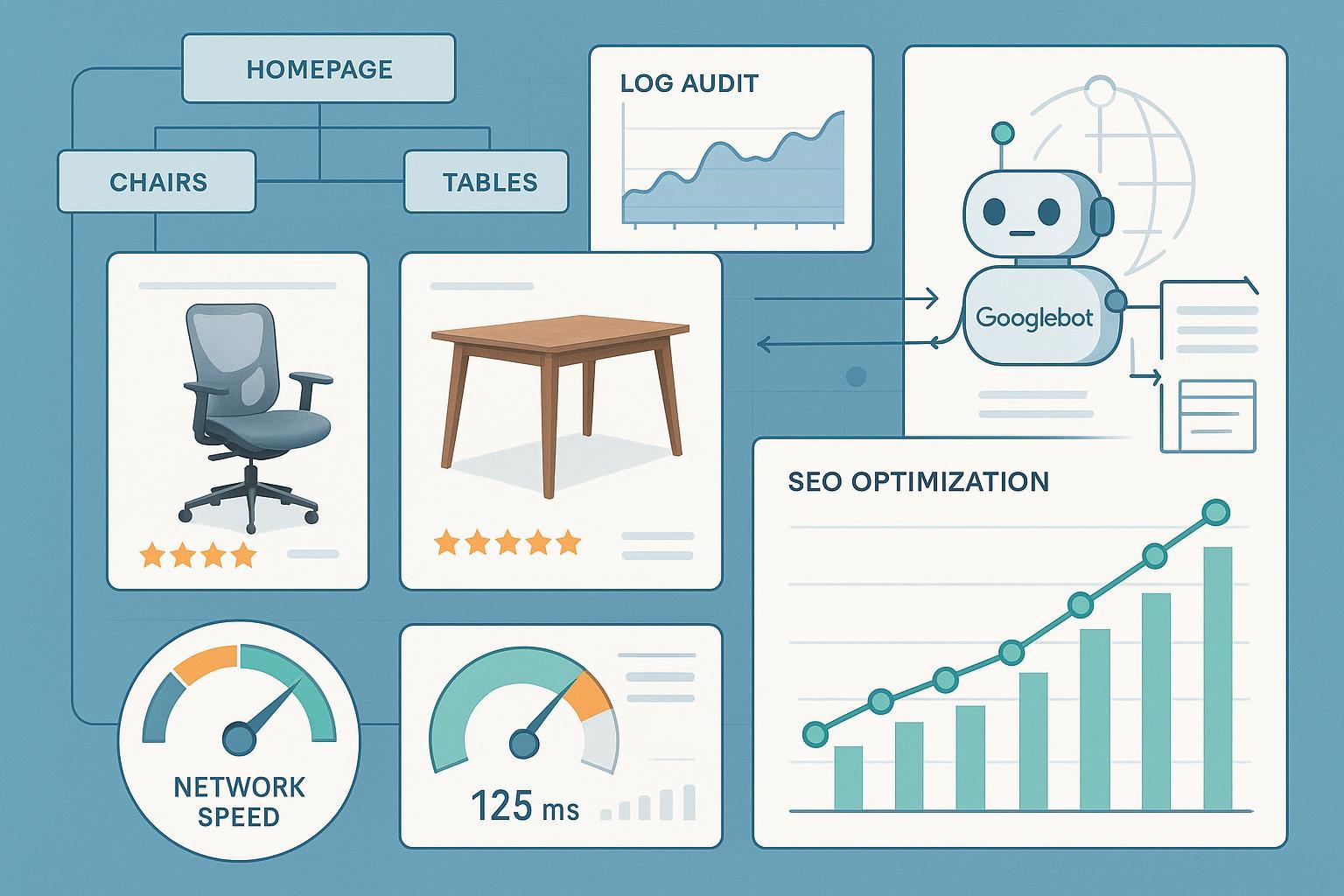
Introduction: Why Furniture & Office Chair E-Commerce Faces Unique Technical SEO Challenges
Furniture and office chair e-commerce sites—whether indoor, outdoor, or hybrid—feature thousands of SKUs, complex category trees, filter-heavy faceted navigation, and dense, image-rich product pages. These realities create three major technical SEO barriers:
- Crawl inefficiency and wasted budget from parametric/filter sprawl
- Index bloat, duplicate/near-duplicate URLs, and thin content
- Sluggish page speed from high-resolution imagery and 3D/media assets
For technical SEOs managing such environments, precision is mandatory. Mistakes compound at scale—leading to wasted crawl resources, poor rankings, and conversion losses. Industry benchmarks highlight that, for large catalogs, over 80% of indexed pages should be unique and valuable (OWDT), while LCP (Largest Contentful Paint) below 2.5 seconds is critical for conversions (Google).
Below, we deliver best-in-class, data-driven technical SEO practices—backed by enterprise case studies, expert documentation, and tailored tactical checklists.
1. Prioritize and Optimize Crawl Budget with Log-File Audits and Aggressive Low-Value URL Suppression
Key Principle:
Use log-based analysis and proactive URL suppression (robots.txt, GSC Parameters, canonicals) to maximize crawl focus on high-value furniture and chair category/product pages.
Stepwise Implementation:
-
Perform Log-Based Crawl Audits
- Use Screaming Frog Log Analyzer or enterprise tools (DeepCrawl, OnCrawl) to identify crawl waste on parameter/filter/low-value URLs.
- Review crawl stats in Google Search Console (Coverage & Crawl Stats) to detect index bloat and missed priority pages.
-
Aggressively Suppress Low-Value URLs
- Disallow non-essential filters/parameters, checkout, admin, and session pages via
robots.txt. - Use the GSC URL Parameters tool to specify crawl logic for dynamic URLs.
- Disallow non-essential filters/parameters, checkout, admin, and session pages via
-
Apply Canonicalization & Noindex
- Canonicalize main category/product URLs; apply
noindexto thin/filtered views unlikely to drive search visits. - Ensure canonical logic is dynamic and adaptive for frequent catalog/SKU changes.
- Canonicalize main category/product URLs; apply
-
Prioritize Key Page Types
- Optimize site architecture for shallow click depth (<3 from home/category) to maximize crawl frequency on money pages.
- Validate with regular log analysis—quarterly as a minimum.
Sector Case Example
- Mebelcenter.bg: By acquiring an authoritative expired domain, rigorously blocking filter/admin pages in robots.txt, and enhancing internal linking, this furniture retailer grew to 5,000 monthly organic clicks and €70K in annual SEO revenue (case study).
Tools & Resources
2. Master Faceted Navigation: Dynamic Canonical Logic & URL Suppression for SKU-Heavy Catalogs
Key Principle:
Implement selective canonicalization and rules-driven suppression for faceted/filter URLs to avoid index bloat without sacrificing UX or valuable ranking opportunities.
Advanced Facet Management Workflow
-
Audit and Categorize Facets
- Identify which filter/facet combinations yield unique, valuable landing pages (e.g., "Leather Recliners" or "Ergonomic Mesh Office Chairs").
- Assign canonical status to these priority combinations; suppress all others.
-
Suppress/Noindex Low-Value Facets
- Use
noindex, robots.txt disallow, or AJAX-powered filtering (with SEO-friendly pushState URLs) for low/no-value parameters. - Regularly log-audit for any indexation leaks.
- Use
-
Distinct Content for Canonicalized Facets
- High-value facet pages must have unique H1s, descriptive text, and differentiated metadata—no "empty shelves." (SEJ on Canonical Navigation)
-
Optimize Pagination and Breadcrumbs
- Implement proper rel=next/prev (deprecated for Google, but still a best practice for users/other engines); use clear, logical breadcrumbs for crawl ease.
Visual Workflow Example
- (Visual flowchart can be found in the source: Ahrefs Faceted Navigation Guide)
Industry Benchmark
- Zalando: Combines canonicalized, unique-content facet landing pages with aggressive filtering of low-value parametric URLs. Recognized by experts (SEJ Reference) for industry-leading approach, resulting in top 10 Google rankings for major category queries.
Faceted Navigation Decision Table
| Facet URL Type | Action |
|---|---|
| Primary category (e.g., /office-chairs/) | Index, canonical |
| High-value combo (e.g., /chairs/leather/) | Index, unique content, canonical |
| Multi-parameter facet (e.g., /chairs/leather/blue/adjustable/) | Noindex, disallow, AJAX filter |
| Price/Sort/Inventory param | Disallow, URL Params |
| Out-of-stock/empty | Noindex, block or canonical to parent |
3. Accelerate Page Speed: Media-Heavy Catalog SEO for Core Web Vitals
Key Principle:
Target LCP <2.5s, FID <100ms, and CLS <0.1 through robust image/media optimization, modern formats, edge/CDN delivery, and real-user monitoring tailored for furniture/office e-commerce.
Scalable Speed Optimization Tactics
-
Adopt Next-Gen Image/Video Formats
- Batch-convert all imagery to WebP/AVIF; process 3D assets via optimized formats.
- Use lazy/priority loading and responsive (
srcset) delivery.
-
Leverage Edge/CDN Caching Aggressively
- Serve all static assets (images, JS/CSS) via a global CDN (Cloudflare, Akamai).
- Enable Image CDN features (automatic resizing, compression-by-device).
-
Implement Automated CI Performance Budgets
- Integrate Lighthouse CI or PageSpeed Insights in the deployment workflow, setting page-level performance thresholds.
-
Monitor Real User Metrics
- Use RUM providers (e.g., New Relic, Cloudflare Analytics) to validate sitewide speed and quickly troubleshoot across geos/devices.
Furniture/Office Chair Site Example
- Mebelcenter.bg: Improved image handling and server speed post-index bloat reduction, yielding a dramatic performance uplift; e-commerce research shows moving from >3s to <2.5s LCP correlates with 200-300% conversion boosts (BIG research).
Core Tools & Resources
Conclusion & Action Checklist: Technical SEO for High-Impact Furniture E-commerce (2024)
Prioritized Technical SEO Checklist for Furniture & Office Chair E-commerce:
- Quarterly log-file audits for crawl waste—take action on any rising crawl bloat using Screaming Frog/DeepCrawl and GSC.
- Suppress non-key filters/facets using robots.txt, GSC Parameters, and selective noindex; dynamic canonicalization for all valuable landing pages.
- Mandate unique content/meta for canonicalized facets; eliminate empty/thin duplicates.
- Optimize all imagery/assets to modern formats with programmatic CDN delivery; enforce performance budgets with Lighthouse CI.
- Continuously monitor Core Web Vitals via RUM tools, with a rapid-response playbook for speed regressions.
- Benchmark frequently: Strive for >80% unique, valuable indexed pages and LCP <2.5s for all main catalog/product URLs.
By rigorously applying these specialized, stepwise practices—supported by authoritative industry guidance and battle-proven in furniture/office chair e-commerce—technical SEOs can drive greater index efficiency, fast UX, and higher organic ROI even at massive scale.
References:
- Advanced Crawl Budget Management (GoFish Digital)
- Faceted Navigation Deep Dive (Search Engine Journal)
- E-commerce Technical SEO Checklist (OWDT)
- Furniture SEO Case Study (Ves Ivanov)
- Core Web Vitals (Google)
- Faceted Navigation Best Practices (Ahrefs)
For downloadable workflow diagrams and an advanced action checklist, visit the linked resources above or reach out to the cited sources for further implementation guides.
