Technical SEO for Beauty & Personal Care Devices in 2025: Crawl Budget, Faceted Navigation, and Page Speed

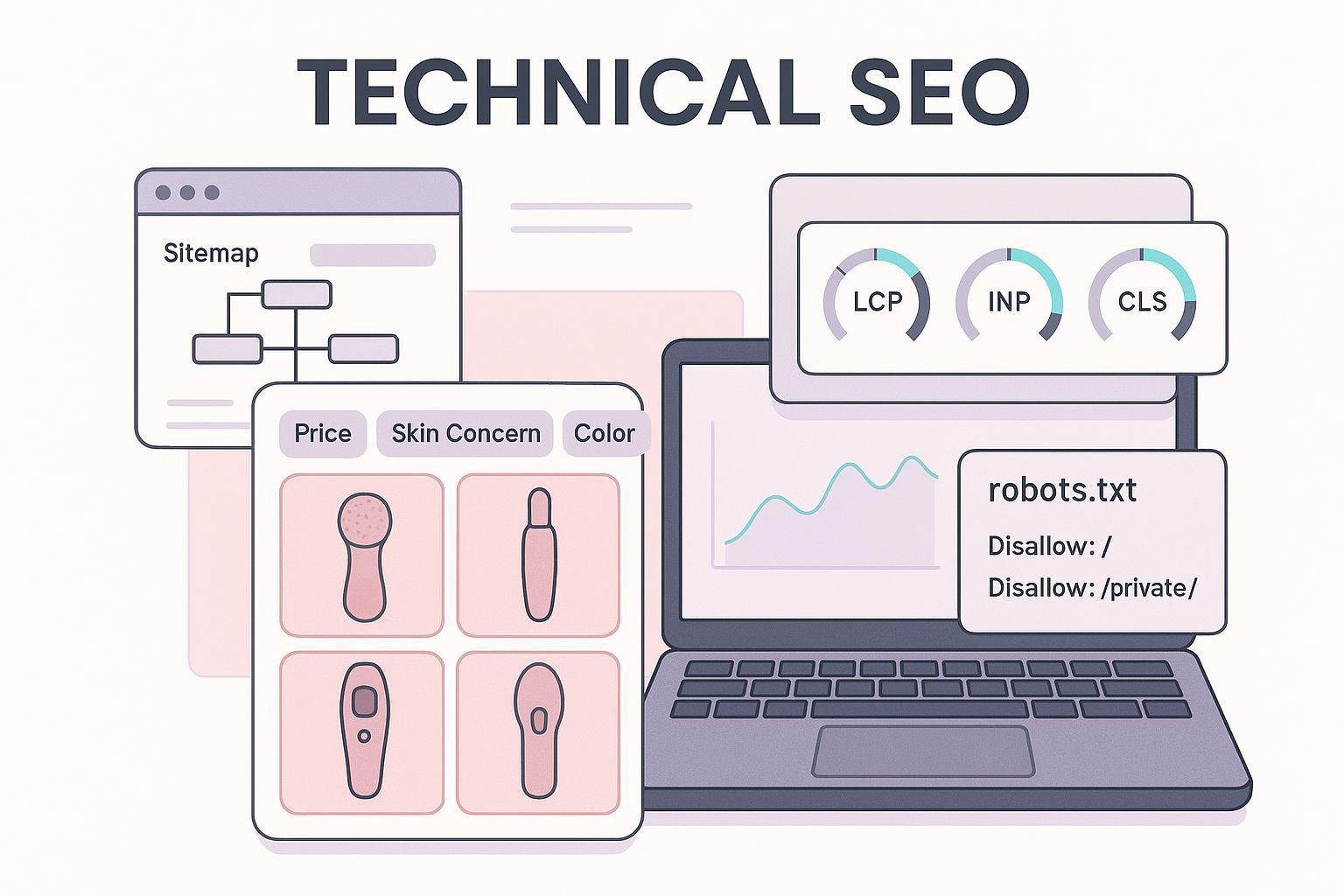
If you manage SEO for beauty and personal care device ecommerce, you’re balancing two realities: filter-heavy catalogs (IPL, microcurrent, attachments, skin concerns) and image/video‑rich product experiences. In practice, most underperforming sites I audit leak crawl budget through faceted URL explosions and lose conversions to slow pages. This playbook consolidates what consistently works in 2025, with clear trade‑offs and step‑by‑step tactics you can ship with your dev team.
Key premise: We focus on three technical levers you can control and measure—crawl budget, faceted navigation, and page speed—anchored to Google’s current guidance and Core Web Vitals.
—
1) Crawl Budget: When It Matters and How to Control It
For small catalogs, crawl budget rarely limits performance. But for filterable beauty device stores (thousands of URL variants), it directly impacts how fast new products and price changes get discovered. Google defines crawl budget as the combination of crawl capacity and crawl demand; fast, stable sites get crawled more, and wasteful URL spaces drag you down, per Google’s crawl budget management for large sites (2025).
The 8‑step workflow I use on beauty device catalogs
-
Baseline with Search Console Crawl Stats
- Open Crawl Stats and chart 30–60 days of requests by response code, file type, and top hosts/paths. Look for spikes in parameterized URLs and 4xx/5xx. This is the fastest way to see crawl waste indicated in Google’s Crawl Stats documentation (2025).
-
Pull and analyze server logs
- Collect 30–60 days. Filter for Googlebot/Bingbot. Aggregate hits by URL pattern and response codes. Identify: a) top‑crawled param pages, b) high 404/500 paths, c) orphaned URLs crawled but not internally linked. See practical workflows in the Semrush log file analysis guide and Botify’s log analysis overview.
-
Inventory URL parameters and infinite spaces
- List all filter parameters (e.g., color, attachment, skin_concern, price, in_stock). Map combinations. Google’s 2025 guidance on managing faceted navigation crawling explicitly warns against infinite spaces created by free‑combination filters.
-
Decide control method per parameter (disallow vs noindex vs canonical)
- robots.txt Disallow: Prevent crawling for clearly low‑value filters (e.g., sort=, view=, session=). Use when you never want these crawled. Remember robots.txt blocks crawling but not indexing if discovered elsewhere—so don’t block URLs that need noindex to be seen.
- Meta robots noindex,follow: Use when a filter page exists for UX but should not be indexed; Google must crawl to see the noindex. Per Google’s robots meta tag guidance (2025).
- rel=canonical: If a filtered page doesn’t add unique value, canonicalize to the base category. See Google’s consolidation of duplicate URLs.
-
Adjust robots.txt safely
# Block useless parameter spaces
User-agent: *
Disallow: /*?sort=
Disallow: /*?view=
Disallow: /*?session=
# If filters chain parameters with & also consider patterns like:
Disallow: /*&sort=
Disallow: /*&view=
- Test patterns in the Search Console robots.txt tester. Do not Disallow pages where you rely on meta noindex.
-
Prune sitemaps to only canonical URLs
- Include only canonical, absolute URLs; keep faceted pages out. Use
to help scheduling; Google notes changefreq/priority are mostly ignored. See Google’s sitemap build guidance (2025) and large sitemap limits.
- Include only canonical, absolute URLs; keep faceted pages out. Use
-
Stabilize server performance
- Crawl rate increases when servers are responsive; frequent 5xx and timeouts suppress crawl, per Google’s crawl budget overview (2025). Apply CDN caching, HTTP/3, and Brotli.
-
Measure impact
- Track: a) % of crawl hitting HTML canonical URLs, b) reduction in param URL hits, c) time to discovery for new PDPs (days), d) Crawl Stats average response time. Iterate monthly with logs and Crawl Stats.
Trade‑offs to keep in mind
- No silver bullet: Over‑blocking via robots.txt can hide legitimate variants needed for indexation. Overusing noindex on pages you also block via robots.txt won’t work because Google can’t see the tag. Align the method to the goal.
- URL Parameters tool is gone: Since 2022, Google deprecated the tool; focus on sound URL design and crawling controls as Google notes in its deprecation announcement.
—
2) Faceted Navigation: Prevent Crawl Traps, Preserve UX, and Selectively Win Long‑Tail
Beauty device shoppers expect to filter by treatment area, skin concern, price, attachment type, and color. That UX is non‑negotiable. The SEO question is which combinations deserve indexation.
Google’s 2025 page on managing faceted navigation crawling frames your options: limit crawling via robots.txt, canonicalize non‑valuable facets, and ensure internal linking doesn’t expose infinite loops.
Decision tree: Which filter combos should be indexable?
- Does the combo map to real search demand and unique intent? Example: “IPL hair removal for sensitive skin” or “microcurrent device for jawline.” If yes, consider making a curated, indexable collection page.
- Can you add unique value beyond raw filtered results? Add tailored copy, FAQs, comparison blocks, and internal links to top PDPs; otherwise, it’s a thin duplicate.
- Will the URL be stable and maintained (stock, pricing, content)? If seasonal/ephemeral, it might be better as noindex.
Implementation rules that work in practice
-
URL design and internal links
- Keep indexable collections clean (no “?color=red&concern=sensitive” if you’re targeting a strategic segment). Use descriptive, static paths where possible (e.g., /ipl/sensitive-skin/). For generic dynamic filters, keep them crawl‑controlled.
-
Canonical policy
- Base categories self‑canonicalize. Pure filter pages canonicalize back to the base unless promoted to a curated, indexable landing. Follow Google’s duplicate URL consolidation.
-
Pagination handling (filters and categories)
- Google deprecated rel=next/prev; each page in a paginated set should be self‑canonical and linked with plain elements. See Google’s current pagination guidance (2025).
-
Meta robots and robots.txt
- Use meta robots noindex,follow on thin filter pages you keep for UX. Do not block them in robots.txt if you rely on noindex. Disallow only truly useless parameters (sort, view). The distinction is clarified in Google’s robots meta vs robots.txt docs (2025) and robots.txt reference.
-
Sitemaps and navigation
- Include only canonical categories and curated collections in XML sitemaps. Avoid linking to infinite combinations in sitewide nav; expose limited, strategic collections.
-
Structured data on collections
- Collections can carry descriptive copy and internal links; structured data generally remains at PDP level, but you can use BreadcrumbList and ItemList markup if helpful and compliant with Google’s structured data policies (2025).
Common mistakes I see (and how to fix them)
- Allowing free combination of 5–7 filters crawlable by default. Fix: Disallow low‑value params; noindex remaining; promote only select high‑value combos to static collections.
- Canonicalizing every paginated page to page 1. Fix: self‑canonical each page per Google’s pagination guidance.
- Listing filter URLs in sitemaps. Fix: Sitemaps are for canonical targets only per Google’s sitemap build documentation.
—
3) Page Speed for Image/Video‑Rich PDPs: Hitting 2025 Core Web Vitals
The most common LCP element on beauty device PDPs is the hero product image (sometimes a video frame). In 2025, your CWV targets are: LCP ≤ 2.5 s, INP ≤ 200 ms, and CLS ≤ 0.1, measured at the 75th percentile of field data, as summarized on web.dev’s Core Web Vitals thresholds (2025) and the INP launch update.
Prioritize LCP the right way
- Serve the hero via CDN in AVIF (fallback WebP/JPEG). Use width/height to reserve space and reduce CLS. Mark the hero with fetchpriority="high" and decoding="async". See patterns in web.dev’s optimize LCP guidance and responsive images course.
<img src="/images/pdp-hero.avif"
     srcset="/images/pdp-hero-640.avif 640w, /images/pdp-hero-960.avif 960w, /images/pdp-hero-1280.avif 1280w"
     sizes="(max-width: 768px) 90vw, 800px"
     width="800" height="600"
     fetchpriority="high" decoding="async" alt="IPL hair removal device front view">
- Avoid lazy‑loading the LCP image; lazy‑load below‑the‑fold assets only.
- Preload the critical font and inline critical CSS; avoid massive blocking CSS.
Control INP by taming JavaScript and third‑parties
- Break up long tasks (>50 ms), code‑split, and defer non‑critical JS. Consider Web Workers for heavy work. Practical patterns are summarized in web.dev’s JavaScript performance guidance.
- Gate non‑essential third‑party scripts behind user consent or interaction; use async/defer. See web.dev’s cookie notice best practices (2025).
Eliminate CLS in carousels, pop‑ups, and UGC modules
- Reserve dimensions for images, videos, and embeds. Don’t inject banners above content on scroll. Stabilize fonts with font-display: swap and size-adjust to keep CLS ≤ 0.1 per web.dev CWV thresholds.
Delivery: TTFB, CDN, and modern protocols
- Use edge caching/full‑page caching where your platform permits; adopt HTTP/3 and Brotli; consider Early Hints (103) to start fetching critical resources sooner. The HTTP Archive Web Almanac 2024 CDN chapter discusses modern delivery impacts for ecommerce at scale.
Measurement workflow that sticks
- Pre‑release: Lighthouse in CI; keep budgets for LCP, INP, CLS.
- Post‑release: PageSpeed Insights for lab + CrUX field trends; Core Web Vitals report in Search Console for origin‑ and URL‑level tracking using web.dev’s INP transition notes.
- Segment by template: home, category, PDP, cart/checkout. Fix regressions fast.
What the data says about ecommerce bottlenecks
- Hybrid ecommerce stacks with heavy JS tend to show lower CWV pass rates vs prerendered setups, per Web Almanac 2024 Performance and JAMstack chapter. If you’re fighting the platform, prioritize JS reduction and caching before micro‑optimizations.
—
4) Structured Data for PDPs and Variants (Beauty Device Essentials)
Implementing clean Product structured data is table stakes for rich results and merchant listings. In 2025, Google expects one of offers, review, or aggregateRating for product snippet eligibility, detailed in Google’s Product structured data guide and product snippet documentation.
Best‑practice checklist
- Product: name, description, brand, images.
- Offer: price, priceCurrency, availability, url.
- Reviews: Review or AggregateRating when legitimately present.
- Variants: For color/attachment variants, use ProductGroup with hasVariant/variesBy if applicable per Google’s product variants guidance and Schema.org ProductGroup.
- Policies: Include merchant return and shipping policies where required for listings; conform to Google’s structured data policies.
- Validate via the Rich Results Test before deployment.
—
5) Seasonal Drops, Limited Editions, and Out‑of‑Stock Handling
Beauty device brands often run seasonal bundles and limited editions.
- Seasonal collections: Use clean, indexable category URLs; add them to sitemaps with
updates per Google’s sitemap guidance. When a collection ends, 301 to the closest evergreen category if intent aligns; otherwise, consider noindex but keep user paths sane. - Out‑of‑stock PDPs: If returning soon, keep indexable with clear availability and alternatives. If discontinued permanently, 301 to successor or category; avoid soft 404s and endless 302s.
—
6) Putting It Together: 30‑Day Implementation Plan
Week 1: Discover and decide
- Crawl Stats review; export top‑crawled paths and response codes from Search Console.
- Log sample collection (30–60 days). Summarize bot hits by URL patterns and status codes using the workflow outlined in Oncrawl’s crawl budget optimization guide.
- Parameter inventory: list all filters and map value domains; flag infinite combos.
- Draft control matrix: per parameter, choose robots.txt Disallow, meta noindex, canonical, or “promote to curated collection.”
Week 2: Ship crawl controls and sitemap fixes
- Update robots.txt (Disallow low‑value params). Test in the GSC tester.
- Add meta robots noindex,follow to thin filter templates retained for UX.
- Ensure self‑canonicals on paginated categories; remove canonical‑to‑page‑1.
- Regenerate XML sitemaps with canonical URLs only; include
.
Week 3: Page speed hardening
- LCP: Convert hero to AVIF/WebP; set width/height; add fetchpriority=high; inline critical CSS.
- INP: Defer non‑critical JS; break long tasks; consent‑gate third‑party tags.
- CLS: Fix dimensionless media and stabilize fonts.
- Delivery: Enable Brotli, HTTP/3; verify CDN edge caching on PDPs and categories; consider Early Hints if supported.
Week 4: Structured data and monitoring
- Audit Product/Offer/Review markup and ProductGroup for variants; validate in Rich Results Test with Google’s Product schema guide.
- Monitor: Crawl Stats for param crawl reduction; Core Web Vitals report for LCP/INP/CLS; PageSpeed Insights spot checks; log deltas week‑over‑week.
- Create ongoing dashboards for: a) % of crawl to canonical HTML, b) CWV pass rate by template, c) new PDP discovery time.
—
7) Quick Reference Checklists
Crawl budget & faceted navigation
- [ ] Crawl Stats and logs reviewed (30–60 days)
- [ ] robots.txt Disallow applied to useless params (sort, view, session)
- [ ] Meta robots noindex,follow on thin filter pages retained for UX
- [ ] rel=canonical: filtered pages → base category unless curated
- [ ] Pagination: self‑canonical, standard links
- [ ] XML sitemaps: canonical URLs only;
set - [ ] Internal links avoid infinite combinations; curated collections only
Page speed (Core Web Vitals)
- [ ] LCP hero image: AVIF/WebP, width/height set, fetchpriority=high, no lazy‑load
- [ ] Critical CSS inlined; blocking CSS/JS minimized
- [ ] INP: long tasks split; non‑critical JS deferred; third‑parties gated
- [ ] CLS: dimensions reserved; fonts stabilized; no layout‑shifting banners
- [ ] Delivery: CDN edge caching; HTTP/3; Brotli; consider Early Hints
- [ ] Monitor PSI + Search Console CWV; segment by template
Structured data
- [ ] Product + Offer + Review/AggregateRating (when applicable)
- [ ] ProductGroup for variants; consistent URLs and markup
- [ ] Merchant policies included where needed; pass Rich Results Test
—
8) FAQs and Edge Cases (2025)
- Should I block all filtered URLs in robots.txt? No. If a page must be noindexed, Google has to crawl it to see the directive; don’t Disallow and noindex the same target. The distinction is in Google’s robots meta vs robots.txt docs.
- Do I still need rel=next/prev for pagination? No. Google stopped using it; use self‑canonicals and clear pagination, per Google’s pagination guidance (2025).
- Can curated filter pages rank? Yes—when they meet real demand and add unique value. Promote a small set (e.g., “IPL for sensitive skin”) to static, content‑rich collections and include them in sitemaps.
- How fast will crawl improvements show? Typically within 2–4 weeks you’ll see Crawl Stats shifts; larger catalogs may take longer. This aligns with how Google adjusts crawl based on responsiveness and demand per crawl budget guidance.
—
Closing Thoughts
The winning pattern for beauty and personal care device SEO in 2025 is disciplined: constrain crawl to high‑value surfaces, curate a handful of filter‑driven collections that truly deserve to rank, and engineer page speed like revenue depends on it—because it does. Ground your decisions in Google’s current guidance, verify with logs and field data, and iterate monthly. If you only have bandwidth for three changes this quarter: prune sitemap to canonicals, implement a firm param control policy, and fix LCP on your top 20 PDPs.
References used throughout
- Google: Crawl budget management for large sites (2025)
- Google: Managing crawling of faceted navigation URLs (2025)
- Google: Robots meta tag (2025) and robots.txt
- Google: Consolidate duplicate URLs (2025)
- Google: Pagination & incremental page loading (2025)
- Google: URL Parameters tool deprecated (2022)
- web.dev: Core Web Vitals thresholds (2025); INP launch; INP rollout notes; Optimize LCP; Learn Images; JavaScript performance; Cookie notice best practices
- HTTP Archive Web Almanac 2024: Performance; JAMstack; CDN
- Semrush: Log file analysis guide; Botify: Log analysis overview; Oncrawl: Crawl budget optimization
