What Is Small‑Batch Production? Definition, Benefits, and Trade‑Offs

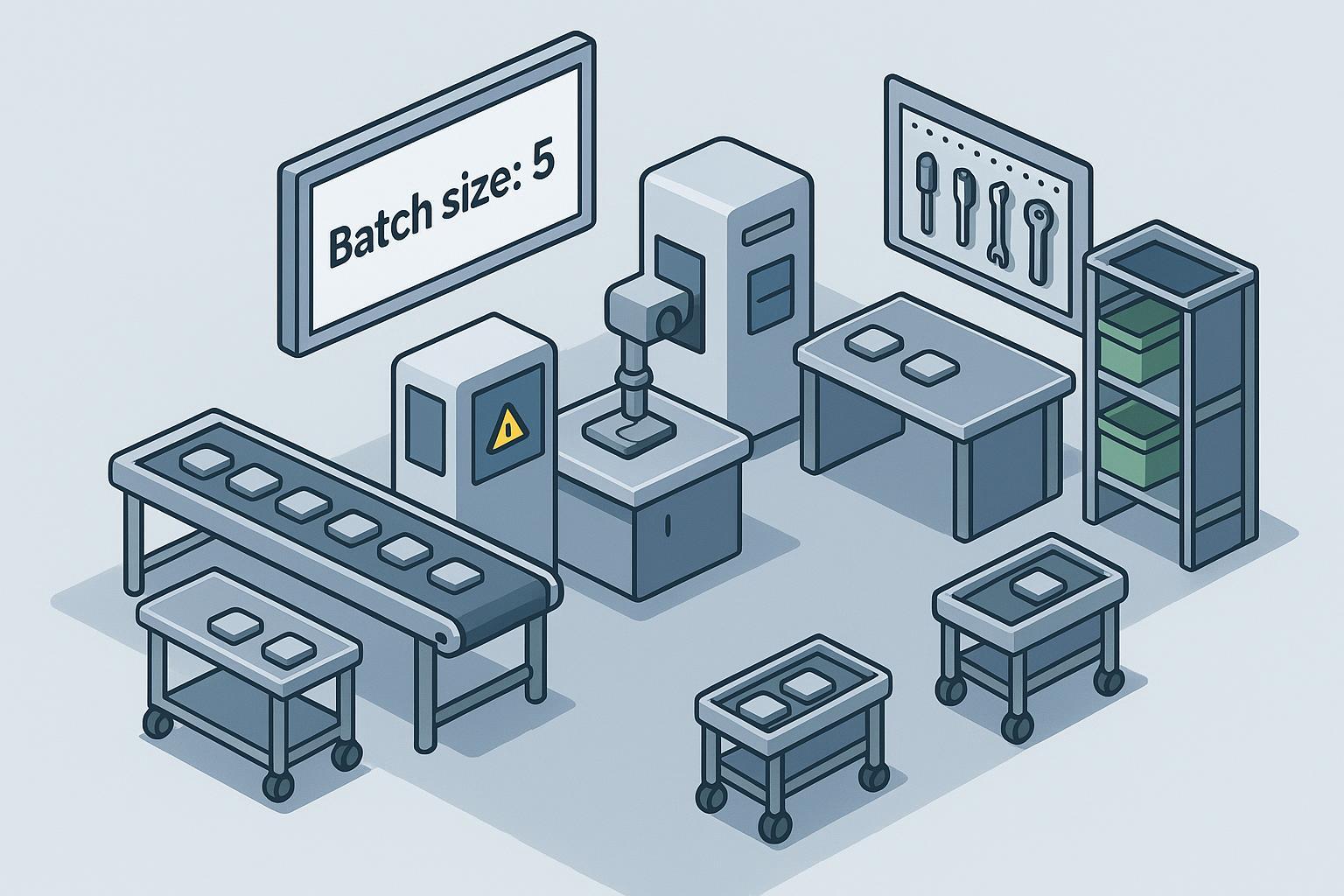
Small‑batch production is a way of making products in limited quantities per run—mini lots rather than very large runs—to stay flexible, reduce risk, and get faster feedback. It sits between prototyping and mass production. In lean terms, it’s a practical step on the path from traditional batch‑and‑queue toward smoother flow.
If you’re deciding how to launch a new product, respond to volatile demand, or cut lead time without massive capital, understanding small‑batch production helps you choose the right lot size and avoid costly missteps.
What small‑batch production is—and is not
- What it is: Producing in small lots so work moves through the factory more often, in smaller chunks. “Small” depends on your product, setup time, and demand; there’s no universal number.
- What it is not:
- Mass production: very large lots or continuous runs aimed at the lowest unit cost via economies of scale.
- One‑piece flow: the lean ideal where the transfer batch is literally one item. The American Society for Quality describes one‑piece (continuous) flow as each process making only what the next needs, immediately, i.e., a transfer batch of one, per the ASQ Quality Glossary entry on one‑piece flow.
- “Just prototyping”: While many teams pilot in small batches first, small‑batch production is also used for ongoing, low‑volume or high‑mix products.
Practically, small‑batch production acknowledges constraints (changeover time, tooling, regulatory checks) while pushing toward better flow.
Why smaller batches improve flow and lead time
In most factories, big batches create big queues. Items wait between steps, inflating work‑in‑process (WIP) and lengthening lead time. By shrinking batches:
- Less material waits between steps → lower WIP.
- Smaller queues shorten the time from start to finish.
- Earlier items reach downstream processes sooner, exposing problems fast.
This is the core lean rationale for moving from batch‑and‑queue toward flow, as explained by the Lean Enterprise Institute’s Art Byrne in 2018: reducing batch sizes reveals waste and shortens lead time, enabling responsiveness to customers, according to the Lean Enterprise Institute “Ask Art” column on switching from batch to flow (2018).
Two related lean ideas help here:
- Every Product Every Interval (EPEx): How frequently you produce each product. Reducing EPEx usually means smaller lots and more frequent cycles, which cuts inventory and improves responsiveness. See the Lean Enterprise Institute Lexicon entry on EPEx.
- Transfer vs. process batch: You can keep a larger process batch for efficiency but move smaller transfer sub‑lots forward sooner. That accelerates feedback without fully overhauling the upstream step.
Small batches also pair naturally with pull systems and demand leveling. When production is triggered by actual demand and leveled, lot sizes tend to shrink and flow improves. If you’re new to these concepts, this overview of push versus pull systems in manufacturing unpacks how inventory and responsiveness interact.
Benefits and trade‑offs (and why setup time matters)
Common benefits of small‑batch production
- Faster feedback and defect detection. Problems surface after a handful of units, not thousands.
- Lower WIP and shorter lead time. Less inventory waiting between steps.
- Better responsiveness to demand changes. Easier to change mix or incorporate engineering updates.
- Reduced risk exposure. Less scrap and obsolescence when designs evolve.
Trade‑offs to plan for
- More frequent changeovers and coordination. If your setup time is long, tiny batches can crush throughput.
- Potentially higher unit cost in the near term. You forgo some scale economies.
- Scheduling complexity in high‑mix environments. Requires clear visual management and disciplined standard work.
This is why setup reduction (SMED) is essential. Lean guidance emphasizes that slashing changeovers—from hours to minutes—lets you shrink batch size without sacrificing capacity. For a concise explanation, see the Lean Enterprise Institute lexicon on setup reduction (SMED). In public‑sector guidance, the U.S. NIST Manufacturing Extension Partnership promotes value stream mapping and lean methods to remove delays and achieve continuous flow, which typically involves reducing batch sizes and WIP; see NIST MEP’s overview of lean and process improvement.
When small‑batch production makes sense
Consider small batches when you see these signals:
- Demand is uncertain or seasonal. You need flexibility more than maximum scale.
- Products change frequently. Early feedback beats producing a large run of the “old” version.
- Quality risk is high. Catching defects early has outsized value.
- You’re introducing a new product. Use small pilots to validate manufacturability and market fit.
- Setup times are being reduced (or can be). SMED efforts unlock smaller lots.
- Capital is constrained. Carrying less inventory frees up cash.
Examples across sectors
- Machining/job shops: Instead of one run of 200 brackets, run four lots of 50 after a design change. The first 50 exposes any fit or tolerance issues before you commit to the remaining 150.
- Apparel: Make 150 units per style to test colorways and sizing before scaling. Limited runs prevent dead inventory if demand shifts.
- Electronics/EMS: Build small batches during NPI to validate process capability, ESD robustness, and compliance before committing to higher volumes.
- Food and beverage: Pilot small lots to tune recipes and packaging, then scale once shelf‑life and sensory results are confirmed.
On the shop floor, operators and inspectors play a central role in making small‑batch work—especially during frequent changeovers and first‑article checks. If you’re clarifying duties, this primer on the roles and responsibilities of a general operator explains how standardized work supports reliable setups and quick verifications.
How to implement small‑batch production without hurting throughput
- Map the value stream. Identify where big batches create queues and delays; use these as targets for batch reduction.
- Reduce setup times first. Apply SMED principles to bring changeovers down dramatically before slashing lot sizes.
- Start with transfer batches. If full process‑batch cuts are risky, split finished pieces into smaller sub‑lots moving downstream sooner.
- Level and pull. Align to takt, level the mix (heijunka), and trigger production with pull signals instead of building to forecast.
- Standardize first‑article checks. Create quick, robust verification steps so defects are caught early when running smaller lots.
- Size lots using real data. Consider demand variability, process capability, and setup time. Revisit often as changeovers fall.
- Measure what matters. Track lead time, WIP, schedule adherence, first‑pass yield, and cost per changeover. For context on quantifying output and variability, see this explainer on understanding volume metrics and their importance.
A simple decision checklist
Use this quick screen before you commit to a small‑batch plan:
- Has setup time been reduced enough to absorb more frequent changeovers?
- Is demand uncertain, customized, or changing quickly?
- Will earlier feedback significantly reduce risk (quality, design, compliance)?
- Can downstream processes accept smaller transfer batches without starving or flooding?
- Do we have clear visual management and standard work to coordinate more frequent lot changes?
- Are we measuring lead time and WIP so improvements are visible and sustained?
If you answer “no” to setup time and coordination readiness, prioritize SMED and standardization first, then shrink lots progressively.
Related concepts to know (and how they connect)
- Batch size: The number of units produced before a changeover. Distinguish process batch (what you run) from transfer batch (what you move downstream at once).
- Setup time (SMED): Time to switch from one product to another; a primary constraint on batch size.
- WIP and lead time: Inventory between steps and the total time from order to shipment; smaller batches generally reduce both by shrinking queues.
- Takt time and cycle time: Customer‑paced demand vs. actual process time; aligning to takt encourages leveling and smaller, more frequent lots.
- Pull systems and heijunka (leveling): Producing to actual demand and smoothing product mix over time encourages small, mixed lots; EPEx is a way to visualize how often each product runs. For a practical definition and method, see the Lean Enterprise Institute’s EPEx lexicon entry.
Common pitfalls (and how to avoid them)
- Tiny batches with long changeovers. This is the classic trap. Fix changeovers first.
- Starving/overloading downstream steps. Coordinate transfer batch sizing so flow is balanced.
- Over‑reliance on forecasts. Use pull and frequent replenishment instead of building big batches to “keep busy.”
- Ignoring verification steps. Smaller lots only pay off if first‑article checks are fast and reliable.
Quick example: Breaking a 25‑piece transfer batch
Imagine a three‑step line that used to build and move 25 pieces at a time. Splitting the transfer into five lots of five means the first five reach step two much sooner, uncovering issues earlier and cutting average lead time—without changing the total process batch yet. As setups fall, you can then reduce the process batch itself.
Bottom line
Small‑batch production is a practical, lower‑risk way to move from batch‑and‑queue toward flow. Keep the definition simple—smaller lots to gain flexibility and faster feedback—and make it work by reducing setup times, coordinating transfer batches, and aligning to pull and leveling. As of 2025, the lean playbook remains consistent: shrink batches as far as your setup times and process stability allow, using data to size lots and confirm improvements.
References and further reading
- Lean’s rationale and flow benefits: Lean Enterprise Institute “Ask Art” on switching from batch to flow (2018)
- One‑piece flow (ideal state to aim toward): ASQ Quality Glossary entry on one‑piece flow
- Frequency of production and leveling: Lean Enterprise Institute Lexicon on EPEx
- Public‑sector lean guidance: NIST MEP – Lean and Process Improvement
- Setup reduction (SMED) to unlock smaller batches: Lean Enterprise Institute Lexicon on setup reduction
