SEO vs. SEM (Paid Advertising) in 2025: What’s the Difference—and When to Choose SEO

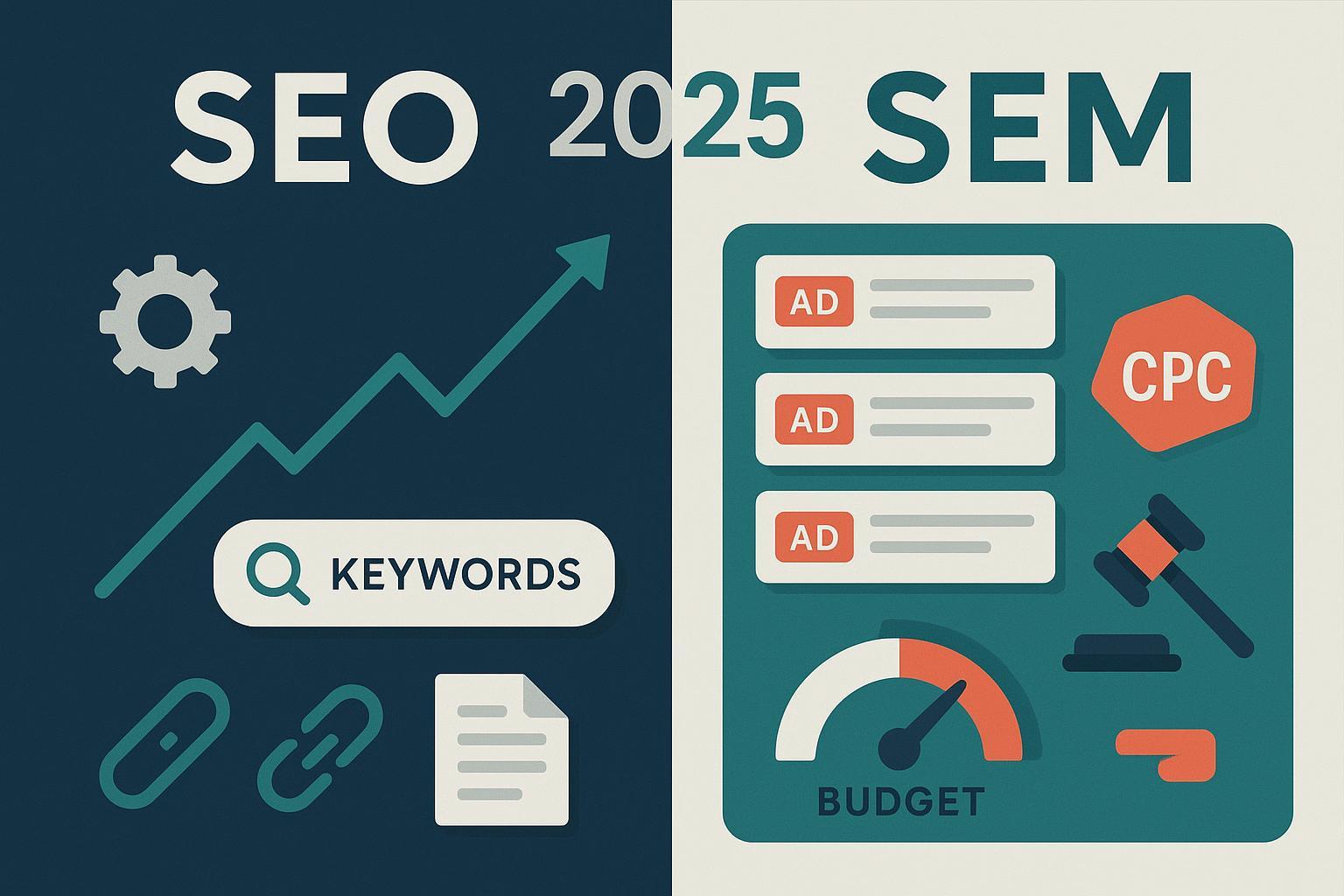
If you’re deciding how to invest limited marketing budget this year, “SEO vs. SEM” is probably the first fork in the road. As a growth marketer who’s managed both organic programs and seven‑figure paid search accounts, my goal here is to cut through jargon and quantify the trade‑offs so you can choose confidently—whether you run a local service, an e‑commerce operation, or a B2B startup.
We’ll define each channel, compare costs and timelines with 2024–2025 benchmarks, unpack risks and attribution, show how SEO and SEM work together, and finish with scenario‑based recommendations plus a phased plan many teams use in practice.
SEO vs. SEM: Plain‑English definitions
- Search Engine Optimization (SEO) is the practice of earning visibility in organic (non‑paid) results by improving content relevance, technical health, and site authority.
- Search Engine Marketing (SEM) is often used two ways in the wild. The classic definition treats SEM as an umbrella that includes both SEO and paid search (PPC). In everyday use, many marketers use SEM to mean paid search advertising specifically. For clarity here, we’ll use SEM to mean paid search ads (e.g., Google Ads, Microsoft Ads).
For a concise reference, Backlinko’s 2025 guide explains the distinction clearly in its overview of the relationship between organic SEO and PPC in search engines—see the summary in the Backlinko hub: SEO vs. SEM (2025). The American Marketing Association’s explainer also contrasts scope and speed between the two channels (2024) in its AMA overview of SEO vs. SEM.
If you want to go deeper on fundamentals after this section, you can revisit the building blocks in SEO explained: fundamentals and intent alignment.
How they work (and where the money goes)
- SEO mechanics in brief: research search intent, create high‑quality content, optimize on‑page elements, ensure fast and crawlable pages, and earn authority via internal links and reputable external mentions. Costs are primarily labor (in‑house or agency), content creation, technical fixes, and tools.
- SEM mechanics in brief: choose keywords and match types, write ads, set bids and budgets, manage negatives, craft high‑converting landing pages, and optimize to target CPA/ROAS. Costs include media spend (CPC‑based) and management (internal time or agency fees).
A quick terminology refresher you’ll see throughout:
- CPC: cost per click (what you pay for each ad click)
- CPA: cost per acquisition (cost per lead/sale)
- ROAS: return on ad spend (revenue divided by ad spend)
Costs in 2025: what budgets actually look like
Paid search benchmarks vary widely by industry and ad format, so rely on time‑stamped data and compare like‑for‑like:
- WordStream’s 2025 update reports sector medians for search CPCs and CPLs, helpful to gauge competitiveness by niche; see the latest figures in the WordStream 2025 Google Ads benchmarks.
- For Shopping campaigns, StoreGrowers’ 2025 analysis reports average Shopping CPC around $0.66 and average CPA around $38.87 across accounts, with notable spread by vertical; details in the StoreGrowers 2025 Google Ads benchmarks.
Management fees are layered on top of media. Common models include 10%–35% of spend or flat monthly retainers; ranges and structures are broken down in AgencyAnalytics’ 2025 overview of PPC pricing models in its PPC pricing guide (2025).
On the SEO side, pricing depends on scope and market:
- Backlinko’s 2025 survey summarizes averages such as $1,000–$2,500/month retainers for many SMB‑level engagements and higher for complex/enterprise programs; see the ranges in the Backlinko SEO pricing breakdown (2025).
Takeaways for planning:
- SEM has direct, ongoing media costs that scale linearly with volume. To collect enough data for meaningful optimization, many agencies recommend at least low four‑figure monthly spend in competitive markets.
- SEO has front‑loaded labor and content costs; marginal traffic costs tend to decline as the program compounds.
Time to results: speed vs. compounding
- SEM is fast. You can switch on campaigns and see clicks within hours. It usually takes a few weeks to stabilize and a few months to reach efficient CPAs as you prune keywords, refine ads, and improve landing pages.
- SEO compounds. Shopify summarizes the typical arc succinctly: most sites see measurable results within three to six months, with more meaningful traction in the following months as content and links accrue—see Shopify’s How long does SEO take? (2025).
The AMA’s 2024 comparison likewise emphasizes that SEM delivers visibility immediately, whereas SEO builds durable visibility over time; context in the AMA overview of SEO vs. SEM.
Measurement and attribution: why the math feels easier in paid
- SEM gives you direct control and direct feedback loops: CPC, CTR, CPA, and ROAS tie spend to outcomes in platform dashboards. A practical, current rundown of what to track and how to report is captured in the AgencyAnalytics SEM tracking guide (2025).
- SEO performance is clear at the macro level (organic sessions, conversions, assisted revenue), but attribution is harder at the page/keyword level, especially with multi‑touch journeys and branded vs. non‑branded effects. Use GA4 plus search console data, keep an eye on assisted conversions, and forecast impact by content cluster rather than individual pages when possible.
For both channels, consider incrementality experiments when spend is material, and be wary of last‑click bias that can under‑credit upper‑funnel organic content.
For a practical primer on using historical data to inform forecasting and channel shifts, see this explainer on using historical traffic and keyword data for strategy.
Risk profiles in 2025: what can go wrong (and how to mitigate)
- SEO risks: Google’s core updates can reshuffle rankings, especially for thin, duplicative, or unhelpful content. Google’s official documentation outlines how these updates aim to reward people‑first content; see the Google Developers core updates overview. Mitigations include focusing on genuine user value, demonstrating E‑E‑A‑T, consolidating cannibalized pages, and maintaining strong technical health (speed, mobile UX, structured data).
- SEM risks: Auction inflation (higher CPCs/CPLs), stricter policy enforcement, and privacy‑driven signal loss can reduce efficiency. Mitigations include rigorous negative keyword management, creative testing, audience layering, and continuous landing‑page optimization to protect Quality Scores and conversion rates.
How SEO and SEM strengthen each other
Treat them as complementary levers rather than rivals:
- Use SEM to validate demand quickly. High‑intent keywords that drive conversions in paid often deserve evergreen SEO pages. Short‑term SEM data (queries, ads with high conversion rates) can prioritize your organic content roadmap.
- Let SEO improve SEM efficiency. Better, more relevant content and stronger landing pages can raise Quality Scores and conversion rates—reducing CPCs and CPAs over time. Search Engine Land and other industry sources have long emphasized the role of landing page relevance; the concept is covered in many 2024–2025 landing page/SEO crossover guides.
If you’re refining your organic plan, make sure your content maps to intent types (informational, commercial, transactional). A quick refresher is here: align keywords to search intent.
Scenario‑based recommendations (with a compact comparison table)
Below are typical scenarios I see in 2025 and the channel emphasis that pays off most often.
- New product/startup launch: Prioritize SEM for immediate visibility and fast learning; start an SEO foundation (technical audit, key landing pages, one or two content clusters) so you’re compounding in parallel.
- Evergreen growth for SMB/B2B: Emphasize SEO for durable compounding; keep SEM for bottom‑funnel capture, brand defense, and retargeting.
- Seasonal or time‑bound promos: SEM takes the lead; use organic pages to support pre‑season research and internal links to promo pages.
- Hyper‑competitive short‑tail terms: Use SEM to participate immediately; build an SEO moat with long‑tail, comparative, and problem‑solution content.
- Local services: Do both. Invest in local SEO (GBP optimization, citations, location pages) and run SEM on core service + geo modifiers during peak windows.
| Scenario | Channel Emphasis | Why it Works |
|---|---|---|
| Startup/launch | SEM now, SEO foundation | Immediate demand capture; SEO begins compounding |
| Evergreen growth | SEO lead, SEM support | Lower marginal cost at scale; brand trust |
| Seasonal promo | SEM lead | Speed, precise budget control, time‑boxing |
| Competitive head terms | SEM for coverage, SEO for long‑tail moat | Paid reach today; organic defensibility over time |
| Local services | Hybrid | High intent via ads; durable local rankings |
Why choose SEO in 2025 (and how to blend with SEM)
Reasons many teams skew toward SEO for their core growth engine this year:
- Compounding economics: After the initial build, additional organic clicks often arrive at a lower marginal cost than comparable paid clicks.
- Brand trust and SERP real estate: Strong organic visibility plus branded navigational dominance reduces reliance on ads.
- Strategic durability: Algorithm volatility exists, but a deep library of helpful, intent‑matched content tends to weather changes better than any single page.
Caveats:
- SEO requires patience (expect 3–6 months for early signals and 6–12+ months for strong momentum) and consistent execution.
- You still need high‑quality landing pages and conversion optimization—traffic alone won’t fix weak offers.
A pragmatic phased plan I recommend often:
- Months 0–3: Allocate a heavier share to SEM (e.g., 70/30 SEM/SEO) to validate keywords, capture early demand, and test offers. Build technical SEO baseline and 1–2 high‑intent landing pages plus one content cluster.
- Months 4–6: Shift to 50/50 as organic content begins indexing; use paid search data to prioritize organic topics. Improve landing pages to raise Quality Scores and organic conversion rates.
- Months 7–12: If organic is producing consistent conversions with improving rankings, tilt toward 30/70 SEM/SEO (or whatever ratio your CPA/ROAS and organic CPL justify). Maintain SEM for bottom‑funnel, brand defense, and net‑new tests.
Trigger metrics to justify reallocation:
- SEO: rising impressions/clicks for target clusters, top‑10 rankings on priority terms, organic conversion rate within 20–30% of paid channel benchmarks.
- SEM: stable or improving ROAS/CPA after pruning; diminishing returns on incremental budget increases.
Execution notes for SEO’s off‑page component: If link acquisition is part of your plan, work from a quality‑first checklist to avoid spammy tactics and volatility. A practical overview is here: link building checklist and strategy guide.
Frequently asked clarifications
- Is SEM just Google Ads? Not quite—Microsoft Ads (Bing) and smaller engines also matter. Google dominates share in most markets, but channel mix can improve reach and cost.
- Is SEM “better” than SEO? Neither wins universally. SEM is better for immediate, time‑boxed goals and controlled testing. SEO is better for durable, compounding growth and brand trust.
- What if my industry’s CPCs look low/high vs. benchmarks? Benchmarks are medians across many accounts. Your geography, competition, and ad format (search vs. Shopping) drive variance. Cross‑check 2025 figures for your vertical in WordStream and StoreGrowers and then judge by your own CPA/ROAS.
- How do Google updates affect SEO planning? Plan for user‑first content and strong technical foundations. Google’s core updates overview describes the principles behind changes; building helpful, original content reduces downside risk.
Also consider: implementation help
If you decide to invest in SEO and need a simple way to create, optimize, and publish content, you might consider QuickCreator for AI‑assisted blog creation, SERP‑informed optimization, and publishing workflows. Disclosure: QuickCreator is our product.
The bottom line
- Use SEM when speed and control are paramount—launches, short promos, aggressive testing, or when you’re priced out of organic visibility near‑term.
- Invest in SEO as your compounding engine for 2025—especially for evergreen demand, brand building, and lowering marginal acquisition costs. Expect a 3–12+ month ramp depending on competition and execution quality.
- Blend both in phases. Let paid search data inform your organic roadmap; let organic content improve paid efficiency. Reallocate budget based on CPA/ROAS and organic traction rather than rigid rules.
Sources cited in this article include Backlinko’s overview of SEO vs. SEM (2025), the American Marketing Association’s comparison (2024), WordStream’s Google Ads benchmarks (2025), StoreGrowers’ Shopping benchmarks (2025), Shopify’s timeline for SEO results (2025), Google’s core updates documentation, and AgencyAnalytics’ SEM tracking/metrics guide (2025).
