Seasonality or Google Updates? Diagnosing SEO Fluctuations in 2025

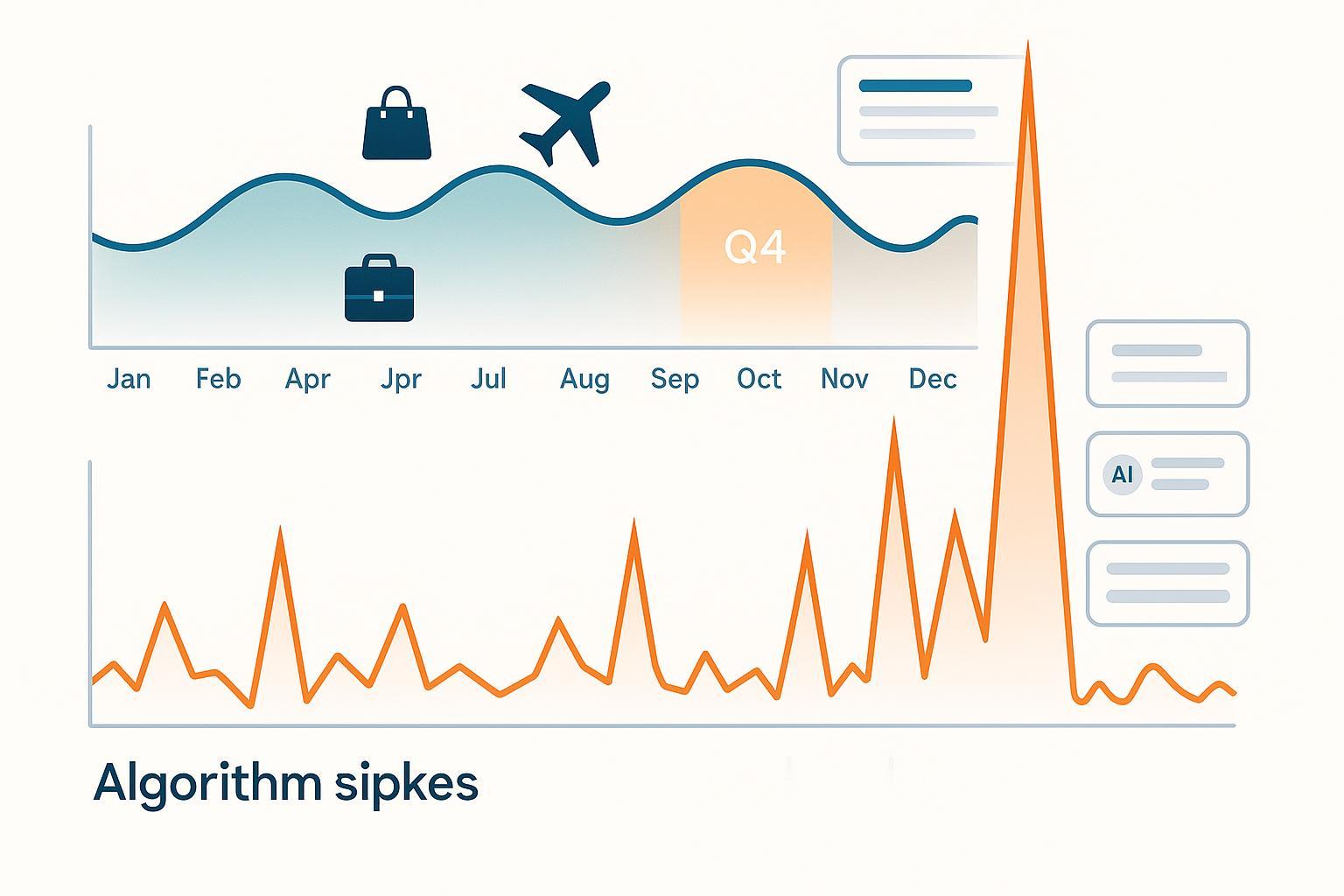
Organic search metrics (impressions, clicks, sessions) move for more than one reason. In 2025, two forces dominate: predictable industry seasonality and multi-week Google algorithm updates—plus a third complicator, shifts in SERP features like AI Overviews that can suppress click-through without changing your rank. This article gives you a practical, evidence-backed way to tell them apart and respond with confidence.
The two primary drivers of SEO volatility
- Seasonality: Demand rises and falls on a calendar—Q4 retail shopping, holiday travel, conference cycles. These patterns usually repeat year over year.
- Algorithm updates: Core and spam updates roll out over days or weeks, reshaping which content Google prefers. For example, the August 2024 core update began August 15 and completed September 3 per Google’s Search Central blog announcement (2024); Google’s core updates overview (2025) explains that significant recoveries often align with later updates.
- SERP features & AI Overviews: Since Google’s U.S. launch of AI Overviews in May 2024, summarized answers and enriched result types increasingly satisfy queries in-SERP. Google’s Generative AI in Search announcement (May 2024) outlines this rollout.
A fast decision tree for diagnosis
-
Pin the timing
- Did the inflection start within a known update window? If yes, suspect algorithmic change.
- Did it align with a well-known seasonal event (e.g., Black Friday, Thanksgiving travel)? If yes, suspect seasonality.
-
Check historical baselines (2–3 years)
- If the pattern repeats YoY in the same weeks, seasonality is likely.
- If it’s a new shape or magnitude, investigate algorithmic or technical causes.
-
Compare CTR vs average position
- If position is stable but CTR drops, suspect SERP feature changes (AI Overviews, featured snippets, People Also Ask) rather than ranking losses.
-
Run technical and content quality checks
- Confirm crawlability/indexation, page performance, and schema.
- Review content originality and intent match before assuming an “update hit.”
The diagnostic workflow (step by step)
1) Timeline overlay
List the weeks when your traffic changed and compare them to Google’s public update windows. For context, Google confirmed multi-week core updates in late 2024 (Aug 15–Sep 3; Nov 11–Dec 5; Dec 12–Dec 18) and continued into 2025, with official guidance consolidated in Google’s core updates overview (2025). If your inflection begins during these windows, algorithmic influence is plausible; if it maps to seasonal cycles, seasonality is a stronger hypothesis.
2) Build 2–3-year baselines
Export clicks, impressions, CTR, and average position by page and query from Search Console. Overlay year-over-year for Q4 weeks to spot recurring peaks and troughs. For a deeper practitioner walkthrough, see Unveiling the Power of Historical Data in Website Traffic Analysis (QuickCreator).
3) Corroborate with Google Trends
Validate category-level interest over multiple years. If Trends shows a steady or rising interest but your site dips, look for site-specific or SERP changes; if Trends also dips, seasonality is likely. Google details methods in Get started with Google Trends (Search Central docs, 2025).
4) Audit CTR vs position for SERP feature impacts
In Search Console, filter to queries with stable position but falling CTR. Inspect the live SERP for AI Overviews, snippets, PAA boxes, and shopping units. Independent research suggests click behavior is changing: the 2024 zero-click study by SparkToro found roughly 58–60% of searches ended without a click, and Pew Research (2025) on AI summaries reported users were less likely to click when an AI summary appeared. Use these as directional evidence alongside your own query-level data.
5) Vertical benchmarking
Compare against industry peers and reputable roundups to understand whether volatility is sector-wide. Pair your findings with official update timing and avoid over-relying on third-party “sensors.” Benchmarks do not prove causation but can support your narrative with stakeholders.
6) Technical sanity checks
- Crawlability/indexation: Confirm no accidental noindex or blocked paths; check coverage reports.
- Performance & UX: Maintain LCP/INP/CLS standards—poor performance can compound losses when competing against rich SERP features.
- Structured data: Add or refine FAQ, HowTo, Product/schema where appropriate to earn richer visibility. For practical implementation guidance, see From Zero to Hero: Microdata SEO Ranking Success (QuickCreator).
7) Content quality and intent alignment
Evaluate whether pages genuinely satisfy searcher intent with original, comprehensive coverage. Thin or duplicative pages are vulnerable in core updates. If you need a primer on aligning topics and keywords to intent, review What are keywords, topics, and differences? (QuickCreator Docs).
Q4 context: What seasonality looks like in the data
In U.S. retail, demand typically intensifies in November–December. The Advance Monthly Retail Trade Survey (U.S. Census, Aug 2025) reported retail trade sales up 0.6% month over month and 4.8% year over year, with nonstore retailers up 10.1% YoY—consistent with robust e-commerce momentum heading into holiday periods. Expect earlier demand pulses in October tied to major shopping events, which can shift traffic distribution within Q4.
Travel shows similar holiday clustering, with heavy Thanksgiving–New Year interest. While site-specific patterns vary by market and product, you should see recurring spikes when plotting 2–3 years of Search Console data and corroborating with category Trends. For broader context on search behavior ranges, this overview of current figures can help frame expectations: Google Search Statistics You Need to Know Today (QuickCreator).
Mini case: CTR drops without rank loss (AI Overviews and snippets)
- Symptom: Average position ~ stays within ±0.2, but CTR drops 10–20% for informational queries.
- Investigation: SERP now shows an AI Overview and a featured snippet; PAA boxes appear above the first classic organic result.
- Diagnosis: Click cannibalization from SERP features, not a rank fall.
- Response: Strengthen titles/meta to win residual clicks, target queries with clearer transactional intent, and add structured data to qualify for enhanced visibility where relevant.
Practical workflow example (tooling without hype)
Teams often stitch together Search Console exports, Google Trends, and simple dashboards to monitor these signals. A neutral example: QuickCreator can be used to plan and refresh pages when baselines indicate seasonal opportunities or post-update content gaps, pairing its editor and SEO optimization with your own GSC/Trends diagnostics. Disclosure: QuickCreator is our product.
Stakeholder communication: Calm, evidence-first
- Lead with dates and patterns: “Traffic dipped starting Nov 12, which aligns with a core update window; position was stable but CTR fell where AI Overviews appeared.”
- Show YoY comparables: Overlay last year’s Q4 to distinguish recurring seasonality from novel drops.
- Be explicit about uncertainty: Updates are multi-week; recovery may require content improvements and time.
- Commit to a monitoring cadence: Weekly checks during Q4; re-assess within 48–72 hours of any new Google announcement.
Next steps (2025 checklist)
- Overlay your traffic inflection dates with known update windows and seasonal calendars.
- Build 24–36 month baselines for clicks, impressions, CTR, and position.
- Use Trends to confirm category demand; segment by geography where relevant.
- Audit CTR vs position for feature-driven cannibalization; spot AI Overviews and snippets.
- Run technical checks and improve content depth and intent alignment before assuming an “update hit.”
- Create a lightweight change-log: date, signal, likely cause, action taken.
- Refresh priority pages and monitor weekly; expect recovery to follow future core updates per Google’s core updates overview (2025).
When you’re ready to operationalize content refreshes and multilingual rollouts alongside your diagnostics, consider using QuickCreator to streamline drafting, optimization, and publishing while you keep analysis anchored in Search Console and Trends.
Updated on Oct 31, 2025 — Re-validate AI Overviews behavior and update timing monthly to reflect evolving SERP features.
