How to Improve SEO for Your CNC Machine Business

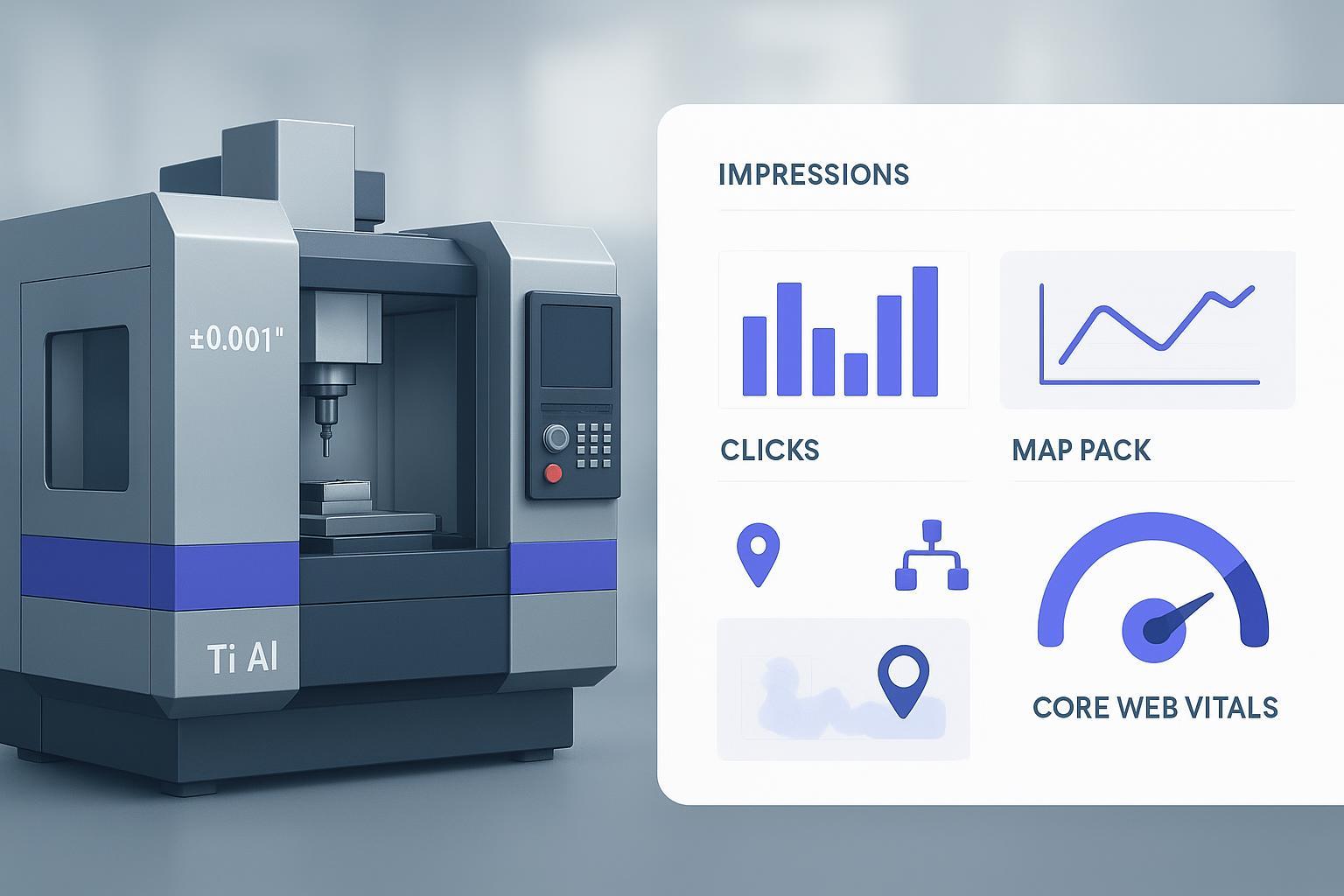
Improving SEO for a CNC machine business is about making it easy for engineers and procurement teams to find, trust, and contact you. This guide gives you a practical, step-by-step playbook to increase qualified RFQs and CAD uploads from organic search.
Difficulty: Medium (you’ll need access to your CMS, Google Business Profile, Google Search Console, and GA4)
Time to complete: Plan on 20–40 hours for initial setup; 3–6 hours/month for maintenance
Prerequisites: Admin access to your website/CMS, Google Search Console (GSC), Google Analytics 4 (GA4), Google Business Profile (GBP)
From experience, the highest-impact wins for CNC shops are: targeted capability pages, strong local SEO, fast-loading pages that pass Core Web Vitals, and content that answers engineers’ DFM and procurement questions.
1) Build a CNC-specific keyword strategy engineers and procurement actually use
Your buyers search with technical language. Capture those queries and map them to content you can own.
Define your axes
Capabilities: CNC milling, turning, 5-axis, Swiss, EDM
Tolerances: ±0.0005", ±0.001", surface finish (e.g., Ra 0.8 µm)
Materials: Aluminum (6061/7075), steels (4140/17-4), titanium (Grade 5), engineering plastics (PEEK, Delrin)
Certifications: ISO 9001, AS9100, ITAR
Industries: Aerospace, medical, automotive, defense
Local modifiers: City/State/“near me”
Collect seed terms from real sources
Pull phrasing from RFQs, customer emails, and your team’s shop-floor terminology
Check GSC > Search results for queries already driving impressions
Expand and qualify
Use tools (Google Keyword Planner, Ahrefs/Semrush) to find long-tail and question queries
Review SERPs to confirm intent (are results capability pages, case studies, or how-to content?)
Cluster by funnel stage
Informational: DFM guides, materials/tolerance explainers
Commercial: Capabilities and industry pages
Transactional: Service pages (RFQ, CAD upload)
Map clusters to your site architecture
Pillar “CNC Machining Services” → subpages for milling, turning, 5-axis, EDM, Swiss
Materials pages (e.g., Titanium CNC Machining)
Industry pages (e.g., Aerospace CNC Machining)
Location pages (e.g., Precision CNC Machining in Austin, TX)
FAQs and case studies hubs
Verification
In GSC, check that targeted pages are indexed and receiving impressions for your mapped queries.
Ensure each target page clearly matches searcher expectations (specs, proof, CTAs).
2) Create high-converting capability and location pages
Engineers and procurement need proof, clarity, and confidence. Structure your pages to deliver exactly that.
For each capability service page (e.g., 5-axis CNC milling):
H1 and intro that anchor capability and proof (e.g., tolerances and industries served)
Machines/equipment (models, travels, spindle speeds, tooling)
Tolerances and surface finishes (e.g., ±0.0005", Ra 0.8 µm), max part size, file formats
Materials supported (aluminum alloys, steels, titanium, plastics) and finishing partners (anodizing, passivation)
QA process (CMM, SPC), sample inspection report highlights
Certifications (ISO 9001/AS9100, ITAR), compliance notes
Media: photos/videos of parts, machine cells, inspection
Trust + conversion: RFQ form, CAD upload, typical lead times, MOQs, testimonials/case logos
Internal links to related processes, materials, DFM guides, industry pages
For location pages:
Full NAP, embedded map, service area, localized industries and associations
Unique content per location (not just copy-paste)
Add structured data for clarity
Implement Organization/Logo, BreadcrumbList, and FAQPage (if relevant) from Google’s guidance. Google documents supported rich results in the Structured data search gallery (Google, 2025).
Consider adding semantic context with Service schema at schema.org (not a Google rich result, but helpful semantic markup).
Example Service JSON-LD (adjust to your content):
{
  "@context": "https://schema.org",
  "@type": "Service",
  "name": "5-Axis CNC Milling",
  "provider": {
    "@type": "Organization",
    "name": "Your Machine Shop"
  },
  "areaServed": "United States",
  "serviceType": "Precision CNC machining",
  "description": "5-axis CNC milling to tight tolerances for aerospace and medical components.",
  "hasOfferCatalog": {
    "@type": "OfferCatalog",
    "name": "Capabilities",
    "itemListElement": [
      {"@type": "Offer", "itemOffered": {"@type": "Thing", "name": "Tolerances ±0.0005\""}},
      {"@type": "Offer", "itemOffered": {"@type": "Thing", "name": "Materials: Aluminum, Titanium, Stainless"}}
    ]
  }
}
Verification checklist
Unique title/meta and H1, sufficient content depth, clear CTAs
Schema validates in Google’s Rich Results Test
Page is indexable and loads quickly (baseline PageSpeed Insights score)
3) On-page optimization fundamentals that move the needle
Titles and meta descriptions: Make them benefit-focused and keyword-precise. If you need a refresher on titles/descriptions/keywords basics, see Understanding and Implementing TDK for SEO.
Headings: Use H2/H3 to organize specs, materials, QA, and industries served.
Internal links: Connect capability pages to materials, industries, and DFM guides; maintain logical paths to RFQ/CAD upload.
FAQs: Address common engineering questions (tolerances, finish, materials) and procurement concerns (lead time, MOQs, certs).
Verification
Confirm titles and descriptions are unique and accurate.
Use GSC’s URL Inspection to check index status; monitor query-to-page alignment in Search results.
4) Local SEO: Optimize your Google Business Profile (GBP)
Your Map Pack visibility often drives the fastest local lead gains.
Categories: Choose the most specific primary category (“Machine shop,” “CNC machining service,” or “Machining manufacturer” depending on availability), and relevant secondaries.
Business info: Accurate name, address, phone, hours, website; list services with descriptive text.
Photos/videos: Upload high-quality facility/equipment/team images and short clips regularly.
Posts: Share case studies, new capabilities, hiring, trade shows; include CTA buttons.
Q&A: Monitor and answer common questions; keep answers factual and helpful.
Reviews: Request from satisfied customers and respond professionally. Follow the Business Profile policies and guidelines (Google, 2025).
NAP consistency: Align website, GBP, and directories (quality over quantity; prioritize accuracy).
Verification
Use GBP Insights to track views, calls, website clicks.
Manually check Map Pack coverage for target queries and locations.
5) Technical SEO and Core Web Vitals for manufacturing sites
Manufacturing sites often host heavy images and technical PDFs. Keep them fast and indexable.
Indexing and crawl hygiene
Ensure important pages are indexable (no accidental noindex), submit a clean XML sitemap in GSC, and avoid blocking essential resources in robots.txt. Google explains robots controls in the robots.txt introduction (Google Search Central, 2025).
Use self-referential canonical tags; fix mixed content by enforcing HTTPS throughout.
Core Web Vitals (CWV)
Aim for passing at the 75th percentile: LCP ≤ 2.5s, INP ≤ 200ms, CLS ≤ 0.1. See the Core Web Vitals overview (Google Search Central, updated 2024–2025).
INP replaced FID in March 2024; details and performance guidance are in the INP update announcement (web.dev, 2024).
Industrial-site optimizations
Convert large photos/CAD renders to WebP/AVIF; use responsive images (srcset/sizes)
Lazy-load non-critical media; serve via CDN; reduce TTFB
Defer non-critical JS; offload heavy computations (e.g., CAD viewers) to Web Workers
Stabilize layouts by setting width/height for media and avoiding content shifts
Verification
Test with PageSpeed Insights field and lab data at PageSpeed Insights (Google, 2025)
Monitor the CWV report in GSC; use Lighthouse for lab diagnostics
6) Earn relevant links ethically
Good links come from useful content and real industry relationships.
Publish detailed case studies and DFM guides; pitch them to industry blogs/newsletters.
List in vetted directories/associations (prioritize relevance and quality).
Collaborate with suppliers/customers on co-authored content.
Sponsor or participate in local STEM/industry events to earn mentions.
Announce new certifications, equipment, or awards with PR that links to capability pages.
Verification
Evaluate referring domains for relevance and authority; avoid manipulative schemes.
7) Measure what matters and iterate
Configure GA4 and GSC so you can prove impact on RFQs and CAD uploads.
GA4 events and conversions
Track rfq_form_submit and cad_file_upload as events; mark them as conversions. See the official docs for GA4 event tracking (Google, 2025) and GA4 conversions setup (Google, 2025).
Attribution and page-level analysis
Review organic sessions and conversion paths; analyze by Landing Page to connect entry pages to conversions. The attribution models are documented in GA4 attribution (Google, 2025).
Search Console
Link GSC to GA4; monitor queries, pages, CTR, and average position; inspect indexing for priority pages.
Cadence
Monthly: refresh underperforming pages and expand clusters
Quarterly: revisit your keyword map, fix performance issues, review GBP categories/services
8) Practical example: produce an engineer-focused DFM blog in one day
Disclosure: QuickCreator is our product.
Goal: Publish a DFM blog that attracts engineers searching for “titanium CNC machining tolerances” and drives RFQs.
Workflow I use:
Define the intent and target term
Primary: “CNC machining titanium Grade 5 tolerances”
Supporting entities: Grade 5 Ti properties, tool wear, heat management, achievable tolerances, surface finishes, inspection methods
Outline the article for credibility
Sections: material properties, machinability considerations, tolerance ranges by feature, fixture strategies, inspection (CMM), common pitfalls, RFQ checklist
Draft with an AI assistant
Use an AI blog tool to generate a first draft that aligns with your outline and intent. If you prefer an integrated workflow, the AI Blog Writer can be used to create a structured draft and add headings, images, and internal links.
Add proof and polish
Insert real shop data: machines used, typical tolerances, finish examples, inspection workflow
Add photos/diagrams; ensure alt text is descriptive (e.g., “CMM probe measuring titanium bracket”)
Score content quality against E-E-A-T considerations; tools like the Content Quality Score (EEAT Checker) help you identify gaps (author expertise, sourcing, trust signals)
Optimize and publish
Title/meta optimized; internal links to your Titanium CNC page and RFQ
Validate structured data (FAQPage if you added FAQs) via Google’s test
Publish, then verify indexing in GSC URL Inspection
Measure
Track organic landing page performance and RFQ conversions in GA4
Iterate based on queries pulling impressions and the sections users engage with most
9) Troubleshooting common issues
Pages not indexing
Check meta robots and canonical conflicts; ensure internal links to the page; request indexing via GSC URL Inspection; expand content depth if the page is thin.
Failing Core Web Vitals
Identify the LCP element in PageSpeed Insights; compress/convert the asset; defer heavy scripts; inline critical CSS; reduce third-party tags.
GBP not showing in the Map Pack
Revisit categories, proximity/relevance, NAP consistency; add recent photos/posts; request and respond to more reviews; confirm no guideline violations per Google’s policies.
Schema errors
Fix missing required properties and type mismatches; revalidate; keep schema aligned with on-page content.
GA4 events not firing
Verify triggers in Google Tag Manager Preview; confirm event names; check consent mode configuration where applicable.
10) Next steps
If you’re short on time and need a consistent publishing cadence, you can use QuickCreator to support your blog and landing page workflow while you focus on capability pages, local SEO, and performance fixes. Start with one DFM article per week and one capability page refresh per month, and revisit results in GA4/GSC quarterly.
Optional resources for your team:
Foundational refresher: SEO Explained
Build campaign landing pages for case studies or downloads: Landing Page Builder
From one industrial marketer to another: pick one high-margin capability, build a best-in-class page, and publish a DFM article that engineers bookmark. The leads follow when the substance is there and the site is fast and findable.
See Also
Enhance Your Plumbing Company Using Effective SEO Solutions
Essential SEO Writing Tools to Elevate Your Website Ranking
Comprehensive SEO Strategies Tailored for Plumbing Professionals
Elevate Your Search Engine Rankings with These Effective Strategies
Effective B2B SEO Tactics to Engage Key Decision-Makers in 2024
