Best Tools for SEO Content Scoring and Keyword Cannibalization Detection in 2025

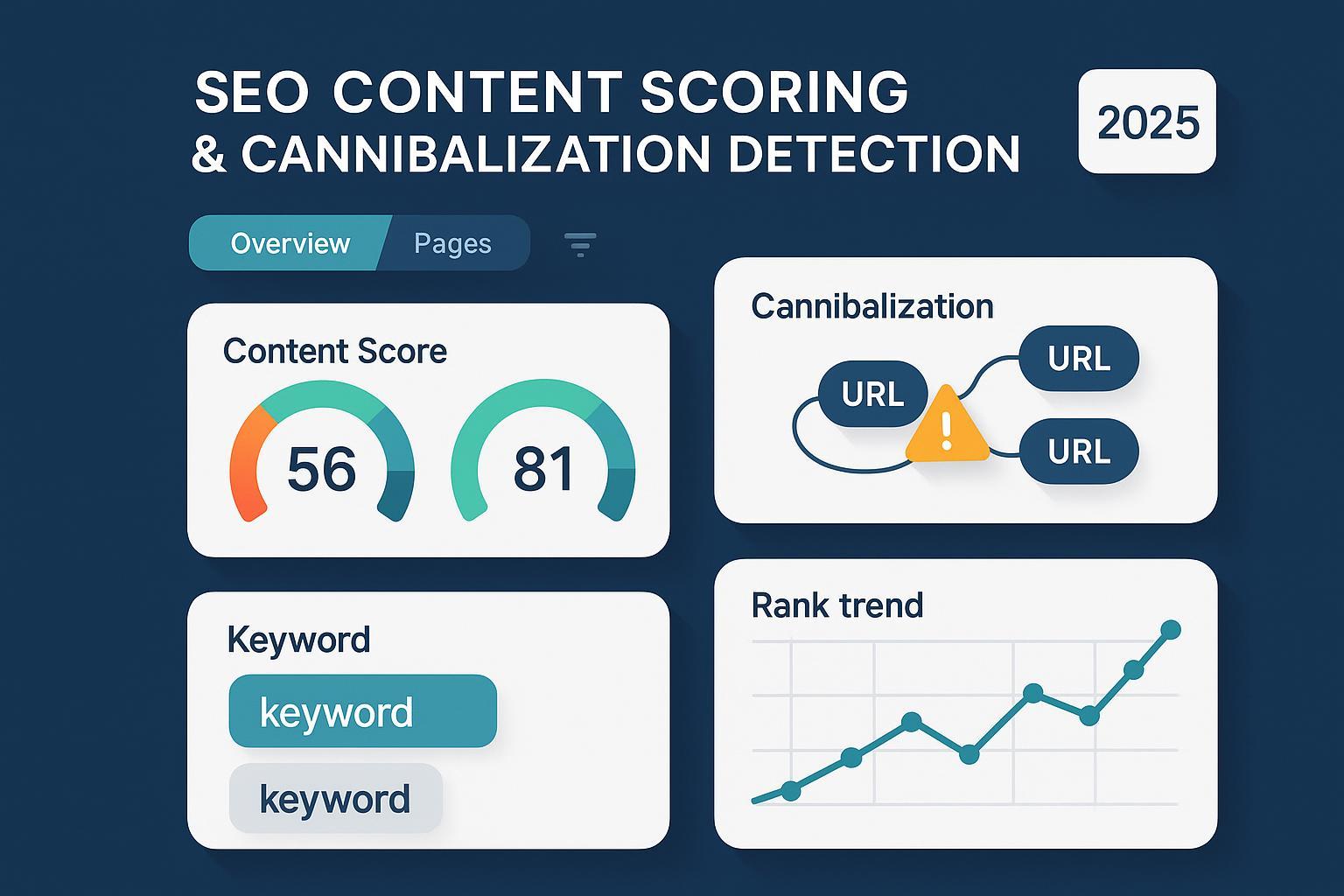
If you manage a growing library of content, two questions never go away: “Is this page good enough to rank?” and “Do any of our URLs compete for the same keyword?” In 2025, a handful of tools stand out for giving practical content quality scores and for detecting keyword cannibalization (conflicting URLs targeting the same query).
Below is a curated, evidence-backed stack you can actually use. We grouped tools by core strengths and prioritized official product/help documentation. Pricing notes are indicative and subject to change—always verify on the vendor’s site.
How we chose (transparent methodology)
We evaluated tools against the following criteria and weights:
- Capability match (content scoring + cannibalization/conflict detection) — 30%
- Learning curve & usability — 15%
- Ecosystem/compatibility (e.g., GSC integrations, CMS add-ons) — 15%
- Evidence quality & recency (official docs, product pages) — 15%
- Value (pricing vs. features) — 15%
- Support/reliability — 10%
We emphasized tools with defensible workflows and first-party documentation. We also avoided filler entries and limited external link density for readability.
1) Semrush — All-in-one suite with dedicated cannibalization reporting
- Best for: SMBs and agencies that want integrated rank tracking + cannibalization diagnostics.
- Content scoring: The SEO Writing Assistant provides an overall optimization score as you edit.
- Cannibalization detection: Position Tracking includes a Cannibalization tab with a health score and affected pages/keywords; set up tracking, then review overlapping URLs and remediate with consolidation or redirects. See Semrush’s own workflow in Semrush — How to Track Keywords (Cannibalization tab).
- Price notes: “From” pricing varies by plan and usage; confirm on the Semrush site.
- Pros: Integrated workflow; clear visualization of affected keywords/URLs.
- Cons: Learning curve; advanced features may require higher-tier plans.
2) Ahrefs — Robust data with “Potential cannibalization” insights
- Best for: Analysts comfortable with query/page mapping and manual investigations.
- Content scoring: Not a traditional “grade,” but strong on content gap analysis and SERP mapping.
- Cannibalization detection: Workflows use Organic Keywords with “Multiple URLs only,” plus historical ranking swaps; in 2024 Ahrefs added “Potential cannibalization” in Opportunities to surface overlapping targeting. Details are in Ahrefs — What’s new (May 2024).
- Price notes: Pay attention to data limits/rows per plan; verify on Ahrefs pricing.
- Pros: Excellent data depth; flexible analysis.
- Cons: Not a one-click report; interpretation required.
3) Clearscope — Content Grade that writers understand
- Best for: Content teams optimizing drafts and refreshes with a clear, actionable score.
- Content scoring: The Editor shows a real-time Content Grade with recommendations, word count, and readability. See the official overview at Clearscope — Getting started with the Editor.
- Cannibalization detection: Not a core feature; pair with GSC or a rank tracker.
- Price notes: Essentials plan announced at $129/month in 2025; confirm current details on the pricing page.
- Pros: Intuitive grading; editor integrations streamline workflows.
- Cons: Limited conflict detection; best combined with tracking tools.
4) Surfer — Content Score + data-backed content audits
- Best for: Teams that want a numeric score and audit-driven refresh process.
- Content scoring: Surfer’s Content Score (1–100) benchmarks pages against top competitors in both the Content Editor and Content Audit. See Surfer Docs — Content Audit.
- Cannibalization detection: Use Sites/Content Audit with GSC data to flag underperformers and inspect overlapping queries—then consolidate and re-optimize in the editor.
- Price notes: Plans vary by credits and modules; verify on Surfer pricing.
- Pros: Clear score; practical audit guidance; editor bridges analysis and execution.
- Cons: Requires pairing with search data to confirm conflicts.
5) MarketMuse — Topic modeling and live Content Score
- Best for: Brands investing in topical authority and comprehensive coverage.
- Content scoring: MarketMuse defines and updates Content Score live while you write, aligned to topic models. See MarketMuse Docs — What is Content Score?.
- Cannibalization detection: Indirect; use inventory/briefs and topic clustering to avoid overlapping intent.
- Price notes: Multiple plan tiers (including Free) exist; check current plan details.
- Pros: Strong for planning and topical depth; helpful briefs.
- Cons: Higher learning curve; indirect conflict detection.
6) Frase — Practical optimization with topic-level scoring
- Best for: Lean content teams that want rapid briefs and optimization suggestions.
- Content scoring: Frase provides optimization guidance and topic scoring within its editor/brief workflow. The platform explains combined optimization (SEO + GEO) in Frase Help — Optimize for SEO & GEO.
- Cannibalization detection: Indirect; identify overlapping topics during research and cluster accordingly.
- Price notes: Plans are credit-based; confirm current pricing.
- Pros: Fast research-to-draft pipeline; approachable UI.
- Cons: Conflict detection requires external rank/GSC checks.
7) SISTRIX — Purpose-built cannibalization analysis
- Best for: SEOs who want a dedicated cannibalization workflow inside a trusted suite.
- Content scoring: Not a grading tool; use in combination with on-page optimizers.
- Cannibalization detection: SISTRIX documents a step-by-step analysis and remediation approach in SISTRIX Tutorial — Analyse and Fix Keyword Cannibalisation.
- Price notes: Modular licensing; verify the module you need includes cannibalization features.
- Pros: Clear detection and instructions; strong visibility metrics.
- Cons: Separate tooling needed for content scoring.
8) SE Ranking — Cannibalization report with practical metrics
- Best for: Teams seeking an accessible, integrated cannibalization view in a mid-market platform.
- Content scoring: Not a traditional grade; focus is on rankings and insights.
- Cannibalization detection: The official knowledge base details a Keyword Cannibalization report that lists competing URLs per keyword and key metrics for decisions. See SE Ranking KB — Keyword cannibalization.
- Price notes: Competitive “from” pricing; confirm data limits.
- Pros: Purpose-built report; easy exports and prioritization.
- Cons: Pair with an on-page optimizer for content improvements.
9) Screaming Frog SEO Spider — Technical crawl + similarity analysis
- Best for: Technical SEOs and auditors who want to combine crawl data with performance signals.
- Content scoring: No grade; focus is on duplication, similarity, and site architecture.
- Cannibalization detection: Use Near Duplicates and semantic similarity (v22) to flag overlapping content, then map against GSC queries for conflicting URLs. The team explains near-duplicate issues (including cannibalisation risks) in Screaming Frog — Near Duplicates issue.
- Price notes: Desktop license; integrates with GA/GSC via APIs.
- Pros: Powerful diagnostic depth; customizable workflows.
- Cons: Manual analysis; steeper learning curve for non-technical users.
QuickCreator — A helpful content scoring companion for quality and trust
On first mention: QuickCreator. Disclosure: QuickCreator is our product.
- Best for: Content teams that want to standardize on-page quality checks and trust signals while drafting.
- What it does here: QuickCreator offers a Content Quality Score aligned to SEO optimization criteria and an AI E-E-A-T Checker to evaluate experience, expertise, authoritativeness, and trust signals. For scoring details, see the Content Quality Score help doc. For trust checks, explore the AI E-E-A-T Checker.
- Cannibalization note: QuickCreator doesn’t provide a dedicated cannibalization report; pair it with the detection tools above (e.g., Semrush, SE Ranking) and use QuickCreator to re-optimize the consolidated page.
- Pros: Clear scoring UI; integrated drafting and optimization.
- Cons: Use alongside a rank/GSC-based conflict detector.
How to run a quick cannibalization audit (actionable checklist)
- Map queries to URLs: Export top queries and landing pages from GSC; group by intent/topic.
- Spot overlaps: Use a detection tool (e.g., Semrush Cannibalization tab or SE Ranking’s report) to identify keywords where multiple URLs compete.
- Decide remediation: Choose one “canonical” URL to own the topic; merge, redirect, or retarget the others.
- Re-optimize: Use a content grader (Clearscope, Surfer, MarketMuse, or QuickCreator) to tighten headings, entities, and coverage on the primary page.
- Strengthen signals: Update internal links to point to the chosen URL; refresh metadata; ensure consistent intent.
- Monitor: Track rankings and clicks for the consolidated query over 4–8 weeks; iterate if needed.
What matters most in 2025 when choosing tools
- Prioritize clarity over features: A simple, trustworthy report beats an overloaded UI.
- Pair scoring with detection: Graders raise quality; rank/GSC-based tools reveal conflicts. You need both.
- Watch methodology: Scores differ by platform—choose one rubric and stick to it across your team.
- Verify pricing and data limits: “From” prices can hide usage caps that impact large sites.
- Build a repeatable workflow: Document how your team audits, consolidates, and refreshes content; make it part of quarterly operations.
Next steps
- Pick one detection tool and one content grader from the list above—then standardize your workflow for the next quarter.
- If you want a streamlined drafting + scoring experience, see How QuickCreator works. Pair it with Semrush or SE Ranking for cannibalization detection and close the loop.
Notes on pricing and features
All pricing and feature details are subject to change. Confirm plan limits and current capabilities on the vendor’s site before purchase or team rollout.
