SEM vs SEO: Differences, Benefits, and When to Use Each (2025)

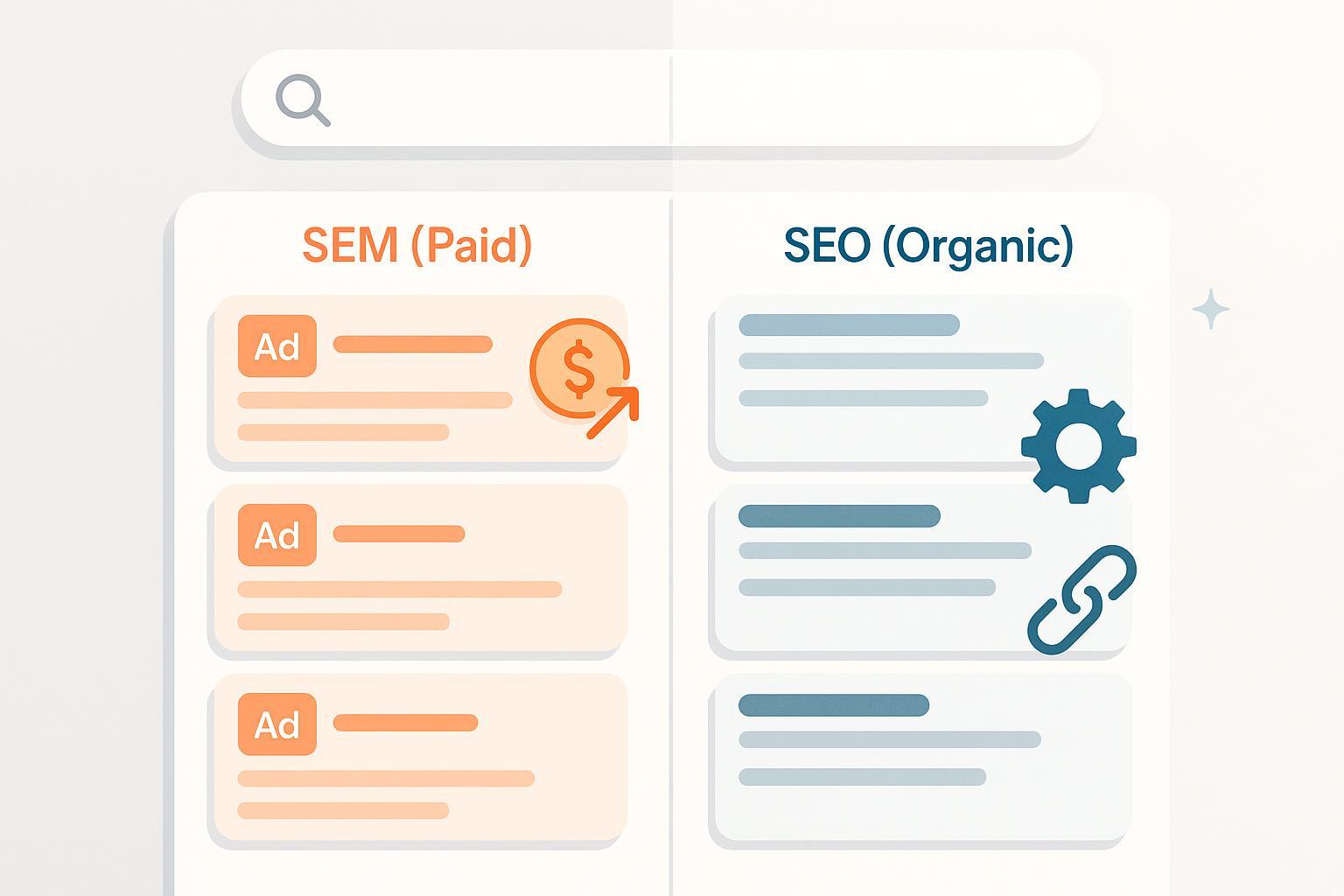
If you’re choosing between SEM and SEO in 2025, you’re really deciding between speed and compounding value—and how much control you want over targeting and spend. Both channels still work, but the search landscape has shifted with AI Overviews changing click behavior, higher CPCs in many verticals, and stricter ad policies in some categories. This guide lays out the practical differences, what changed in 2025, how to measure success, and when each approach fits best (including how to combine them).
SEM vs SEO, clearly defined
- In day-to-day marketing practice, SEM typically means paid search (PPC)—you bid on keywords and pay per click or conversion to show ads on search results pages. See the succinct definition in the Adobe Business SEM basics (2025).
- SEO is the process of improving your site to rank organically—technical, on-page, and off-page work that helps search engines understand and surface your content. The Search Engine Land SEO guide provides the canonical overview.
Note: Some academic and older sources still use “SEM” as an umbrella that includes SEO. The American Marketing Association notes this inclusive usage in its AMA overview of SEO vs. SEM (2024). For clarity here, we’ll use SEM = paid search and SEO = organic.
What changed in 2025 that affects the choice
- AI Overviews (also called SGE) have reduced organic click-through rates on many informational queries. Across multiple studies, declines range from mid-teens to 30%+ on average. For example, coverage in Search Engine Land’s 2024–2025 analysis of AI Overviews and CTR highlights material drops, and an April 2025 enterprise study from Amsive reports average declines near the high teens in their datasets, discussed in Amsive’s 2025 AEO guide.
- Google Ads benchmarks shifted as well. WordStream’s 2025 data pegs average Search CTR at roughly the mid-6% range, CPC around $5.26, and average CPL around $70. According to WordStream’s 2025 Google Ads benchmarks, CPC and CPL rose year over year across many industries.
Bottom line: Organic requires smarter strategy (target selection, content depth, UX), and paid search demands tighter efficiency (targets, creatives, landing pages) to protect ROAS.
Quick side-by-side: SEM vs SEO
| Dimension | SEM (Paid Search) | SEO (Organic) |
|---|---|---|
| Speed to impact | Hours to days after launch; immediate visibility | Typically 3–6 months for movement; 6–12+ months for compounding wins |
| Cost model | Ongoing media spend (CPC/CPA) + management | Upfront investment in content/tech; lower marginal costs later |
| Control | High control over keywords, audiences, budgets | Indirect control via content quality and authority |
| Typical KPIs | CPC, CTR, CVR, CPA, ROAS, Impression Share | Organic traffic, rankings, organic CTR, conversions, Core Web Vitals |
| Best for | Launches, time-bound promos, competitive tests | Evergreen growth, brand authority, broad discovery |
| Main risks | Rising CPC/CPL, policy limits, platform dependency | Algorithm/AI changes, slow ramp, content/tech resourcing |
Channel capsules (parity view)
SEM (paid search)
- Strengths
- Immediate visibility and predictable testing cadence
- Precise control over spend, keywords, locations, and audiences
- Retargeting and Shopping/product feeds accelerate conversion paths
- Limitations
- Visibility stops when budget stops; rising CPCs/CPL in many categories (2025)
- Policy constraints (e.g., healthcare) and evolving ad rules
- Efficiency depends on creative testing and landing page quality
- Typical costs and timelines in 2025
- Media budgets vary by size and industry; many SMBs start around low four figures monthly while mid-market budgets scale into five figures. WordStream’s 2025 report shows average CPC around $5.26 and CPL around $70, per WordStream’s 2025 benchmarks.
- Management pricing ranges from flat fees to percentage-of-spend models; 10–20% of ad spend is common per agency pricing roundups such as AgencyAnalytics’ 2025 PPC pricing overview.
- Core KPIs to watch
- CPC, CTR, CVR, CPA, ROAS, Impression Share; benchmark directionally against your CAC/LTV and category norms
- When SEM excels
- Launches and promotions with deadlines; competitive categories where organic will take time; retargeting high-intent audiences; keyword validation before large content investments
SEO (organic)
- Strengths
- Compounding traffic and durable brand authority
- Lower marginal cost per additional click as content library grows
- Broad discovery across the funnel, including long-tail queries
- Limitations
- Slower ramp (months); requires content, technical upkeep, and authority building
- Exposure to algorithm and AI Overview changes; requires ongoing optimization
- Typical costs and timelines in 2025
- Expect 3–6 months for noticeable movement and 6–12+ months for substantial gains, especially in competitive niches. See the ranges and drivers in Backlinko’s 2025 SEO pricing analysis.
- Core KPIs to watch
- Organic sessions, rankings by intent cluster, organic CTR, conversions, Core Web Vitals, backlinks/referring domains
- When SEO excels
- Evergreen growth, brand trust, and owning informational intent; local maps visibility; content-led acquisition for SaaS and ecommerce categories over time
Measurement frameworks that work in 2025
- Connect GA4 with Google Ads and Search Console to unify channel reporting. SEMrush’s walkthrough on GA4 for SEO outlines best practices for tying organic metrics to business outcomes in SEMrush’s GA4 for SEO guide (2025).
- For SEM: Monitor CPC → CPA → ROAS across campaigns and keyword themes; compare CAC vs LTV. Build negative keyword lists and segment high-intent vs exploratory terms.
- For SEO: Track rankings and organic CTR by intent cluster, conversions, Core Web Vitals, and referring domains. Use Search Console queries to inform content roadmaps.
- Beginner-friendly resources
- If you need a refresher on analytics and on-page basics, this internal primer covers GA4 basics and on-page optimization.
How AI Overviews (SGE) changes practical strategy
- Re-evaluate which queries you invest in. Informational queries above the fold may see reduced organic CTR; prioritize pieces that deliver unique value and depth, plus formats that attract links and shares.
- Improve content quality and trust signals. Google rewards helpful, trustworthy content; see this explainer on content quality/E-E-A-T for what quality frameworks typically include.
- Diversify SERP coverage. Use SEM for immediate coverage on high-stakes terms and SEO for comprehensive content libraries; optimize for featured snippets, People Also Ask, and shopping modules as relevant. Search Engine Land’s co-optimization perspective is a helpful primer in their 2025 PPC/SEO co-optimization piece.
Scenario-based recommendations (with examples)
- New product launch or limited-time promotion
- Choose: SEM first, SEO second
- Why: You need clicks now; paid search delivers controlled visibility and audience targeting within hours to days. SEO content and landing pages should launch in parallel to begin compounding.
- KPIs: For SEM, CPA and ROAS by ad group; for SEO, early indexing and rankings for core pages within 4–8 weeks.
- Evergreen growth and brand trust
- Choose: SEO first, SEM as a complement
- Why: Organic content compounds and lowers marginal acquisition costs. Use SEM to fill gaps on competitive terms and to test messaging.
- KPIs: Organic sessions/conversions, backlink growth, Core Web Vitals; SEM assists measured via assisted conversions in GA4.
- Entering a highly competitive category
- Choose: Hybrid
- Why: Paid buys you presence while your organic authority builds. Use SEM to validate which terms convert before investing in large content clusters.
- KPIs: For SEM, CPA/ROAS by intent; for SEO, rankings and organic CTR on a defined set of “wedge” keywords.
- Local services with seasonal spikes (e.g., HVAC, dental, legal)
- Choose: Hybrid with seasonality
- Why: Local SEO (Maps + reviews + service pages) for ongoing discovery; SEM during peak seasons and for urgent-intent terms.
- KPIs: Local pack visibility, calls, form fills; SEM CPA during seasonal promotions.
- Ecommerce and retail
- Choose: Hybrid
- Why: Product feeds (Shopping) plus brand and category queries via SEM; category and guide content via SEO for long-term discovery and link earning.
- KPIs: ROAS per product/category in SEM; organic revenue by category and non-branded search growth.
- B2B/SaaS
- Choose: Hybrid with content-led SEO
- Why: Use SEM for high-intent “software” and “solutions” queries to drive demos; build SEO thought leadership and use-cases for authority and long-tail capture.
- KPIs: Demo requests and pipeline attribution; organic growth on solution pages and comparison content.
- Regulated/sensitive industries
- Consider: SEO-heavy with careful SEM
- Why: Google Ads policies can limit or complicate campaigns in healthcare and other sensitive areas; SEO remains a reliable path to visibility but demands greater trust signals and content rigor. Policy updates are tracked regularly in industry coverage such as Search Engine Land’s 2025 Google Ads policy update report.
Practical hybrid playbook (from test to scale)
- Phase 1: Validate with SEM
- Launch tightly themed campaigns for 5–10 high-intent keywords. Measure CVR and CPA. Build negatives early.
- Phase 2: Build SEO around proven intents
- Create clusters and pillar pages around winners; structure internal links; pursue authority with helpful resources and references. If you’re new to clustering, start with an explainer on keywords and topics and then plan topic clusters.
- Phase 3: Rebalance budget
- As organic rankings take hold, reduce bids where SEO now brings consistent, high-quality traffic. Keep SEM on time-bound promos, highly competitive head terms, and remarketing.
When NOT to lean on each channel
-
Be cautious with SEM if…
- Your CAC can’t support current CPCs/CPL in your niche; your landing pages are not conversion-ready; or policies are likely to restrict your ads. In 2025, average CPCs and CPLs have risen across many categories per WordStream’s 2025 benchmarks.
-
Be cautious with SEO if…
- You have a hard deadline for demand generation; you can’t resource content, technical fixes, or link earning; or your category is dominated by entrenched authorities and AI Overviews are suppressing clicks in early months. The CTR impact discussion in Search Engine Land’s 2024–2025 coverage and Amsive’s 2025 guidance is a useful reality check (see their AEO guide cited earlier).
Frequently asked questions
-
Is SEM cheaper than SEO?
- Not usually over the long run. SEM’s costs scale linearly with spend; SEO’s marginal cost per incremental click tends to decline as content and authority compound. However, SEM can be cheaper for short bursts and testing.
-
How long until SEO “pays off” in 2025?
- Expect months, not weeks. Competitive markets may require a year or more to crack head terms. See pricing/time drivers in Backlinko’s 2025 SEO pricing analysis.
-
Has AI Overviews “killed” SEO?
- No. But it has changed where and how you win, especially on informational queries. Target selection, content quality, UX, and link earning matter more; hybrid strategies cushion volatility. See the AI Overview CTR analysis in Search Engine Land’s coverage and Amsive’s 2025 findings cited above.
Also consider: tools that help you execute
If you need help systematizing SEO content workflows (research, writing, internal linking, and basic optimization), consider exploring QuickCreator to speed up production while staying organized. Disclosure: QuickCreator is our product.
Sources and further reading (selected)
-
Definitions and frameworks
-
Benchmarks and measurement
-
AI Overviews and hybrid strategy
