The Definitive Keyword Map for Rubber, Plastics & Silicone Products (2025): From TOFU to BOFU

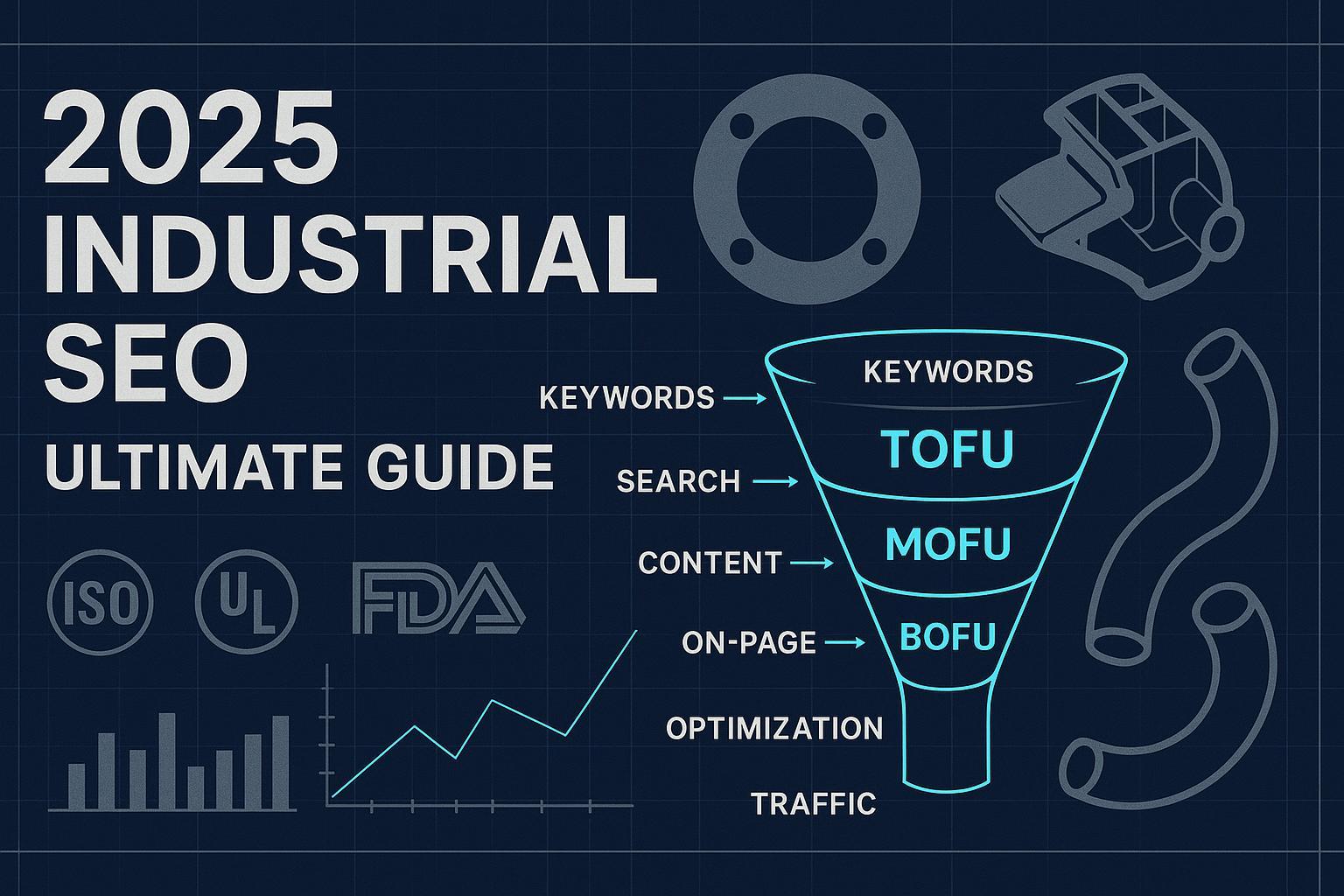
If you sell rubber, plastics, or silicone products and services, winning high‑intent search traffic isn’t about dumping keywords into a sheet. In 2025, it’s about mapping queries to buyer stages, aligning with compliance needs, and structuring pages to earn featured snippets and inclusion in AI Overviews.
Who this guide is for: manufacturing engineers, procurement/sourcing, QA/compliance, and operations leaders at industrial manufacturers and converters.
What you’ll get:
- A reusable keyword‑map template (TOFU/MOFU/BOFU, buyer roles, modifiers, SERP targets, conversions)
- Three pillar maps (Rubber, Plastics, Silicone) with role‑specific examples
- Three worked examples turned into content briefs (comparison, RFQ/spec, and compliance‑led)
- A 30‑day rollout plan and measurement checklist
1) The 2025 search reality for industrial B2B
You’re competing not just with vendors but with answer engines. Google’s AI Overviews summarize complex informational queries and pull from authoritative sources; content that’s passage‑clear, well‑structured, and demonstrably expert stands a better chance of being referenced, as outlined in Google’s own help documentation in the 2024 rollout of AI Overviews: see the explanation in Google’s “About AI Overviews” (2024).
Google also tightened quality signals in the March 2024 core update and spam policy changes, emphasizing helpful, people‑first content and reducing scaled/low‑value pages; see the announcement in Google Search Central: “March 2024 core update and new spam policies” (2024) and the ongoing guidance in Google’s “Creating helpful, reliable, people‑first content” (updated 2024).
Implication: build topic pillars (Rubber, Plastics, Silicone) with interlinked clusters; use answer‑first passages, precise headings, and on‑page evidence (specs, standards, test methods). That structure is more likely to win snippets and be quoted within AI Overviews.
2) Industrial funnel and buyer‑committee mapping
- TOFU (Awareness; informational): what/how/why queries, definitions, process overviews, material properties, introductory design guidance.
- MOFU (Consideration; commercial investigation): comparisons, application notes, tolerances, capability ranges, industry‑specific requirements, calculators.
- BOFU (Decision; transactional): supplier/manufacturer + certification terms, RFQ/quote, pricing/cost, lead time/MOQ, regions, sample requests, spec/datasheet downloads.
Role lenses to apply to every keyword:
- Engineer: performance, temperature/chemical resistance, tolerances, design for manufacturability.
- Procurement: certifications, MOQ/lead time, geography, reliability, cost.
- QA/Compliance: ISO/UL/FDA/USP, documentation, audits, traceability.
- Operations/Program: capacity, throughput, risk, warranty/service.
Common buyer‑intent modifiers (use especially for MOFU/BOFU): supplier, manufacturer, RFQ, quote, pricing, cost, lead time, in stock, datasheet/spec sheet, tolerance, capability, ISO 9001/13485, UL 94, FDA 21 CFR 177.2600, USP Class VI, ISO 10993, near me, USA, EU, cleanroom, Class 7/8.
3) The universal keyword‑map template (copy‑ready CSV)
Columns to include in your master sheet:
- Pillar (Rubber / Plastics / Silicone)
- Cluster/Theme (Process / Material / Product / Application / Compliance)
- Funnel Stage (TOFU / MOFU / BOFU)
- Primary Keyword | Secondary Variants
- Buyer Role (Eng / Procurement / QA‑Reg / Ops)
- Content Type (Guide / Comparison / Application Note / Spec Page / RFQ / Case Study / Calculator)
- SERP Target (Featured Snippet / FAQ / Product/Service / Video / AI Overview passage)
- Conversion Goal (Subscribe / Download / RFQ / Contact / Sample Request)
Copy this into a CSV to seed your own map:
Pillar,Cluster,Stage,Primary Keyword,Secondary Variants,Buyer Role,Content Type,SERP Target,Conversion Goal
Rubber,Material,MOFU,EPDM vs Viton temperature resistance,"EPDM vs FKM, chemical resistance EPDM vs Viton",Engineer,Comparison,Featured Snippet,Download selection chart
Plastics,Process,TOFU,Injection molding vs thermoforming,"thermoforming vs vacuum forming, plastic process comparison",Engineer,Guide,Featured Snippet,Newsletter signup
Silicone,Compliance,BOFU,USP Class VI silicone tubing supplier,"USP <88> compliant silicone tubing RFQ",QA‑Reg,RFQ/Spec Page,Product/Service,Request a quote
Silicone,Compliance,MOFU,ISO 10993 testing for silicone gaskets,"biocompatibility testing silicone ISO 10993-1",QA‑Reg,Application Note,FAQ/AI Overview,Download test checklist
Plastics,Compliance,BOFU,UL 94 V-0 plastic enclosure manufacturer,"UL 94 V-0 ABS supplier quote",Procurement,RFQ Page,Product/Service,RFQ
Rubber,Compliance,BOFU,FDA 21 CFR 177.2600 rubber gaskets quote,"food-grade silicone rubber gasket supplier",QA‑Reg,RFQ/Spec Page,AI Overview/FAQ,RFQ
Pro tip: Tag each row with expected ACV/revenue impact and difficulty (KD). Then prioritize by BOFU revenue and MOFU assist value.
4) Pillar 1 — Rubber keyword map (EPDM, NBR, FKM/Viton; gaskets, O‑rings, seals)
Stage tagging: [Engineer], [Procurement], [QA/Reg], [Ops]
- TOFU examples (Informational):
- “What is NBR rubber used for?” [Engineer]
- “EPDM vs Viton: temperature and chemical resistance” [Engineer]
- “How to choose rubber gasket materials for chemical plants” [Engineer/QA]
- “O‑ring material selection guide for high temperature” [Engineer]
- MOFU examples (Commercial investigation):
- “Chemical‑resistant Viton O‑rings for petrochemical applications” [Engineer/Procurement]
- “EPDM gasket properties for steam and UV exposure” [Engineer]
- “NBR vs EPDM for fuel systems comparison chart” [Engineer]
- “Rubber gasket failure modes and testing methods” [QA/Engineer]
- BOFU examples (Transactional):
- “Viton O‑ring supplier RFQ” [Procurement]
- “Custom rubber gaskets manufacturer ISO 9001” [Procurement/QA]
- “EPDM rubber sheet pricing and lead time” [Procurement/Ops]
- “Food‑grade silicone rubber gaskets FDA compliant quote” [QA/Procurement]
What to publish and how:
- TOFU pillar: “Rubber Materials and Sealing: Properties, Standards, Applications” with short, answer‑first passages on properties, test methods (ASTM), and a linked glossary. Target the featured snippet for definitions and short comparisons.
- MOFU clusters: application notes (chemical compatibility, temperature ranges), comparison charts, and test/inspection explainers.
- BOFU: RFQ/spec pages per product (O‑rings, gaskets, sheets), per certification (ISO 9001, FDA 21 CFR 177.2600), and per industry (petrochemical, food & beverage).
SERP features to target:
- TOFU: snippet + glossary/FAQ blocks
- MOFU: comparison tables + FAQ blocks; target AI Overview passages with clear 80–120 word answers
- BOFU: Product/Service results; include downloadable spec sheets and “Request a Quote” modules
Worked Example A (Rubber, MOFU comparison brief)
- Working title: “EPDM vs Viton (FKM): Temperature, Chemical Resistance, and When to Choose Each”
- Primary intent: MOFU comparison for engineers
- Target terms: EPDM vs Viton, EPDM vs FKM, EPDM temperature range, Viton chemical resistance
- Outline:
- Answer‑first summary (80–100 words): crisp comparison of temp ranges, chemical resistance, cost, and typical uses
- Temperature ranges table (with qualifiers like steam)
- Chemical compatibility snapshots (fuels, oils, acids)
- Compliance callouts (food‑grade exceptions, FDA 21 CFR 177.2600 for silicone rubber in food contact applications per eCFR 21 CFR 177.2600 (current))
- Failure modes and testing (reference ASTM nomenclature and classifications via ASTM D1418 rubber nomenclature overview and ASTM D2000 classification for rubber products)
- Internal links to BOFU RFQ/spec pages
- Conversion: Download a one‑page material selection matrix; soft CTA to “Request a material recommendation.”
5) Pillar 2 — Plastics keyword map (injection molding, extrusion, thermoforming; ABS, PP, PE, PEEK, PTFE)
- TOFU examples:
- “Injection molding vs thermoforming: pros and cons” [Engineer]
- “PEEK vs PTFE properties and applications” [Engineer]
- “What is UL 94 flammability rating for plastics?” [QA/Engineer]
- “How plastic extrusion works: a step‑by‑step guide” [Engineer]
- MOFU examples:
- “PEEK injection molding tolerances and design guidelines” [Engineer]
- “Thermoforming ABS for medical housings: FDA considerations” [Engineer/QA]
- “CNC machining PTFE vs PEEK cost comparison” [Procurement/Engineer]
- “Extrusion line capabilities: wall thickness and throughput” [Ops/Engineer]
- BOFU examples:
- “Medical‑grade plastic injection molding ISO 13485 supplier” [Procurement/QA]
- “UL 94 V‑0 plastic enclosure manufacturing quote” [Procurement]
- “Custom plastic extrusion manufacturer lead time USA” [Procurement/Ops]
- “PEEK machining services pricing” [Procurement]
What to publish and how:
- TOFU pillar: “Plastics Manufacturing Processes and Materials: The Complete Guide” with short explainers and an embedded glossary of UL 94 ratings; see overview material in UL Solutions: “UL 94 flammability of plastic materials” (resource).
- MOFU clusters: DFM/tolerance guides, application notes by industry (medical, aerospace, EV), and cost/comparison calculators.
- BOFU: capability pages (press tonnage, shot size, tolerances), certification pages (ISO 9001/13485), and RFQ pages by industry/use case.
SERP features to target:
- TOFU: featured snippet for definitions (e.g., UL 94 V‑0 definition), FAQs
- MOFU: comparison tables + calculator embeds; passage‑clear explainers
- BOFU: product/service results; downloadable spec checklists, sample requests
Worked Example B (Plastics, BOFU RFQ/spec page)
- Working title: “ISO 13485 Medical‑Grade Plastic Injection Molding — RFQ and Capabilities”
- Primary intent: BOFU supplier discovery for procurement/QA
- Target terms: medical‑grade injection molding ISO 13485, ISO 13485 molding supplier, cleanroom molding quote
- Outline:
- Evidence‑first intro (cert numbers, audit cadence, cleanroom class)
- Capabilities (presses, materials, tolerances, validation, packaging)
- Compliance and QMS (link to standard overview at ISO: “ISO 13485 — Medical devices QMS” and quality management context via ISO: “ISO 9001 — Quality management systems”)
- Industries served and case thumbnails
- RFQ form with BOM/spec upload; lead‑time bands and MOQs
- FAQ: sterilization compatibility, documentation provided
- Conversion: Primary RFQ; secondary sample request.
6) Pillar 3 — Silicone keyword map (LSR molding, tubing, gaskets; medical/food‑grade)
- TOFU examples:
- “What is Liquid Silicone Rubber (LSR)?” [Engineer]
- “USP Class VI vs ISO 10993: what manufacturers need to know” [QA]
- “Silicone rubber temperature range and compression set explained” [Engineer]
- “FDA 21 CFR 177.2600 overview for silicone” [QA]
- MOFU examples:
- “Medical‑grade silicone tubing specifications (biocompatibility, sterilization)” [Engineer/QA]
- “Custom LSR molding for wearables: design guide” [Engineer]
- “ISO 10993 testing requirements for silicone gaskets” [QA]
- “Food‑grade silicone seals for dairy processing: application note” [QA/Engineer]
- BOFU examples:
- “USP Class VI silicone tubing supplier RFQ” [Procurement/QA]
- “Custom LSR injection molding manufacturer ISO 13485 quote” [Procurement/QA]
- “FDA compliant silicone gasket supplier lead time” [Procurement]
- “Biocompatible silicone seals spec sheet download” [Engineer/QA]
What to publish and how:
- TOFU pillar: “Silicone and LSR: Materials, Compliance, and Applications” with short passages on temperature, compression set, and sterilization methods. For compliance, reference USP’s overview of General Chapter <88> Biological Reactivity Tests, In Vivo and FDA’s guidance adopting ISO 10993‑1 risk‑based biocompatibility principles in FDA’s “Use of ISO 10993‑1” guidance (2020).
- MOFU clusters: sterilization methods guide (EtO, gamma, autoclave), tubing/gasket spec explainers, LSR gating/venting design notes.
- BOFU: RFQ/spec pages filtered by certification (ISO 13485), cleanroom class, and industry application.
Worked Example C (Silicone, compliance‑led MOFU → BOFU)
- Working title: “USP Class VI vs ISO 10993 for Silicone Tubing and Gaskets: What QA Needs Before RFQ”
- Primary intent: MOFU compliance de‑risking for QA/Procurement
- Target terms: USP Class VI vs ISO 10993, medical silicone compliance, silicone tubing USP Class VI
- Outline:
- Answer‑first summary (differences, where each applies, test scope)
- Definitions/Scope with links to USP General Chapter <88> overview and FDA ISO 10993‑1 guidance
- Documentation checklist (CoC, CoA, lot traceability, biocomp test reports)
- Application examples (implantable vs external communicating devices)
- Transition CTA to BOFU: “Submit RFQ with your device classification and sterilization method”
- Conversion: RFQ + gated compliance checklist download.
7) Compliance keywords as demand capture (how to turn standards into leads)
Standards and regulations drive industrial searches. Map each to MOFU explainers and BOFU RFQ/spec pages.
- FDA food‑contact rubber: “FDA 21 CFR 177.2600 rubber articles intended for repeated use” is the governing section for many food‑contact elastomers; cite and summarize scope in your pages and link to the primary text at eCFR Title 21, §177.2600 (current).
- UL flammability for plastics: Target searches around UL 94 (e.g., “UL 94 V‑0 ABS enclosure”). Provide a concise definition table and link an authoritative overview such as UL Solutions’ “UL 94 flammability of plastic materials” on your TOFU/MOFU pages.
- Gaskets and seals safety: If your products are evaluated to UL 157, state that clearly and link a short explainer; background is available at UL Standards & Engagement: “UL 157 Gaskets and Seals”.
- Biocompatibility for silicone/medical: Frame your content around risk‑based testing per FDA’s ISO 10993‑1 guidance (2020) and, where appropriate, note USP <88> test expectations via USP’s General Chapter <88> overview.
- Quality management expectations: Buyers search for “ISO 9001” and “ISO 13485” alongside products (e.g., “ISO 13485 silicone molding”). Provide capability/cert pages that reference and briefly summarize the frameworks: ISO’s ISO 9001 overview page and ISO’s ISO 13485 overview.
- Rubber classification and nomenclature: Engineers rely on standard material naming and spec systems; add short glossaries that cite ASTM D1418 rubber nomenclature and ASTM D2000 automotive rubber classification so your pages are considered technically credible.
Pro tip: Add a compact “Standards applied on this page” panel with badges (ISO/UL/FDA/USP/ASTM) and links to your documents. That panel often gets quoted verbatim in snippets.
8) On‑page patterns that win in 2025 (AI Overview + snippet friendly)
- Answer‑first passages: Start each subsection with an 80–120‑word direct answer; elaborate after. This format maps well to AI Overview extractions as described in Google’s AI Overviews help (2024).
- Semantic headings: One question per H2/H3; include the main modifier in the heading (e.g., “What is UL 94 V‑0?”).
- Evidence blocks: Inline specs, test methods, and short citations to standards (see links above). Avoid bare URLs; name the publisher and artifact.
- Rich results and structured data: Where applicable, implement schema for your page type; for Q&A sections add validated FAQ blocks aligned with Google’s “FAQPage structured data” specs.
- Interlink by intent: From TOFU explainers → MOFU comparisons/app notes → BOFU RFQ/spec pages. Keep anchor text intent‑specific (e.g., “request a UL 94 V‑0 enclosure quote”).
- Trust scaffolding: Prominently show certifications, audits, facility photos, inspection equipment, and sample test reports. Link to recognized directories like Thomasnet’s supplier directory homepage and GlobalSpec (Engineering360) profiles where you maintain listings.
9) Two sector‑agnostic tools you should publish this quarter
- Material selection matrix (download): Rows = common materials (EPDM, NBR, FKM, PTFE, PEEK, ABS); columns = temperature range, chemical compatibility flags, compliance notes (UL 94, FDA, USP), cost tier; output a recommendation per application.
- Tolerance and capability cheatsheets: Per process (injection molding, extrusion, LSR molding), show typical tolerances, wall thickness ranges, and validation steps. These pages earn bookmarks and drive assisted conversions.
10) Measurement plan (what to track and why)
Primary outcomes:
- RFQs/quotes from BOFU pages (by SKU/service, by certification intent)
- Spec/doc downloads (datasheets, compliance checklists)
Leading indicators:
- Featured snippet ownership for TOFU/MOFU definitions/comparisons
- AI Overview references on informational queries (monitor via manual sampling and rank tracking screenshots)
- Scroll depth and time on page for pillar and comparison content
- Internal link CTR from TOFU → MOFU → BOFU
Tooling stack:
- Google Search Console and GA4 for impressions, clicks, engagement
- Rank tracking for snippets and AI Overview appearances
- CRM and form analytics to attribute RFQs to landing pages
11) 30‑day rollout plan (80/20 focus)
Week 1:
- Publish three TOFU pillars (Rubber, Plastics, Silicone) with glossaries and internal link stubs
- Build RFQ/spec page template (with cert badges, capabilities, and upload fields)
Week 2:
- Ship two MOFU comparisons (e.g., “EPDM vs Viton,” “Injection molding vs thermoforming”)
- Launch one compliance explainer per pillar (FDA 21 CFR 177.2600, UL 94 overview, USP Class VI vs ISO 10993)
Week 3:
- Publish three BOFU RFQ pages aligned to your top revenue services (e.g., “ISO 13485 LSR molding quote,” “UL 94 V‑0 enclosure manufacturing quote,” “Viton O‑rings supplier RFQ”)
- Add “Standards applied” panels and FAQs to existing posts
Week 4:
- Interlink all clusters; add calculator or downloadable matrices to MOFU pages
- Start directory/PR push: update Thomasnet and GlobalSpec listings; pitch one case study to an industry publication
12) Role‑based modifier cheat sheet (save this)
Engineer:
- temperature range, chemical compatibility, compression set, tolerance, DFM, datasheet, spec sheet, CAD, material grade
Procurement:
- supplier, manufacturer, RFQ, quote, pricing, cost, lead time, MOQ, in stock, USA, near me, warranty, terms
QA/Regulatory:
- ISO 9001, ISO 13485, UL 94, UL 157, FDA 21 CFR 177.2600, USP Class VI, ISO 10993, documentation, validation, lot traceability, CoC/CoA
Operations/Program:
- capacity, throughput, on‑time delivery, service agreement, inventory program, PPAP, FAI, IQ/OQ/PQ
13) On‑page SEO and publishing checklist (print this)
- Title and H1 include the stage‑defining modifier where natural (e.g., “supplier,” “RFQ”) and the material/process
- First 120 words answer the query directly; keep a concise definition or decision rule
- One question per heading; include a short FAQ section validated for structured data per Google’s FAQPage documentation
- Compliance panel with badges and links (ISO/UL/FDA/USP/ASTM)
- Clear next step: RFQ, sample request, or download; short form with spec/BOM upload
- Visuals: comparison tables, property charts, process diagrams with descriptive alt text
- Internal links: TOFU → MOFU → BOFU; include breadcrumbs
- Technical hygiene: fast, mobile‑friendly, indexable; unique meta titles/descriptions; canonical URLs
References you can cite on your pages (canonical sources mentioned above):
- AI Overviews: Google Search Help — “About AI Overviews” (2024)
- March 2024 core update: Google Search Central — “March 2024 core update and new spam policies”
- Helpful content guidance: Google — “Creating helpful, reliable, people‑first content”
- FDA rubber for repeated use: eCFR Title 21 §177.2600
- UL flammability ratings: UL Solutions — UL 94 flammability overview
- UL gaskets and seals: UL Standards & Engagement — UL 157
- ISO quality management: ISO — ISO 9001 overview, ISO — ISO 13485 overview
- Biocompatibility: FDA — “Use of ISO 10993‑1” guidance (2020), USP — General Chapter <88> overview
- Rubber standards: ASTM — D1418 rubber nomenclature, ASTM — D2000 classification
- Industrial directories: Thomasnet supplier directory, GlobalSpec (Engineering360)
