The Complete Pet Supplies SEO Strategy 2025: How to Rank in 90 Days

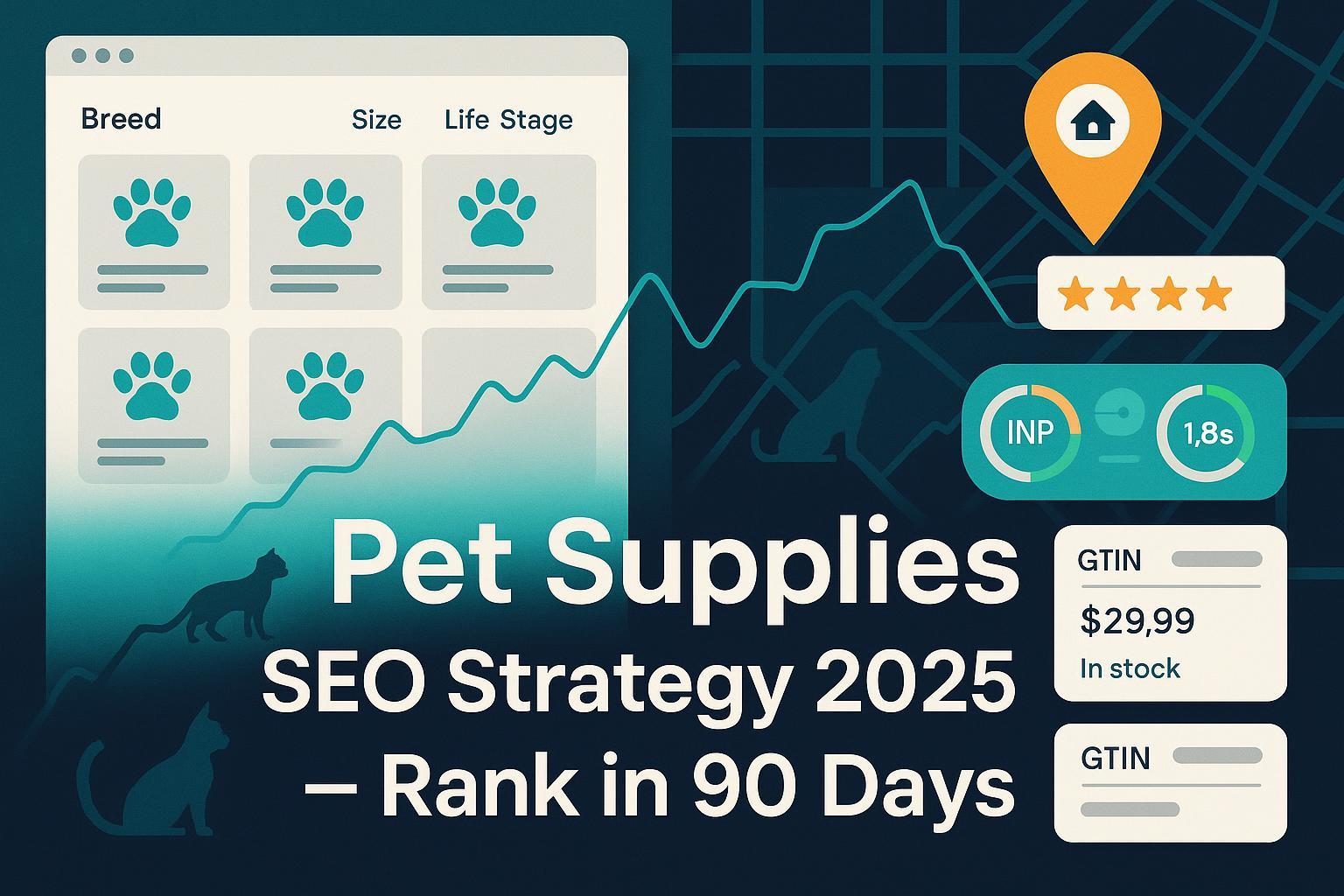
If you sell pet supplies online (and/or operate brick‑and‑mortar stores), this is your one‑stop, 90‑day SEO playbook. We’ll focus on what actually moves the needle fast for pet retailers in 2025: Core Web Vitals with an INP focus, revenue‑aligned category/PDP optimization, clean faceted navigation, structured data, Google Merchant Center Free Listings, internal linking and content hubs, and Local SEO that wins the pack.
Throughout, we align with Google’s 2024–2025 changes, including the March 2024 core update and new spam policies targeting scaled, unoriginal content (Google’s stated goal was reducing low‑quality results by roughly 45% in 2024, per the Google product blog March 2024 update and Google Search Central core update + spam policies guidance (2024)).
Quick promise: If you execute the sprints below, you’ll likely see measurable gains—richer results on categories/PDPs, Free Listings impressions, stronger local visibility, and faster, more converting pages—by Day 90.
Part I — Foundations: Site Architecture, Speed, and the 80/20 Audit
In practice, 80% of your 90‑day gains come from fixing what users and Google hit most: category and product templates, faceted navigation, and Core Web Vitals.
1) Information Architecture for Pet Stores
Recommended hierarchy:
- Species: Dogs, Cats, Small Pets, Birds, Fish, Reptiles
- Category: Food, Treats, Toys, Health, Grooming, Litter/Bedding, Accessories
- Subcategories and filters: Size (toy/small/large), breed, life stage (puppy/kitten/senior), health condition (sensitive stomach, allergies), ingredient preferences (grain‑free), chew strength, flavor
Rules of thumb:
- Each category page must answer the searcher’s core intent and highlight unique value (e.g., vet‑reviewed tips, brand comparisons, feeding guidelines, sizing charts).
- Filters that reflect real search demand (e.g., “grain‑free dog food for Huskies,” “senior small breed”) deserve special handling in faceted SEO (see Part III).
2) Performance First: INP (Interaction to Next Paint)
INP replaced FID as a Core Web Vital on Mar 12, 2024; aim for ≤200 ms to be “Good,” 201–500 ms “Needs improvement,” >500 ms “Poor,” per the web.dev INP launch explainer (2024). For diagnosis and remediation patterns, see web.dev INP guidance (2024–2025).
INP remediation checklist for image‑heavy category/PDP templates:
- Split long tasks, trim JavaScript, and keep event handlers lightweight. Audit and defer/async non‑critical work; remove unused vendors.
- Implement script budgeting: chat, A/B testing, reviews, and analytics should load on interaction or after idle when possible.
- Use server‑side rendering/ISR where applicable; reduce hydration work; keep DOM lean.
- Add resource hints: fetchpriority="high" on the LCP image; preload critical CSS/fonts judiciously.
- Prefetch/prerender likely next pages (from category → PDP) to accelerate product‑click responsiveness.
Measuring INP: rely on field data (CrUX, Search Console CWV, PageSpeed Insights field) and use Lighthouse/Web Vitals extension for lab diagnostics, as detailed in the web.dev INP resources (2024).
3) The 80/20 SEO Audit (Days 1–7)
Prioritize what users hit most and what Google relies on:
- Top 20 categories by revenue/traffic and top 50 PDPs.
- Faceted URL explosion risks.
- Structured data completeness on category/PDP templates (Product, Offer, Review/AggregateRating, Breadcrumb, Organization/LocalBusiness).
- Image optimization and alt text quality.
- Google Merchant Center feed eligibility and error diagnostics.
Quick wins summary:
- Reduce/defang heavy third‑party scripts.
- Fix obvious CWV regressions; add priority hints for hero images.
- Ensure every PDP has accurate price/availability and valid Product structured data.
- Confirm breadcrumb structure and schema.
Part II — Pages That Sell: Category and Product Pages
4) Category Pages: Intent + Conversion Blocks
What to include:
- H1 with core entity + modifier (e.g., “Grain‑Free Dog Food for Large Breeds”).
- Short buying guide above the fold: what matters (protein %, kibble size for large breeds, transition tips), with internal links to subcategories/spokes.
- Comparison blocks (brand, price per lb, ingredient highlights) and “Best for” callouts.
- FAQ answering real questions (safe to add FAQ schema when the content matches the page Q&As).
Copy notes:
- Use pet‑specific terms: life stage, breed size, chew strength, allergen avoidance, prescription disclaimers.
- Include internal links to content hubs (e.g., “Large Breed Puppy Nutrition Guide”).
Schema: Ensure Breadcrumb and consider placing Product snippets for featured items only if they’re actually present and visible.
5) PDPs: Make Every Product Page Original
Avoid manufacturer duplication. Add:
- “Why we recommend” paragraph (experience/EEAT), sizing/feeding calculators, care/transition tips, comparison to similar items, and UGC (photo/video reviews).
- Image sets with alt text that includes species/breed/size descriptors.
- Clear shipping/returns and local availability messaging.
Must‑have structured data based on 2024–2025 guidance:
- Product with nested Offer (price, priceCurrency, availability), brand, sku/mpn, and reviews, per Google Product structured data docs (2025) and Merchant listings structured data reference (2025).
- AggregateRating/Review must reflect real, visible reviews, per Google Review snippet policy (2024).
Image SEO essentials derive from the Google Images best practices (ongoing, referenced 2024–2025): descriptive alt text, responsive images via srcset/sizes, lazy‑load noncritical images, and next‑gen formats via
Quick wins summary:
- Rewrite top 50 PDPs with unique, experience‑rich copy.
- Add comparison and “best for” callouts; link to related categories.
- Validate Product/Offer/Review schema.
Part III — Smart Discovery: Facets, Pagination, Internal Links, and Shopping Free Listings
6) Faceted Navigation: Control Indexation, Preserve Value
Principles for 2025:
- Canonicalize back to the primary category URL when a filtered page doesn’t represent unique search value.
- Use meta robots noindex, follow for crawled but non‑indexable combinations; don’t block these in robots.txt if you rely on meta robots, as Google must crawl to see the tag, per Google robots meta tag guidance (2024).
- Disallow crawl for purely low‑value parameters (sort=, view=, session IDs) in robots.txt to conserve crawl budget.
- Allow indexation on high‑demand filters (e.g., “grain‑free dog food for Huskies”) and add unique content where appropriate.
Pagination: Since 2019 Google doesn’t use rel=prev/next; ensure clean pagination URLs (e.g., ?page=2), self‑canonical to each paginated URL, and standard links for discoverability, per Google’s eCommerce pagination guidance (2024).
Copy‑paste examples:
- Canonical on a filtered URL:
<link rel="canonical" href="https://example.com/dogs/food/" /> - Meta robots noindex for a filter combo:
<meta name="robots" content="noindex, follow" /> - robots.txt rules for low‑value params:
User-agent: *
Disallow: /*?sort=
Disallow: /*?view=
Disallow: /*?session=
7) Internal Linking and Topical Authority
Create 2–3 content hubs tied directly to revenue categories (e.g., Large Breed Puppy Nutrition, Sensitive Stomach Cat Diets, Heavy Chewer Toys). Use hub‑and‑spoke linking where each spoke links back to the hub and across to related spokes. Reinforce with breadcrumbs and schema as described by Search Engine Land’s topical authority/structure primers (2024–2025) and Google’s Breadcrumb structured data docs (2025).
Anchor text: use descriptive, entity‑rich phrases (“best toys for heavy chewer pit bulls”) rather than generic “learn more.”
8) Google Merchant Center and Free Listings
Set up/optimize your product feed to qualify for free product listings in Search and the Shopping tab. Core attributes include id, title, description, link, image_link, price, availability, brand, and GTIN when assigned; map product_type and google_product_category correctly, per the Merchant Center product data specification (2025). Keep price/availability in sync with your PDP; scheduled fetches can run daily (or more frequently via API), per Google Merchant Center feed management guidance (2025).
Enrich with ratings via a compliant product reviews feed (unique review IDs), per the Merchant Center product ratings policy update (2024).
Quick wins summary:
- Map your top categories to Google taxonomy and your own product_type tree.
- Submit GTINs where assigned; use brand+mpn when GTIN missing.
- Resolve feed errors/warnings and confirm Free Listings impressions start appearing.
Part IV — Local Wins: GBP, Location Pages, and Reviews
If you have physical stores, Local SEO can move fast.
9) Google Business Profile (GBP) Optimization
Key drivers: pick the right primary category (e.g., Pet Store/Pet Supply Store) and add relevant secondary categories for grooming/training, maintain high‑quality photos, and build review velocity. Category choice remains one of the strongest local pack factors according to 2024 surveys summarized by BrightLocal on GBP categories and local factors (2024). Track per‑location performance with UTM‑tagged website/appointment links as recommended in GBP field optimization guides (2024–2025).
Populate Products/Services inside GBP and consider Local Inventory integrations (e.g., Pointy) to surface inventory.
10) Location Pages and Citations
Build a unique, content‑rich page per location:
- NAP, hours, service area, store photos, parking/pet‑friendly notes, and featured products.
- Embedded map, driving directions, and internal links to local‑relevant categories (e.g., “raw dog food in Austin”).
- LocalBusiness schema with address/geo/openingHours aligned with GBP, per Google Local Business structured data guidance (2025).
Ensure NAP consistency across directories. Sponsor local pet events (rescue fundraisers, adoption weekends) and request linked mentions from partner sites.
11) Reviews and UGC — Do It Right
Policies got stricter. The FTC’s final rule bans fake reviews and undisclosed incentives and prohibits review suppression as of Oct 2024; see the FTC press release and rule Q&A (2024). For search snippets, Google requires that Review/AggregateRating markup reflect real, visible reviews; see Google’s Review snippet documentation (2024).
Best practices:
- Request reviews consistently post‑purchase; disclose any incentives clearly; never gate or suppress.
- Display a representative set (positive and negative) with clear moderation policies.
- Encourage photo/video reviews; they increase conversion and can enrich PDP content.
Quick wins summary:
- Audit GBP categories, photos, and UTMs.
- Launch a compliant, steady review program.
- Build 1–2 local sponsorships/partnerships with linked mentions.
Part V — Authority & Content: Hubs That Survive Updates and AI Overviews
Google’s 2024–2025 updates reinforced “people‑first” content and spam policy enforcement. If you publish thin, generic, scaled content, expect volatility, as noted in the Google Search Central core update + spam policies explainer (2024).
AI Overviews expanded broadly in 2025; they’re more prevalent on complex informational queries than on transactional ones, per the Google AI Overviews expansion update (2025). Independent studies in 2024–2025 showed mixed but often negative impacts on organic clicks where AIO appears on informational SERPs; methodologies vary, but double‑digit CTR dips were observed in some cohorts, as summarized by Search Engine Land’s AIO impact reporting (2025) and the Semrush AIO study overview (2025).
How to win anyway:
- Build hubs that include unique assets that AIO can’t easily compress: calculators (feeding/sizing), vet‑reviewed checklists, side‑by‑side brand/ingredient tables, first‑party data (best‑sellers by breed/size), and local availability.
- Demonstrate E‑E‑A‑T: expert authorship, vet‑reviewed annotations for health/nutrition, and accurate citations aligned with Google’s helpful content guidance (2024–2025).
- Interlink hubs ↔ categories ↔ PDPs to pass relevance and help users navigate.
Hub ideas:
- Large Breed Puppy Nutrition (calorie needs, kibble size, transition plan; link to Puppy Food > Large Breed)
- Sensitive Stomach Cat Diets (ingredients to avoid, gradual transitions; link to Cat > Food > Sensitive Stomach)
- Heavy Chewer Toys (materials, sizing, safety testing; link to Dog Toys > Heavy Chewer)
Quick wins summary:
- Publish 2–3 hubs with 3–6 spokes each; embed calculators and comparison tables.
- Add expert/vet review notes where medical advice appears.
Part VI — The 90‑Day Roadmap (Week‑by‑Week)
This is designed for small teams. Swap order only if dependencies demand it.
Weeks 1–2: Audit, Prioritize, and Stabilize
- Technical & CWV
- Run PSI/GSC CWV; identify Category/PDP template issues (INP/LCP/CLS). Add priority hints and trim blocking CSS/JS.
- Defer/async or remove heavy third‑party scripts; establish a script budget and load‑on‑interaction policy.
- IA & Facets
- Map core categories; list high‑value filters; define canonical/noindex/robots rules.
- Implement breadcrumb navigation and schema.
- Schema baseline
- Ensure Product/Offer/Review/Breadcrumb are present on PDPs; Organization site‑wide.
- GMC setup
- Validate feed basics (id, title, link, image_link, price, availability, brand, GTIN) and taxonomy mapping. Fix errors.
- Local (if applicable)
- Audit GBP categories, NAP, photos; add UTMs; outline review program.
Milestones/KPIs:
- INP median improves on templates; initial Free Listings impressions; Product rich results appearing; GBP fully populated.
Weeks 3–4: Category + PDP Rebuild (Top SKUs)
- Rewrite top 10 categories and top 25 PDPs with unique, intent‑matched copy.
- Add comparison blocks, “best for,” and sizing/feeding guidance.
- Implement FAQ where appropriate; validate schema with Rich Results Test.
- Image SEO: responsive srcset/sizes, AVIF/WebP via
, descriptive alt.
Milestones/KPIs:
- Increased CTR and rich result coverage on targeted pages; early ranking improvements for long‑tails (e.g., breed/life stage modifiers).
Weeks 5–6: Faceted SEO + Internal Linking + Pagination
- Deploy canonical/noindex/robots patterns to control crawl.
- Decide which filtered pages to index (search‑demand‑backed) and add unique content blocks to them.
- Build internal linking from hubs/spokes to categories/PDPs; refine breadcrumbs.
- Fix pagination patterns per Google’s eCommerce guidance.
Milestones/KPIs:
- Crawl stats stabilize (fewer parameter URLs in index); improved discovery of key categories; faster navigation.
Weeks 7–8: Content Hubs That Convert
- Publish 2 hubs with 3–4 spokes each; include calculators/tables and expert notes.
- Interlink to categories and PDPs; add newsletter hooks or buyer’s guides.
- Start light digital PR: pitch rescue/vet partners for expert quotes and links.
Milestones/KPIs:
- Hub traffic and internal link CTR; first new referring domains from pet/vet/shelter sites.
Weeks 9–10: Merchant Center + Reviews Engine
- Expand feed attributes: product_type depth, additional_images, item_group_id for variants; confirm price/inventory freshness cadence.
- Implement product ratings feed if eligible; ensure unique review IDs.
- Launch review acquisition with clear disclosures compliant with the FTC’s 2024 rule.
Milestones/KPIs:
- Rising Free Listings impressions/clicks; growing review velocity and coverage on PDPs.
Weeks 11–12: Local Authority + Final Polish
- Build or enhance location pages; add LocalBusiness schema and local links to relevant categories.
- Sponsor or co‑host a local pet event (adoption weekend); secure linked mentions.
- Final CWV pass for INP; re‑audit scripts; verify that rich results (Product/Review/Breadcrumb) trigger consistently.
- Prepare Q4 content calendar for hub expansions.
Milestones/KPIs:
- Improved local pack rankings/GBP actions; template‑level INP ≤200 ms on the majority of field visits; revenue lift from targeted categories.
Measurement: What to Track Weekly
- Technical: INP/LCP/CLS by template; crawl stats and index coverage. Use CrUX/PSI field and GSC CWV.
- Visibility: Impressions/clicks/CTR/avg position for targeted categories and PDPs; rich result share.
- GMC: Diagnostics errors/warnings; Free Listings impressions/clicks; ratings coverage.
- Local: GBP views, calls, direction requests; review count and average rating.
- Content/Authority: Hub traffic, internal link CTR; backlinks/referring domains from pet/vet/shelter.
- Commercial: Organic revenue and conversion rate; AOV by focus categories; revenue attributable to Free Listings.
Set dashboards in GA4/GSC and Merchant Center. For walkthroughs, see Search Engine Land’s GA4 guides (2024–2025) and review GSC Enhancements for Product/Review/Breadcrumb. Monitor GBP Insights with UTM tagging and a local rank tracker; BrightLocal’s learning hub has practical checklists in its Local SEO management resources (2024–2025).
Implementation Appendices
A) Schema Essentials (Copy‑Ready)
Product + Offer (minimum skeleton):
{
  "@context": "https://schema.org",
  "@type": "Product",
  "name": "Grain‑Free Large Breed Puppy Food – Chicken",
  "image": [
    "https://example.com/images/puppy-food-front.jpg",
    "https://example.com/images/puppy-food-back.jpg"
  ],
  "description": "High‑protein, grain‑free dry food designed for large breed puppies; kibble size supports slower eating.",
  "sku": "LBP‑CH‑24LB",
  "brand": {"@type": "Brand", "name": "Pawsitive"},
  "offers": {
    "@type": "Offer",
    "price": "69.99",
    "priceCurrency": "USD",
    "availability": "https://schema.org/InStock",
    "url": "https://example.com/dogs/food/large-breed-puppy/grain-free-chicken-24lb",
    "itemCondition": "https://schema.org/NewCondition"
  },
  "aggregateRating": {
    "@type": "AggregateRating",
    "ratingValue": "4.7",
    "reviewCount": "183"
  }
}
Reference the Product structured data documentation (2025) for full options and variant handling.
Breadcrumb:
{
  "@context": "https://schema.org",
  "@type": "BreadcrumbList",
  "itemListElement": [
    {"@type": "ListItem", "position": 1, "name": "Dogs", "item": "https://example.com/dogs/"},
    {"@type": "ListItem", "position": 2, "name": "Food", "item": "https://example.com/dogs/food/"},
    {"@type": "ListItem", "position": 3, "name": "Large Breed Puppy", "item": "https://example.com/dogs/food/large-breed-puppy/"}
  ]
}
See Google Breadcrumb structured data (2025).
LocalBusiness (store location):
{
  "@context": "https://schema.org",
  "@type": "PetStore",
  "name": "Paws & Co. – Austin",
  "image": "https://example.com/austin-storefront.jpg",
  "telephone": "+1-512-555-0199",
  "address": {
    "@type": "PostalAddress",
    "streetAddress": "123 Barton Springs Rd",
    "addressLocality": "Austin",
    "addressRegion": "TX",
    "postalCode": "78704",
    "addressCountry": "US"
  },
  "geo": {"@type": "GeoCoordinates", "latitude": 30.260, "longitude": -97.748},
  "openingHours": "Mo-Sa 10:00-19:00, Su 11:00-17:00",
  "url": "https://example.com/locations/austin/"
}
Follow Google Local Business structured data (2025).
B) Faceted Navigation Patterns
- Index when: filter aligns to distinct search demand and you can add unique content (e.g., breed‑specific grain‑free lines) and internal links.
- Otherwise: canonicalize to base category and/or use meta robots noindex, follow; restrict low‑value params in robots.txt.
- Pagination: use unique URLs with self‑canonicals; don’t rely on prev/next, per Google’s pagination guidance (2024).
C) INP Script Budgeting Playbook
- Inventory every script (size, timing, purpose). Remove what you can.
- Convert blocking scripts to async/defer; load optional features on interaction.
- Replace heavy widgets (e.g., review carousels) with lighter, server‑rendered versions.
- Monitor field INP in GSC/CrUX; set thresholds and regressions alerts. See web.dev INP guidance (2024–2025).
D) Google Merchant Center Feed Checklist
- Identifiers: id, brand, GTIN (when assigned), mpn if no GTIN.
- Content: title with species/breed/life stage/size; description with key ingredients/benefits.
- Taxonomy: product_type (your hierarchy) + google_product_category mapped precisely, per the Merchant Center product data spec (2025).
- Freshness: ensure price/availability match PDP; schedule frequent fetches or push updates via API, per feed management guidance (2025).
- Ratings: comply with review feed rules (unique IDs), per the product ratings policy (2024).
E) Image SEO and Performance
- Use srcset/sizes and modern formats; lazy‑load noncritical images.
- Provide descriptive alt text that names species/breed/size/variant when relevant.
- Include multiple aspect ratios in Product.image arrays.
- Follow Google Images best practices (2024–2025).
Common Pitfalls (and How to Avoid Them)
- Facet bloat: thousands of crawlable URLs for trivial filter combos. Fix with canonical/noindex/robots discipline.
- Thin AI text: scaled, unoriginal content risks suppression under the 2024–2025 policies; prioritize experience‑backed copy, per Google’s helpful content guidance (2024–2025).
- JS overload: third‑party scripts silently torpedo INP; enforce budgeting and load‑on‑interaction.
- Missing GTINs: hurts Shopping eligibility/matching; collect and submit per the Merchant Center spec (2025).
- Review noncompliance: undisclosed incentives or self‑serving snippets can trigger issues; align to the FTC’s 2024 rule and Google’s review snippet policies.
Final Notes and Next Steps
- Keep your content “people‑first” and experience‑rich; cite sources and add expert/vet review where medical guidance appears.
- Double down on mid‑ and long‑tail modifiers (breed, life stage, condition, chew strength) where AI Overviews are less dominant and specificity wins.
- Treat your feed and Free Listings as an organic discovery engine alongside classic SEO.
By Day 90, you should see: faster, more responsive templates; clean indexation patterns; richer results on high‑value pages; Free Listings traffic; stronger GBP visibility; and content hubs that earn links and guide buyers to the right products. Maintain the cadence, expand hubs, and iterate on INP/script budgets to keep your edge.
