The Definitive Keyword Map for Pet Supplies: From TOFU to BOFU (2025)

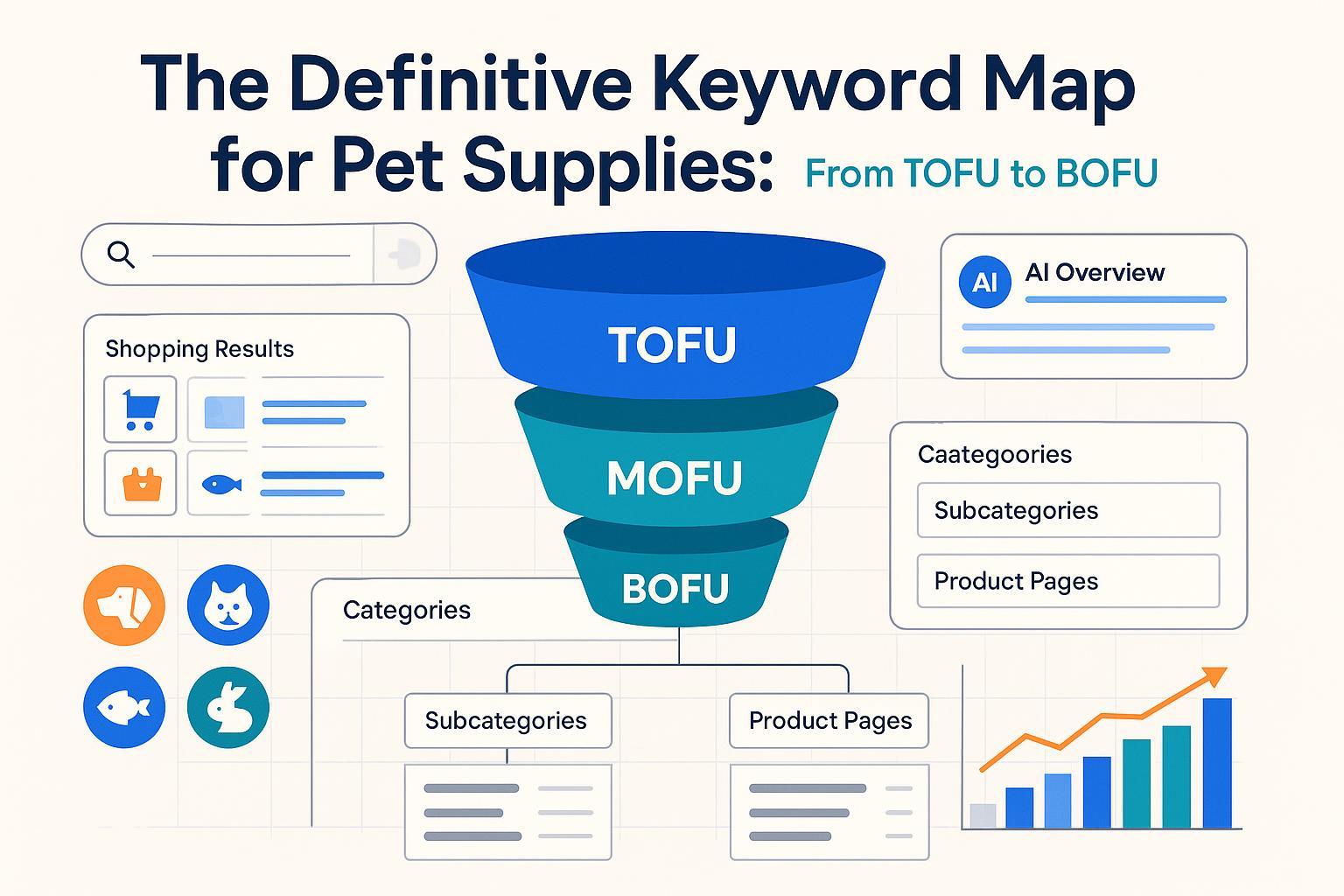
If you run an online pet store or manage SEO for a pet brand, you’ve probably felt it: search is changing fast. AI Overviews now appear on a growing share of queries, zero‑click searches are common, and product results demand clean feeds plus robust on‑page structured data. You need a plan that maps your keywords to your customer journey and your site architecture—so every page has a clear job, and nothing cannibalizes anything else.
This is that plan. Below you’ll find a complete, 2025‑ready keyword mapping framework tailored to pet supplies, with real examples, templates, and checklists you can put to work immediately.
Part I — Foundations: Funnel + Intent for Pet Supplies
Before you open a keyword tool, align on two things: your funnel and your intent taxonomy. They’ll guide every mapping decision.
- TOFU (Top of Funnel) — Awareness and education. Users want answers or inspiration, not yet a product. Example: “how much to feed a puppy,” “cat won’t use litter box,” “are lick mats safe for dogs.”
- MOFU (Middle of Funnel) — Commercial investigation. Users are comparing options, features, brands, and formats. Example: “best puppy food for sensitive stomach,” “covered vs open litter box,” “air‑dried vs freeze‑dried dog food.”
- BOFU (Bottom of Funnel) — Transactional. Users are ready to buy. Example: “buy Purina Pro Plan puppy chicken 18 lb,” “order automatic self‑cleaning litter box,” “GPS dog collar with subscription deals.”
Map these to classic intents:
- Informational (mostly TOFU)
- Commercial investigation (mostly MOFU)
- Transactional (mostly BOFU)
- Navigational (brand/store searches—often BOFU)
- Local (store visits, grooming, vet‑adjacent accessories)
Why this matters in 2025: AI Overviews give quick answers for many informational queries. Google states AI Overviews are intended to connect people to the open web with prominent links and rely on the same helpfulness and quality systems you already optimize for, not a new set of “SGE tricks” (see the May 2024 and 2025 announcements in Google’s Search and I/O blogs). For strategy, that means you must provide concise, accurate answers on-page and then offer depth (comparisons, calculators, testing) to win the click from the overview and SERP features, per Google’s guidance on connecting users to the web in AI Overviews in 2024–2025: Google’s “new ways to connect to the web with AI Overviews” (2024) and I/O 2025 announcements.
It’s also a zero‑click world: a 2024 clickstream study found roughly 58.5% of U.S. Google searches end without a click (SparkToro + Datos, 2024). Your keyword map must prioritize SERP features you can win (snippets, Shopping/merchant listings, images, videos) and give users compelling reasons to click.
Pet industry lens: Spending remains resilient, with APPA’s 2025 releases underscoring steady demand across food, supplies, and services; while many detailed figures are member‑only, the association highlights durable post‑pandemic pet care spend patterns in its public updates. See APPA’s 2025 State of the Industry release for context.
Part II — From Research to Clusters: A Pet‑Specific Workflow
- Build seed lists by taxonomy
- Species: Dogs, Cats, Fish/Aquatics, Small Pets (rabbits, hamsters, guinea pigs), Birds, Reptiles.
- Need states: Nutrition, Hygiene/Grooming, Health/Safety, Enrichment/Toys, Training/Behavior, Travel.
- Life stages and conditions: Puppy/Kitten, Senior, Sensitive stomach, Allergies, Weight management, Hairball control, Anxiety.
- Product categories and attributes: Dry food, Wet food, Freeze‑dried, Air‑dried, Grain‑free, Novel protein, Clumping litter, Automatic litter box, Hypoallergenic shampoo, GPS collar, Invisible fence, Lick mat, Slow feeder, Car seat harness.
- Expand with multiple inputs
- Keyword platforms (e.g., Google Keyword Planner, Ahrefs, Semrush) to get volumes, variants, and questions.
- SERP mining: scrape People Also Ask, “Related searches,” and top‑ranking page H2/H3 patterns.
- Community signals: Reddit (r/dogs, r/cats), Quora, and TikTok for intent language (e.g., “itchy pup diet,” “litter robot troubleshooting”).
- Merchant data: your site search logs, Merchant Center search terms, and CRM queries.
- Cluster by parent topic + intent
- Example cluster: “Puppy feeding.”
- TOFU: “how much to feed a puppy,” “puppy feeding schedule,” “puppy growth chart food.”
- MOFU: “best puppy food for large breeds,” “puppy food for sensitive stomach,” “wet vs dry puppy food.”
- BOFU: “buy Purina Pro Plan puppy chicken 18 lb,” “Royal Canin large breed puppy dry price,” “subscribe puppy food delivery.”
- De‑duplicate and disambiguate
- Split “raw dog food” vs “freeze‑dried” vs “air‑dried” into separate clusters; users expect different formats, benefits, and price points.
- Separate “automatic litter box” (device) from “clumping litter” (consumable). They’re different page types.
- Prioritize with 80/20 thinking
- Focus first on categories that drive margin and repeat purchase (e.g., dog food, cat litter, flea/tick). Align with seasonality: flea/tick demand spikes in warm months, but vets increasingly recommend year‑round prevention given climate and indoor survival—see veterinary advice highlighting year‑round prevention importance (Green Dog Dental, 2023).
Part III — Map Clusters to Site Architecture (and Prevent Cannibalization)
Your keyword map must plug directly into your site’s structure. Think “one primary keyword (or tightly synonymous set) per URL.”
- Page types and their jobs
- Category page (collection): Rank for broad, high‑value commercial head terms. Example: “dog food,” “cat litter,” “dog shampoo.”
- Subcategory page: Target format/attribute collections. Example: “freeze‑dried dog food,” “automatic litter boxes,” “hypoallergenic dog shampoo.”
- Product detail page (PDP): Rank for exact product names, model numbers, sizes, and strong long‑tail modifiers (e.g., “18 lb,” “unscented,” “grain‑free turkey”).
- Buying guide (blog hub): Capture TOFU/MOFU, answer questions, and link to relevant categories/PDPs. Example: “How much to feed a puppy (calculator + charts).”
- Comparison page: “X vs Y,” “best [category] for [use case],” and “brand A vs brand B.”
- Local store page: If you have retail locations, target “[product] near me,” store hours, services, and inventory context.
- Internal linking blueprint
- Hub → Spoke: Buying guide links to subcategories and top PDPs; subcategories link back to the hub and to related comparisons.
- Category ↔ Guide: Category pages feature a “Learn” module linking to guides (e.g., “Puppy feeding guide”).
- PDP ↔ FAQs/Guides: PDPs link to relevant guides (“Puppy feeding amounts”) and comparison pages.
- Breadcrumbs: Species > Category > Subcategory > Product. Use structured data for breadcrumbs.
- Faceted navigation rules
- Avoid index bloat. For parameterized filters that add little unique value, prevent crawling and consolidate signals using canonicals back to the base collection. See Google’s guidance on managing faceted navigation crawling (2024). When a filter combination represents real user demand (e.g., “large breed grain‑free puppy food”), consider a dedicated subcategory landing with unique content and internal links.
- Canonical and title/H1 uniqueness
- Each URL gets a unique primary keyword, title, and H1. Related variants live as secondary keywords within the same page or as on‑page sections, not separate URLs.
- Merchant listings and feeds
- Maximize coverage by pairing clean on‑page Product structured data with Merchant Center feeds so you qualify for organic merchant listings in Search and the Shopping tab, per Google’s merchant listings documentation.
Part IV — On‑Page & SERP Feature Optimization for 2025
- Product and Merchant structured data
- Implement Product schema with required/recommended properties to unlock product snippets and richer merchant listings: name, image, description, identifiers (SKU/GTIN/MPN), offers (price, availability), brand, aggregateRating, review, and additionalProperty for key specs. See Google’s Product structured data guide and product snippet details.
- Include shipping/returns details via ShippingDetails and MerchantReturnPolicy so searchers see costs and return terms right on the SERP, per Google’s merchant listing structured data.
- For variants (size/flavor/scent), use Schema.org ProductGroup with hasVariant and variesBy so Google better aggregates variants—see Google’s product variants guidance (2024).
- Reviews and first‑hand content
- Google’s Reviews system (integrated into core) rewards original, evidence‑rich reviews with photos/videos, hands‑on testing, pros/cons, and comparisons. Align PDPs and buying guides to those quality signals; see Google’s Reviews system documentation (updated 2024–2025).
- AI Overviews readiness
- Provide concise answers in scannable sections with citations to authoritative sources where health/safety claims arise.
- Add unique value beyond the snippet: side‑by‑side comparisons, calculators (e.g., puppy feeding), downloadable checklists, and first‑hand test results.
- Google emphasizes that AI Overviews rely on existing quality systems and include prominent web links. Align with Search Essentials and helpful content guidance; see Google’s helpful content guidelines and the 2024 blog on linking to the web within AI Overviews.
- Core Web Vitals: INP in focus
- As of March 2024, Interaction to Next Paint (INP) replaced FID as a Core Web Vital; aim for INP < 200 ms for “Good.” This matters for ecommerce interactions like filtering and add‑to‑cart. See the Web.dev overview on INP’s launch and thresholds (2024).
- FAQ/HowTo rich results in 2025
- FAQ rich results are mostly limited to authoritative health/government sites since 2023. Still include on‑page FAQs for users and PAA capture, but don’t expect FAQ rich results on most commerce domains. See Google’s FAQPage structured data documentation.
- HowTo rich results were deprecated and removed in 2025; plan content for users, not the (now retired) markup. See Google’s 2025 update on simplifying search results.
- Local and voice search
- If you have stores or services, optimize your Google Business Profile with accurate categories, hours, photos, and reviews—Google cites relevance, distance, and prominence as the core ranking factors. See Google’s Improve your local ranking help doc. Add conversational FAQs on store pages to align with voice queries.
Part V — Example Keyword Maps (Pet‑Specific)
Below are compact, end‑to‑end examples you can adapt.
- Dogs > Food (Life stage: Puppy)
- TOFU (Informational):
- how much to feed a puppy
- puppy feeding schedule by age
- puppy growth chart food amounts
- MOFU (Commercial investigation):
- best puppy food for sensitive stomach
- large breed puppy food recommendations
- wet vs dry puppy food
- BOFU (Transactional):
- buy Purina Pro Plan puppy chicken 18 lb
- Royal Canin large breed puppy dry price
- subscribe puppy food delivery
- Mapping:
- Hub guide: “How Much to Feed a Puppy (Calculator + Vet‑Vetted Charts)” → answers, calculator, links to subcategories and PDPs.
- Category: Dogs > Food > Puppy Food → targets “puppy food” and “best puppy food” variants.
- Subcategory: “Sensitive Stomach Puppy Food” → curated selection + comparison table.
- Comparison: “Wet vs Dry Puppy Food: Cost, Digestibility, and Cleanup.”
- PDPs: Brand + size modifiers with rich specs, feeding guidance, UGC photos, and FAQs.
- Cats > Litter (Device vs Consumable)
- TOFU:
- why does my cat avoid litter box
- how often to change cat litter
- litter robot pros and cons (hybrid intent)
- MOFU:
- covered vs open litter box
- best litter for multi‑cat households
- automatic self‑cleaning litter box comparison
- BOFU:
- order automatic self‑cleaning litter box
- clumping unscented cat litter 40 lb price
- litter mat large waterproof
- Mapping:
- Hub guide: “Stop Litter Box Avoidance: Causes, Fixes, and Product Checklist.”
- Category: Cats > Litter (consumables) vs Cats > Litter Boxes (devices) = separate collections.
- Subcategories: “Automatic Litter Boxes,” “Unscented Clumping Litter,” “Multi‑Cat Litter.”
- Comparison page: “Covered vs Open Litter Boxes.”
- PDPs: Include video demos and odor/dust control tests; emphasize shipping weight and bundle deals.
- Grooming (Skin/Sensitivity)
- TOFU:
- how often to bathe a dog
- dog itchy skin remedies at home
- MOFU:
- hypoallergenic dog shampoo for sensitive skin
- oatmeal vs medicated dog shampoo
- BOFU:
- buy oatmeal dog shampoo 16 oz
- chlorhexidine dog shampoo gallon
- Mapping:
- Hub guide: “Dog Bathing Frequency + Itchy Skin Playbook.”
- Subcategory: “Hypoallergenic Dog Shampoo” + filters by scent‑free, soap‑free, veterinary‑grade.
- Comparison page: “Oatmeal vs Medicated Dog Shampoo.”
- PDPs: Patch‑test instructions, ingredient lists, vet quotes where appropriate, and review prompts for specific conditions.
- Smart Safety (Wearables)
- TOFU:
- are GPS dog collars worth it
- how do invisible dog fences work
- MOFU:
- best GPS dog collar with subscription
- GPS collar vs AirTag for dogs
- BOFU:
- buy GPS dog collar waterproof
- invisible fence kit for 1 acre price
- Mapping:
- Hub guide: “Choosing a GPS Dog Collar: Range, Battery, and Subscription Costs.”
- Subcategory: “GPS Collars & Fences” with filters for range, battery, waterproof rating.
- Comparison: “GPS Collar vs AirTag for Dogs.”
- PDPs: Field‑test videos, map screenshots, subscription breakdowns, and returns policy clarity.
- Local Example (If you have stores)
- TOFU: “dog nail trim at home vs groomer,” “how often to groom a doodle.”
- MOFU: “best dog groomer for anxious dogs [city],” “walk‑in nail trim near me.”
- BOFU: “book dog grooming appointment [store name],” “[store] same‑day nail trim price.”
- Mapping:
- Location pages for each store with services, pricing, staff bios, photos, and online booking.
- Blog content addressing anxiety‑friendly grooming and seasonal shedding.
- Internal links from category pages (brushes, de‑shedding tools) to store services.
Part VI — Execution Playbook (Templates, Rules, and Cadence)
- Keyword mapping spreadsheet (core columns)
- Cluster (Parent Topic)
- Funnel Stage (TOFU/MOFU/BOFU)
- Intent (Info/Commercial/Transactional/Local)
- Primary Keyword (one per URL)
- Secondary Keywords (tight variants/questions)
- Page Type (Category/Subcategory/PDP/Guide/Comparison/Location)
- Target URL (existing or planned)
- Status (Planned/In Draft/Published/Refresh)
- Owner (Assignee)
- Schema (Product, BreadcrumbList, Article, Video, Review)
- Notes (Seasonality, internal links, unique value)
- Governance to prevent cannibalization
- Golden rule: one primary keyword per URL. If two pages compete, consolidate via 301 or canonical.
- Canonicals: Use rel=canonical from filtered/faceted URLs that don’t deserve their own indexable page back to the parent collection. Follow Google’s advice on helping Google understand ecommerce site structure (2024) and its guide to faceted navigation.
- Breadcrumbs and sitemaps: keep your hierarchy crawlable and logical.
- Internal linking rules of thumb
- Every guide includes: top 2 related subcategories, top 3 PDPs, and 1 comparison page.
- Each subcategory links up to the parent category, sideways to siblings (where helpful), and down to hero PDPs.
- PDPs link to care/how‑to content and comparisons answering common objections.
- On‑page anatomy by page type
- Category/Subcategory:
- H1 = parent topic (unique modifiers for subcategories: “Freeze‑Dried Dog Food”).
- Intro explaining benefits and how to choose (50–120 words) + quick filters.
- Featured products with consistent cards (rating, price, shipping/returns snippet).
- FAQ block targeting PAAs (even without FAQ rich results).
- Schema: BreadcrumbList + ItemList (where appropriate) + internal links to guides.
- PDP:
- Above‑the‑fold essentials: images/video, price, shipping/returns, size/flavor picker, availability.
- Detailed specs (structured as additionalProperty), brand story, care instructions.
- Reviews with evidence (photos/video), Q&A, comparisons.
- Schema: Product with offers, aggregateRating/review, variant data; ShippingDetails and MerchantReturnPolicy for SERP visibility—see Google’s merchant listing structured data.
- Guides/Comparisons:
- Clear TL;DR answer block (for snippets/Overviews) with vetted stats/citations.
- Visuals: tables, calculators, and checklists.
- Schema: Article/How‑to visuals (but note HowTo rich results are deprecated in 2025).
- Performance and UX standards
- Target INP < 200 ms and keep image payloads efficient (WebP/AVIF, responsive srcset). This aligns with Web.dev’s INP Core Web Vital thresholds.
- Make filters fast and accessible; test add‑to‑cart under mobile data throttling.
- Cadence and refresh strategy
- Quarterly: re‑pull SERPs, PAAs, and competitor pages for top 10 revenue clusters.
- Monthly: add internal links from new guides to categories/PDPs; review top 20 PDPs for review freshness.
- Seasonal: pre‑build flea/tick, shedding, and holiday gift hub content 6–8 weeks ahead. Veterinary sources increasingly recommend year‑round flea/tick prevention due to climate and indoor risks—see the clinical perspective on year‑round prevention (True Animal Vet, 2023).
- Measurement & KPIs by funnel stage
- TOFU: impressions, featured snippet/PAA ownership, scroll depth, newsletter signups.
- MOFU: rankings of comparison pages, clicks to subcategories/PDPs, product view rate.
- BOFU: add‑to‑cart, checkout starts, revenue, merchant listing visibility.
- AI Overviews: track whether your guides are cited/linked, and monitor CTR deltas for queries with/without Overviews. Note broader zero‑click context from the SparkToro + Datos 2024 study.
- Proof that mapping works
- A documented ecommerce keyword mapping case study (F&B vertical) showed CTR rising from 17.1% to 22.1% and a 620% QoQ performance increase after focusing 1–3 high‑intent keywords per page across collections/PDPs—method transferable to pet supplies; see the Backlinko ecommerce keyword research case (2023, Nicola Hughes/TAL Agency).
Part VII — Ready‑to‑Use Assets
Use these checklists and templates directly in your workflow.
- Keyword Mapping Checklist
- Define species, need states, life stages, and product categories.
- Build seed list; expand via keyword platforms, SERP PAAs/related searches, and community language.
- Cluster by parent topic + intent; separate formats/attributes clearly.
- Assign one primary keyword per URL; designate secondary questions/variants.
- Choose page type (category, subcategory, PDP, guide, comparison, location).
- Add internal link targets (hub ↔ spoke; category ↔ guide; PDP ↔ FAQ/comparison).
- Set schema plan (Product, BreadcrumbList, Article, Review, Video).
- Note seasonality and emerging trends per cluster.
- Prioritize top 10 revenue clusters for immediate execution.
- PDP Review Content Checklist (aligned to Reviews system)
- First‑hand photos/videos of the product in use (e.g., litter dust test, shampoo lather/rinse test).
- Specific pros/cons and use‑case fit (e.g., “multi‑cat odor control,” “short‑haired breeds”).
- Comparative statements with evidence (vs previous model/brand).
- Detailed specs and measurable tests (absorption grams, battery life hours, GPS range miles).
- Owner quotes (“Worked for our anxious doodle after 2 weeks”).
- Q&A addressing objections (allergens, scent, noise level, assembly time).
- Clear shipping/returns and warranty terms.
- AI Overview Readiness Checklist
- TL;DR answer block for each guide with precise definitions, steps, or dosage/amount tables (where medically appropriate, cite veterinary sources).
- Unique depth: side‑by‑side comparisons, calculators, annotated images.
- Structured data in HTML; indexable images/video with descriptive alt text.
- E‑E‑A‑T signals: author bios, expert review notes, citations to authoritative sources.
- Clear next steps and CTAs to deeper pages (subcategories, PDPs, tools).
- Monitor whether pages are being cited in AI Overviews and update with new data.
- Local SEO Checklist for Pet Retailers
- Google Business Profile: correct categories (e.g., “Pet Store,” “Pet Groomer”), hours, holiday hours, services, photos.
- Reviews: request, respond, and showcase particularly helpful reviews.
- Location pages: NAP consistency, embedded map, appointment link, staff bios, unique photos.
- On‑page FAQs tailored to “near me,” “open now,” “walk‑in,” “same‑day” phrases.
- Internal links from relevant categories (e.g., grooming tools → grooming services page).
- Align with Google’s local ranking pillars—relevance, distance, and prominence—as outlined in Improve your local ranking.
- CSV Template (copy into Google Sheets)
- Columns: Cluster | Funnel | Intent | Primary Keyword | Secondary Keywords | Page Type | Target URL | Status | Owner | Schema | Internal Links | Seasonality | Notes
- Example rows:
- Puppy Feeding | TOFU | Informational | how much to feed a puppy | puppy feeding schedule; puppy growth chart food | Guide | /dog/food/puppy-feeding-guide | Planned | Jenna | Article, BreadcrumbList | Link to /dog/food/puppy; top PDPs | Spring puppies; evergreen | Add calculator
- Sensitive Stomach Puppy Food | MOFU | Commercial | best puppy food for sensitive stomach | gentle puppy food; puppy food for diarrhea | Subcategory | /dog/food/puppy-sensitive-stomach | In Draft | Maya | BreadcrumbList, ItemList | Link to guide + top 3 PDPs | Evergreen | Vet quotes
- Purina Pro Plan Puppy 18 lb | BOFU | Transactional | buy Purina Pro Plan puppy chicken 18 lb | pro plan puppy 18 lb price; subscribe | PDP | /p/purina-pro-plan-puppy-chicken-18lb | Published | Luis | Product, MerchantReturnPolicy | Link to guide + subcategory | Evergreen | Bundle with treats
Frequently Asked Questions (Fast Answers You Can Reuse)
- Should I add the year to my guide titles in 2025? For time‑sensitive SEO topics (like SERP features/AI Overviews), adding the year can improve CTR and expectation‑setting; for evergreen concepts, skip the year.
- Are FAQ rich results worth pursuing? Most commerce sites won’t receive FAQ rich results in 2025 due to eligibility limits; still keep FAQs on page for users and PAA capture per Google’s FAQPage documentation.
- What Core Web Vitals matter most for ecommerce now? INP replaced FID in 2024; shoot for < 200 ms per Web.dev’s INP thresholds. Prioritize interaction speed on filters, add‑to‑cart, and checkout.
- How do I get in AI Overviews? There’s no special markup. Focus on helpful, accurate content, structured data, and unique value. Google’s 2024–2025 posts emphasize AI Overviews rely on core quality systems and include prominent links—see Google’s AI Overviews guidance.
- What’s the difference between product snippets and merchant listings? Product snippets are rich results from on‑page schema; merchant listings combine on‑page data and Merchant Center feeds for organic placements in Search/Shopping. See Google’s Product schema and merchant listings docs.
Final Action Plan (One‑Week Sprint)
Day 1
- Pull sales by category; pick top 10 revenue drivers.
- Create seed list and define clusters for each.
Day 2–3
- Expand keywords via tools + SERP mining; organize by TOFU/MOFU/BOFU.
- Map clusters to existing URLs; flag gaps for new pages.
Day 4
- Draft/refresh: 1 hub guide, 2 subcategories, 5 PDPs for your highest‑value cluster.
- Implement Product schema and MerchantReturnPolicy; verify in Rich Results Test.
Day 5
- Build internal links: guide ↔ subcategories ↔ PDPs; add breadcrumbs and FAQs.
- Optimize performance: image compression, lazy‑load, INP audits.
Day 6–7
- Publish and request indexing; build a simple Looker Studio dashboard for KPIs.
- Set calendar reminders for seasonal hubs (flea/tick, shedding, holidays).
Closing Thoughts
A great keyword map is more than a spreadsheet—it’s your content architecture, your product presentation, and your measurement plan, all aligned. In 2025, that alignment is the only way to compete in SERPs dominated by rich results and AI Overviews. Start with your top revenue categories, map TOFU→MOFU→BOFU with discipline, and give every page a singular purpose. The results compound.
References for further reading
- AI Overviews status and linking to the web: Google’s May 2024 AI Overviews update and 2025 I/O keynotes
- Helpful content and reviews quality: Google’s helpful content and Reviews system
- Core Web Vitals (INP): Web.dev INP launch
- Structured data for ecommerce: Product schema, Merchant listings, Product variants
- Zero‑click context: SparkToro + Datos zero‑click study (2024)
- Pet industry context: APPA 2025 State of the Industry release
- Faceted navigation/site structure: Google ecommerce site structure guidance and Faceted navigation crawling
- Case method: Backlinko ecommerce keyword research case
