Outsmart Local SEO Competition with Proven Strategies


You really can outrank your competition in local search. With the right local SEO strategies, your business stands out in your community and attracts more customers ready to buy. Local SEO Competition feels tough, but it gives you the chance to shine where it matters most—right in your neighborhood.
- Local SEO boosts your visibility on Google Maps and local packs, helping people find you fast.
- Positive reviews and a strong Google Business Profile make you the top choice for local searchers.
- Customers trust businesses with high ratings, and more visibility means more foot traffic and sales.
When you focus on local SEO, you put your business in front of high-intent customers and outrank your competition every time.
Local SEO Competition
What Is Local SEO?
Local SEO helps you connect with customers in your area. You use strategies that make your business show up when people search for products or services nearby. Local SEO means you focus on ranking well for searches that matter most to your community. You want your business to appear in Google Maps, the Local Pack, and other spots where local customers look for solutions.
Local SEO is different from traditional SEO. You target people in a specific city or neighborhood, not the whole country. You use location-based keywords, create content about local events, and build links from local directories. You also manage your Google Business Profile and make sure your business information is always correct. Here’s a quick look at how local SEO compares to traditional SEO:
| Aspect | Local SEO | Traditional SEO |
|---|---|---|
| Target Audience | Local customers | National/global audience |
| Content Focus | Local events, community news | Industry topics, broad guides |
| Keywords | City, “near me”, neighborhood terms | General keywords |
| Link Building | Local directories, community sites | High-authority industry sites |
Why Local SEO Competition Matters
Local SEO competition is fierce. You compete with other local businesses and even big national chains for the same customers. If you want to stand out, you need to understand what makes local SEO competition tough and why it matters for your business.
Many businesses invest in local SEO to get noticed. About 64% of small businesses have a local SEO presence, and 77% have in-house SEO staff. Still, 56% haven’t claimed their Google Business Profile, so there’s room for you to get ahead.
You face challenges like limited reach, budget constraints, and the need for consistent business info. Here are some common hurdles:
- Intense competition for top spots in local search results
- Inconsistent NAP (Name, Address, Phone) details across directories
- Fewer reviews and backlinks than bigger competitors
- Pressure to show quick results, even though local SEO takes time
- Difficulty tracking ROI and measuring success
Local SEO competition drives business growth. When you rank higher, you get more website visits, foot traffic, and sales. Most local searches lead to visits within a day, and many turn into real customers. If you ignore local SEO, you risk losing business to competitors who do it better. Staying visible and trusted in your community helps you build lasting relationships and keeps your business growing.
Local Search Landscape
The Local 3-Pack
When you search for a business near you, Google often shows a special box at the top of the page. This is called the Local 3-Pack. It highlights three local businesses that match your search. You see their names, ratings, reviews, and even a map. Most people trust these results and click on them first.
Did you know that about 44% of people click on a business in the Local 3-Pack? The first spot alone gets almost 18% of all clicks. If your business lands in this pack, you get more calls, website visits, and customers walking through your door. Businesses in the 3-Pack get 126% more traffic than those ranked lower. They also get 93% more actions, like calls and clicks.
Here’s a quick look at how the Local 3-Pack compares to other results:
| Metric | Percentage / Statistic |
|---|---|
| Percentage of local searchers clicking on Google Local 3-Pack | ~44% |
| Click-through rate for #1 local pack result | 17.6% - 17.8% |
| Click-through rate for #2 local pack result | ~15.4% |
| Click-through rate for #3 local pack result | ~15.1% |
| Comparison: Organic results click-through | 29% |
| Comparison: Paid results click-through | 19% |
| Comparison: More local results click-through | 8% |
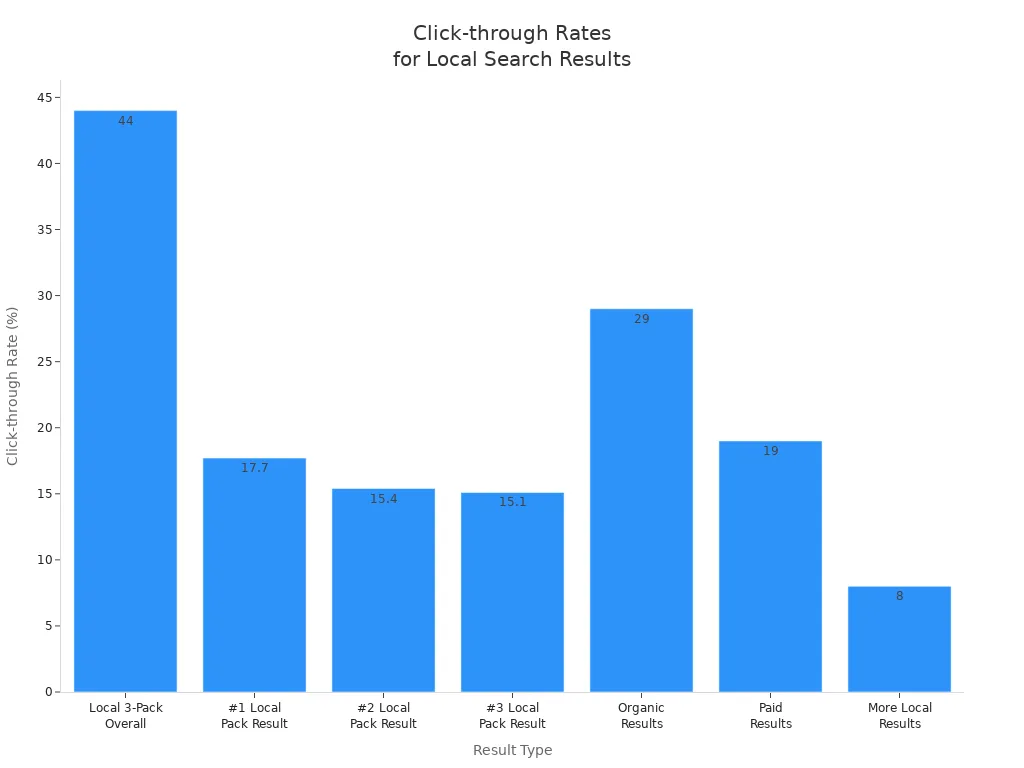
People trust the Local 3-Pack because it shows reviews and ratings. Almost everyone uses the internet to find local businesses, and most say good reviews make them more likely to choose a business. If you want to win at local search, aim for a spot in the 3-Pack.
Proximity, Prominence, Relevance
Google uses three main factors to decide which businesses show up in local search: proximity, prominence, and relevance.
- Proximity means how close your business is to the person searching. If someone searches for pizza, Google shows places nearby.
- Relevance is about how well your business matches what people are looking for. If your business info and content match the search, you rank higher in local search results.
- Prominence is your reputation. Google looks at your reviews, backlinks, and how often people mention your business online.
| Factor | Definition | How It Affects Local Search Rankings |
|---|---|---|
| Proximity | Physical closeness of a business to the searcher or specified location in the query. | Businesses closer to the user are more likely to appear in local search results, increasing local visibility. |
| Relevance | How well a business matches the search query through keywords and content alignment. | Businesses with content and listings that closely match user search terms rank higher due to better query alignment. |
| Prominence | The reputation and recognition of a business based on reviews, backlinks, and mentions online. | More prominent businesses with positive reviews and strong online presence tend to rank higher in local search results. |
You can boost your local seo by making sure your business info is correct, getting good reviews, and using the right keywords. These three factors work together to help you show up in local search and get more customers.
Competitor Analysis
If you want to outrank your competition in local SEO, you need to know exactly who you’re up against and what they’re doing right. Competitor analysis gives you the inside scoop on your local rivals. You can spot their strengths, find their weaknesses, and use this knowledge to boost your own business in local search results.
Identify Local Competitors
You can’t win a race if you don’t know who’s running beside you. Start by finding out which businesses show up when people search for your products or services in your area. Here’s a simple way to spot your local competitors:
- Do local keyword research. Think about what your customers type into Google when they need your service.
- Search those keywords on Google. Look at who pops up in Google Maps, the local pack, and the regular search results.
- Use location spoofing tools like BrightLocal’s Local Search Results Checker or GS Location Changer. These tools let you see search results from different places, so you get a real view of the competition.
- Make a spreadsheet. Write down the businesses that show up, their ranking, and where you see them (Maps, local pack, or organic results).
- Try competitor analysis tools like BrightLocal’s dashboards or Local Search Grid. These tools help you track and compare competitors automatically.
- Check out their Google Business Profiles, websites, local citations, and backlinks. This shows you what they’re doing well.
- Keep an eye on your competitors over time. Use dashboards to watch how their rankings change.
Tip: Don’t just look at the top three. Sometimes, a business ranked lower today could climb up tomorrow. Stay alert!
Analyze Competitor Strategies
Once you know who your competitors are, it’s time to dig deeper. Why do they rank higher? What makes them stand out in local SEO competition? Here’s what you should look for:
- Check their Google Business Profiles. Are their Name, Address, and Phone (NAP) details always the same? Do they post updates and reply to reviews?
- Look at their local citations and backlinks. Are they listed on local blogs, news sites, or business directories?
- Read their website content. Do they write about local events, share customer stories, or offer neighborhood guides?
- See if they run local ads. Some businesses use local PPC campaigns to get more attention in certain areas.
- Watch how they handle reviews. Do they answer quickly and politely? Do they thank happy customers and help unhappy ones?
- Test their website. Is it fast, mobile-friendly, and easy to use?
- Notice their partnerships. Are they working with local groups, charities, or media?
When you study these things, you learn what works in your area. You can spot gaps in your own strategy and find ways to outrank your competition. Benchmarking against local competitors helps you see which keywords they target, how they build links, and how they interact with customers. You can then improve your own local SEO by doing what they do—only better.
Note: Businesses that keep their Google Business Profile updated and post photos get more clicks and calls. Google’s data backs this up!
Tools for Local SEO Competition
You don’t have to do all this by hand. Many tools make competitor analysis easier and faster. Here are some of the most popular ones and what they do:
| Tool Name | Key Features | Special Focus / Notes |
|---|---|---|
| Places Scout | Local rank tracking, citation monitoring, review management, competitor analysis, Google Business Profile monitoring, NAP consistency | In-depth competitor analysis and local listing management |
| Ahrefs | Keyword research, backlink analysis, competitor analysis | Broad SEO competitor insights, lacks ultra-local keyword granularity (state/city/zip) |
| Google Ads Keyword Planner | Localized keyword data with state, city, or zip code granularity, keyword relevancy, search volume, cost estimates | Most accurate keyword volume data from Google, supports granular local keyword research |
| SEO Pro Extension | On-page SEO analysis (meta tags, headings, internal links) | Instant on-page SEO checks for own and competitor sites |
| GS Location Changer | Location-based rank testing by changing browser location | Test local SEO rankings from various global locations |
| Grid My Business | Grid view for local rank tracking, customizable radius and size, bulk keyword rank queries, side-by-side ranking comparison | Addresses ranking variations by location, visual grid tracking |
| SEOProfiler | Website optimization, audits, link disinfection, keyword research, link management, uptime monitoring, competitive intelligence, white-label reports | Comprehensive local SEO tool with multi-location rank tracking |
| Synup | Listing management, analytics, real-time data sync, review notifications, local search engine crawling | All-in-one local SEO marketing suite focused on listings and reputation management |
| Whitespark Local Citation Finder | Local citation discovery, local rank tracking, reputation management, review prompts, NPS calculation | Focused on local citations and business reputation |
| BuzzStream | Link building and outreach management | Helps create high-quality backlinks efficiently |
| LSIGraph | LSI keyword research, personalized keywords, unlimited searches, multi-language support, white-label reports | Focus on semantic keyword optimization for higher rankings |
| Yext Listings | Real-time and scheduled listing updates, listing improvement suggestions, integrations, analytics | Control over business information across digital services and search engines |
Some tools, like Local Falcon, give you visual competitor reports. You can see a heatmap of where your business ranks in different parts of your city. These reports use AI to show trends, suggest quick fixes, and help you spot weak spots. Geo-grid tracking lets you see exactly where you need to improve to outrank your competition. Automated reports keep you updated, so you always know where you stand in local search results.
Pro Tip: Use these tools to find out which areas you dominate and which ones need more work. Focus your local SEO efforts where you can make the biggest gains.
Competitor analysis is your secret weapon in local SEO competition. When you know your rivals and understand their strategies, you can outrank your competition and win more customers in your neighborhood.
Google Business Profile

Claim & Verify
You want your business to show up when people search nearby. Start by claiming and verifying your google my business listing. This step puts you on the map—literally. When you claim your google my business profile, you control what customers see. You make sure your address, phone number, and hours are always correct. Verification proves you own the business and keeps your information safe from changes by others.
Here’s what happens when you claim and verify your google my business:
- Your business appears in local search results, Google Maps, and the local pack.
- Customers see accurate and current details, so they trust you more.
- You can respond to reviews, answer questions, and post updates.
- You get free marketing tools and insights about how people find you.
- Verified profiles show up higher in search, which means more calls and visits.
Tip: Verification can happen by postcard, phone, or email. Pick the method that works best for you.
Optimize Profile
Once you claim your google my business, it’s time to make it shine. Fill out every section. Use the right categories and add keywords that match what people search for in your area. Make sure your name, address, and phone number match everywhere online. This builds trust with Google and your customers.
Upload high-quality photos of your storefront, products, and team. Businesses with fresh photos get 35% more website clicks and 42% more requests for directions. Post updates every week. Share news, offers, or events. Use Google Posts with images and clear calls-to-action. Add answers to common questions in the Q&A section. Keep your hours and attributes up to date.
Many businesses see big results after optimizing their google my business. Some move from the second page to the top three spots. Others double their website visits or see a jump in calls and bookings.
Engage with Reviews
User reviews play a huge role in local search. When you get more reviews, your business looks active and trustworthy. Google likes to see recent, positive feedback. Respond to every review, even the tough ones. Thank happy customers and help those who had problems. This shows you care and encourages more people to leave feedback.
Here’s why reviews matter:
- More reviews boost your ranking and build trust.
- Good star ratings and detailed comments help you stand out.
- New reviews show Google that your business is active.
- Responding to reviews brings in more feedback and keeps your profile fresh.
- Reviews on your google my business and other sites help you appear in the local pack.
Note: Try to get a steady flow of reviews instead of a bunch all at once. This tells Google your business is always busy and relevant.
Local Citations

Consistency Across Directories
You want your business to show up everywhere people look. That means your name, address, and phone number (NAP) must match across all local directories. When you keep your local citations consistent, you help search engines trust your business. This trust boosts your local SEO rankings and makes it easier for customers to find you.
If your information is different on each site, search engines get confused. They might show your business lower in search results. Customers may even lose trust if they see different details. Here’s what happens when you keep your local citations consistent:
- Search engines see your business as real and trustworthy.
- You avoid duplicate listings that can hurt your rankings.
- Customers find the right info and feel confident choosing you.
- Your business has a better chance to show up in the local pack and knowledge panels.
You should check your listings often. Fix any mistakes right away. Use the same format for your NAP on your website, social media, and all local directories. This simple step helps your business stand out and keeps your brand strong.
Top Citation Sources
Not all local citations are equal. Some sites matter more for your local SEO. You want your business listed on the most trusted and popular local directories. These sites have high authority and help you reach more people.
Here are some of the top citation sources you should focus on:
| Citation Source | Why It Matters |
|---|---|
| Most important for local search | |
| Trusted by both users and search engines | |
| Yelp | Popular for reviews and local discovery |
| Industry Sites | Niche authority and relevance |
| Local Government | Shows legitimacy and trust |
| Wikipedia | Strong signal if you qualify |
You should also look for industry-specific sites, like Vitals for healthcare or Avvo for legal services. Local government and educational sites give your business extra trust. Experts say you should fix mistakes on big sites first, then add your business to smaller, niche directories.
Remember, quality matters more than quantity. Focus on the best local citations, not just the most. When you combine strong backlinks and citations, your business gets more attention from search engines and customers. Keep your information accurate, and you’ll see better results in local search.
Local Keywords & Content
Research Local Keywords
You want your business to show up when people search for what you offer in your area. To do this, you need to find the right local keywords. Start by thinking about the words your customers use when they look for your services. Focus on hyperlocal keywords, like your neighborhood or even your street name. These help you reach people who are nearby and ready to buy.
Here are some steps you can follow to find the best local keywords for local search:
- Use tools like Google Keyword Planner or Semrush to discover what people search for in your area.
- Check Google Trends to see if certain local keywords get more searches during special events or seasons.
- Look at your competitors. See which local keywords help them rank high in local search.
- Add words like "near me" or your city name to your main keywords.
- Map each hyperlocal keyword to a specific page on your website.
- Review your keyword performance every month. Update your list to keep up with changes in local search.
- Keep your landing pages fresh and accurate for the best results.
Tip: Using long-tail local keywords with buying intent, like "buy shoes near me," brings in customers who are ready to act.
Create Location Content
A strong local content strategy helps you stand out in local search. You want to create pages and posts that talk about your area, local events, and what makes your business unique. This shows search engines that you care about your community.
| Benefit | How It Helps Your Business |
|---|---|
| Better local search rankings | Search engines know where you serve customers |
| More visibility in map pack | Higher chance to show up in Google Maps |
| Targeted local keywords | Attracts people looking for your exact service |
| Local engagement | Builds trust with stories about local events |
| Stronger SEO signals | Google Maps and local images boost your relevance |
| Consistent NAP info | Makes your business easy to find everywhere |
| Local backlinks | Other local sites link to your business |
| Unique content for each area | Connects with people in different neighborhoods |
| Optimized meta tags | Helps your pages show up for local search queries |
You can write about local news, share customer reviews, or highlight partnerships with other businesses. Add local keywords to your content so search engines know you are a good match for local search. Make sure each location page has directions, reviews, and contact info.
On-Page Optimization
On-page optimization is key for local search optimisation. You want every page to help you rank higher in local search. Start by using local keywords in your titles, headings, and meta descriptions. Add your city or neighborhood to your URL and image alt text.
Follow these steps for strong on-page optimization:
- Create a landing page for each service area with local keywords.
- Write helpful content that answers questions from your local audience.
- Use local keywords in your headlines and subheadings.
- Add images with file names and alt text that include local keywords.
- Link to other pages on your site, like your contact or location pages.
Note: Keep your Name, Address, and Phone number the same on every page. This helps search engines trust your business and improves your local search rankings.
With the right local keywords, a smart local content strategy, and strong on-page optimization, you can boost your local SEO and get noticed in local search.
Backlinks & Partnerships
Local Backlink Opportunities
You want your business to stand out in local search. One of the best ways to do this is by building high-quality backlinks from trusted sources in your area. Not all links are equal. Some carry more weight and help you climb the rankings faster.
Here are the top local backlink opportunities you should focus on:
- Local news sites and online magazines. These give you high-quality backlinks when you share your story or get featured in an article.
- Chambers of Commerce membership listings. These show you are active in your community and give you trusted links.
- Local event sponsorships. When you sponsor a local event, you often get a link from the event website.
- Community blogs. Local bloggers love to write about businesses that make a difference. Their links boost your credibility.
- Niche business directories. Even if the links are no-follow, they help with local visibility and SEO.
You should always look for high-quality local backlinks that come from websites connected to your city or industry. Links placed inside relevant articles or blog posts work better than those hidden in footers or sidebars. Remember, quality matters more than quantity. A few strong backlinks and citations from respected local sources can help you more than many weak ones.
Tip: Focus on links that show your business is part of the local scene. These links tell search engines you are trusted and active in your area.
Community & Media Partnerships
Local partnerships can take your SEO to the next level. When you work with other businesses, organizations, or local influencers, you build trust and show you care about your community. Search engines notice this and reward you with better rankings.
- Local partnerships help you get high-quality backlinks from respected sources. These links boost your domain authority and make your business look more trustworthy.
- When you join forces for events or promotions, you reach new local audiences. This brings more people to your website and your store.
- Co-marketing with local partners often leads to user-generated content, reviews, and social proof. All of these help your SEO.
- You can write guest posts, share press releases, or create joint blog articles. This gives you fresh, local content that both people and search engines love.
- Local partnerships can also lead to media coverage. News outlets may write about your events or collaborations, giving you valuable backlinks and citations.
- Social media is another big win. When your partners share your news, you reach even more people in your area.
You should always track your results. Watch for more referral traffic, better keyword rankings, and higher engagement. Strong local partnerships keep your business visible and trusted in your community.
Online Reviews
Get More Reviews
You want more people to talk about your business online. Reviews help you stand out in local search and build trust with new customers. Most people read reviews before they visit a business. If you have lots of good feedback, you look more reliable.
Here are some easy ways to get more reviews:
- Ask your happy customers right after they buy something or use your service. A simple, “Would you mind leaving us a review?” works well.
- Send a follow-up email or text with a direct link to your review page. Make it easy for people to share their thoughts.
- Put up signs in your store or office. Remind people that their opinion matters.
- Offer great service every time. People love to share positive experiences.
- Thank customers for their feedback. When you show you care, more people want to help.
Tip: Never buy fake reviews. Google can spot them, and it can hurt your ranking.
Respond & Manage
You need to manage your reviews to keep your reputation strong. Responding to reviews shows you care about your customers. It also helps you stand out in local search.
Try these steps to handle reviews the right way:
- Reply to every review, both good and bad. Thank people for their kind words. If someone is unhappy, offer to fix the problem.
- Stay polite and professional. Even if a review is harsh, keep your cool.
- Use feedback to improve your business. Sometimes, reviews point out things you can do better.
- Watch for fake or spammy reviews. Report them to Google if you see any.
A steady stream of user reviews tells search engines that your business is active and trusted. This can help you move up in local search results and attract more customers.
Technical SEO for Local Search
Technical SEO helps your business show up higher in local search. When you get these basics right, you make it easier for people to find you. Let’s look at three important parts of technical SEO for local search.
Site Speed & Mobile
People want answers fast. If your website loads slowly, they leave and pick another business in local search. Google also likes fast websites. You can check your speed with free tools like Google PageSpeed Insights. Try to keep your load time under three seconds.
Most people use their phones for local search. Your website needs to look good and work well on mobile devices. Use big buttons, clear text, and simple menus. Test your site on different phones to make sure everything works. A mobile-friendly site helps you win more clicks in local search.
Schema Markup
Schema markup is special code you add to your website. It helps search engines understand your business better. When you use schema, you can show your address, phone number, hours, and reviews right in local search results.
You do not need to know how to code. Many website builders let you add schema with plugins or simple tools. Schema markup can help your business stand out in local search by showing extra details that catch people’s eyes.
NAP Consistency
NAP stands for Name, Address, and Phone number. You need to keep this information the same everywhere online. If your NAP is different on your website, Google Business Profile, or directories, you might lose trust in local search.
Check your NAP on your website, social media, and all listings. Fix any mistakes right away. Consistent NAP helps you rank higher in local search and makes it easy for customers to contact you.
Tip: Set a reminder to check your NAP every few months. This keeps your business strong in local search.
SEO Localisation for Businesses
Localize Content
You want your business to connect with people in your area. That is where seo localisation for businesses comes in. You need to speak the language of your community. Use words and phrases that locals use every day. When you write about your products or services, add details about your city, neighborhood, or even local landmarks. This helps people feel like you are part of their world.
Try these tips for better seo localisation for businesses:
- Use local keywords in your website titles and headings.
- Write blog posts about local events or news.
- Share stories from your customers who live nearby.
- Add photos of your team at local spots.
Tip: Ask your customers what makes your area special. Use their answers in your content.
Adapt for Multiple Locations
If you run more than one location, you need to tailor your seo localisation for businesses for each spot. Do not use the same page for every city. Create a unique page for each location. Talk about what makes each place different. Mention local landmarks, nearby schools, or popular streets.
Here is an example:
| Location | Unique Content Idea |
|---|---|
| Austin, TX | “Best tacos near Zilker Park” |
| Miami, FL | “Family fun close to South Beach” |
You can also use separate Google Business Profiles for each location. This helps your seo localisation for businesses stand out in every city you serve. Update each profile with the right address, phone number, and photos.
Note: Keep your local keywords fresh for each area. This makes your seo localisation for businesses stronger and helps you reach more people.
Outrank Your Competition
Advanced Tactics
You want to outrank your competition in local search. You need to go beyond the basics. Advanced tactics help you pull ahead and stay on top. Let’s look at what works best when you want to outrank your competition every time.
-
Use hyper-local and long-tail keywords.
Target neighborhoods, landmarks, and even street names. These keywords bring in people who are close by and ready to buy. You can add these words to your website, blog posts, and even your Google Business Profile. This helps you show up in more local search results and outrank your competition. -
Keep your Google Business Profile fresh.
Update your info, add new photos, and post weekly updates. Respond to every review. When you do this, you show Google and your customers that you care. This makes it easier to outrank your competition in local search. -
Build your online reputation everywhere.
Ask for reviews on Google, Yelp, and Facebook. Show off your best reviews on your website. When people see lots of good feedback, they trust you more. This trust helps you outrank your competition. -
Stand out with a unique value.
Tell people what makes you different. Maybe you offer faster service, special products, or a local touch. Share this on your website and in your ads. A clear message helps you outrank your competition because people remember you. -
Partner with other local businesses.
Work together on events, share each other’s news, or link to each other’s websites. These partnerships help you reach more people and build strong local backlinks. You get more attention in local search and can outrank your competition. -
Get involved in your community.
Sponsor local events, support charities, or join local groups. When people see your name around town, they remember you. Google also notices your activity and rewards you in local search. This is a great way to outrank your competition. -
Use advanced tools to watch your rivals.
Tools like SEMrush, Moz, and Google Alerts let you track what your competitors do. You can see their keywords, backlinks, and new reviews. When you know what works for them, you can do it better and outrank your competition. -
Analyze customer reviews for trends.
Look for patterns in what people say about you and your competitors. If you spot a weakness in their service, you can fill that gap. This helps you outrank your competition by meeting needs they miss. -
Create hyper-local content.
Write about local events, news, or tips for your area. Add FAQ sections that answer common questions. Use natural language and question words. This helps you show up in voice searches and outrank your competition in local search. -
Invest in local PPC and retargeting.
Run ads that target your city or neighborhood. Use strong ad copy and landing pages that match your keywords. Watch your ad results and adjust your bids. Smart ads help you outrank your competition and bring in more customers.
Tip: Treat SEO as a long-term plan. Experts suggest spending 5-10% of your target revenue on SEO. This steady investment helps you outrank your competition year after year.
Track & Measure Results
You need to know if your efforts help you outrank your competition. Tracking the right numbers shows what works and what needs fixing. Here’s how you can measure your progress in local search.
-
Monitor your rankings.
Use rank tracking tools to see where you show up in the local pack and organic results. Check your position often. This helps you see if you outrank your competition or if you need to work harder. -
Set clear goals.
Decide what matters most to your business. Maybe you want more calls, more website visits, or more reviews. Track these goals so you know if your local seo strategies help you outrank your competition. -
Use the right tools.
Google Analytics 4, Google Search Console, and Google Business Profile give you lots of data. You can see how many people visit your site, call your business, or ask for directions. Call tracking services help you count every call from local search. -
Track calls and clicks.
Look at how many people click your phone number or call you from your Google Business Profile. This shows real customer interest and helps you outrank your competition. -
Tag your links.
Use UTM parameters on your Google Business Profile links. This lets you see exactly where your traffic comes from in your analytics. You can spot which actions help you outrank your competition. -
Watch your reviews and ratings.
Keep an eye on how many reviews you get, your average star rating, and how fast you reply. Compare your reviews to your competitors. If you have better ratings and more reviews, you can outrank your competition in local search. -
Check your local citations.
Make sure your business name, address, and phone number are the same everywhere. Inconsistent info can hurt your rankings and make it harder to outrank your competition. -
Track your backlinks.
See how many local websites link to you. More local backlinks mean more trust from Google. This helps you outrank your competition. -
Measure your website traffic and conversions.
Look at how many people visit from local search and how many take action, like calling or buying. A high conversion rate means your efforts to outrank your competition pay off.
Here’s a table to help you remember what to track:
| Metric | What It Shows |
|---|---|
| Local Pack Rankings | Your spot in Google Maps and local search results |
| Organic Rankings | Your position for local keywords in regular search |
| Website Traffic | How many people visit from local search |
| Google Business Profile Insights | Clicks, calls, and direction requests from your profile |
| Local Citations | Consistency of your business info across directories |
| Customer Reviews and Ratings | Number, quality, and speed of your reviews |
| Local Backlinks | Links from local websites and partners |
| Local Search Traffic | Visits from people searching in your area |
| Conversion Rate | How many visitors take action (calls, purchases, etc.) |
Note: Trends matter more than single numbers. Watch how your rankings, reviews, and traffic change over time. This helps you see if you really outrank your competition or if you need to adjust your plan.
When you use these advanced tactics and track your results, you put yourself in the best position to outrank your competition in local search. Stay focused, keep improving, and you’ll see your business rise above the rest.
You have the tools to outsmart your local SEO competition. Focus on your Google Business Profile, build strong local links, and keep your info consistent everywhere. Stay active with reviews and fresh content. Local SEO needs steady work, so check your progress often. Keep learning as things change. Ready to see results? Start using these strategies today and watch your business rise above the rest!
FAQ
How long does it take to see results from local SEO?
You might notice small changes in a few weeks. Big improvements often take three to six months. Keep working on your local SEO every month. Consistency helps you move up faster.
What is the most important part of local SEO?
Your Google Business Profile matters most. Keep it updated. Add photos, reply to reviews, and check your info. This helps you show up in local searches and builds trust with customers.
Can I do local SEO myself, or do I need an expert?
You can start local SEO on your own. Use free tools and follow simple steps. If you want faster results or have a big business, you might hire an expert for extra help.
How do I get more local reviews?
Ask happy customers right after they visit.
Send a quick text or email with a review link.
Thank people for leaving feedback.
Make it easy and friendly, and you will get more reviews.
See Also
Effective Tips To Enhance Your Search Engine Rankings
How To Excel At SEO Content Distribution For Marketing
Winning SEO Tactics Using Ethical Link Exchange Methods
