How to Optimize Articles That Don’t Rank on the Top 10 for Their Keyword

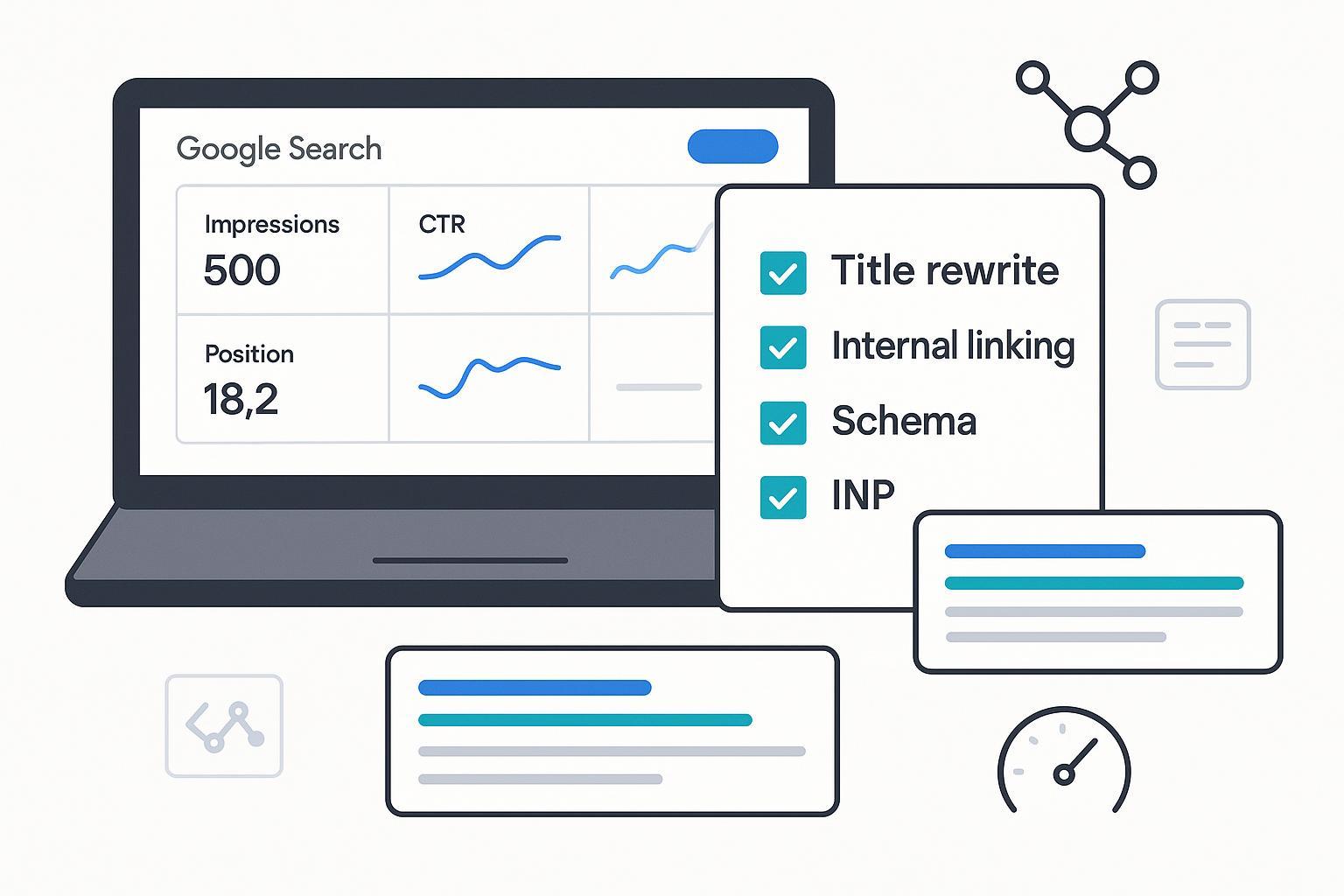
If an article hovers at positions 11–30 for its target keyword, you don’t need a miracle—you need a disciplined, evidence-based workflow. I’ve found that a repeatable audit-to-optimization cycle, anchored in Search Console data and intent-first content improvements, moves stuck articles onto page one more reliably than one-off “hacks.” Below is the playbook I use with SMB and SaaS teams.
1) Diagnose with data (before changing anything)
Start where the evidence lives: Google Search Console.
- Filter the Performance report by the specific page and compare Last 28 vs. Previous 28 days to spot shifts in impressions, CTR, and average position. Google outlines this triage approach in its 2025 documentation on debugging Search traffic drops — Google Developers.
- Segment by device and country. Mobile underperformance can hint at page experience issues. Google clarifies that “Page Experience” is a set of signals, not a single score—CWV, mobile-friendliness, HTTPS, and non-intrusive interstitials contribute when relevance is similar, per the Page Experience overview — Google Developers (2025).
- Inspect URL coverage and indexing. If the page isn’t reliably crawled or indexed, no amount of content tweaks will help. Use URL Inspection and Coverage reports to verify.
- Identify cannibalization. In the Queries tab, note when multiple URLs rank for the same query. If two pages compete, consider consolidation.
Document findings. You’ll use them to prioritize what to change first.
2) Map the intent and the SERP you’re actually competing in
Open the live SERP for your primary query and take notes:
- Result types: featured snippet, video carousel, news, “People Also Ask,” images, and now AI Overviews where applicable. Google rolled out AI Overviews in May 2024 and expanded globally by October 2024, per the Google blog announcements (2024) and follow-up expansion update.
- Content patterns: What do the top results cover that you don’t? Which entities (people, tools, standards) recur? Capture entity gaps.
- Snippet structure: How are top pages structuring answers (lists, tables, concise definitions)? Featured snippet alignment and “AI citability” often depend on clear, succinct blocks.
If the SERP has changed materially (e.g., rich results deprecated), adjust accordingly. For instance, Google reduced visibility for FAQs and removed HowTo rich results in 2023; see the HowTo & FAQ changes — Google Search Central blog (2023).
3) Expand coverage: intent, entities, and questions your audience actually has
Most stuck articles fail intent or entity coverage. Fix both.
- Create a concise content brief. Include the core task or question, subtopics, and entities to cover. Align with Google’s “helpful, reliable, people-first content” guidelines—write for people, demonstrate first-hand experience, and satisfy the task at hand as outlined in Creating helpful content — Google Search Central (2025).
- Add missing sections that match “People Also Ask,” comparison angles, and step-by-step execution. Where relevant, add tables, code blocks, or checklists.
- Encode entities consistently. Reference authoritative definitions and, when suitable, support with structured data.
Measure: Track impressions, CTR, and average position for your target queries in GSC over the next 2–4 weeks. If impressions rise but CTR lags, move to titles/meta testing next.
Pitfalls: Overstuffing keywords, thin summaries of competitors, and ignoring your unique perspective. Be the practitioner who’s done it, not just the commentator.
4) Title and meta description tests to earn the click
Google does not confirm CTR as a direct ranking signal, but improving your title clarity and relevance can lift clicks and visibility. Keep titles ~55–60 characters, front-load the main promise, and mirror user intent.
- Draft 2–3 variants: problem-solution, benefit-first, and authoritative angle.
- Avoid gimmicks; test clarity and specificity.
- Monitor in GSC for 2–4 weeks. Watch CTR shifts on queries with steady impressions.
Evidence note: Industry tests occasionally report traffic lifts from title changes. Treat these as directional rather than universal. For example, analyses summarized in 2025 referenced potential gains from capitalization patterns; see discussion threads like the 2025 roundup by Distinctly mentioning SearchPilot-type tests (latest organic search news — Distinctly, 2025). Apply cautiously and prioritize intent alignment.
5) Strengthen internal linking and hub alignment
Internal links distribute authority and clarify topical relationships.
- Add descriptive anchor links from related pages (tutorials, category hubs) to the target page.
- Ensure the target page links back to its hub and relevant child pages.
- Consider 10–25 contextual internal links on long-form pages, focusing on relevance and user flow. See heuristics like the 2025 guidance from Quattr on how many internal links per page.
Measure: Watch crawl stats for increased discovery and GSC metrics for impressions/CTR changes on the target page.
Pitfalls: Generic anchors (“click here”), orphan pages, and links added without improving user task completion.
6) Implement and validate structured data (supported types)
Use JSON-LD for Article, Organization, WebSite (with sitelinks searchbox), Breadcrumb—and Product/Review/Video if applicable. Validate using Google’s Rich Results Test, then monitor eligibility and performance in Search Console.
- Reference the 2025 Search Gallery — Google Developers and Intro to structured data — Google Developers.
Measure: Check the Rich Results report (where available) and track CTR changes when rich results appear.
Pitfalls: Misaligned schema (marking up what isn’t present), relying on deprecated FAQ/HowTo for visibility, and skipping validation.
7) Fix page experience and technical blockers
If mobile users bounce or interact slowly, you’ll struggle to climb.
- Core Web Vitals targets: LCP ≤ 2.5 s, CLS ≤ 0.1, and INP ≤ 200 ms. INP replaced FID in March 2024 per web.dev’s announcement and 2025 docs; see Interaction to Next Paint becomes a Core Web Vital — web.dev (2024) and Core Web Vitals overview — Google Developers (2025).
- Mobile UX: readable fonts, accessible tap targets, no intrusive interstitials.
- Crawl/indexing: fix canonicalization issues, ensure robots.txt/sitemaps are clean, and resolve soft 404s.
Measure: Use PageSpeed Insights and GSC Page Experience/Core Web Vitals reports. Re-check weekly after fixes.
Pitfalls: Chasing micro-metrics without addressing obvious UX blockers; shipping untested code changes.
8) Consolidate overlapping content (and redirect)
When multiple pages cover nearly the same topic, they compete—and both can lose.
- Pick the strongest URL (links, history, engagement) and merge content from weaker pages.
- 301 redirect the merged pages to the canonical article.
- Update internal links to the canonical.
Measure: In GSC, watch the canonical article’s query coverage and impressions grow over 2–6 weeks.
Pitfalls: Leaving duplicates live, redirect chains, and failing to update navigation/hubs.
9) Refresh, republish, and request indexing
Update meaningfully—new sections, better examples, up-to-date standards—and republish.
- Add a change log at the end and refresh the publication date if material changes were made.
- Use URL Inspection to request indexing.
- Track performance weekly for 4–8 weeks.
Evidence caution: Many marketers cite large lifts after content refreshes, but treat broad claims carefully. Focus on your own telemetry.
10) Practical example: optimize a stuck article with QuickCreator
Here’s how I’ve approached a non-top-10 article using QuickCreator. Disclosure: QuickCreator is our product.
- Build an updated brief: Use real-time SERP/topic recommendations to capture missing entities and PAA-style questions. Expand the outline with clear H2/H3s and answer blocks.
- Improve content quality: Run the content quality score to identify thin sections and engagement gaps; prioritize fixes that align with helpful-content guidance.
- Strengthen internal links: Use the block-based editor to add descriptive anchors to and from relevant articles; keep link density sensible and user-focused.
- Republish and monitor: One-click publish to WordPress, then compare 28-day windows in GSC. Iterate on titles/meta if CTR lags.
Tip: When auditing credibility and author signals, a quick E-E-A-T pass helps. For deeper guidance, see our internal resource on E-E-A-T evaluation and tools.
11) Advanced tactics for 2025’s AI Overviews and answer engines
User behavior shifts when AI summaries appear. Independent analyses in 2025 reported click declines of 1–25% across many publishers and larger drops when AI Overviews were present; see the Digital Content Next discussion of 2025 cohorts in the analysis linking AI Overviews to lower clicks — DCN (2025) and the Pew Research short read (2025). Google has suggested clicks may be of higher quality; either way, adapt:
- Structure concise answer blocks (40–80 words), tables, and step lists that can be cited or featured.
- Keep schema clean and accurate; emphasize Article, Organization, WebSite, Breadcrumb, Product/Review/Video where relevant.
- Focus on brand demand and topical authority with hubs and expert bylines.
- Diversify acquisition: email list growth, social distribution, and community engagement.
For broader strategy context, see 2024–2025 guidance by industry analysts on adapting to AI Overviews, such as the Search Engine Journal perspective (2024) and Amsive’s analysis (2024).
12) Measurement, logs, and iteration cadence
Treat optimization as a series of small, trackable experiments.
- Maintain a test log: date, change, target queries, expected outcome, and owner.
- Monitor weekly, compare 28-day windows, and set stop/continue criteria.
- For large sites, watch crawl budget via server logs; make sure priority pages are discovered and not buried deep.
13) Common pitfalls to avoid
- Theory-only edits with no user value.
- Ignoring structured data changes (e.g., relying on deprecated FAQ/HowTo for visibility).
- Over-optimizing titles for clickbait at the expense of relevance.
- Adding internal links that do not help users complete tasks.
- Shipping design refreshes that worsen CWV or mobile UX.
14) Useful internal resources for deeper execution
- Prioritize refreshes with practical scoring: see our guide on SEO content quality analysis tools (2025).
- Enhance your workflow with automation: check out the best AI SEO Chrome extensions (2025).
Closing: Make the next change measurable
Pick one stuck article, run the full audit, and ship a material update within a week. Track for 28 days, then decide whether to iterate titles/meta, deepen entity coverage, or consolidate pages. If you want a streamlined way to brief, edit, and republish, consider running the process inside QuickCreator’s editor and analytics. No hard sell—just a practical way to keep the workflow tight.
