On-Page SEO for Stationery & Office Supplies Product & Category Pages (2025): Titles, H1s & Internal Links

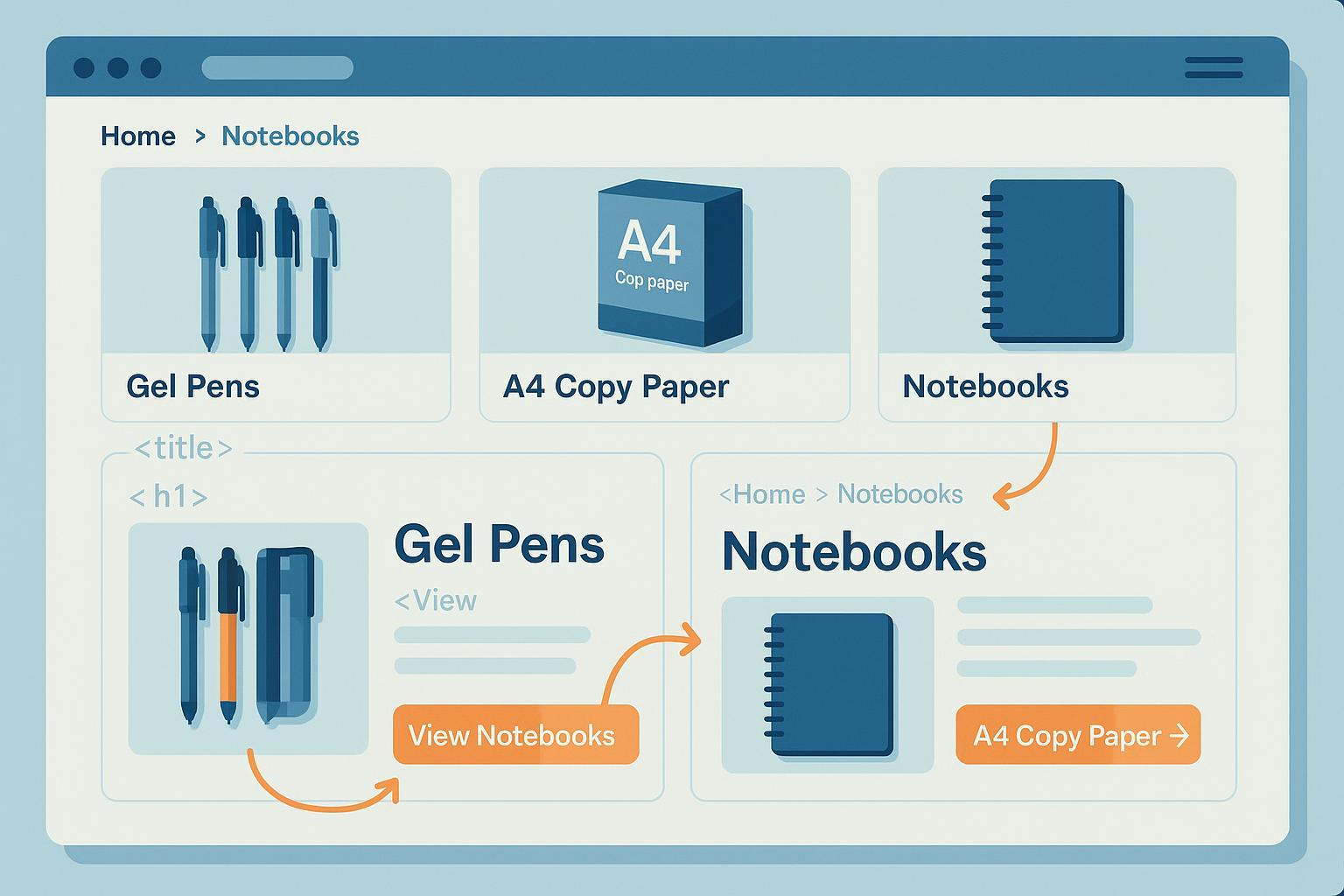
If you sell stationery and office supplies, the fastest on-page wins still come from three levers: title tags, H1s, and internal links. In 2025, Google’s systems lean even harder on clarity, intent alignment, and crawlable connections. This guide distills what consistently works for product and category pages in this niche, with templates and workflows you can ship this quarter.
Key principle: every recommendation below is designed to be 1) easy to implement at scale in a catalog with variants (sizes, weights, pack counts, colors), and 2) verifiable in Search Console or controlled tests.
1) Page Titles That Earn Clicks and Clarify Variants
What Google expects in 2025 hasn’t changed in spirit: unique, descriptive, and non-stuffed titles that accurately describe the page. Google also sometimes rewrites title links using headings or other signals, so the page needs consistent cues. See Google’s guidance in the Title link best practices by Google Search Central (2024–2025) and the broader SEO Starter Guide from Google (updated in 2024).
Practical rules for stationery/office supplies:
- Disambiguate attributes right in the title: paper weight (20 lb vs. 24 lb), size (Letter vs. A4), tip size (0.5 mm vs. 0.7 mm), count (12-pack vs. case), material (recycled, acid-free), and color family (black/blue/multicolor).
- Mirror primary user intent: product pages = transactional; category pages = navigational/transactional (shopping/browsing language).
- Brand placement: test suffix vs. prefix. Results can vary; controlled experiments summarized by SearchPilot show that title changes (e.g., brand-first vs. brand-last, adding modifiers) can materially affect CTR and traffic; see SearchPilot SEO split-test lessons on brand name placement (case study hub, 2023–2024).
Title length and structure:
- Aim for approximately 50–60 characters for primary information. Avoid stuffing; clarity beats keyword repetition per Google’s title link guidance (2024–2025).
Templates you can deploy
- Product title tag: [Primary term] – [Distinguishing attributes] | [Store/Brand]
- Example: “Gel Pens – 0.7 mm Fine Tip, Assorted 12-Pack | Paper&Co”
- Example: “A4 Copy Paper – 24 lb, 500 Sheets/Ream (10-Ream Case) | OfficeSupplyMart”
- Category title tag: [Category] – [Top attribute or use case] | [Store]
- Example: “A4 Copy Paper – Bulk Cases & 24 lb Options | OfficeSupplyMart”
- Example: “Gel Pens – 0.5–1.0 mm, Multicolor & Black Ink | Paper&Co”
Execution notes
- Create a rule-based generator pulling key attributes (size, weight, count, color) from your PIM or CMS.
- Maintain a do-not-duplicate list so variants don’t collapse into identical titles (e.g., “Gel Pens – Assorted Pack” vs. “Gel Pens – Black Ink 12-Pack”).
- For seasonal collections, include intent terms people actually search (e.g., “Back-to-School Supplies | Store”). If you include a year in titles, test it; SearchPilot’s public summaries show mixed outcomes when adding month/year—use experiments when traffic allows; see SearchPilot lessons on adding month/year to titles (2023–2024).
Measurement
- Track impressions/CTR in GSC for title-changed pages. If you can, run split tests to reduce noise; see the methodology in SearchPilot’s catalog of title tag experiments (2023–2025).
2) H1s and Heading Hierarchy That Match Intent and Reduce Rewrites
Use H1s to reinforce the same meaning as the title but written for humans. Google explicitly recommends descriptive headings to aid navigation and comprehension. See Google’s guidance on headings (2024) and the emphasis on helpful, people-first content in the Google 2024 core update & spam policies explainer.
Product pages
- H1 = exact product name with differentiators.
- Example: “A4 Copy Paper, 24 lb, 500 Sheets/Ream (10-Ream Case)”
- H2/H3 sections: Specifications, Compatible Printers, Materials & Sustainability, FAQs, Shipping & Returns.
- Use consistent attribute labels so spec tables are scannable (e.g., “Weight: 24 lb,” “Size: A4,” “Sheets: 500/Ream,” “Pack: 10 Reams”).
Category pages
- H1 = category label that matches navigation.
- Example: “Gel Pens”
- Above-the-fold intro (2–3 lines) clarifies scope and helps with long-tail matches: “Find 0.5–1.0 mm gel pens in black, blue, and multicolor packs. Filters for tip size, color, and pack count.”
- H2/H3 links to subcategories or popular filters (e.g., “Fine Tip 0.5–0.7 mm,” “Multicolor Packs,” “Refillable Gel Pens”). These create contextual links to strengthen internal structure.
Avoid keyword stuffing
- Don’t repeat “gel pens” five times in H2s. Descriptive, user-centered headings map better to intent and avoid Google’s spam triggers per the 2024 spam policies and helpful content guidance.
3) Internal Linking That Scales Authority and Discovery
Google expects crawlable links with descriptive anchor text that indicate the destination’s topic. Ensure links are in the rendered HTML. For image links, alt text becomes the anchor. See Google’s guidance on links and anchor text (2024–2025).
Where links should live
- Header and main navigation: Primary categories (Office Supplies, Writing Instruments, Paper, Notebooks, Filing, Printers & Ink).
- Category pages: Links to subcategories and featured collections; include a short editorial block that naturally links to popular attributes (e.g., “0.7 mm gel pens,” “retractable gel pens”).
- Product pages: Contextual links to parent categories, related accessories, and compatible items (e.g., copy paper → printers & toner; gel pens → refills, notebooks).
- Breadcrumbs: Reinforce hierarchy for users and bots.
Anchor text patterns that work
- Be specific: “A4 copy paper 24 lb,” “gel pens fine tip,” “recycled notebooks,” “bulk sticky notes 24-pack.”
- Avoid generic “click here.” Google uses anchor text as a relevance signal per the Google links documentation (2024–2025).
Evidence for impact
- Controlled tests show measurable gains from adding relevant internal links. For example, SearchPilot reported a +7% organic traffic uplift by adding contextual internal links across regional pages; see the SearchPilot internal linking tests summary (2023–2024).
Crawlability
- If you use JS to insert links, verify they render in the HTML DOM and are crawlable; see Google’s crawlable links guidance (2024–2025).
4) Stationery-Specific Patterns: Variants, B2B, and Seasonality
Variants (paper weight/size, pack count, colors)
- Decide which variants warrant their own indexable page. Popular intent combinations like “A4 24 lb copy paper” may justify standalone pages; obscure combinations might consolidate under a canonical parent. See Google’s guidance on consolidating duplicates in Consolidate duplicate URLs (Google, 2024–2025).
- Use clean, attribute-rich titles/H1s and structured data (sku, brand, gtin, mpn) so Google can disambiguate similar products; see Google’s Product structured data requirements (2024–2025).
B2B considerations
- Surface bulk pack options, per-unit pricing, and return policy highlights in titles/meta descriptions and H1/H2s when aimed at corporate buyers. When relevant, include policy details using structured data; see Google’s return policy structured data (2024–2025).
Seasonality
- Create seasonal hubs (“Back-to-School Supplies,” “Year-End Office Restock”) and link them from relevant categories and top products during peak cycles. This concentrates internal equity around timely intents and helps users complete bundles (notebooks, pens, backpacks). For taxonomy clarity and navigation design, Shopify’s enterprise guidance on category navigation is a useful reference: see Shopify’s eCommerce navigation best practices (2024).
Cross-category linking
- On product pages, add contextual “Complete your setup” blocks with descriptive links: “Printer Ink Cartridges,” “Staplers,” “Legal-Size File Folders.” Keep it relevant to avoid noise and maintain UX quality; Baymard’s research emphasizes scannable navigation and clear category naming for discovery—see the Baymard Institute’s eCommerce search research overview (2024).
5) Faceted Navigation, Pagination, and Crawl Budget (Large Catalogs)
Unchecked filters can explode your URL space. Google advises focusing crawl on valuable pages, consolidating duplicates, and avoiding reliance on nofollow for crawl control. See Google’s guidance on managing crawl budget for large sites (2024–2025) and consolidating duplicate URLs (Google, 2024–2025).
Facets
- Canonicalize low-value combinations to a primary version and selectively allow indexation for high-demand pairs (e.g., “A4 + 24 lb”). Google has shared additional notes regarding faceted navigation and crawl behavior; see Google’s crawling note on faceted navigation (2024).
- Ensure filters don’t generate infinite URL patterns; bound parameters and block crawl of obviously duplicative sorts with robots rules where appropriate, while keeping your primary category/product URLs fully discoverable via internal links.
Pagination
- Keep numbered “Next/Previous” pagination links crawlable. Use self-referential canonicals on each paginated page rather than canonicalizing everything to page 1 (which can orphan items). Google has reiterated modern pagination expectations in office hours and docs; see the Google Search Central Office Hours (April 2024) notes on pagination.
6) Structured Data That Reinforces Your On-Page Signals
Product pages
- Use Product markup with Offer(s): name, image, description, price, availability, sku/brand/gtin/mpn, ratings/reviews where applicable. This supports richer results and clearer disambiguation of variants; see Google’s Product structured data documentation (2024–2025) and Review snippet guidance (2024–2025).
Category pages
- Use ItemList to represent product lists and Breadcrumb markup to clarify hierarchy. See Google’s structured data overview (2024–2025).
Validation
- Validate with Rich Results Test and monitor merchant listings/structured data reports in Search Console. Google’s Search Essentials (2024) reiterates accuracy and crawlability basics.
7) Implementation Templates and Copy-Paste Examples
Plug-in title templates (customize the attribute order to match demand)
- Gel Pens (Product): “Gel Pens – [Tip Size] [Color/Pack Count] | [Store]”
- Example: “Gel Pens – 0.7 mm Black, 12-Pack | Paper&Co”
- Copy Paper (Product): “[Size] Copy Paper – [Weight], [Sheets/Ream] ([Pack Count]) | [Store]”
- Example: “A4 Copy Paper – 24 lb, 500 Sheets/Ream (10-Ream Case) | OfficeSupplyMart”
- Notebooks (Product): “[Ruling/Binding] Notebook – [Size], [Page Count], [Pack Count] | [Store]”
- Example: “College-Ruled Spiral Notebook – Letter, 120 Pages, 6-Pack | Paper&Co”
- Category titles
- “Gel Pens – Fine & Medium Tips, Multicolor Packs | [Store]”
- “A4 Copy Paper – 20–24 lb, Bulk Cases | [Store]”
H1 patterns
- Product H1: exact product name with attributes; keep consistent with PDP title and schema “name”.
- Category H1: match nav label exactly (e.g., “Gel Pens”).
Anchor text library (use naturally in context)
- “A4 copy paper 24 lb,” “gel pens fine tip,” “recycled notebooks,” “bulk sticky notes 24-pack,” “legal-size file folders,” “HP 902 ink cartridges.”
Breadcrumbs
- Home > Office Supplies > Paper > A4 Copy Paper
8) QA and Measurement Workflow
Weekly/biweekly cadence
- Crawl checks: Ensure new titles/H1s render correctly; verify links are standard and crawlable per Google’s crawlable links guidance (2024–2025).
- Structured data validation: Run pages through the Rich Results Test; monitor Search Console for warnings/errors using the docs in Google’s structured data overview (2024–2025).
- GSC tracking: Segment by page type (product vs. category); monitor impressions, CTR, and average position pre/post title updates.
- Split testing (if traffic allows): Isolate a cohort of products or categories and experiment with brand placement, attribute order, or including year/month, referencing SearchPilot’s published title experiments (2023–2025).
Rollback criteria
- If CTR dips >10% on stable impressions for two consecutive weeks on a test cohort, revert that template and iterate.
9) Common Pitfalls (and Fixes)
-
Duplicate titles across variants
- Fix: Inject unique attributes (size/weight/count/color). Consolidate duplicates with canonicalization where appropriate using Google’s duplicate URL consolidation guidance (2024–2025).
-
H1 doesn’t match what the page actually is
- Fix: Product H1 = product name; Category H1 = navigation label. Keep H1 and title semantically aligned to minimize rewrites per Google’s title link best practices (2024–2025).
-
Internal links inserted via JS are not crawlable
- Fix: Render links server-side or ensure hydrated DOM exposes standard tags. Verify with URL Inspection per Google’s crawlable links documentation (2024–2025).
-
Faceted URLs balloon crawl waste
- Fix: Bound parameters, canonicalize, and selectively index high-demand combinations, referencing Google’s crawl budget management (2024–2025).
-
Over-linking hurts UX
- Fix: Prioritize helpful links (compatibility, related essentials). Baymard’s work on scannable navigation supports a user-first linking strategy; see the Baymard eCommerce search overview (2024).
10) 30–60–90 Day Rollout Plan
Day 0–30: Foundations
- Inventory pages and attributes (size/weight/count/color). Map product types (Pens, Paper, Notebooks) to attribute sets.
- Implement rule-based title templates for top 20% of revenue-driving products and all primary categories.
- Align H1s with product names and nav labels. Add 2–3 sentence category intros with links to popular subtypes.
- Add breadcrumbs and ensure they’re marked up. Validate core Product schema.
Day 31–60: Scale and Links
- Expand title/H1 template coverage to the next 50% of SKUs.
- Create contextual link blocks on PDPs: “Compatible with,” “You might also need,” “Shop related categories.”
- Launch seasonal hub(s) and cross-link from relevant categories and top PDPs.
- Configure pagination best practices on large categories; verify self-canonicals and crawlable next/prev links.
Day 61–90: Optimization & Testing
- Run at least one title split test (brand-first vs. brand-last or attribute order) using a cohort with stable traffic; see SearchPilot title test examples (2023–2025).
- Evaluate internal link additions using GSC and analytics; aim for measurable lifts similar to the SearchPilot internal linking test outcomes (+7% reported, 2023–2024).
- Tune facets: whitelist indexable combinations; ensure non-indexable versions consolidate via canonicals and are discoverable via internal links.
11) Quick Checklists
Product page (titles, H1s, internal links)
- Unique
with essential attributes (size/weight/count/color). Brand/store suffix where helpful.</li> <li>H1 = exact product name; H2/H3 for specs, compatibility, FAQs.</li> <li>Contextual links to parent category, accessories, and complementary items.</li> <li>Breadcrumbs present and marked up; Product schema complete (name, image, offers, sku/brand/gtin/mpn, reviews if available). See <a href="https://developers.google.com/search/docs/appearance/structured-data/product" rel="nofollow">Google’s Product structured data docs (2024–2025)</a>.</li> </ul> <p>Category page</p> <ul> <li>Unique <title> with category term + qualifier (e.g., “bulk cases,” “fine tip”).</li> <li>H1 matches nav label; short intro with links to subtypes.</li> <li>Internal links to subcategories/featured collections; ItemList and Breadcrumb markup. See <a href="https://developers.google.com/search/docs/appearance/structured-data/intro-structured-data" rel="nofollow">Google’s structured data overview (2024–2025)</a>.</li> <li>Pagination crawlable; self-referential canonicals.</li> </ul> <p>Sitewide</p> <ul> <li>Header/footer link to primary categories with descriptive anchors, following <a href="https://developers.google.com/search/docs/crawling-indexing/links-crawlable" rel="nofollow">Google’s crawlable links guidance (2024–2025)</a>.</li> <li>Seasonal hubs interlinked; every important page is discoverable from at least one indexable page.</li> </ul> <h2>Final Thoughts</h2> <p>In this vertical, differentiation lives in the details: weight, size, count, and compatibility. When titles, H1s, and internal links surface those details clearly—and you keep your crawl space tidy—you’ll see the needle move. Start with rule-based templates, add user-helpful links, validate with structured data, and iterate through controlled tests. For taxonomy and navigation clarity, align your on-page structure with proven UX patterns such as those discussed by <a href="https://www.shopify.com/enterprise/blog/ecommerce-navigation" rel="nofollow">Shopify’s navigation best practices (2024)</a> and reinforced by <a href="https://baymard.com/research/ecommerce-search" rel="nofollow">Baymard’s eCommerce research overview (2024)</a>. Combine that with Google’s current guidance on <a href="https://developers.google.com/search/docs/appearance/title-link" rel="nofollow">titles</a>, <a href="https://developers.google.com/search/blog/2024/03/core-update-spam-policies" rel="nofollow">headings and helpful content</a>, <a href="https://developers.google.com/search/docs/crawling-indexing/links-crawlable" rel="nofollow">crawlable links</a>, and <a href="https://developers.google.com/search/docs/appearance/structured-data/intro-structured-data" rel="nofollow">structured data</a>, and you’ll have a durable on-page foundation for 2025.</p> </div></div></div><div show="true" showcta="true" class="qc-blog-container-right-sidebar"><div style="border-radius: 12px; padding-left: var(--qc-preset--spacing--0); padding-right: var(--qc-preset--spacing--0); padding-top: var(--qc-preset--spacing--60); padding-bottom: var(--qc-preset--spacing--60); background-color: #B4D6FF; height: auto" class="alignwide qc-cover-wrapper has-custom-content-position is-position-center" elementtype="div" useimagebackground="false" imgbg="" imgbgpositionleft="50" imgbgpositiontop="50" overlay="#165DFF" overlayopacity="0.8" contentposition="center" alt="" parallax="false"><div class="qc-cover-wrapper__inner-container"><div style="flex-wrap: wrap; justify-content: center; display: flex;" class="alignwide"><div colmd="10" class="col col-md-10"><p style="text-align: center"><span style="color: var(--qc-color5)" class="qc-h2-tag">Accelerate Your Blog's SEO with QuickCreator AI Blog Writer</span></p><div class="qc-buttons-wrapper "><div class="alignfull qc-buttons-container is-horizontal is-content-justification-center" custommargin="70" justification="center" style="margin-top:var(--qc-preset--spacing--70);margin-bottom:var(--qc-preset--spacing--70);gap:var(--qc-preset--spacing--40)"><div style="background-color: #2E2372; background-color: #2E2372; " link="https://quickcreator.io/ai-blog-writer" opennewtab="false" width="" outline="false" class="qc-button-wrapper "><a class="qc-button-container" href="https://quickcreator.io/ai-blog-writer" target="_self"><strong><span style="color: #ffffff">Get 3 Free Articles </span></strong></a></div></div></div></div></div></div></div></div></div></div><div style="padding-top: var(--qc-preset--spacing--40); padding-bottom: var(--qc-preset--spacing--50); background-color: #ffffff" contentcontainer="container-fluid" class="qc-default-footer-wrapper alignfull"><div class="qc-default-footer-container container-fluid"><div class="qc-default-footer-menu-box"><div class="qc-navbar-brand-wrapper"><a class="qc-navbar-brand" href="https://quickcreator.io" target="_blank"><div class="qc-navbar-brand-logo"><img src="https://statics.mylandingpages.co/static/block-resources/images/common-header/logo-quick-creator.svg" alt="logo" style=""></div><div class="qc-navbar-brand-name qc-h4-tag" style="color:var(--qc-text-color);">Quick Creator</div></a><div style="display:none"></div></div><div class="qc-links-wrapper "><div addbtnposition="right" defaultlinkcolor="var(--qc-text-color)" style="margin-top:var(--qc-preset--spacing--0);margin-bottom:var(--qc-preset--spacing--0);gap:var(--qc-preset--spacing--40)" class="qc-links-container is-horizontal is-content-justification-left"><div link="https://quickcreator.io" opennewtab="false" class="qc-link-wrapper" style=" "><a href="https://quickcreator.io" target="_self"><span class="qc-p2-tag">Home</span></a></div><div link="https://quickcerator.io/aboutus" opennewtab="false" class="qc-link-wrapper" style=" "><a href="https://quickcerator.io/aboutus" target="_self"><span class="qc-p2-tag">About us</span></a></div></div></div><div logosonly="true" iconcolor="var(--qc-text-color)" iconbackgroundcolor="" size="normal" orientation="horizontal" justification="left" opennewtab="true" customgap="40" custommargin="0" class="qc-icons-view-wrapper "><div style="margin-top:var(--qc-preset--spacing--0);margin-bottom:var(--qc-preset--spacing--0);gap:var(--qc-preset--spacing--40)" class="qc-icons-container is-horizontal is-content-justification-left"><div class="qc-icon __icon-size-normal" style="background: rgba(0,0,0,0)"><a class="qc-icon__link" href="https://www.facebook.com/groups/quickcreatorofficial" style="color:var(--qc-text-color)" target="_blank"><span class="socicon-facebook" style="color:var(--qc-text-color)"></span></a></div><div class="qc-icon __icon-size-normal" style="background: rgba(0,0,0,0)"><a class="qc-icon__link" href="https://youtube.com/@quickcreator10" style="color:var(--qc-text-color)" target="_blank"><span class="socicon-youtube" style="color:var(--qc-text-color)"></span></a></div><div class="qc-icon __icon-size-normal" style="background: rgba(0,0,0,0)"><a class="qc-icon__link" href="https://twitter.com/quick_creator" style="color:var(--qc-text-color)" target="_blank"><span class="socicon-twitter" style="color:var(--qc-text-color)"></span></a></div></div></div></div><div style="margin-top: var(--qc-preset--spacing--20); margin-bottom: var(--qc-preset--spacing--20)" dividerstyle="solid" size="large" color="#EBEBEB" class="qc-divider-wrapper"><div class="qc-divider" style="border-top-style:solid;width:100%;border-top-color:#EBEBEB"></div></div><p><span style="color: var(--qc-color13)" class="qc-p3-tag">© Copyright 2024 seo - All Rights Reserved.</span></p></div></div> </div></div> <script type="text/javascript"> !function(){"use strict";!function(e,t){var r=e.amplitude||{_q:[],_iq:{}};if(r.invoked)e.console&&console.error&&console.error("Amplitude snippet has been loaded.");else{var n=function(e,t){e.prototype[t]=function(){return this._q.push({name:t,args:Array.prototype.slice.call(arguments,0)}),this}},s=function(e,t,r){return function(n){e._q.push({name:t,args:Array.prototype.slice.call(r,0),resolve:n})}},o=function(e,t,r){e._q.push({name:t,args:Array.prototype.slice.call(r,0)})},i=function(e,t,r){e[t]=function(){if(r)return{promise:new Promise(s(e,t,Array.prototype.slice.call(arguments)))};o(e,t,Array.prototype.slice.call(arguments))}},a=function(e){for(var t=0;t<y.length;t++)i(e,y[t],!1);for(var r=0;r<g.length;r++)i(e,g[r],!0)};r.invoked=!0;var c=t.createElement("script");c.type="text/javascript",c.integrity="sha384-50E2mqsjqfklfAkrd6NTKCEXwLzmZKduLvbfgO21IZcqaAnt4Sd98IyALQz7obmW",c.crossOrigin="anonymous",c.async=!0,c.src="https://cdn.amplitude.com/libs/analytics-browser-2.3.6-min.js.gz",c.onload=function(){e.amplitude.runQueuedFunctions||console.log("[Amplitude] Error: could not load SDK")};var u=t.getElementsByTagName("script")[0];u.parentNode.insertBefore(c,u);for(var l=function(){return this._q=[],this},p=["add","append","clearAll","prepend","set","setOnce","unset","preInsert","postInsert","remove","getUserProperties"],d=0;d<p.length;d++)n(l,p[d]);r.Identify=l;for(var f=function(){return this._q=[],this},v=["getEventProperties","setProductId","setQuantity","setPrice","setRevenue","setRevenueType","setEventProperties"],m=0;m<v.length;m++)n(f,v[m]);r.Revenue=f;var y=["getDeviceId","setDeviceId","getSessionId","setSessionId","getUserId","setUserId","setOptOut","setTransport","reset","extendSession"],g=["init","add","remove","track","logEvent","identify","groupIdentify","setGroup","revenue","flush"];a(r),r.createInstance=function(e){return r._iq[e]={_q:[]},a(r._iq[e]),r._iq[e]},e.amplitude=r}}(window,document)}(); amplitude.init("f7883d2dda3e7c3a18c4656a50e3aa8e"); </script> </body> </html>